One of these is a generator with a battery bolted on, and the other is the only 2kWh box a person can carry upstairs
Buy the Jackery unless you can park a running engine within sixteen feet of wherever the battery lives and you intend to feed it propane, because that single situation is the only one in which the EcoFlow bundle's four-figure premium buys you anything the Jackery cannot.
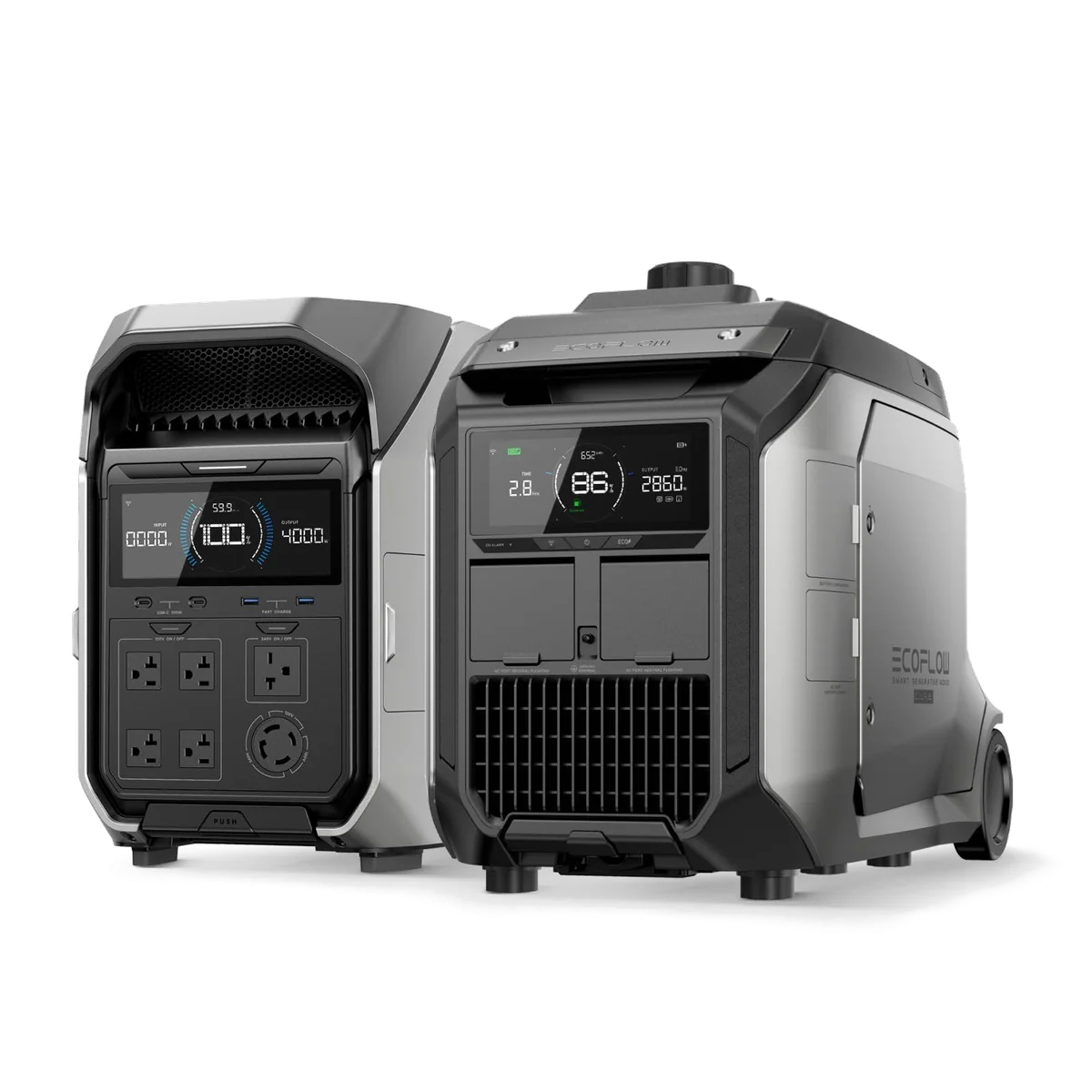
EcoFlow Delta Pro 3 smart generator
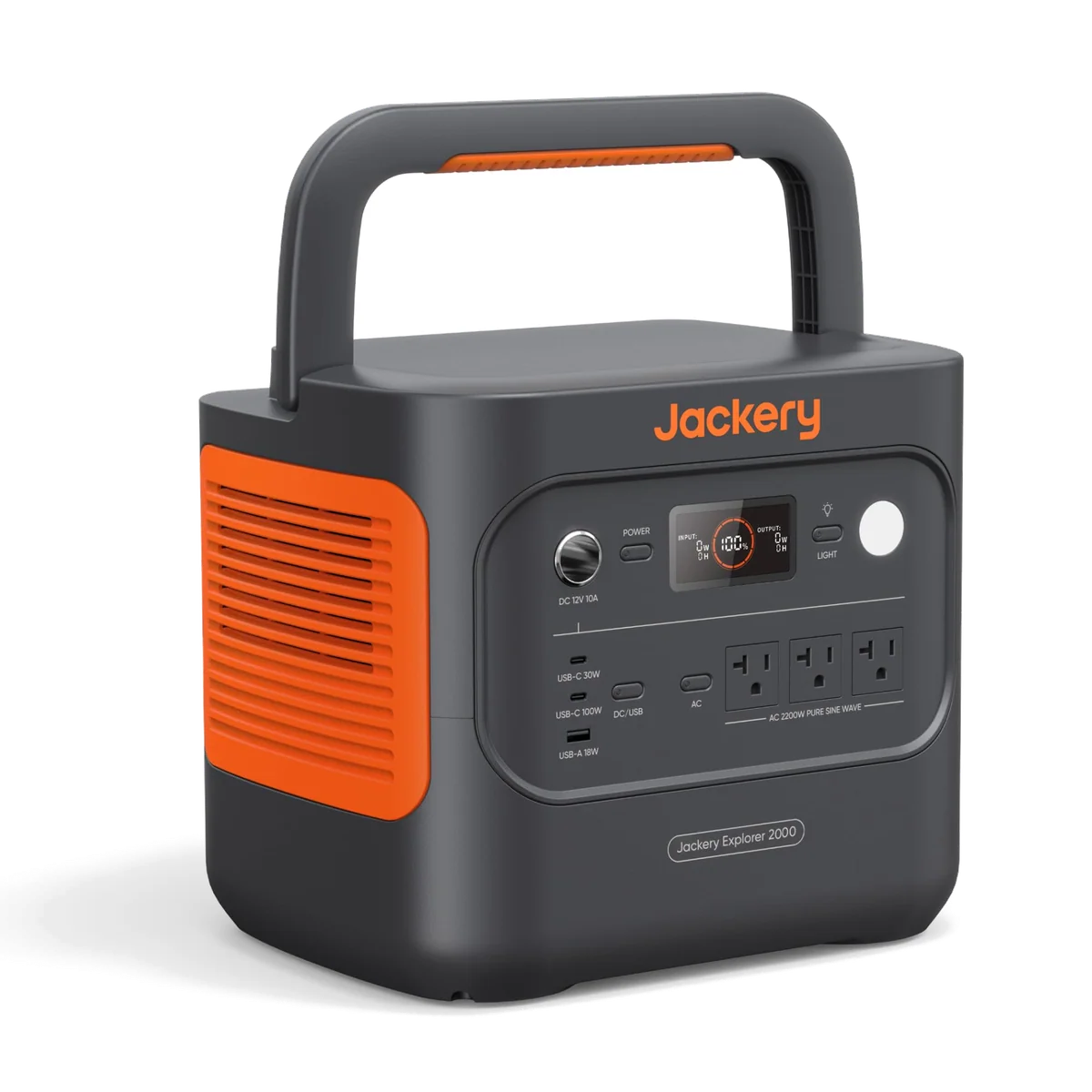
Jackery Explorer 2000 v2 Portable
People type this as a brand fight, and it is not one. The EcoFlow side of it is two packages: a 4,096Wh lithium iron phosphate battery on wheels at roughly 113 lb, and an 83 lb engine that burns petrol or propane and starts itself when the battery runs low. The Jackery side is one box, 39.5 lb, 2,042Wh, 2,200W of AC output, and no engine anywhere in the story. Ranking those two on watt-hours per pound or watt-hours per dollar tells you almost nothing, because they are answers to different questions.
The EcoFlow is selling indefinite runtime without anybody walking outside at three in the morning. The Jackery is selling the ability to pick the thing up. Both of those are real products with real buyers, and each has one constraint that decides whether it works at your address. For the EcoFlow it is the cable between the engine and the battery, which is sixteen feet and cannot be extended. For the Jackery it is a 17-watt overhead the inverter spends simply being switched on, which is nowhere in the listing and which quietly halves the runtime on exactly the small always-on loads Jackery advertises this machine for.
- Buy the EcoFlow bundle if
- Your outages are measured in days, you have somewhere outdoors an engine can safely and legally run within sixteen feet of where you want the battery, and propane is your primary fuel. It is also the only one of the two that gives you 240V from a single unit and a path to expansion, so if the plan is to grow into a house-scale system rather than to own a box, this is the side of the comparison with a future.
- Buy the Jackery if
- The battery has to move: to a camper, an outbuilding, a car boot, a relative's house to recharge, or up a flight of stairs to whichever room the outage is worst in. It is also the better buy if what you actually need is a fridge kept alive for the best part of a day, quietly, with no exhaust and nothing to refuel.
- Buy neither if
- You want central air conditioning through an outage, or you want a box to sit in a basement for years powering a modem. Neither machine starts a residential condenser, and the second job is one the Jackery is poor at and the EcoFlow is absurdly expensive at.
One caution before any of the numbers below carry weight with you. Specific Load has not run either machine, and does not own either. What follows is built from instrumented bench work on both halves of the EcoFlow, from EcoFlow's own published arithmetic where it can be checked against itself, and from the people who bought the Jackery and wrote down what it did. Where those disagree with a marketing bullet, the measurement wins.
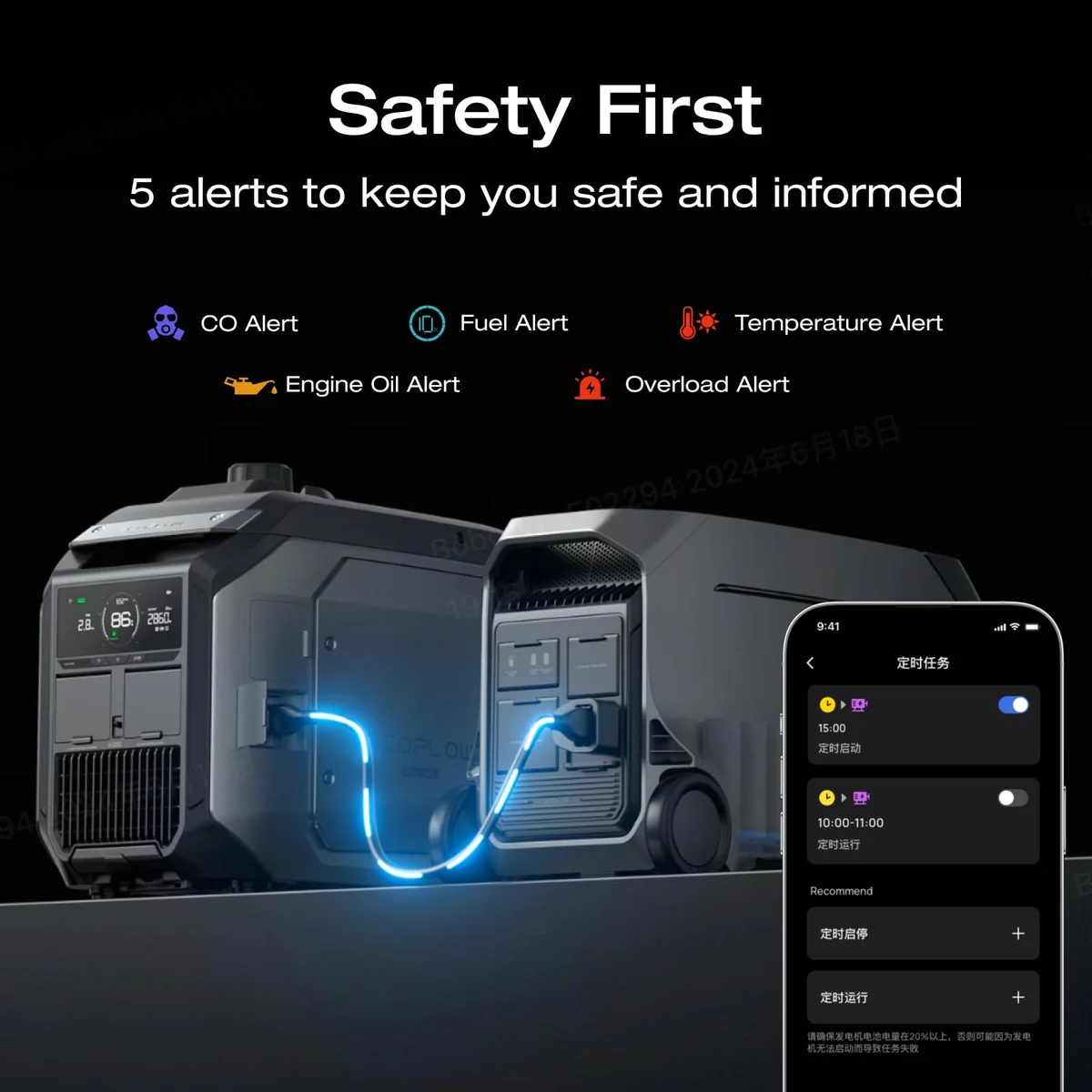
EcoFlow Delta Pro 3 smart generator
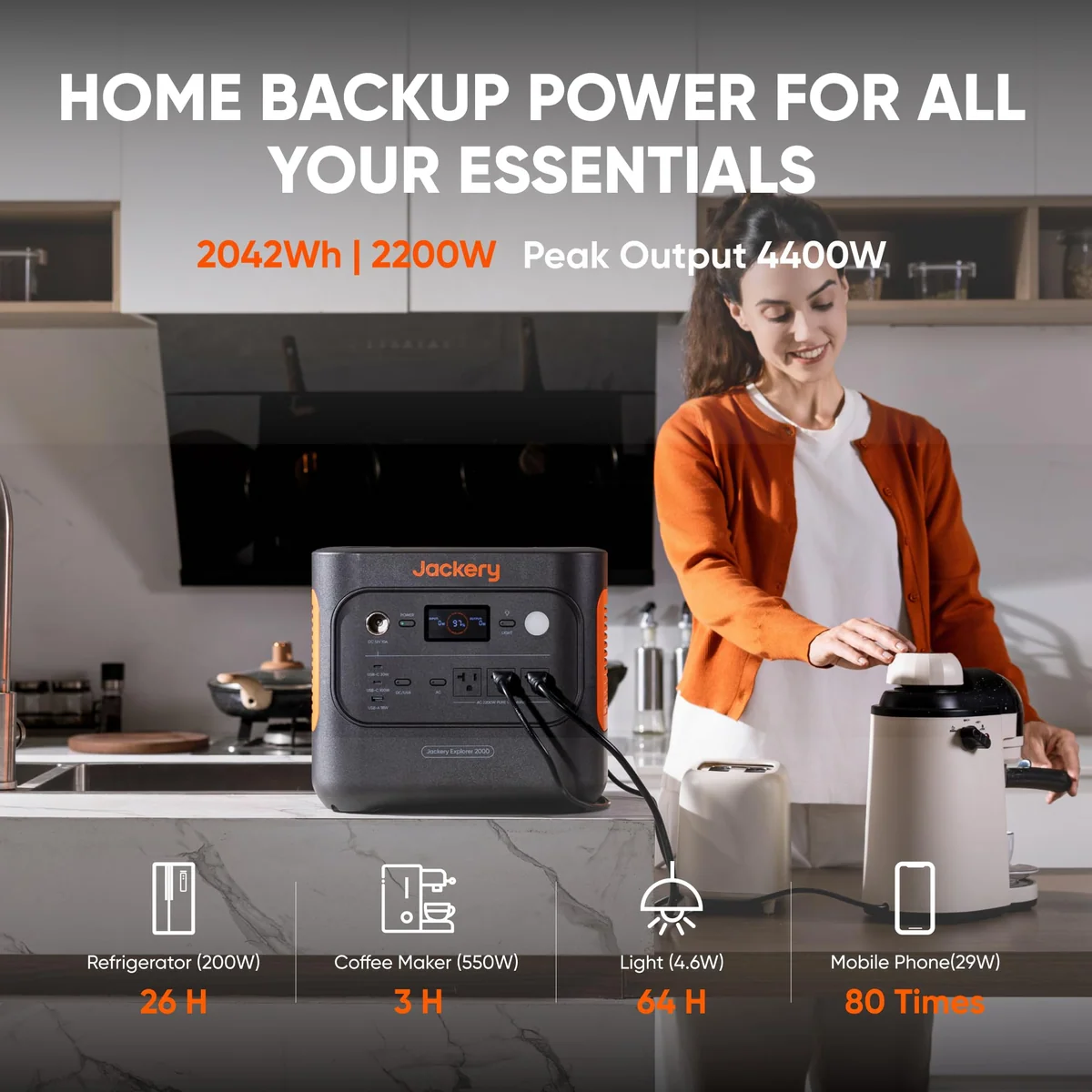
Jackery Explorer 2000 v2 Portable
At a Glance
| Feature | EcoFlow Delta Pro 3 smart generator | Editor's Pick Jackery Explorer 2000 v2 Portable |
|---|---|---|
| Price Range | $3,000+ | $500–$1,000 |
| Finish | Grey | — |
| Power | 3200 W | 2200 W |
| Check Price on Amazon | Check Price on Amazon |
What each box is actually selling
The EcoFlow premium does not buy watt-hours and it does not buy watts. You can get both cheaper, and the people who tested the engine say so plainly. What it buys is an agreement between two devices: you set a floor and a ceiling in the app, the engine wakes when the battery drops through the floor, the station feeds power backwards to the engine's starter battery so a flat starter cannot strand you, solar gets priority so the engine does not run when it does not have to, and it all stops at the ceiling. Nobody goes outside. That is a genuinely good idea, it has been confirmed working with this exact station by an outside tester rather than merely claimed, and it is the entire product.
The Jackery premium buys the opposite thing: subtraction. The cells are structural, the same cell-to-body idea electric cars use, and the weight that comes off is not a spec-sheet trick. An owner who shopped this against EcoFlow, Anker and Bluetti chose it for that reason and then said the sentence that matters more than any bullet point: at 40 lb it is still heavy, but it goes up and down stairs in a way a 50 to 60 lb rival of the same capacity does not, and he could hoist it onto a kitchen counter. If your power station has to reach the problem instead of waiting for it, that is the whole argument, and it is a good one.
| Delta Pro 3 bundle | Explorer 2000 v2 | |
|---|---|---|
| Rated capacity | 4,096Wh | 2,042Wh |
| Usable, by the maker's own sums | ~3.3kWh | ~1.74kWh |
| Independently measured delivery | 3,830Wh at an 800W draw | none published |
| AC output | 4,000W held at 117 to 118V | 2,200W rated |
| 240V from one unit | yes | no |
| Weight to move it | ~113 lb plus an 83 lb engine | 39.5 lb |
| Runtime beyond the pack | petrol or propane, indefinitely | recharge or nothing |
| Idle overhead | not published | 17W, per Jackery's own formula |
| Crowd evidence | 3.6 from 8 ratings | 4.4 from 858 ratings |
The row that decides small-load duty
Take the second and eighth rows together, because between them they answer the question most people are really asking when they ask how long one of these lasts. An electrical engineer bought the Jackery as a backup for a cable modem and WiFi, measured his own load at 15 to 16 watts with a smart plug, watched the app promise 65 hours and then revise itself to about 34 a day later, and wrote the angriest review in the file. Pushed to escalate, Jackery handed him its own runtime formula: rated capacity multiplied by 0.85, divided by the device draw plus 17 watts.
That 0.85 is not an excuse and it is not a Jackery problem. Roughly a sixth of what goes into any of these boxes leaves as heat, and an Anker C1000 put through an independent capacity test delivered 897Wh of an advertised 1,056Wh, which is 85 percent to the letter. The 17 watts is the interesting term. Add it to a 16-watt router and your load has doubled before the router has done anything, which is how five days of expected runtime becomes about two. On a fridge that overhead is noise. On a modem it is the dominant cost, and it is the one number Jackery never prints next to the uninterruptible-power-supply claim it markets hardest.
In fairness, 17 watts is competitive rather than bad: an Anker F3000 has been measured idling at 20.5W, and a five-year retest of the previous-generation Delta Pro found about 21W going the same way. The EcoFlow does not escape this tax, it simply has twice the pack to hide it in and an engine to top the pack back up. If you want the full arithmetic of what survives the inverter on the way to a compressor, we have worked it through on how long a power station really runs a fridge.
Where the EcoFlow is straightforwardly the better machine
Drained through a steady 800W load, the Delta Pro 3 gave up 3,830Wh of its rated 4,096Wh, which is a better capacity result than most stations in this class manage. Loaded to roughly 4,000W with a kettle, a heat gun and a space heater together, its inverter held 117 to 118 volts rather than sagging, and sag is what browns out a fridge compressor. It does 120V and 240V from one unit, expands toward house scale, carries a 30A 12V outlet instead of the usual 10A, and has a native RV socket on the front. The Jackery meets its 2,200W ceiling and stops; an owner running an RV through a 30A adapter reports the microwave and the water heater individually, one at a time, and the rooftop air conditioner never.
Note the mild embarrassment in that first row of the table, though. The bench figure says 93.5 percent, while EcoFlow's own published runtime chart, multiplied back out load by load, lands between about 3,240Wh and 3,410Wh every time. That is the company's own spec table conceding roughly a fifth of the pack to conversion loss. Plan your outage around 3.3kWh per charge and the machine will never disappoint you.
Where the EcoFlow's case falls apart
Three findings from twenty-four hours with the engine in a freezer should change a buying decision more than any spec on either listing. On petrol it was a struggle to start at all and the automatic start frequently failed, because the engine has no choke. On propane in the same conditions it started after a few primes and ran steadily. And it is loud and vibrates hard enough to walk about on its rubber feet for the first ten minutes of a run. Outages cluster in winter storms, so a machine that will not wake itself in the cold is a machine you have to go outside and pull-start, which is the precise thing you paid extra not to do. Buy it intending to run propane, accept the roughly 300W that costs you, and read what each fuel costs you in watts and runtime if you want the general version of the trade.
Then measure the cable run, around corners, from a position where an engine can safely run to the position where you want the battery. The testers found their own garage, twenty-two feet deep, already too long. A carbon monoxide alarm in the app with automatic shutdown is a real safety feature and not a bullet point, but an alarm is not permission to bring an engine closer to a house, and the distance an engine needs does not negotiate with a cable length. If that measurement comes back over sixteen feet, the automation you are paying for does not exist at your address, and you are buying a large station and an unrelated generator at bundle prices.
The evidence behind the two products is lopsided too
The EcoFlow bundle carries a 3.6 star rating built from eight ratings. Eight is noise, not a verdict, and this page will not read it as one; what the EcoFlow has instead is proper instrumented testing of each half. The Jackery has the opposite: no lab teardown or capacity test we can find, no published cycle count, no IP rating, no maximum solar input in watts, and 858 ratings' worth of people describing what happened in their houses. Thirteen retained reviews is a small self-selected sample and three of them involve a replacement or refund, including one unit dead on arrival, which is worth registering and not worth building a failure rate from.
Two further asymmetries belong here rather than in a footnote. The EcoFlow bundle's listing states a three-year warranty while EcoFlow's own storefront advertises five years on the station, and the most repeated advice in EcoFlow's own community forum is not about which model to choose but about buying somewhere with a generous returns policy, because owners expect to need one. Jackery's record cuts the other way for dead hardware and the same way for arguments: owners with a unit that simply would not work were sent replacements immediately and volunteered praise for it, while the owner whose complaint was about performance got scripted first-line support asking him to prove a capacity fault on video.
On money, without quoting a figure at either end: neither of these is a product to pay list for. Jackery's list price is theatre, with a coupon box and a sale cycle that are permanent features, and EcoFlow flagships depreciate hard enough that the previous Delta Pro has been found for well under half its launch price. Buying either at full sticker is a choice, not a requirement.

EcoFlow Delta Pro 3 smart generator
Jackery Explorer 2000 v2 Portable
So which one is yours
Work backwards from where the box lives. If it lives in one place, near a spot where an engine can run, and the job is keeping a household going through a storm that lasts longer than a night, the EcoFlow bundle is the machine and nothing here is a close call. If it lives wherever you need it that week, the Jackery is the machine and the EcoFlow's extra capacity is irrelevant, because you were never going to get 113 lb plus an engine up the stairs or into the camper anyway. The awkward middle case, a single fixed box for a fridge and a router through a one-day outage, goes to the Jackery on weight and on price, with the 17-watt caveat priced in.
The one that refills itself while you are asleep
Nothing else in this comparison turns a fixed number of kilowatt-hours into an indefinite supply without somebody going outside, and that automation, not the capacity and not the watts, is the whole of what the premium buys.
The sixteen feet of cable between the engine and the battery cannot be extended, and on petrol in freezing weather the automatic start that justifies the price is the exact feature that stops working.
The 2kWh battery a person can actually carry to the problem
At 39.5 lb it goes up stairs and onto a counter in a way that rivals of the same capacity do not, and owners report a fridge kept alive for 21.3 hours on one charge and a 30-hour outage covered by ferrying it away to recharge twice.
A 17-watt idle overhead that appears nowhere in the listing roughly halves the runtime on the small always-on loads Jackery markets this thing for, and early units need a firmware update the company has been poor at pushing.
If neither shape fits, two other pages here cover the honest alternatives. The direct rival to the EcoFlow, from a company whose support record is the one everyone else in this space gets measured against, is the Anker SOLIX F3800 Plus, and we have set those two head to head for whole-home backup. If what you want is runtime rather than silence and you are content to press the button yourself, the GENMAX GM9000iED dual fuel inverter gives you nearly three times the EcoFlow engine's output for a fraction of the money. And the reason most people who take outages seriously end up owning a battery and an engine rather than choosing between them is worked through in solar generator versus gas generator; the rest of the field sits in our roundup of power stations.
Whichever you buy, exercise it twice a year. The saddest failure in the whole record is not a unit that died under load. It is a unit that sat fully charged in a cupboard for a year and was dead on the night it was needed.
Frequently Asked Questions
Is EcoFlow or Jackery the better brand?
Neither, on this evidence: EcoFlow builds the more capable hardware and has the weaker after-sale reputation, Jackery builds the lighter and simpler box and replaces dead units promptly, so the choice belongs to the job rather than the badge.
Will either of these run my central air conditioning?
No, because a residential condenser wants something in the region of eleven kilowatts at the instant the compressor turns over and neither a 3,200W engine nor a 2,200W inverter is anywhere near that, though an RV rooftop unit with a soft start is a realistic target for the EcoFlow and is beyond the Jackery.
How long will the Jackery keep a fridge cold?
One owner ran an ordinary household fridge, opening it and dispensing water as normal, for 21.3 hours on a single charge, which is exactly what a pack delivering around 85 percent of 2,042Wh looks like in practice.
Can I skip the EcoFlow's generator and just buy the battery?
You can, and if the engine is not the reason you are here then you should, because the engine accounts for something close to half the bundle's ticket and buying the station alone is a different listing entirely.
Does the Jackery take expansion batteries the way the EcoFlow does?
Nothing in the record suggests the Explorer 2000 v2 accepts one, while the Delta Pro 3 is specified to expand toward 48kWh, so a system you intend to grow points firmly at the EcoFlow.
What should I do the day the Jackery arrives?
Ask Jackery to push firmware v1.1 to the unit, because v1.0 has a known bug that makes solar charging pulse on and off and one owner lost hours to it before finding out the hardware was fine all along.
Which fuel should the EcoFlow engine run on?
Propane, because it starts reliably in the cold where petrol frequently would not, and one 20 lb bottle carries roughly three times the energy of a full petrol tank for the sake of about 300 watts of output.
Should the EcoFlow's 3.6 star rating put me off?
Not on its own, since that score rests on eight ratings and is statistically meaningless, but it does mean there is no crowd verdict to lean on and you are buying on test data and on the brand's support record instead.
How much solar does either of them need to be self-sufficient?
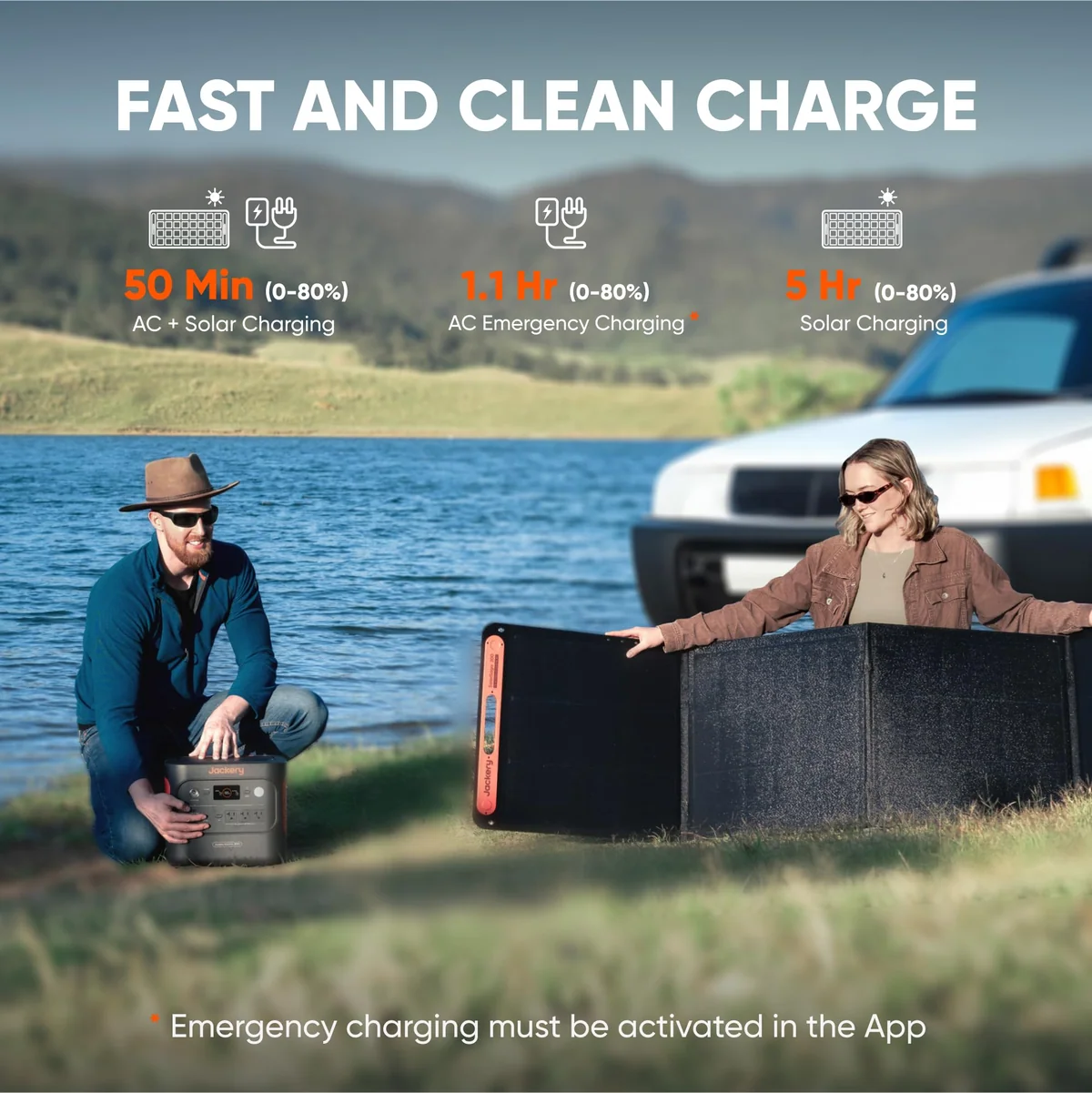
Jackery advertises a full charge in as few as six hours from 400W of panel, the EcoFlow needs proportionally more for twice the pack, and in both cases a single folding panel is nowhere near enough .
Ready to Choose?
Sources (6)
- Amazon listings and customer reviews — Ecoflow Delta Pro 3 and Jackery Explorer 2000 V2
- Owner reports across r/Ecoflow_community threads
- Owner and reviewer video, 2 channels
- Thesolarlab — Article — www.thesolarlab.com
- Outdoorgearlab — Article — www.outdoorgearlab.com
- EcoFlow — Article — us.ecoflow.com