Aceup 4000 vs Pulsar GD400BN: identical wattage, and only one of them lets you choose the fuel
Buy the Pulsar GD400BN: it is the quieter of the two, the CARB-compliant one, and the only one whose carburettor can stay dry between outages, and the Aceup earns your money only if you are certain you will never run propane and want its digital meter, its extra household socket and its bigger tank enough to accept a louder machine and a fuel cap that can collapse its own tank.
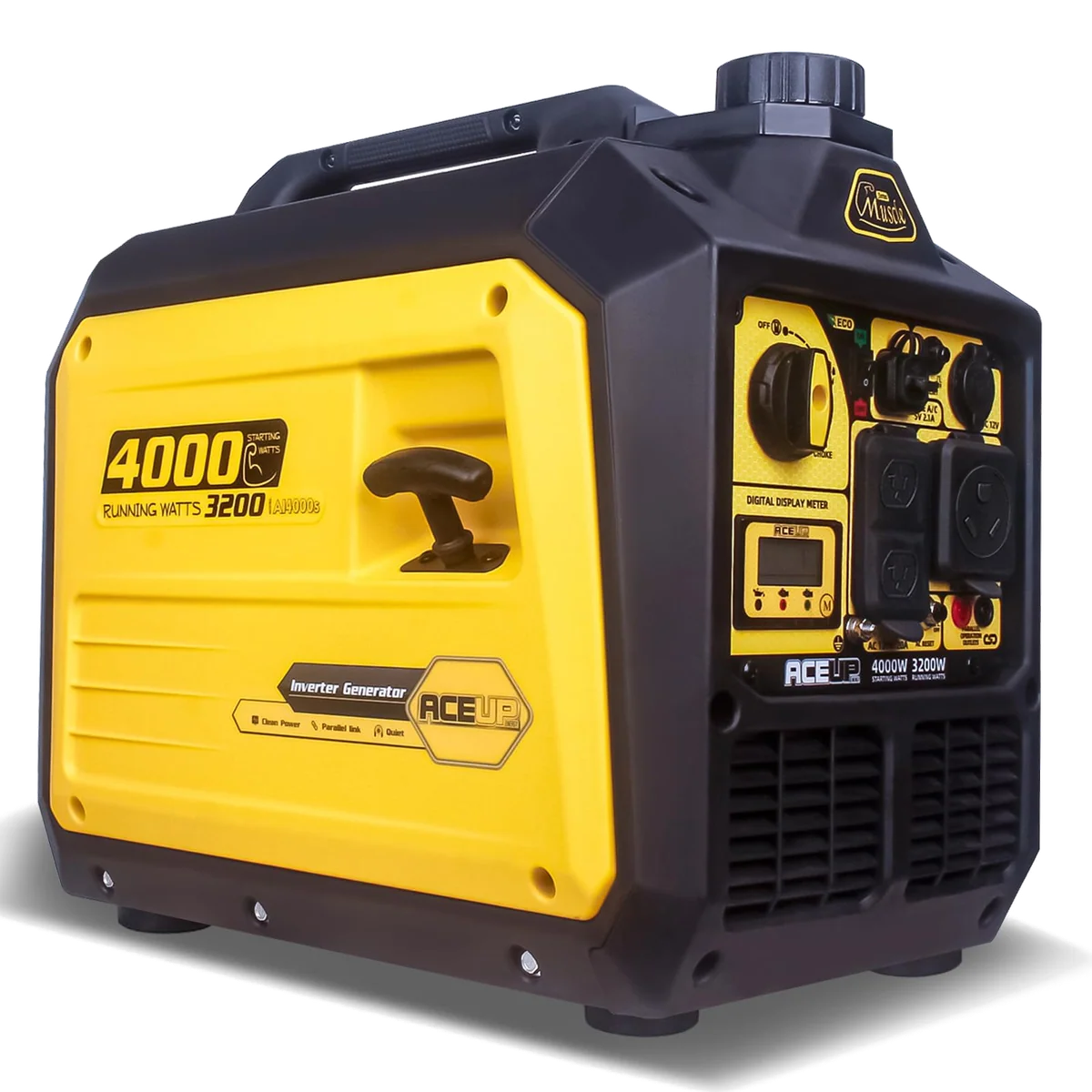
Aceup Energy 4000 watt generator
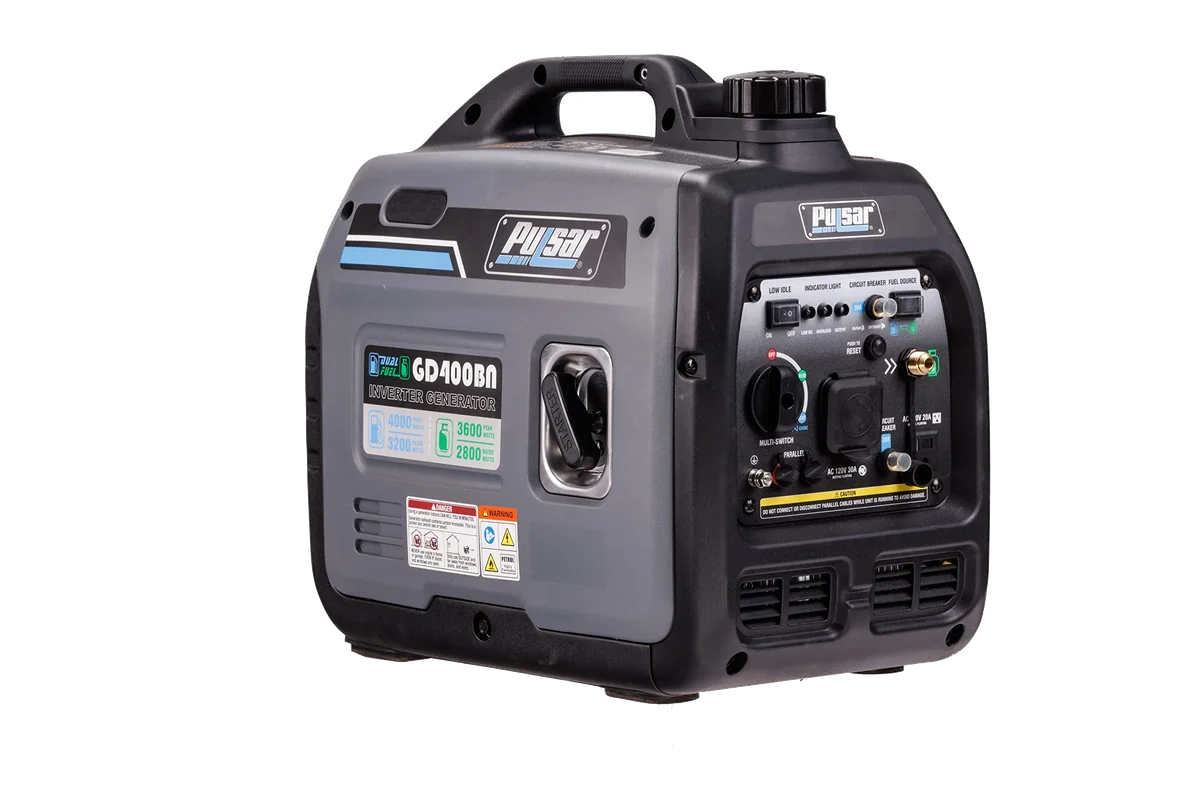
Pulsar Products GD400BN, 4000W Portable
Take the Pulsar if you already have propane on the property or on the trailer, you want RV air conditioning from something one person lifts into a truck bed, and you will spend one afternoon learning where the choke lever wants to sit.
Take the Aceup if gasoline is your only fuel, you want to see volts, hertz, load percentage and lifetime engine hours on a screen rather than guess at all four, and you will keep the fuel cap vent open every time there is fuel in the tank.
Take neither if the job is a whole house, a quiet campground, or a situation where a warranty claim is the difference between a generator and a paperweight, because both of these are budget machines with parts-in-the-mail support behind them.
Start with the disambiguation, because the search traffic says people arrive at the wrong machine. The Aceup in this comparison is the AI4000s-1: gasoline only, recoil start, 149cc, 4,000 peak watts and 3,200 running. Aceup also sells a dual-fuel 4,000-watt generator on a separate listing, and it is a different unit with a different fuel system. If you came here because you wanted propane from the Aceup, you want that other page, and one of the reviews sitting on this listing is plainly about it, praising a propane tank this generator cannot accept.
Once that is straight, the two machines line up almost eerily well. Both are small single-cylinder inverters rated 4,000 peak and 3,200 running on gasoline. Both weigh within a few pounds of each other. Both are recoil start with no electric option. Both are parallel-ready. Both wear the phrase super quiet in their own product titles, and both are filed on Amazon under power take off generators, which neither of them remotely is. The differences that decide this are not in the headline numbers at all.
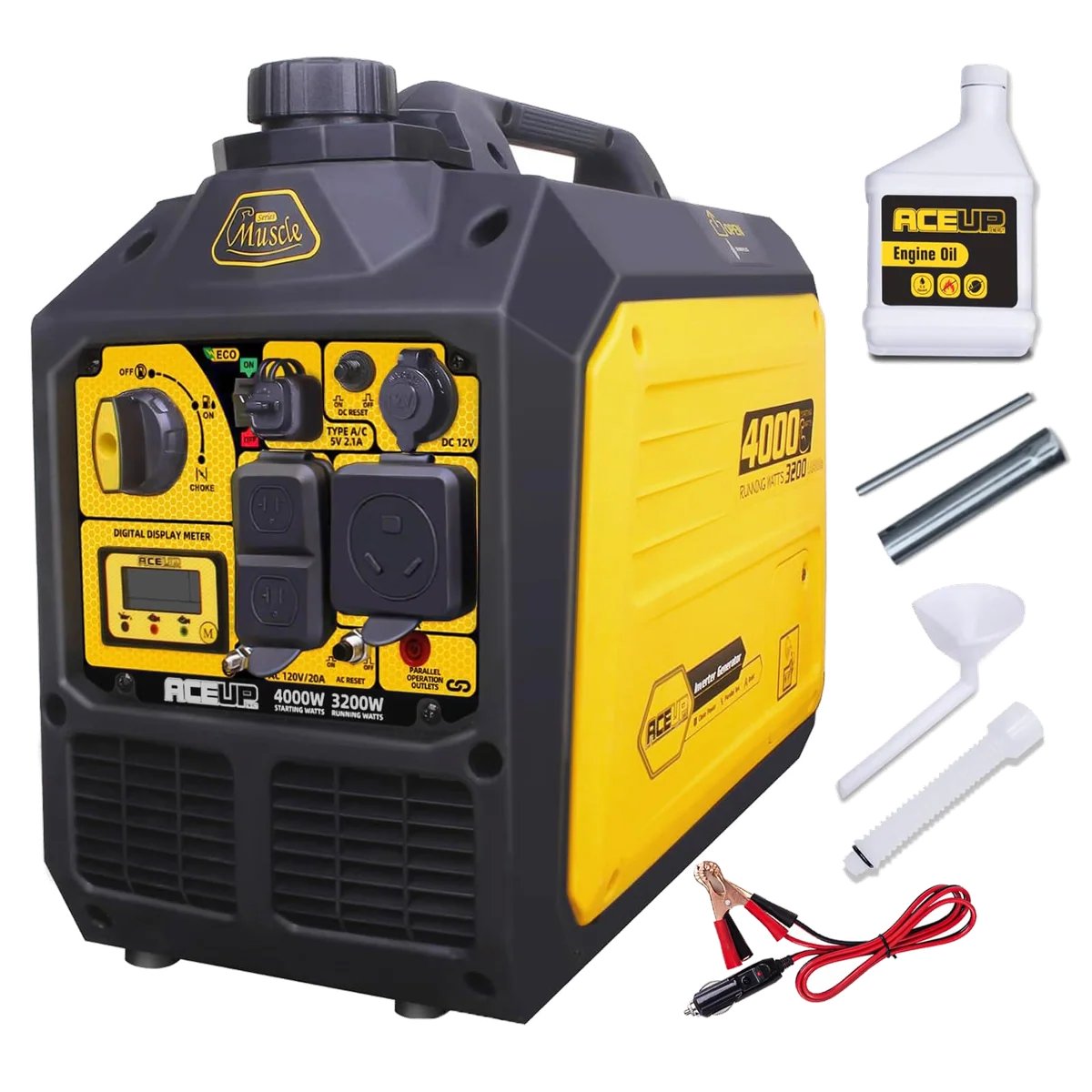
Aceup Energy 4000 watt generator
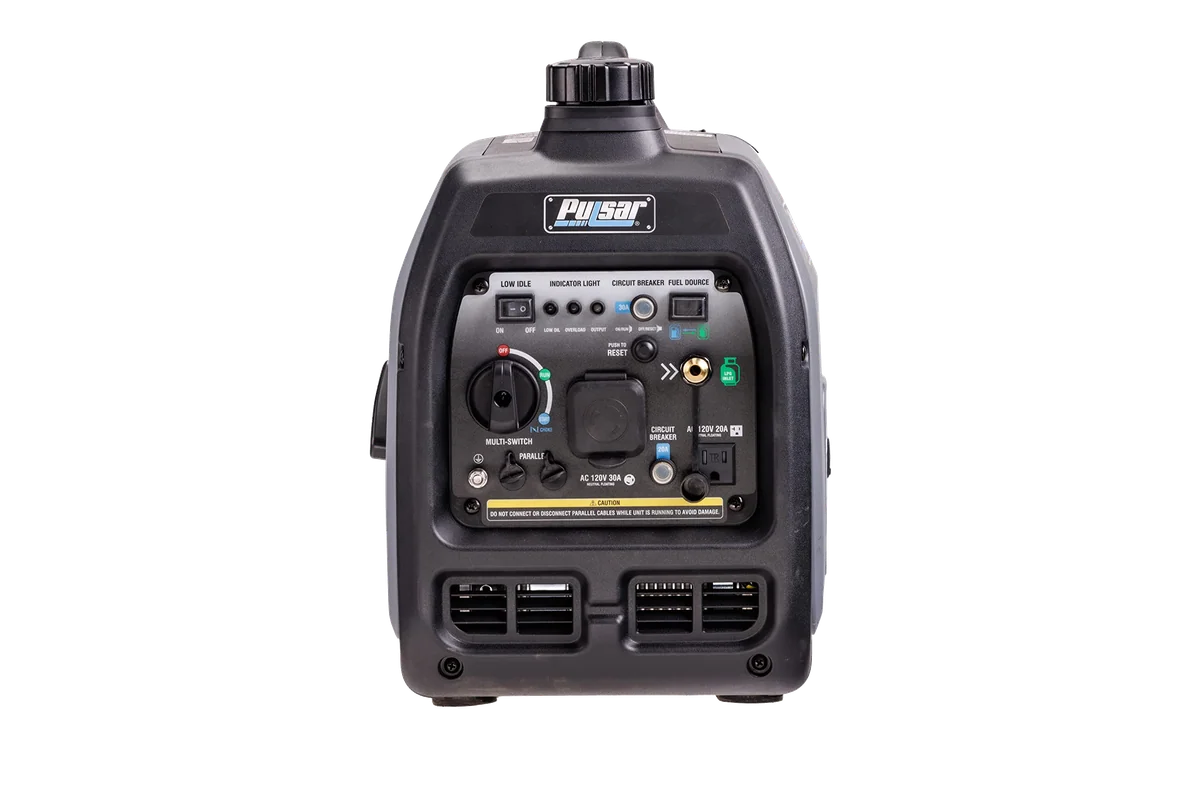
Pulsar Products GD400BN, 4000W Portable
At a Glance
| Feature | Aceup Energy 4000 watt generator | Editor's Pick Pulsar Products GD400BN, 4000W Portable |
|---|---|---|
| Price Range | Under $200 | $500–$1,000 |
| Finish | Yellow+black | — |
| Power | 4000 W | 4000 W |
| Check Price on Amazon | Check Price on Amazon |
Somebody actually put these two side by side
This is rarer than it sounds. Most head-to-heads in this bracket are assembled from two separate listings and a spec sheet, but there is one hands-on comparison in the public record that ran an Aceup AI4000s against a Pulsar GD400BN at 23 feet, at no load, in eco mode, and at 500W, 1,000W, 1,500W and roughly full output. The result, in words rather than numbers, because no meter reading was published: the Aceup is audibly louder than the Pulsar at every step, not dramatically so, and pitched noticeably higher. The Pulsar's note is the lower, heavier one, and low frequencies are the ones that stop annoying people at a distance.
That matches what owners describe from the other side. The Pulsar gets called quiet enough to hold a conversation next to, a few decibels above a Honda EU2200i while making close to twice the power, and one owner reports a neighbour assuming the noise was an air compressor rather than a generator. Pulsar's own claim of roughly 59 dB at half load has never been independently metered, and Specific Load has not metered it either, so treat it as the manufacturer's figure. The direction of travel is the part that is solid: between these two, the Pulsar is the one you would rather have running behind your trailer.
Aceup's marketing does itself no favours here. The brand has published both 57 dBA and 60 dBA for this machine on its own storefront, and when a tester put a meter on the smaller 2300W Aceup it read 74 dB at the machine in eco with no load against 72 dB for a Honda EU2200i, with the gap widening to five decibels under load. Two different testers on two different Aceup models independently flagged the same characteristic, and it was the pitch, not the volume. Every manufacturer number in this category is measured on a good day in eco at no load, which is what a decibel rating on a generator actually means.
One free finding from that side-by-side worth carrying to whichever you buy: setting the machine on thick grass instead of concrete or gravel made a large difference at 23 feet. A great many online arguments about generator noise are really arguments about ground cover.
The specification sheet, minus the marketing
| Aceup AI4000s-1 | Pulsar GD400BN | |
|---|---|---|
| Fuel | Gasoline only | Gasoline or propane, and at least one owner runs house natural gas through the propane inlet |
| Rated output on gas | 4,000 peak, 3,200 running | 4,000 peak, 3,200 running |
| Rated output on propane | Not applicable | 3,600 peak, 2,800 running |
| Engine | 149cc four-stroke OHV | 145cc, quoted at 5.5HP |
| Weight | Around 50 lb | 47.3 lb |
| Gasoline tank | 1.32 gallons | 1.1 gallons |
| Starting | Recoil, first or second pull on gasoline with unusual consistency | Recoil, easy on gasoline, genuinely difficult on propane until you find the unmarked choke position |
| Instrumentation | Volts, hertz, amps, load percentage, RPM, fuel level, session hours and lifetime hours | None of it, not even an hour meter or a fuel gauge |
| Sockets | Two 120V household, one 30A RV, one 12V DC, parallel ports | Sparse by comparison; RV-ready means the plug is there, not that the panel is generous |
| Emissions claim | EPA, with no CARB claim made | CARB compliant |
| Maker's runtime claim | Five hours at half load in the Amazon bullets, eight hours at the same load on the brand's own page | 4.5 hours at half load, which no owner can confirm because there is no fuel gauge |
Read that table and the shape of each machine emerges. Aceup spent the money on the panel and the outlets. Pulsar spent it on the fuel system and left the dashboard off entirely. Neither is a bad decision, but they suit different owners, and the one that survives a five-year view is not the one with the nicer screen.
Propane is not a feature, it is the whole argument
Dual fuel gets sold as flexibility, as though the point were having a spare option in a hurricane. The real reasons owners of this Pulsar have stopped buying gasoline altogether are more specific than that. Propane keeps the carburettor dry, so a generator that sits from one outage to the next does not gum itself shut, which is the single most common way a stored backup generator dies. Propane sidesteps rejetting the carburettor at altitude. And propane solves an RV problem nobody mentions until it happens to them: a generator that has to go into a camper compartment on its side leaks gasoline into that compartment, and a machine that has never had gasoline in it cannot. Several owners in the record have run nothing but propane since day one.
The cost is watts. On propane the Pulsar drops from 4,000 peak and 3,200 running to 3,600 and 2,800, which is not a Pulsar defect but simply what each fuel is worth in energy density. Owners running air conditioning on propane describe the loss as a few watts of headroom rather than a wall. The Aceup has no equivalent trade available, because it has one fuel and that fuel is the one that varnishes carburettors and has to be stabilised, rotated and stored.
Tank endurance is where the Aceup takes its one clean win on fuel. It carries 1.32 gallons to the Pulsar's 1.1, and the only owner-measured figure on the Aceup is eight hours on a light load, which lines up with the 7.5 hours at quarter load stamped on the machine's own spec plate. The Aceup's problem is that its maker will not commit to a number: five hours at half load in the Amazon bullets and eight hours at half load on the brand's own page cannot both be true off the same tank, and the arithmetic favours the smaller figure. Plan on roughly seven to eight hours running a fridge and a few lights, and closer to five if you are leaning on it.
Each has one ugly failure, and they are nothing alike
Neither machine gets to be the clean one here, so take both faults at full weight before deciding which you would rather live with.
The Aceup's is mechanical and it is the maker's fault. Owners describe the internal fuel tank pulling inward on itself and deforming after the generator has been run and then left to sit. One took the unit apart, confirmed the tank was inverted, was told by support that nothing was broken and that a part had simply come loose, and was refused a replacement inside the warranty window. Another diagnosed the actual mechanism, a vacuum formed by closing the fuel cap vent with fuel still in the tank as the temperature drops, repositioned the tank himself, and left four stars with one complaint: the manual should have said so.
The second owner is almost certainly right, and here is the part that turns a user error into a design problem. Aceup's own instructional video for its 2300W generator lists turning the fuel cap vent on as a startup step and turning it off as a shutdown step. Follow the brand's documented routine with a half-full tank, park the machine, let it cool overnight, and you have built exactly the vacuum that crushes the tank. Specific Load's reading is that both of those reviewers are telling the truth: the collapse is user-triggered, and the instructions trigger it. Leave the vent open whenever there is fuel in there, and better still, close the fuel valve and let the engine run itself dry before you put it away.
The Pulsar's fault is not mechanical at all, which is why it is the more survivable of the two: it is genuinely difficult to start on propane the first time, and the manual does not tell you how. The selector is marked Off, Run and Choke, and on propane neither marked running position reliably works. The position that works is an unmarked spot between Run and Choke with no detent, so you are holding a lever somewhere the machine gives you no feedback about. Six of the eight retained owner reviews raise it. One owner logged around 87 failed attempts before it fired, and the honest summary is his own line afterwards: "Now I know the secret, at least for mine."
The disagreement between owners about exactly where that spot sits is itself the finding rather than a gap in the evidence. One says stay on Run and do not go past the detent, one says between start and Run at somewhere between half and three quarters of the way over, one found it halfway between Run and Choke, and one uses a two-stage routine of full choke until a partial catch and then halfway back. There is unit-to-unit variation and you will find your own position. Two things make the hunt worse than it needs to be: you can flood this engine on propane, so the instinct to pull harder and longer is exactly wrong, and the widely repeated online tip that propane bypasses the carburettor so you should never touch the choke is what sends people through hundreds of pulls. With no electric start, every one of those experiments is paid for with your shoulder.
Once found, the problem evaporates. Warm restarts happen on Run, a genuine winter outage start took three pulls, and owners running single-digit temperatures to power a truck block heater report no cold-start drama at all. On gasoline none of it applies and the Pulsar starts first time. So the fair framing is this: the Aceup's fault can destroy a component and the manual will never warn you, while the Pulsar's fault costs you one bad afternoon and is then permanently solved. The Aceup, for its part, has its own version of the invisible-control problem, a black cap on a black panel that owners cannot see in the dark, producing a generator that starts, runs for thirty seconds on what is in the carburettor bowl and dies. That symptom is fuel, not spark, and it is the most common false alarm in the whole category.
What either of them will actually carry
The Pulsar's output claim survives contact with owners better than most in this bracket. Documented loads include a 10,000 BTU window air conditioner, a 5,000 BTU unit and a small microwave together, a 13.5k BTU RV rooftop with a soft start fitted alongside a 12V fridge, over 2kW of space heater and assorted gear held for an hour, household fridges through an outage, and a diesel truck's block heater at 700 to 800 watts for three hours straight. Fit the soft start if the rooftop unit is the reason you are buying, because a compressor start on a generator this size is exactly the case where locked rotor amps decide the outcome.
The Aceup's record is thinner and more modest. Its most convincing owner account is three days of continuous running through an outage on a fridge, a deep freezer and phone charging, and another used it for heat and lights in an RV and concluded he would need a second unit in parallel to carry the rest of the trailer. Nobody in the public record has put a rooftop air conditioner on an AI4000s and reported back, so treat a 13,500 BTU start on this one as unproven rather than promised. That asymmetry is not a claim that the Aceup is weaker; it is the same 3,200 watts. It is a claim that we know what one of these machines does under a hard load and we are guessing about the other.
Neither is a whole-house generator. A typical tally of furnace blower, fridge, lights, television, sump pump and a window air conditioner lands north of 4,000 running watts before the customary buffer, which is beyond both. Run your own numbers before you choose a size, and if the answer comes back well above 3,000 watts, the home backup shortlist is a better place to be shopping than this page.
If it breaks, both of you are on your own
The most serious single report against the Pulsar is one owner whose unit passed every test run, then died 17 minutes into its first real job while boondocking, with no spark. Pulsar told him to take it somewhere and that parts would be sent; the parts had not arrived and no notification that they were coming had either. That is one failure among eight retained reviews on a listing rated 4.2 across 443 ratings, and it is not enough to call this an unreliable generator. It is, however, the only support datapoint in the file, and the failure mode it describes, ignition dying only once the machine is finally needed, is the worst kind to discover.
The Aceup's support record is no better and arguably worse, because its one documented claim was refused after the customer had already done the diagnostic work and photographed the damage. Aceup also cannot agree with itself on what coverage you hold: the seller's bullets promise a two-year limited warranty while Amazon's catalogue data for the same product says one year. Neither brand has a dealer network, and the structural point applies to both: at this end of the market you are buying parts-in-the-mail support, which is what a budget generator brand actually owes you and what it does not.
The practical countermeasure is the same for either machine, and it is the one experienced buyers repeat to each other constantly: buy where the return policy is real, run it hard well inside that window, and do it before the season you need it. Do not unbox either of these the night the forecast turns.
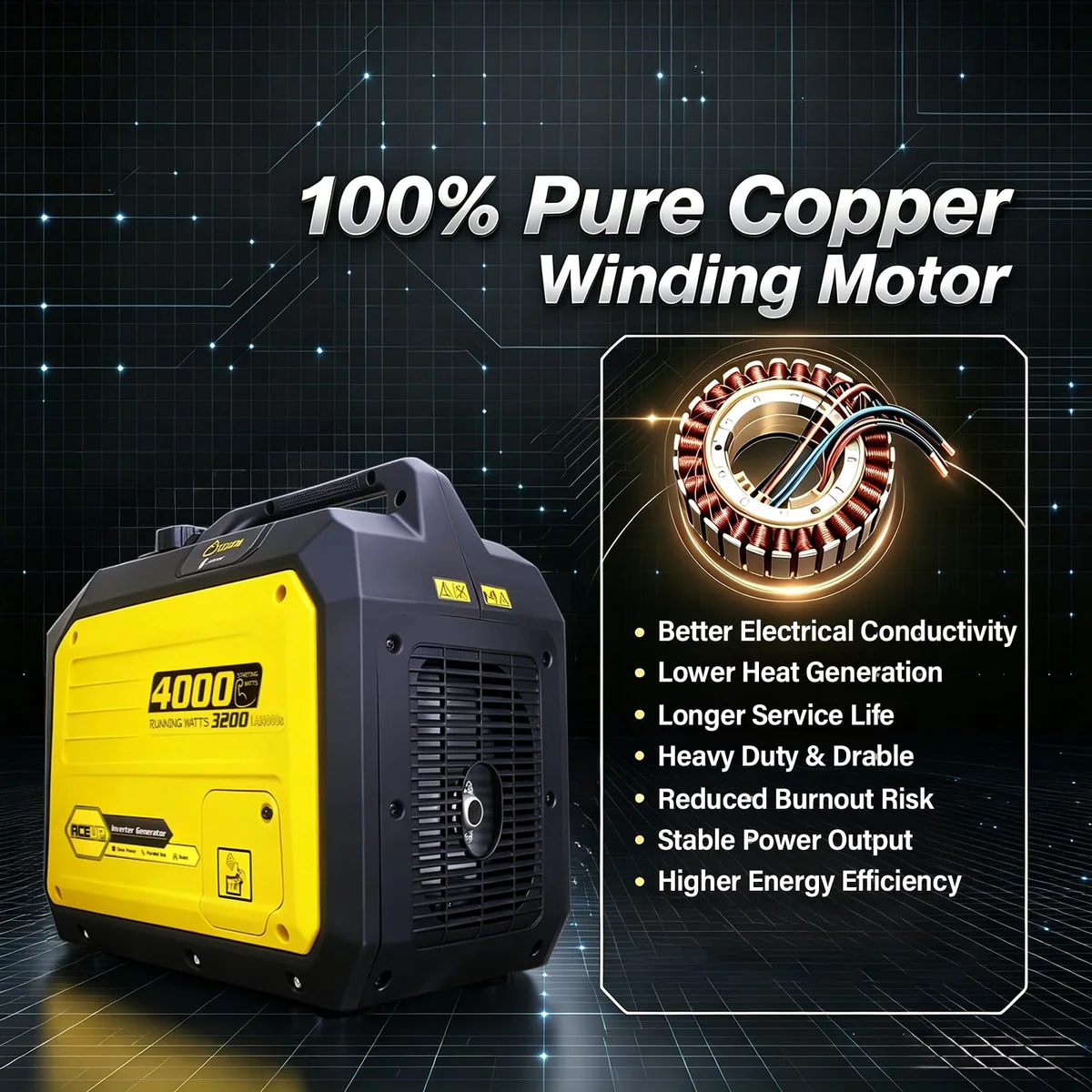
Aceup Energy 4000 watt generator
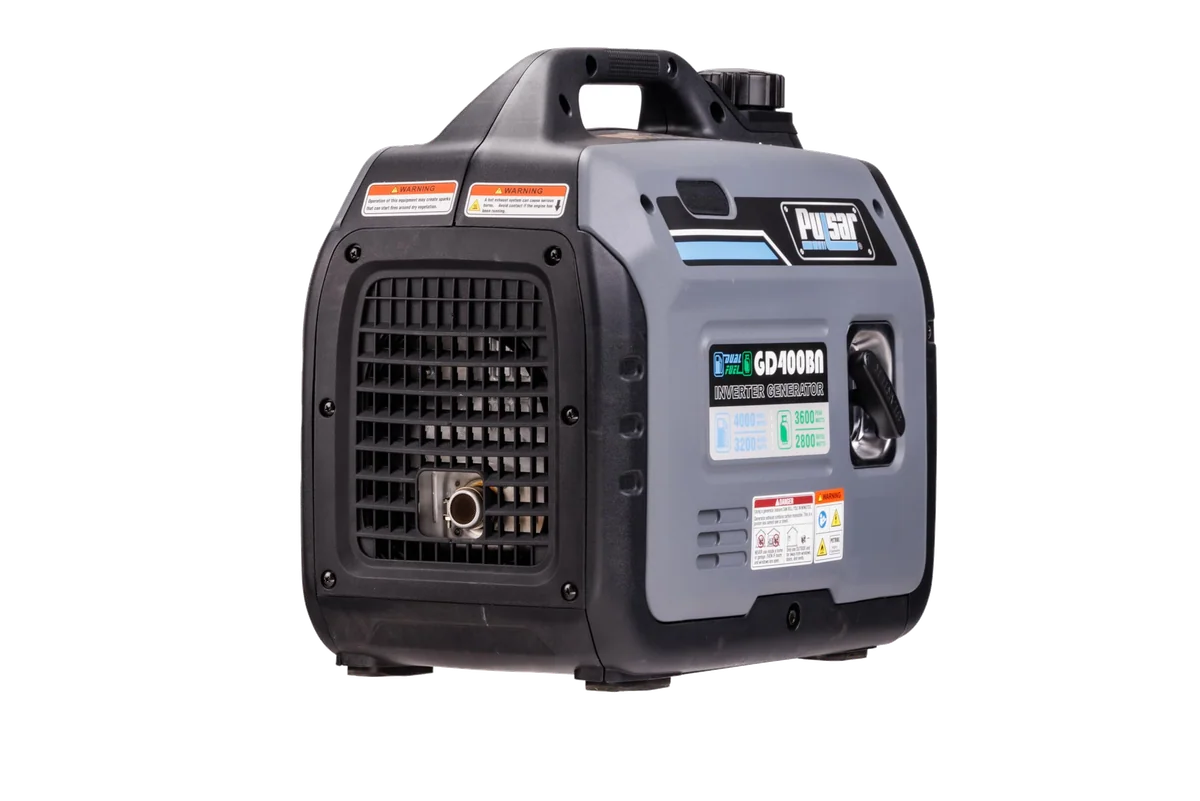
Pulsar Products GD400BN, 4000W Portable
Which one is yours
Specific Load has not run either generator. Nobody here has pulled a cord, timed a tank or held a meter to one, and everything above comes from reading the two records whole: 317 ratings and thirteen retained reviews on the Aceup, 443 ratings and eight retained reviews on the Pulsar, plus the one hands-on comparison that put both machines in the same yard on the same afternoon. Where sources disagreed, the disagreement is reported rather than resolved into a tidy number.
The one that tells you what it is doing
Pick this if gasoline is your only fuel and you want a real digital meter, a second household socket, a 30A RV receptacle and the largest tank of the two, on a machine that starts first or second pull with more consistency than anything else in its record.
Its internal fuel tank can collapse under vacuum if you close the cap vent with fuel inside, which is precisely what the brand's own shutdown routine tells you to do and which the manual never warns you about.
The one that will still start in five years
This is the better generator for most buyers here: quieter and lower-pitched than the Aceup in a direct comparison, CARB compliant, lighter, and able to run off a propane bottle or a house tank so the carburettor never gums between outages.
Starting it on propane the first time is genuinely hard and the manual does not tell you how, because the position that works is an unmarked spot on the choke lever that varies between units and costs some owners dozens of pulls to find.
If neither fits, the useful escape routes are all sideways rather than up. Wanting dual fuel with an actual starter button and a display puts you at the PowerSmart 4400 or the LIFAN 4800 with remote start, and the LIFAN against the WEN DF480iX is the comparison to read if that is the bracket you have landed in. Needing more than 3,200 running watts takes you to the Oxseryn 5000 and then to the dual fuel roundup. If the reason you are shopping is a trailer, start with the RV shortlist; if it is a campsite with neighbours close by, read the quiet camping guide first, because the Aceup in particular is not that machine. And if you have no safe outdoor space at all, no engine is the right answer and a battery is.
Where this lands, then. The Pulsar is a genuinely good machine wearing a bad first impression, and the Aceup is a well-equipped machine with a documented way of hurting itself. One of those problems is solved permanently on a Saturday afternoon and the other is a rule you have to remember every single time you put the generator away. That is the whole comparison, and it is why the Pulsar takes it.
Frequently Asked Questions
Is the Aceup 4000 in this comparison the dual fuel one?
No, the AI4000s-1 runs on gasoline only, and Aceup's dual fuel 4,000-watt generator is a separate listing with a different fuel system.
Which of the two is actually quieter?
The Pulsar, by an audible margin at every load step in the one side-by-side comparison on record, and with a lower-pitched note that carries less than the Aceup's higher one.
Which one starts more easily?
On gasoline they are both easy and the Aceup is the more consistently praised of the two, but on propane the Pulsar is difficult until you find its unmarked choke position, after which it starts in a few pulls every time.
Can I run an RV air conditioner from either?
Pulsar owners have run a 13.5k BTU rooftop unit with a soft start fitted, while nobody in the public record has tested a rooftop unit on the Aceup at all, so treat that as unproven rather than promised.
Can I parallel an Aceup to a Pulsar for more power?
No, plan on a second copy of whichever machine you buy rather than mixing brands, since parallel kits pair a generator with its own kind.
Which one can I buy in California?
The Pulsar's listing claims CARB compliance while the Aceup claims EPA only and makes no CARB claim, which California buyers need to check before ordering.
Neither has electric start, so how do I track maintenance?
The Aceup does it for you with a lifetime hour counter on its display, and on the Pulsar there is no hour meter at all, so your service schedule is whatever you write down yourself.
Does either have a carbon monoxide shutoff?
Neither listing specifies a CO sensor in its own bullet points, so confirm it on the unit before you rely on it and site the generator well away from the house regardless.
Ready to Choose?
Sources (3)
- Amazon listings and customer reviews — Aceup Energy 4000 Watt and Pulsar Products Gd400bn 4000w
- Owner reports across r/Generator threads
- Owner and reviewer video, 3 channels