How long a power station runs a fridge: take the number on the box, remove a fifth, then divide by the fridge you actually own
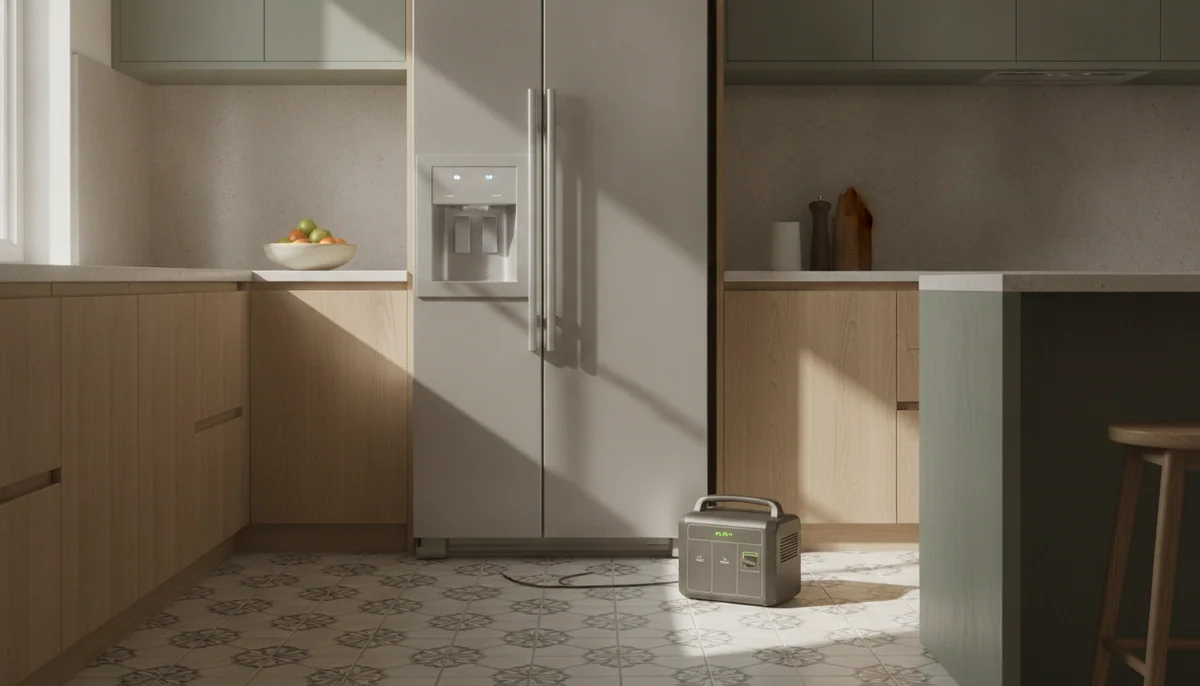
Everybody does the same sum. Capacity divided by watts. A thousand watt-hours, a hundred-watt fridge, ten hours, done. It is wrong in three separate places at once, and the three errors do not cancel out.
The first is the inverter, which takes a cut of everything it converts from the pack's DC to the 120V your fridge expects. The second is that the station is awake for all twenty-four hours while the compressor is running for maybe eight of them, and being awake is not free. The third is that fridges do not draw their plate rating any more than a car uses its peak horsepower on the motorway. Get all three right and the answer changes by a factor of two in either direction, which is exactly the spread you see when owners compare notes and conclude somebody must have a faulty unit.
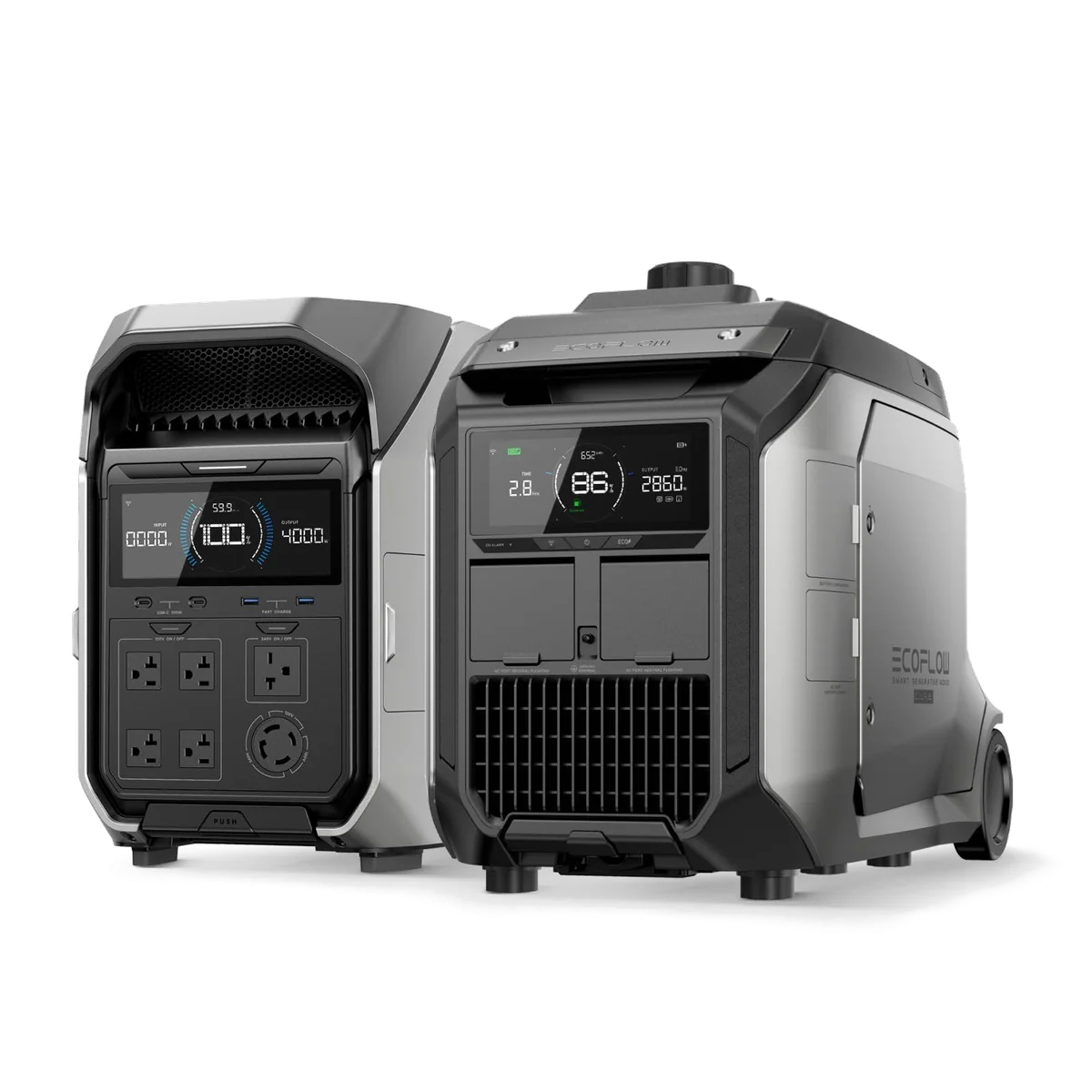
How big is the first cut? Bench-drained through a steady 800W load, an EcoFlow Delta Pro 3 gave back 3,830Wh of its rated 4,096Wh, and the tester noted that most stations put through the same test land somewhere between seventy-five and eighty-five percent. EcoFlow's own published runtime chart for that same station is more pessimistic than its own bench result: multiply every row back out and each one lands near 3.3kWh from a 4,096Wh pack, which is the company quietly conceding about twenty percent.
- Buy more battery if
- Your outages run a night or two, your fridge is an ordinary mains appliance you are not going to replace, and you have nowhere an engine can legally and safely run: a flat, a terrace, a shared driveway, a condo. Storage is the only answer that works indoors and the only one that switches over fast enough that the compressor never notices.
- Buy fuel or panels instead if
- Your outages are measured in days. A battery large enough to carry a fridge for three days unaided costs more than a mid-sized battery and a generator bought together, and it still arrives at hour seventy-two with nothing left and no way to refill itself after dark.
- Ignore all of this if
- The thing you actually want to keep cold is a cooler at a campsite. A 12V compressor fridge running straight off a DC socket never meets an inverter, and the arithmetic below stops applying to you.
What the meters say the inverter costs
There is no single derate figure, which is why the internet argues about this. There is a range, and the range is measurable. Here is every efficiency figure Specific Load could find attached to hardware on this page, alongside the one a manufacturer prints in its own FAQ.
| Where the number comes from | Conditions | Delivered |
|---|---|---|
| Bench test of the EcoFlow Delta Pro 3 | Steady 800W resistive load, run to empty | 93.5% |
| EcoFlow's own published runtime chart, multiplied back out | Loads from 10W to 1,800W | about 80% |
| Bench test of the Anker SOLIX F3000 | Inverter efficiency measured | about 84% |
| Published test of a VTOMAN Jump 1800 | AC discharge, varying by load | about 79%, ranging 70 to 85% |
| DaranEner's own runtime formula for the R100 | Capacity multiplied by a stated conversion rate | 95% |
Two things jump out. The maker's own number is the most flattering in the table by a distance, and the best measured number was taken under the conditions least like a fridge. A steady 800W is the friendliest load an inverter ever sees: it puts the thing in its efficient band and keeps it there. A fridge does the opposite, sitting at zero for two thirds of the hour and then asking for a hundred-odd watts for twenty minutes. If you are planning around a fridge, take eighty percent, not ninety-three.
There is a fourth deduction nobody advertises, and DaranEner is unusually straight about it: the R100's AC output shuts off when the pack still has ten percent left, to protect the cells, and you can only spend that last tenth through the DC and USB ports. Every station does some version of this. The label counts energy in the cells, and your fridge is only offered the part above the floor.
Being switched on is a load
Here is the deduction that explains most of the disappointment in this category, and it is specific to fridges rather than kettles.
An inverter draws power to exist. It has a display, a controller, fans and a transformer that is energised whether or not anything is plugged into it. On the bench, the Anker SOLIX F3000 was measured at 20.5W of idle draw, which was better than Anker's own published claim. Now run that for a day: 20.5W across twenty-four hours is roughly 490Wh, which is half of a 1,000Wh station spent on nothing but the machine being awake.
A fridge is the load that gets hurt worst by this, because it is the load that requires the station to stay on around the clock while asking for real power only intermittently. A fridge that genuinely averages 60W of cooling work costs you more like 80W all-in on a station with a 20W tare, a third more than the calculator promised. Boil a kettle and the tare is a rounding error. Keep milk cold for a weekend and the tare is a third of your outage plan.
The uncomfortable corollary is that the bigger the inverter, the more it costs to keep awake, which means a 6,000W machine minding a 60W fridge is working against itself. Specific Load will not put a figure on that, because there isn't one to put: no independent instrumented test of the Anker SOLIX F3800 Plus has published its usable capacity or its idle draw, and the most technical review of that model says as much. Treat the 20.5W as the best measured example available and assume a larger inverter costs more rather than less. If your station has an eco or standby mode that drops the inverter when nothing is drawing, this is the load it exists for, and if it has a 12V output, read on.
Your fridge's plate rating is fiction too
The sticker inside the door tells you about the worst second of the hour. What you need is the average across a day, and there are two honest ways to get it. Take the kWh-per-year figure off the energy label and divide by 8,760, which gives you average watts directly. Or put a plug-in energy meter on the fridge for a full twenty-four hours and read the kWh off it, which is better because it captures your kitchen, your door-opening habits and your climate rather than a laboratory's.
The variables that move that number are not subtle. A fridge in a hot garage in August runs a far higher duty cycle than the same fridge in an air-conditioned kitchen, which is why outage stories from Texas and stories from Oregon do not agree. A full freezer coasts through a compressor-off period much better than an empty one. And a fridge whose door stays shut, which is the discipline every outage guide asks for and nobody keeps, drops its duty cycle dramatically.
Once you have your real number, the sum is finally worth doing.
| Nameplate capacity | Fridge averaging 60W | 80W | 110W |
|---|---|---|---|
| 90Wh | about 1 hour | under an hour | under an hour |
| 270Wh | 3 hours | 2 to 3 hours | 2 hours |
| 1,000Wh | 13 hours | 10 hours | 7 hours |
| 2,000Wh | 26 hours | 20 hours | 14 hours |
| 3,840Wh | 2 days | 38 hours | 28 hours |
| 4,096Wh | 2 days | 41 hours | 30 hours |
That table is arithmetic, not a stopwatch. Nobody here has run a fridge off any of these machines. What it is good for is setting expectations honestly before you spend, and its most useful row is the third: a kilowatt-hour, the size most people picture when they picture a power station, gets an ordinary fridge from bedtime to breakfast and no further.
The half-second nobody plans for
A compressor starting draws several times what it draws running, for a fraction of a second, and a small inverter meets that spike by shutting down rather than by supplying it. This is the reason a station rated well above your fridge's running draw can still refuse to carry it, and it is the same arithmetic that governs everything else with a motor in it, which our page on why the number on the box is not the power you get works through properly.
Read surge claims with suspicion, because some of them are not surge. VTOMAN's Jump 600X advertises 1200W above its 600W continuous rating, and the listing explains in its own first bullet that this is achieved by reducing output voltage for certain resistive appliances, and that sensitive electronics should be kept inside the rated 600W. A compressor is not a resistive appliance. That headroom is for kettles and heating elements, and it is not available to the thing you are reading this page about.
DC ports carry their own hidden ceilings. An owner of that same station found it kept shutting down under a 150W car heater, chased VTOMAN's support and was told the 12V port would not carry it while the AC output would, which resolved the fault and is documented nowhere in the listing. If you are planning to run a cooler from a car socket, find that ceiling before the storm rather than during it.
Take the inverter out of the loop
Everything above is an argument for one conclusion: the cheapest watt-hours in your power station are the ones that never get converted. A 12V compressor fridge running off a DC socket skips the conversion loss entirely, and on a light duty-cycled load that is the difference between a night and a weekend.
EcoFlow built an entire product around this reasoning. The TRAIL Plus 300 DC has 288Wh, three USB-C ports, a 12V car socket rated at 10A, and no AC outlet at all, a fact the listing concedes only in an asterisk at the end of its sixth bullet while calling the thing a generator throughout. That naming habit is endemic to this category and we have taken it apart in what these listings actually are. As a DC battery for a compressor cooler it is well judged; as backup for anything with a moulded plug it is useless, and it cannot even be charged from a wall socket without a USB-C brick, which took an owner rather than the listing to spell out. Three of the eight owners on record received a unit with an out-of-box fault, so if you buy it, buy it where the return is easy, and read our full account of that defect record first.
The same logic applies at the top of the range. The Delta Pro 3 carries a 12V outlet rated at 30A rather than the usual 10A, which is the port to use for a 12V fridge if you want the runtime you were hoping for, with the caveat that it is an Anderson Powerpole connector and you are buying an adapter before you can use it.
Which of these five keeps food cold, and what each one costs you
All five machines on this page are sold under the same category heading. Only two of them are fridge answers, one is a cooler answer, and two are not in this conversation at all.
| Machine | For a fridge | The catch |
|---|---|---|
| DaranEner R100, 89.6Wh | No, and it does not pretend otherwise: 100W of AC output total | Its AC shuts off with a tenth of the pack still in it, and its own runtime formula assumes a conversion rate more generous than any measured station here |
| VTOMAN Jump 600X, 268.8Wh | A 12V cooler or a small portable fridge for a few hours, not a kitchen appliance overnight | The 1200W figure is voltage reduction with sensitive electronics excluded, and the 12V port quits below 150W |
| EcoFlow TRAIL Plus 300, 288Wh | Only a 12V compressor cooler, because there is no AC outlet on it | No wall charging either, and a defect rate in its short public record that no amount of good design offsets |
| Anker SOLIX F3800 Plus, 3,840Wh | Roughly two days of an average fridge, and 240V for the rest of the house alongside it | While it recharges from a 120V socket only its three UPS outlets stay live, so plug the fridge into one of those or watch it stop |
| EcoFlow Delta Pro 3 with its dual fuel generator, 4,096Wh | About two days on the battery, then indefinitely, because the engine wakes itself and refills the pack | Sixteen feet of unextendable cable between engine and battery, and an auto-start that struggles on petrol in the cold |
That fourth row deserves a sentence of its own, because it is the trap that catches people mid-outage. Anker's own documentation states that when the F3800 Plus is charging from a 120V AC input, only the three 120V UPS outlets will run anything, and when it is charging from a 120V generator, only the TT-30R output is usable. Work that out in the dark with a defrosting freezer and you will not enjoy it. Work it out now, label the outlet, and the machine does what you bought it for. Everything else about that unit, including the bundled 400W panel that supplies roughly an eighth of the solar input it can take, is in our review of the F3800 Plus, and the case for whole-home backup rather than fridge backup rests on the split-phase 240V rather than the capacity.
If the fridge is genuinely the whole job and the outage is short, spend less. If the fridge is the excuse and the real requirement is that the house keeps working for a week, the honest recommendation on this site is the battery that came with an engine: the Delta Pro 3 bundle for people who can park a running engine within sixteen feet of the battery, and a dual fuel generator on its own for everyone else. For the small end of this list, our reviews of the Jump 600X and the wider field of solar generators and power stations will tell you which one matches the load you actually measured.
Past the first night
A battery is a fixed number of watt-hours, and a fridge is a load that never stops asking. That means every plan longer than about two days is really a plan about refilling, and there are only two ways to do it.
Solar first, sized properly. The working rule owners use is around 200W of panel for every 1,000Wh of storage, which puts a 3,840Wh station somewhere near 800W of array. A single folding panel is not that, and the owner on record who bought Anker's panels for this exact machine reported that even in full sun aimed at the sun they never produced the advertised output, which he correctly treated as normal for portable solar rather than a defect. Derate your panels the way you derated your battery, and size the array against your fridge's daily kilowatt-hours rather than against the battery's label. Our page on how much solar it really takes to refill a station does that arithmetic in full.
Fuel second, and fuel is what actually wins on runtime. EcoFlow's own listing figures put a 20 lb propane bottle at up to 24kWh through their engine and a single tank of petrol at about 8kWh, against 4,096Wh stored in the pack. One bottle from a hardware store carries several times what the most expensive battery on this page holds. That is not an argument against storage, it is the argument for owning both, which is exactly the division of labour long-outage owners describe: the battery covers nights, bad weather and unattended hours, the engine covers indefinite runtime. The full version of that argument is solar generator against gas generator.
One caution on the automated version of that arrangement. When testers ran EcoFlow's smart generator through a twenty-four hour freezer test, it started reliably on propane and struggled badly on petrol, where the automatic start frequently failed because the engine has no choke. Outages cluster in cold weather. If you are buying an engine to wake itself up and feed a fridge at three in the morning, buy it intending to run propane and set the battery's floor low enough that it does not wake the neighbourhood before it has to.
What this page is and is not
Specific Load has not run a refrigerator off any of these machines, has not timed a compressor cycle and has taken no measurements of its own. The efficiency figures above are other people's published tests and the makers' own published arithmetic, attributed where they sit. The runtime tables are our sums on those figures, labelled as sums, and they exclude the specifics of your kitchen, which is why the instruction throughout is to go and measure your own fridge rather than trust a row in a table. Where the record has a hole, such as the missing idle-draw figure for the F3800 Plus, this page says so instead of filling it.
The last piece of advice is the least exciting and the most likely to matter. A power station bought for a fridge spends almost all of its life doing nothing, and the failure that ruins an outage is not a unit that dies under load but a unit that was fully charged, untouched for a year, and dead on the night it was needed. Anker's own storage instructions ask you to check the charge weekly, recharge below thirty percent and take it back to full every three months. Exercise it, keep the firmware current, and learn how to work through a station that shows charge and will not switch on while the lights are still on.
Frequently Asked Questions
How long will a 1,000Wh power station run a normal kitchen fridge?
Roughly ten to thirteen hours if the fridge averages 60 to 80 watts and the station returns four fifths of its label, which gets you from bedtime to breakfast and not through a working day.
How do I find out what my fridge actually draws?
Divide the kWh-per-year figure on the energy label by 8,760 to get average watts, or leave a plug-in energy meter on it for a full twenty-four hours, which is better because it measures your kitchen rather than a laboratory's.
Why did mine last half as long as the calculator promised?
Some combination of the inverter's cut, the tare it draws simply staying awake for the hours your compressor is off, a hot ambient temperature raising the duty cycle, and a low-voltage cutoff that stops the AC output before the pack is truly empty.
Is a 12V fridge really better on a power station than a mains one?
Yes, because a DC fridge running from a 12V socket never pays the conversion loss, which is the single biggest deduction between the number on the box and the food in the box.
Will the VTOMAN Jump 600X keep a refrigerator running?
A 12V cooler or a small portable fridge for a few hours, yes, but 268.8Wh will not carry a full-size kitchen fridge through a night no matter how the surge figure is worded.
Can the EcoFlow TRAIL Plus 300 run a fridge?
Only a 12V compressor cooler off its car socket, because that unit has no AC outlet on it at all despite the word generator appearing throughout its listing.
Can I keep using the outlets while the station recharges from a generator?
Not always, and on the F3800 Plus specifically only the TT-30R output stays live while it charges from a 120V generator, so the fridge needs to be on the right socket before the engine starts.
How much solar do I need to keep a fridge running indefinitely?
Work backwards from the fridge's daily kilowatt-hours rather than the battery's label, then derate the panels hard, because owners on this hardware report portable panels never reaching their advertised output even aimed at the sun.
Should I buy a bigger battery or a generator for a multi-day outage?
A generator, because one 20 lb propane bottle carries several times the energy of the largest battery on this page and can be refilled after dark.
Sources (7)
- Amazon listings and customer reviews
- Owner reports across r/Generator threads
- Owner and reviewer video, 1 channel
- EcoFlow — Article — us.ecoflow.com
- Thesolarlab — Article — www.thesolarlab.com
- the Gadgeteer — Article — the-gadgeteer.com
- Cnet — Article — www.cnet.com