The Gidrox 11000W tri-fuel is a more thoughtfully built machine than its reputation is old
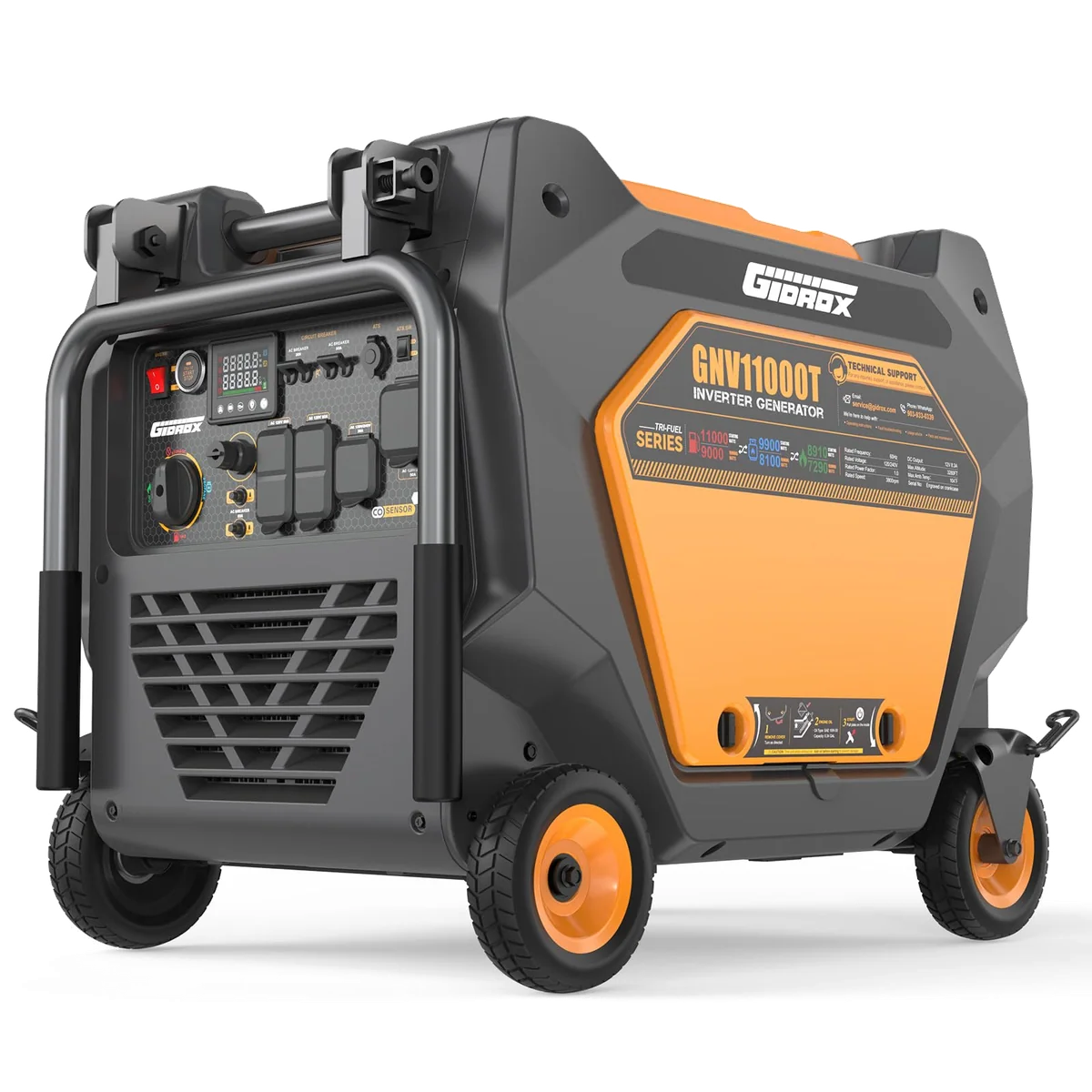
Buy this only if you will put a real load on it inside the return window and treat the 9,000W running figure as a claim rather than a measurement, because on the current evidence nobody has proved it and one of the two owners who tried says it quits well before it.
Based on 25 owner ratings, 7 owner discussions and 5 other sources. We have not tested this machine ourselves.
We earn a commission if you buy through our links, which does not affect what we say.
Read how this site works →
The verdict, restated with everything on the table
The details owners actually noticed here are better than average, and the drain tubes in particular suggest somebody at Gidrox has read the complaints that sink cheap generators. Against that sits a machine with a four-week-old reputation, a listing that overstates its own quietness in a way you can check with a calculator, a runtime figure that only works at light load, no published rating for the fuel it is most likely to run on, and one owner reporting a wall at roughly 60% of the number on the box. So the stance stands: this is a buy only for someone who will treat week one as an acceptance test and who has a fallback if it fails that test. If that is not you, buy something with a service history and spend the difference on the transfer switch, which is the part of this project that actually decides whether the lights come on.
Buy it if you want tri-fuel flexibility and a natural gas hookup for a multi-day outage, you have a clamp meter or a Kill A Watt and the willingness to load it up in week one, and you are comfortable being an early owner of a brand with no service history in front of it.
Walk away if this is the machine that keeps a sump pump or a medical device running and you need that certainty on day one. A known brand with a decade of parts channels behind it is worth more to you than a hose kit in the box. Our home backup picks and the GENMAX GM9000iED are the safer versions of this purchase.
Four and a half stars from twenty-five ratings looks like a small but real consensus. It is not one. Specific Load read all eight retained reviews, and the ones that say anything about running the machine mostly say a version of the same sentence: not yet. One owner has put a few hours on it. One says outright he has not had it long enough to comment on reliability. One has not tested it at all. One has done voltage checks at every receptacle and has his transfer switch on order, which means his house has not yet run on it. The earliest delivery in the set landed on the first of August. What you are looking at is an opening-week score, and an opening-week score tells you about packaging, fit and finish, and first impressions, which is exactly what those reviews are about.
That leaves precisely two owners describing behaviour under load, and they disagree with each other. One reports powering a whole house without issues, with no load figure, no house size and no duration attached. The other, the only three-star review in the set, writes: This is good gerenator but after 5500Wtts this don't work, this is good for under 5000watts, another think is when this use 5000watts the fuel consumption is very high. Overall is ok
. That is a reported ceiling at somewhere around 60% of the advertised running rating, from someone who was clearly trying to use the thing properly. Specific Load cannot resolve those two accounts against each other, and neither can anyone else, because no independent load test of this generator exists anywhere we could find.
One piece of housekeeping before the argument, because it explains how a lot of readers get here. Amazon files this generator under power take off equipment, and it is not that. A PTO unit is a bare alternator on a driveshaft that bolts to the back of a tractor and borrows the tractor's engine. This is a self-contained 499cc engine with its own inverter, its own tank and its own cabinet. If you arrived looking for something to run off a tractor, you are in the wrong aisle entirely, and we wrote the explanation of why these listings carry that label for exactly this reason.
Key Specifications
The listing, audited claim by claim
Gidrox writes a confident listing. Some of it is straightforwardly true, some of it is unverifiable, and two lines of it do not survive arithmetic. Here is the whole thing, sorted.
| What the listing says | What the record supports |
|---|---|
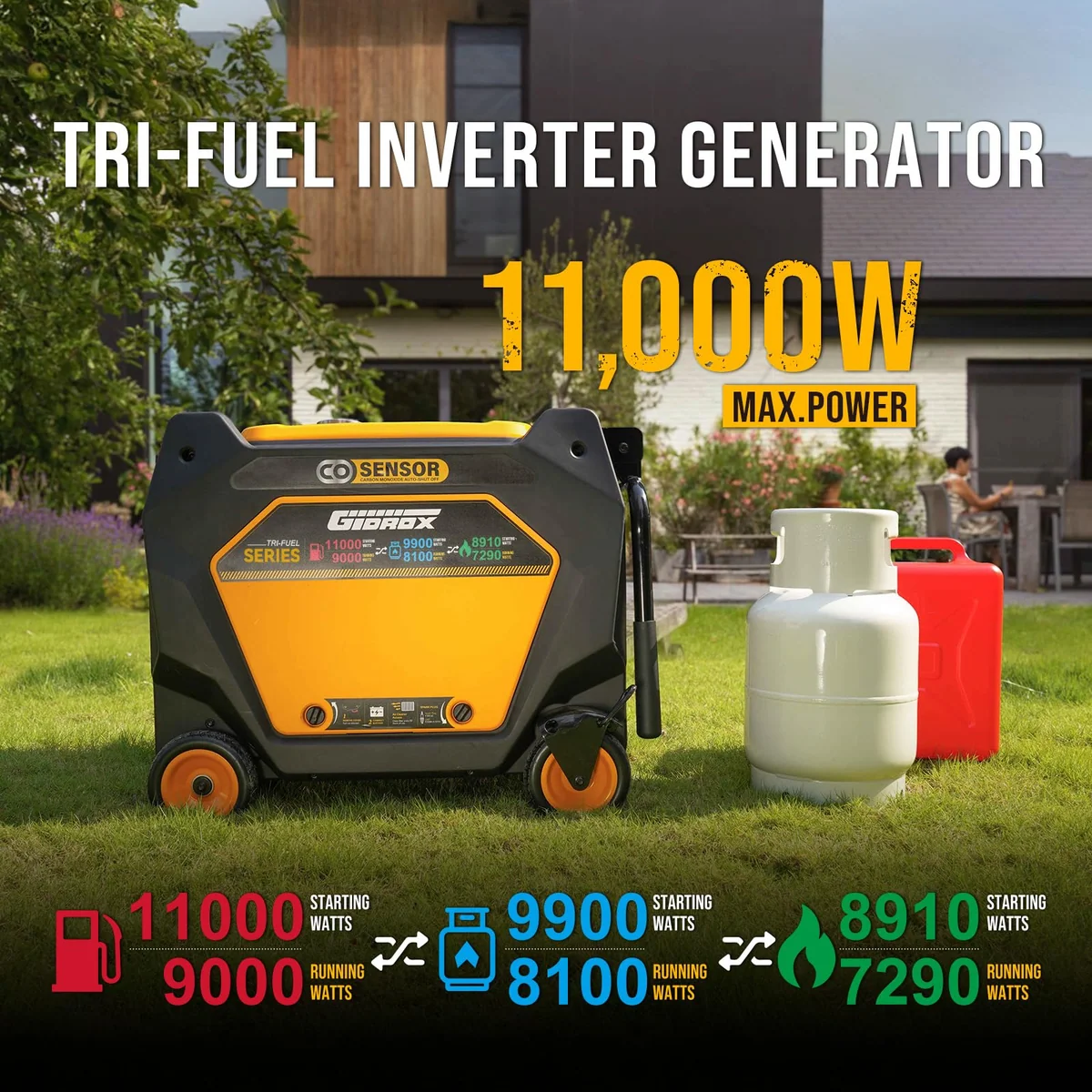
| 11,000W peak, 9,000W running on gasoline | Unmeasured by anyone independent. One owner reports failure between 5,000 and 5,500W. |
| Tri-fuel: gasoline, propane, natural gas | True, and the hoses are in the box. Gidrox's own product page derates propane to 9,900 peak and 8,100 running. |
| Natural gas capability, sold as whole-home backup | No natural gas output figure is published anywhere Specific Load could find, on Amazon or on the manufacturer's site. |
| 8.7-gallon tank, up to 21 hours | That works out to roughly 0.41 gallons an hour, which is a quarter-load number for a 499cc engine, not a backup-the-house number. |
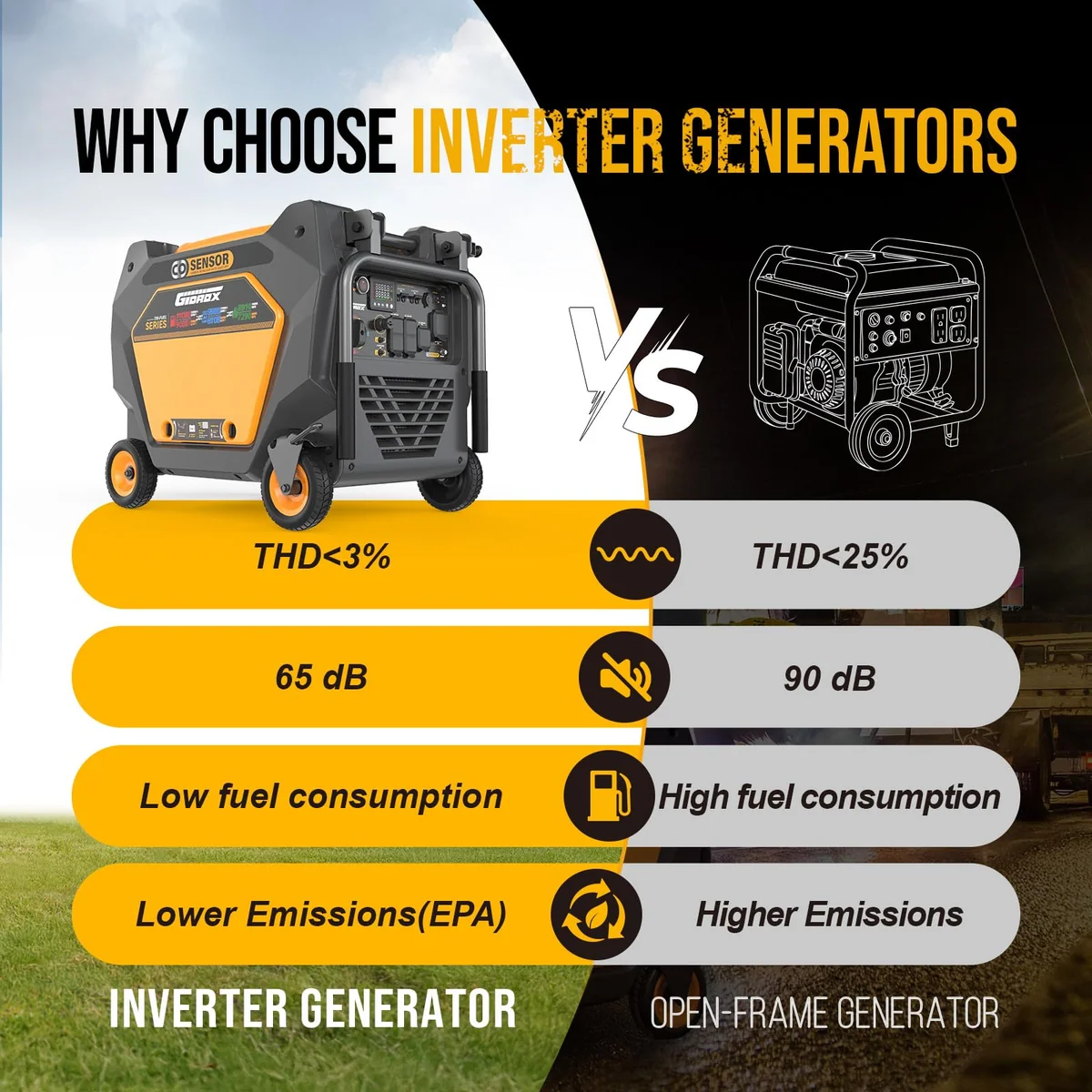
| 62 to 65 dB, quieter than a normal conversation | Normal conversation is about 60 dB, so this is louder than a conversation, not quieter. No measuring distance is given either. |
| Under 3% THD, safe for sensitive electronics | Unverified rather than disproved. Nobody in the record has put a scope on it. |
| Handles 5-ton central AC units | The shakiest claim on the page, and the one most directly contradicted by the reported 5,500W ceiling. |
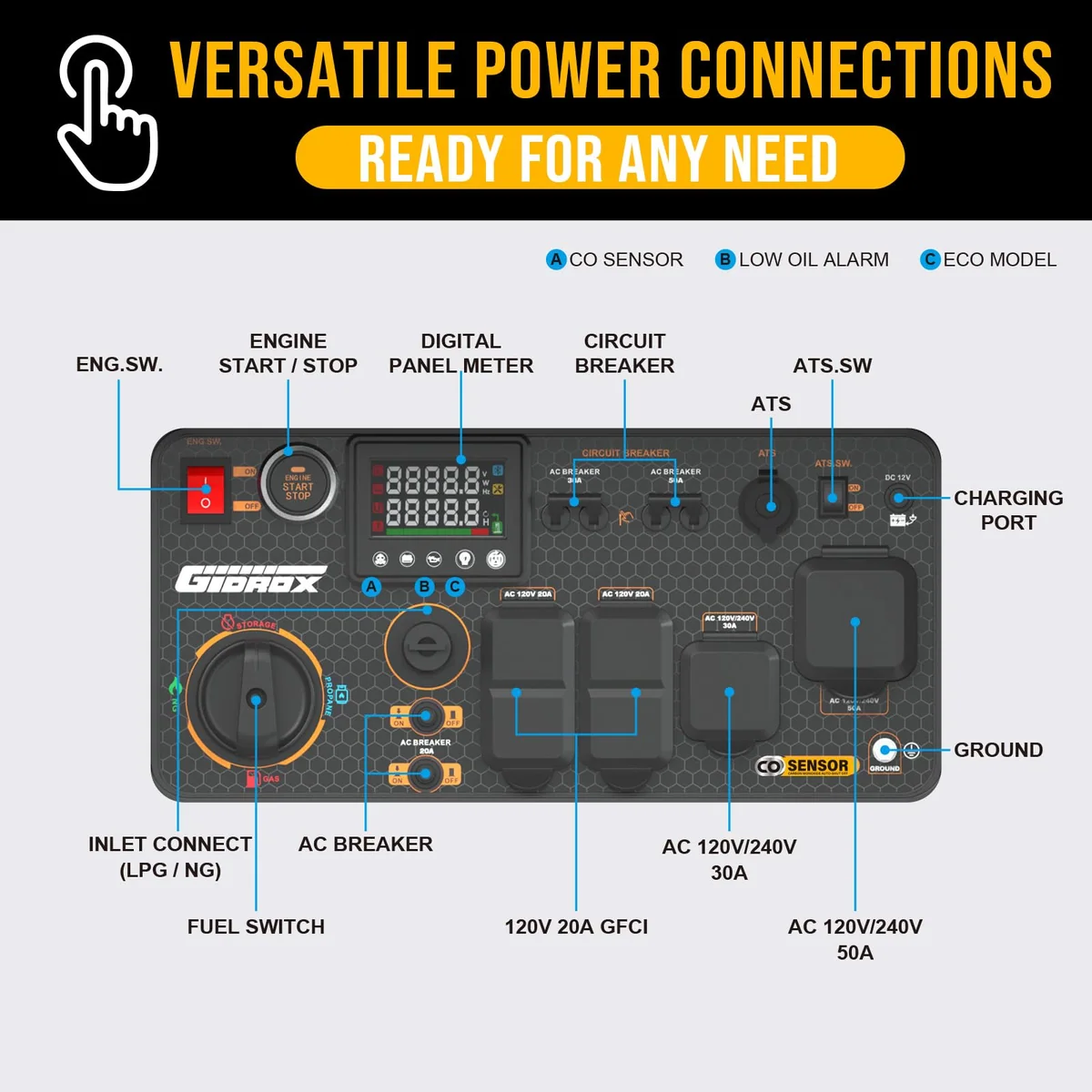
| 50A 14-50R plus 30A L14-30R | The outlets are there. What the engine can push through them is a separate question. |
| ATS-ready dedicated port | A port. No transfer switch is included, and no compatible model is named. |
| 3-year limited warranty | Stated, and completely untested by any evidence, since the oldest owner in the record is four weeks in. |
The missing natural gas rating deserves more than a table row. This machine is sold on tri-fuel, ships with a natural gas hose, and is marketed for whole-home backup, which is the job natural gas is best at because a gas line does not run out on day three. Yet the fuel most likely to be doing that work is the one with no published number attached. Natural gas normally lands meaningfully below the propane figure, so if propane is 8,100 running, the real natural gas figure is lower still and you are being asked to guess it. On top of that, your household line pressure and meter capacity set their own limit on what a 499cc engine can draw, which is a constraint no listing in this category ever mentions. If you are choosing between fuels, what each one costs you in watts and runtime is the piece to read before you buy anything.
The 50A outlet is worth a moment of scepticism too. Fifty amps at 240V is 12,000W, which is more than this generator's peak and considerably more than its running rating, so the receptacle is a connector convenience for RV cords rather than a promise of fifty continuous amps. An owner on a power equipment forum put the general case better than any spec sheet does: his generator's 30A outlet and 30A breaker were, in his words, really only useful as a switch, because the engine could not drive it that hard and would stall first.
Strengths & Limitations
Strengths
- The carburettor bowl drain and oil drain tubing address the exact failure that kills stored generators, and owners noticed them unprompted.
- The natural gas and propane hose kit ships in the box, so the tri-fuel capability is usable on day one rather than after a hardware store trip.
- Oil, a clear filler hose and a funnel are supplied, and the machine takes about a quart to the full mark.
- Push-button and remote start are backed by a manual pull, which is the correct answer to the dead-battery failure that strands most standby owners.
- The enclosed cabinet appears to do its job, with one owner who has other generators to compare against calling it noticeably quieter.
- Packaging and assembly drew unusual praise from the most detailed reviewer in the set.
Limitations
- No independent load test exists, and the only owner who reports pushing it says it stops working somewhere between 5,000 and 5,500W against a 9,000W running rating.
- No natural gas output figure is published anywhere, on a generator whose main argument is natural gas.
- The claim that 62 to 65 dB is quieter than a normal conversation is arithmetically false, and no measuring distance is given.
- The 21-hour runtime implies about 0.41 gallons an hour, which is a light-load figure and not what backing a house will look like.
- ATS-ready means a port, so the transfer switch, the permit, the inspection and the electrician are all additional and none of them are cheap.
- Whether the neutral is bonded or floating is unstated, which is a real gap on a machine sold for transfer switch use.
- It is heavy enough that an owner made a point of warning about it, and no shipping weight appears in anything we read.
- There is no long-term reliability evidence of any kind, and no visible parts or service channel behind the three-year warranty.


Where the ceiling probably is, and how to find yours
Start with arithmetic you can trust, because it does not depend on anybody's opinion. The conventional sizing guidance for keeping a generator efficient and long-lived is to hold continuous load at about 80% of the running rating. On this machine that is 7,200W on gasoline. On propane, using Gidrox's own 8,100W running figure, it is roughly 6,480W. On natural gas it is an unpublished number below that. So even taking every specification at face value and disbelieving the critical review entirely, the honest continuous budget here is closer to six and a half kilowatts than to eleven. That gap between the number on the box and the power you actually get is the whole subject of starting watts versus running watts, and it is the single most common reason people buy the wrong size.
Now add the critical review back in. If that owner is right, this generator falls over somewhere between 5,000 and 5,500W, which is below even the propane 80% figure. He does not say how it failed, whether it tripped, stalled, shut down or sagged, and that distinction matters enormously. It is unknowable from the text, and inventing a mechanism for him would be dishonest. What can be said is that a new generator badly under-delivering against its rating is not exotic. Owners of a brand new machine from a very large retailer spent a whole thread watching it surge out of the box, and one of them pointed at published sound-testing footage where a 4,200W-rated unit could not hold 2,500W. The rating on the box is a marketing claim until someone measures it.
There is also a way to lose half your capacity without the generator doing anything wrong. A 120/240V machine produces two semi-independent legs, and a dogbone adapter connects its 120V outlet to one of them, so a household plugged carelessly into a single leg is asking 9,000W of generator to deliver everything through 4,500W of capacity. That thread also contains the reason summer is worse: an air conditioner draws more power on the hottest days, because the pressure differential across the compressor is higher, so the load peaks precisely when you most need the machine to cope.
And breakers do not cut cleanly at 100%. Overcurrent protection typically opens somewhere in the 110% to 125% band, with a time curve that will pass a large inrush for several seconds without complaint, which is why a machine can seem fine right up until it is not. The same industrial troubleshooting logic supplies the missing half of the 5-ton air conditioning claim: when voltage dips on load acceptance, the fix is a soft starter, and this listing markets central air compatibility without mentioning one. If that is your plan, read what an AC compressor actually asks of a generator first.
What to do in week one
Because nobody has load-tested this generator and the two owner accounts contradict each other, the burden falls on you, and it falls inside the return window. Do it in steps: run the machine on gasoline, add load in roughly 25% increments with a clamp meter or a plug-in power monitor watching, and note where the voltage sags or the breaker goes. Balance loads across both legs deliberately rather than hoping. Repeat the top step on propane, which is the fuel most owners of this class actually use for backup. If it holds 7,000W on gasoline, you have a generator that matches its paperwork and the critical review was an outlier or a bad unit. If it quits at 5,500W, you have found that out while you can still send it back, rather than in the dark with a freezer thawing. Nobody sells a load bank to homeowners, but a water heater, a space heater and a kettle make a serviceable one.
What you are really deciding
Strip away the specification sheet and this is a bet on a brand. Gidrox is an Amazon-native house label whose adjacent products include air conditioners, tankless water heaters, water pumps and an app, which is not disqualifying but is a different animal from a company that has been selling engines for forty years. Specific Load found no independent load test, no editorial teardown and no video review of this generator. What we did find is people searching for exactly those things, which is the clearest possible signal that the verdict this machine needs does not yet exist. There are also at least three near-identical Gidrox listings in circulation, two tri-fuel and one dual fuel, carrying the same copied marketing bullets, so ratings you see on a sibling listing are not evidence about the one in your basket.
The practical consequence is that the three-year warranty is worth precisely as much as the parts channel behind it, and there is no evidence at all about that channel. That is the whole argument in what you actually buy with an unfamiliar generator brand, and it applies here even though this is not a cheap machine.
If the brand risk is the sticking point rather than the specification, there are honest alternatives on this site. The GENMAX GM9000iED is the closest thing in this class with an actual owner base behind it, and it is dual fuel rather than tri-fuel, which matters only if your natural gas line is genuinely part of the plan. The LIFAN 4800W and Oxseryn 5000W are the right size for the load most households actually run, which is frequently a good deal less than people buy for. If the real requirement is unattended, automatic, no-thinking backup, a portable with an ATS port is an imitation of a standby unit rather than a substitute, and what the extra money buys is a more honest comparison than any listing will offer. For CPAP, oxygen or anything else where silence and certainty beat raw watts, a battery is the better instrument: see our medical equipment picks and the Anker SOLIX F3800 Plus.
Where the Gidrox has a real and underplayed argument is duration. Storm outages in the American Midwest this month ran to five days for some households, and five days is the point at which an 8.7-gallon tank and a propane bottle both become a logistics problem while a natural gas line does not. Tri-fuel done properly means effectively unlimited runtime on the house supply, and that is a genuinely stronger case than the listing bothers to make for itself. It is also why the missing natural gas rating is such an irritating omission: the best reason to buy this machine is the one number Gidrox will not publish.
The parts of this machine that made owners sit up
Here is where the Gidrox earns something real. One owner, comparing it against the other generators he owns, wrote that the engineers seemed to given some thought to the design as they have added tubing to make draining the oil easier and emptying the carburetor bowl of gas after usage prior to storage
. An oil drain tube is a convenience. The carburettor bowl drain is not: it is the direct countermeasure to the most common failure story in the entire body of generator evidence.
That story goes like this. The machine sits for months with fuel in it, starts fine on the first pull because the bowl has filled while it sat, runs for twenty or thirty seconds, and dies the moment a house load is put on it, because a gummed carburettor cannot feed the engine when it has to work. Every experienced hand in that thread converged on it independently. A generator that ships with a way to empty the bowl before storage is a generator whose designers have read the same complaints. Pair it with our guide to storing a backup generator so it starts when the power goes out and you have removed the biggest single risk to a machine that spends 360 days a year doing nothing.
The second-most-common field answer to "it trips after a while" is duller still, and it is oil. An RV owner whose generator faulted after roughly thirty minutes on nothing but one air conditioner and some 12V lights went through the whole diagnostic parade and came back with a two-word resolution: oil was the problem. Notably, the most thorough owner in the Gidrox record filled to the full mark with the supplied quart, using the supplied clear hose and funnel, before first start. Copy that behaviour, and know what these engines take and when the break-in change is due.
The CO sensor cuts both ways
Automatic carbon monoxide shutdown is a genuine safety feature and it belongs on every machine sold. It is also, on this class of generator, a documented source of shutdowns that are not about carbon monoxide at all: an owner of two 11,500W tri-fuel machines in that same thread describes following the instructions to bypass the sensor because his kept stopping. Repeat his action if you like, but not his reasoning, because he bypassed the sensor and then concluded the problem had been fuel-related. More importantly, a sensor at the generator tells you nothing about where the exhaust goes. The case that should scare you is the homeowner whose standby unit put carbon monoxide into the house because a loose spark plug had it running on one cylinder and dumping unburned gas, at which point the argument became clearances: five feet minimum to any opening, ten better, and clear of the air conditioner that will otherwise blast exhaust into the soffit. Distance is the control, not the sensor, and where to put a running generator is worth more of your attention than the bullet point.
ATS-ready is a port, not an installation
The listing's automatic backup story requires a compatible transfer switch you buy, an electrician you hire, a permit and an inspection. What that costs and how badly it can go is its own subject: electricians pass around photographs of standby installs so poorly planned that the professional response is to refuse to touch them, and one of the more useful lines in that discussion is that being an authorised dealer for a major brand means very little, because the manufacturers will sign almost anyone up. Budget the install as a real project, and read the honest comparison of transfer switch, interlock and backfeeding before you commit to a method. One specification you will need and cannot get from this listing is whether the neutral is bonded or floating, which is a genuine gap on a machine sold for transfer switch duty and something you should determine for yourself before wiring anything.
Do the job properly and there is a further payoff that has nothing to do with convenience. A Lansing homeowner's cameras caught a utility contractor shutting off the generator that was running her sump pump while she was out, and her basement flooded; the utility's explanation was that the crew shut it down to avoid backfeed during restoration work. Her own reaction was the part worth remembering: What if it was somebody on a medical device or something like that? They had no idea what was plugged into that.
A properly interlocked connection is the difference between a machine a stranger has to guess about and one that is visibly not energising the street.
When it trips and it is not the generator's fault
Ground fault receptacles account for a large share of "it keeps tripping" reports, and they fail differently from breakers: a GFCI senses leakage to ground from moisture, dust, tired insulation or an old appliance, not overcurrent. One owner of a brand new dual fuel machine spent a thread chasing a trip that came about five minutes into running nothing but a refrigerator, on two extension cords that were both fifteen years old. That is a textbook profile. The isolation procedure that works is boring and effective: shut everything off, restart, reset the receptacle and confirm the button stays down, then add one small load directly with no cord, then the cord, then the strip, then the real loads one at a time, giving anything motorised a full fifteen minutes rather than fifteen seconds for leakage to show itself. Our page on why a generator trips, stalls or shuts down under load walks the same ladder, and the no-output case is a different animal with a different cause.
Test it before you need it
The most quotable line in this entire body of evidence came from someone answering a homeowner whose inherited generator gave nothing but silence when the storm hit: You should always test parachutes and generators before you need them. Be happy you are not sky diving.
Electric start and remote start both depend on a battery that is quietly discharging in your garage all year, and this machine's manual pull backup is the right answer to that risk only if you have confirmed it works. Run it monthly under real load. Put it in a calendar.
Frequently Asked Questions
Is this actually a tractor-driven PTO unit?
No, it is a self-contained 499cc engine-driven inverter generator that Amazon happens to file in that category, and nothing about it attaches to a tractor.
How many watts should I plan to draw from it continuously?
Plan on about 7,200W on gasoline and roughly 6,480W on propane, using the conventional 80% of running rating, and expect the natural gas figure to be lower still since it is unpublished.
Will it start a 5-ton central air conditioner?
Nobody has demonstrated that it will, and given a reported ceiling near 5,500W and the absence of any mention of a soft starter, this is the listing claim Specific Load would test first and trust least.
Does ATS-ready mean it comes with an automatic transfer switch?
No, it means a dedicated port, and the switch, the wiring, the permit and the electrician are all separate purchases the listing does not price.
Why would a generator trip or shut down on a load it should handle?
In the field the answer is usually oil level first, then stale fuel or a gummed carburettor, then a bad cord or connection, then all the load sitting on one 120V leg, and only then the generator being genuinely undersized for what you asked it to do.
Does the carbon monoxide sensor mean it is safe closer to the house?
No, the sensor shuts the machine down after carbon monoxide has been detected at the generator, which is no substitute for keeping the exhaust well away from doors, windows, vents and the air conditioner.
Is a 4.5-star average from twenty-five ratings enough to buy on?
Not for a machine this expensive, because those ratings are about four weeks old and most of them explicitly describe first impressions rather than use.
Is the included hose kit a real advantage?
Yes, in the sense that most competitors at this size make you source natural gas and propane connections separately, though no owner in the record has documented what the kit actually contains.
Sources (7)
- Amazon listings and customer reviews — Gidrox 11000w Tri Fuel
- Owner reports across r/Generator, r/Generac_Generators, r/electricians and 1 more threads
- Owner and reviewer video, 2 channels
- Powerequipmentforum — Article — www.powerequipmentforum.com
- Generatorbible — Article — generatorbible.com
- Jubailibros — Article — ng.jubailibros.com
- Facebook — Article — www.facebook.com