The EcoFlow River 3 Plus is the better box, and the VTOMAN Jump 600X is the one with nothing to log into
Buy the EcoFlow River 3 Plus: for the same handful of watt-hours it gives you a specified sub-10ms UPS, three backed AC outlets, an expansion port, nearly double the solar input and a five-year service term on the listing, and the only buyer who should take the VTOMAN Jump 600X instead is the one who wants a battery with no app, no account and no cloud behind it, and will accept a 12V output whose ceiling nobody has ever published.
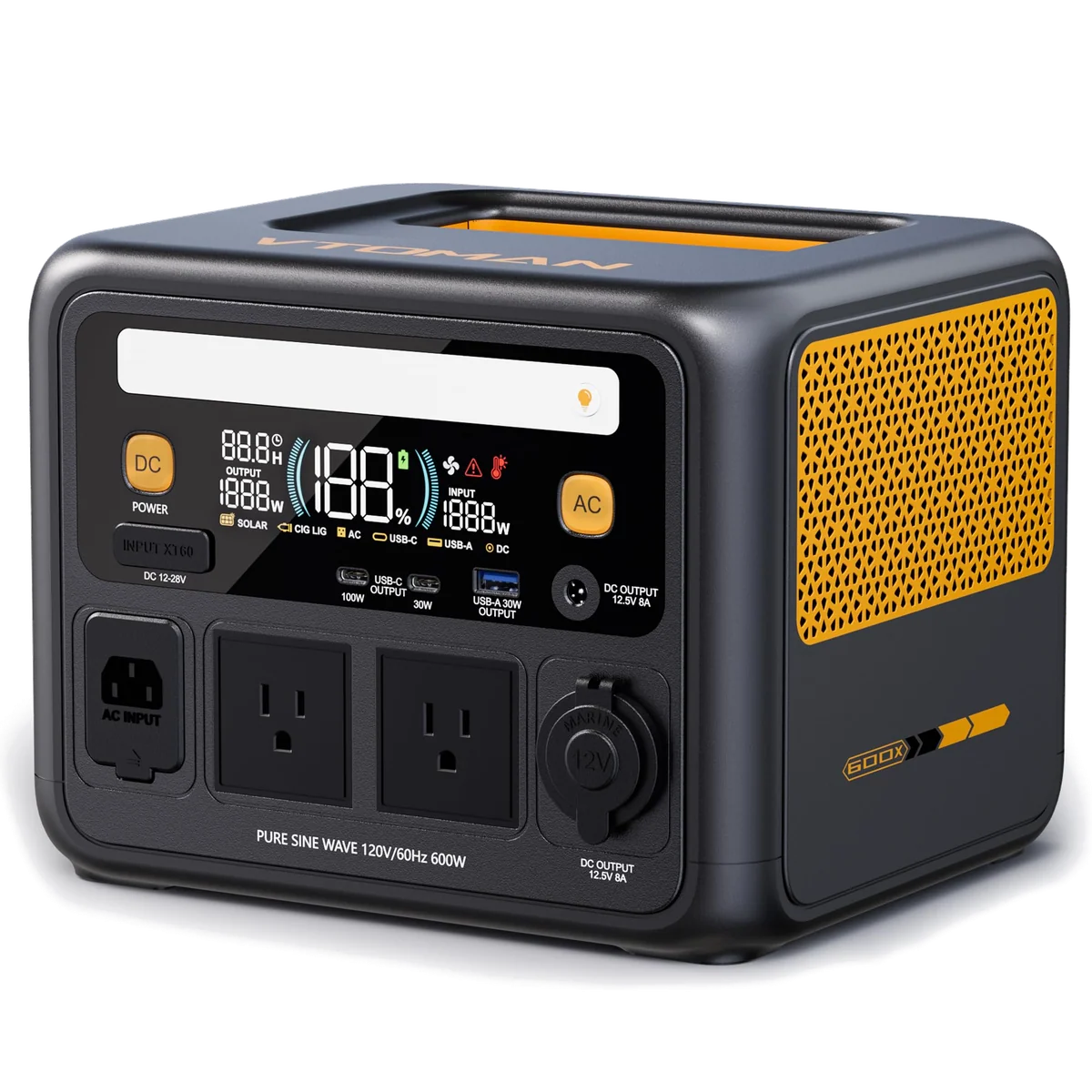
VTOMAN Jump 600X
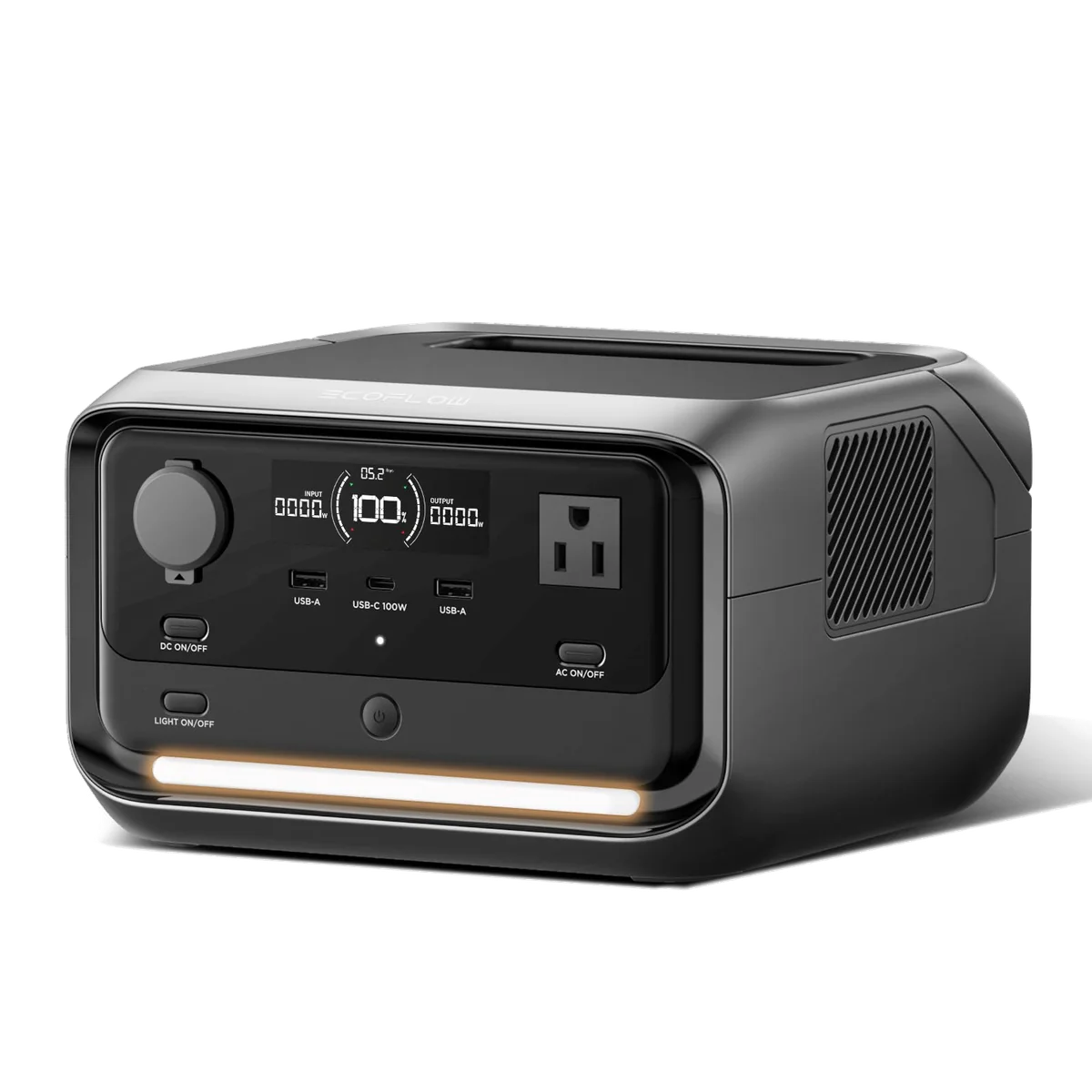
EF ECOFLOW Portable Power Station
Put the two side by side and the headline numbers say this is a coin toss. VTOMAN gives you 268.8Wh of LiFePO4 in a 9.92 lb box with 600W of continuous pure sine output. EcoFlow gives you 286Wh of LiFePO4 in a 10.4 lb box with 600W of continuous output. Six per cent of capacity and half a pound apart, both rated for 3,000 cycles, both claiming 1200W in letters large enough to mislead somebody. On the spec that people shop by, there is nothing to choose.
Which is exactly why the spec people shop by is the wrong one. Everything that will decide whether you are still happy with this purchase in a year is in the second tier of the listing: what the 12V socket will actually carry, whether the AC cuts over fast enough to keep a computer alive, whether you can bolt more capacity on later, and what happens the day the unit stops charging. On all four of those the EcoFlow is ahead, in one case by a distance that ought to end the argument on its own.
Neither of these is a generator, whatever the category headings and the word Solar on the VTOMAN's title suggest. Both are roughly a night of a router, a laptop and some lights. If you arrived here wanting a fridge kept cold through a three-day outage, the arithmetic never gets there for either one, and our page on usable watt-hours after inverter losses shows why before you spend anything.
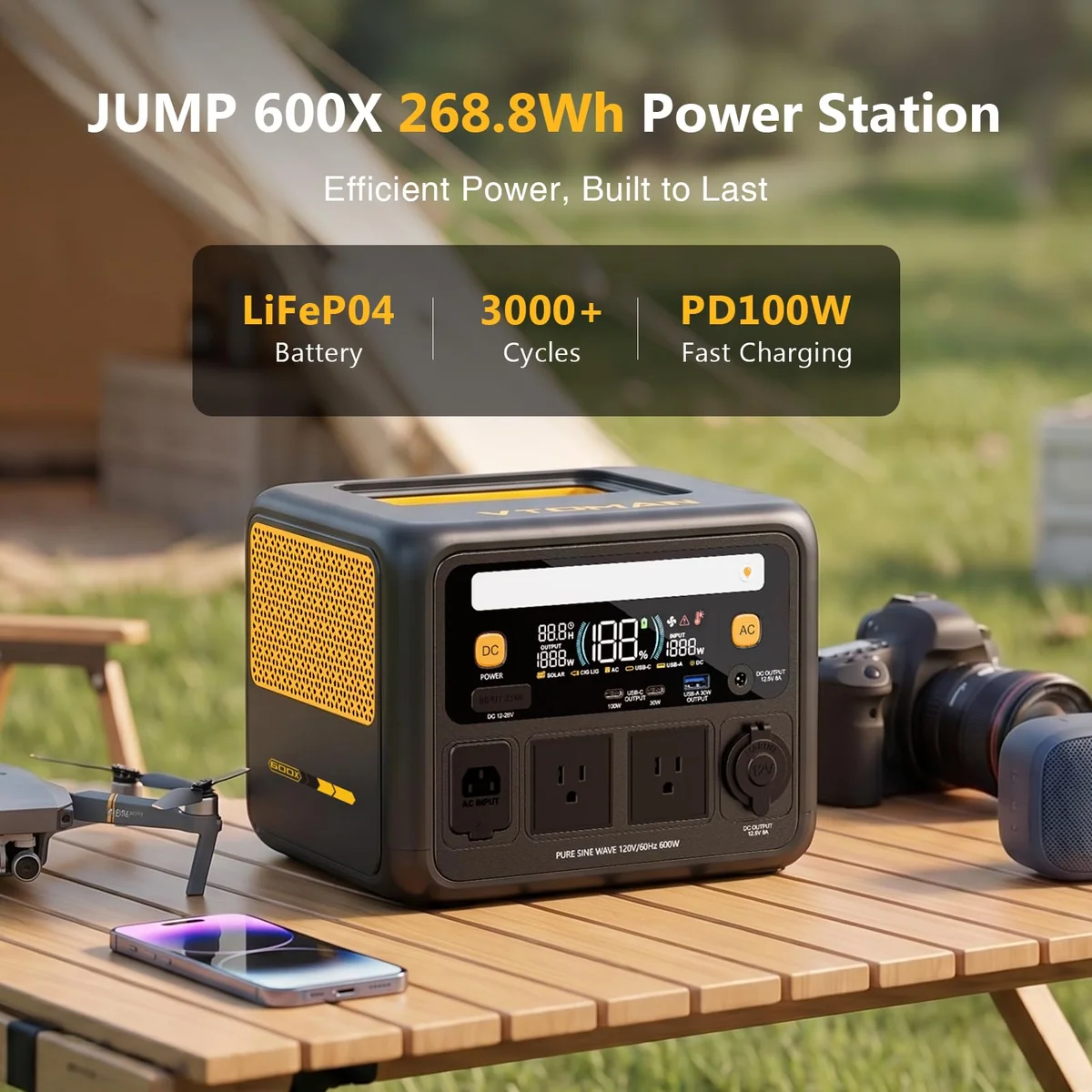
VTOMAN Jump 600X
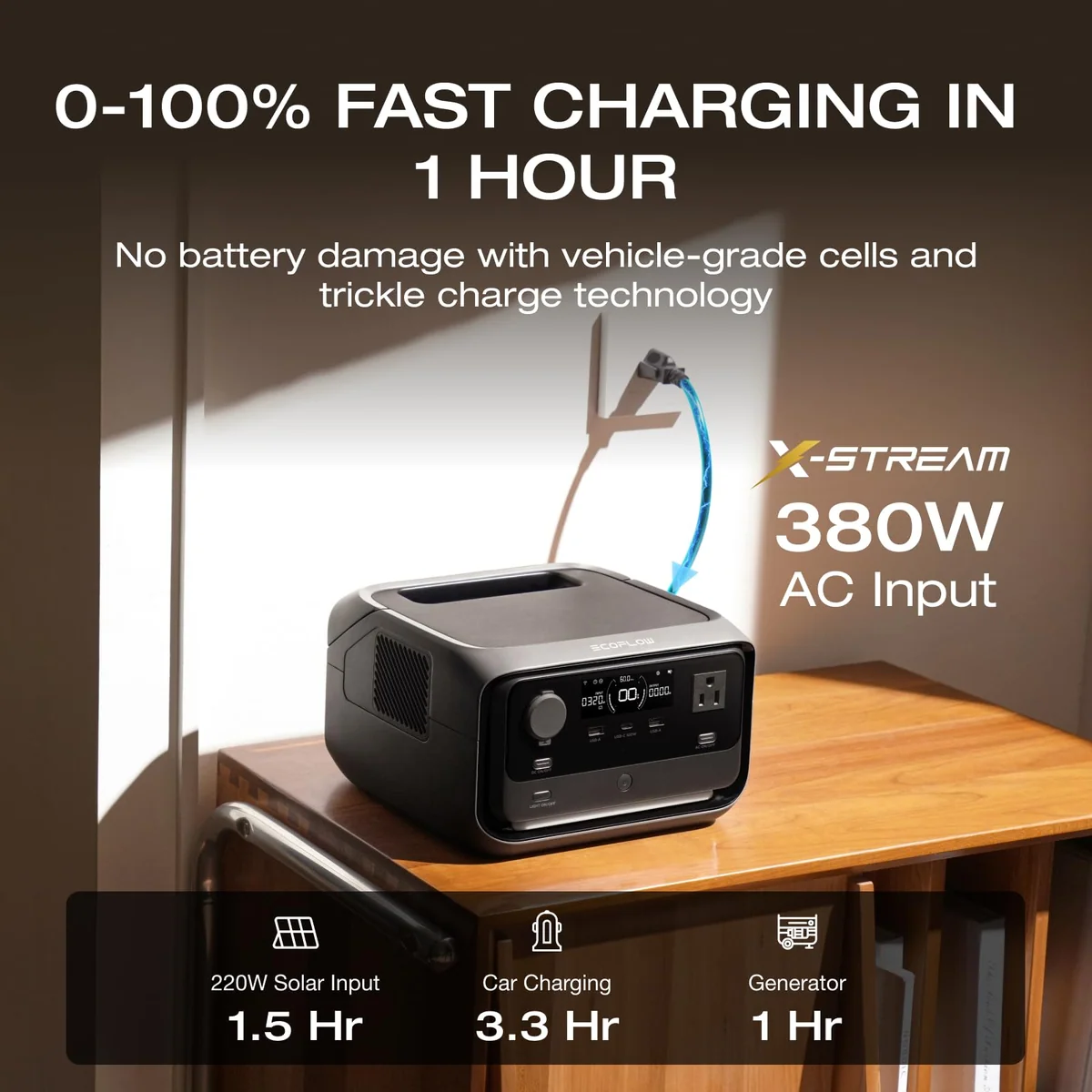
EF ECOFLOW Portable Power Station
At a Glance
| Feature | VTOMAN Jump 600X | Editor's Pick EF ECOFLOW Portable Power Station |
|---|---|---|
| Price Range | Under $200 | $200–$500 |
| Power | 110 W | 760 W |
| Check Price on Amazon | Check Price on Amazon |
The differences that survive contact with a real week
| VTOMAN Jump 600X | EcoFlow River 3 Plus | |
|---|---|---|
| Battery | 268.8Wh LiFePO4 | 286Wh LiFePO4 |
| Continuous AC | 600W | 600W, despite a title that says 760W |
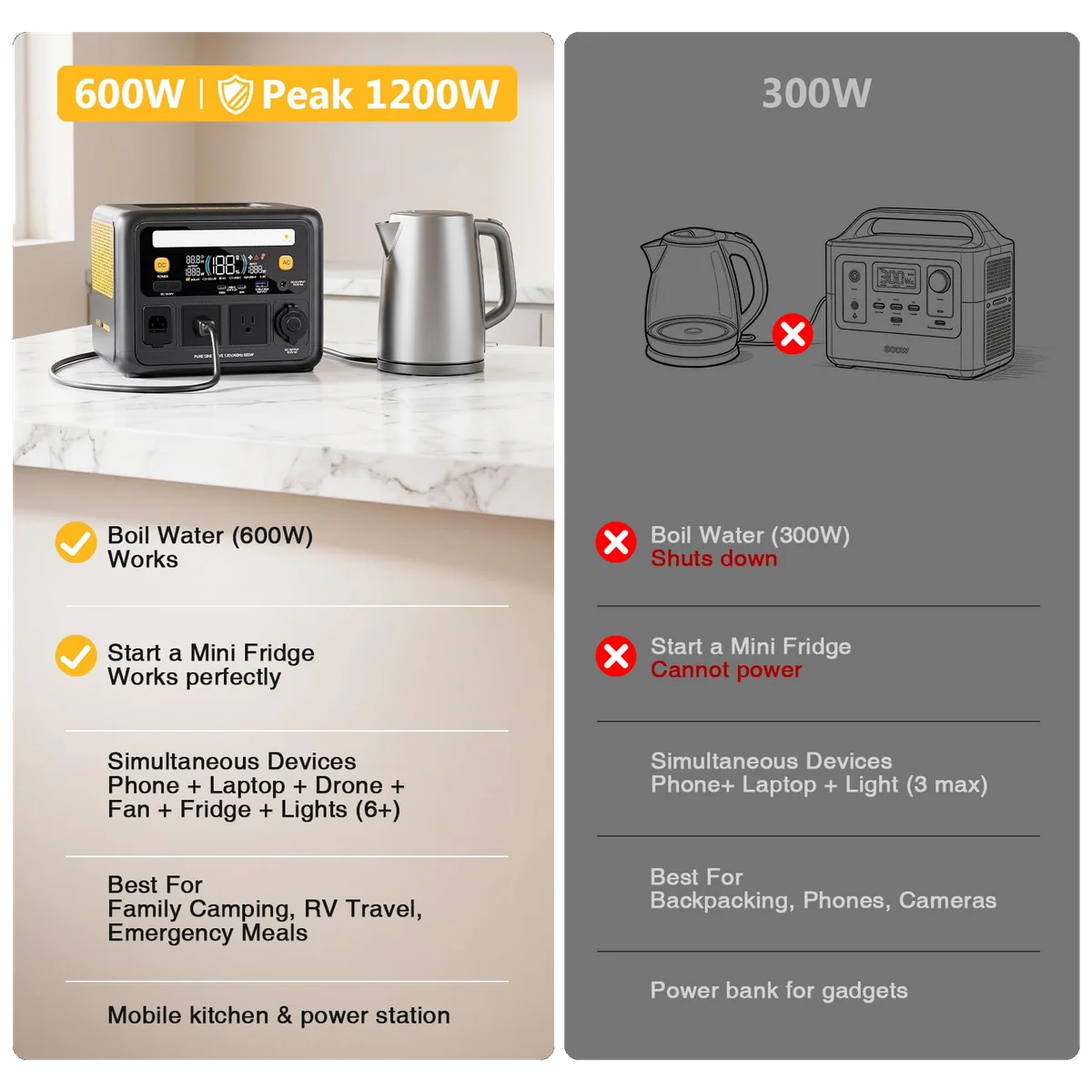
| The big number | 1200W by dropping output voltage, sensitive electronics excluded in writing | 1200W X-Boost, which is a quarter of an hour of battery at that draw |
| Weight | 9.92 lb | 10.4 lb |
| Box volume, our arithmetic | about 548 cubic inches | about 486 cubic inches |
| UPS switchover | A UPS function is claimed; no time is stated anywhere | Under 10ms, across three backed AC outlets |
| Solar input | Up to 120W MPPT | Up to 220W |
| Recharge | About two hours on a 170W AC input; 75 minutes only with AC and DC together | One hour claimed on AC alone |
| Expansion | None | EB300 or EB600, stacking to 858Wh |
| App | None, and no Bluetooth | Bluetooth and Wi-Fi, routed through EcoFlow |
| Cables in the box | AC, USB-C and 12V car | AC and a USB-B comms cable; no car cable |
| Ingress claim | None made | IP54, worded as battery protection |
| Service term on the listing | Not stated in the bullets | Five years |
The lighter one is the bigger one
VTOMAN sells lightness hard, and the 9.92 lb is real, but the margin is half a pound and the EcoFlow holds more energy in about thirteen per cent less space. The shapes differ in a way that matters more than either number: the Jump 600X is a chunky 7.2 inches tall, the River 3 Plus is a flatter 5.8, which is the difference between a box that lives on a desk and one that slides under it. Whatever you are buying here, you are not buying it because one of them is easier to carry.
The 12V socket is where this stops being close
A VTOMAN owner bought the Jump 600X to run a 150W car heater, and the unit kept shutting off. VTOMAN's support explained that the DC port will not run something at 150W and the AC port will, which is true, useful, and stated nowhere in the listing. So the 12V output has a ceiling somewhere meaningfully under 150W, its actual rating has never been published, and the buyer discovers it by having the machine appear to fail.
The EcoFlow's DC side is the thing owners actively recommend it for. The best idea in its whole review record is using it as a buffer between a car's 12V socket and a portable cooler: charge on the move, unplug at a rest stop, and the cooler keeps running instead of dying with the ignition, for two to three hours on a thermoelectric box and considerably longer on a compressor fridge that cycles. If a 12V cooler is anywhere in your reason for buying, that single paragraph decides this comparison.
There is a neat and slightly maddening symmetry to it. VTOMAN puts a 12V car charging cable in the carton and will not tell you what the port carries. EcoFlow leaves the car cable out of the box entirely, which is not a broken promise because the listing never promises one, and one owner who asked was simply sent one. One brand gives you the cable and withholds the headroom; the other gives you the headroom and makes you ask for the cable.
Only one of them is specified for the job most buyers use it for
Look at who actually owns a River 3 Plus and you find a modem, a router, a Mac Mini, a Raspberry Pi running Home Assistant, a small home server, a work-from-home desk. That is not what the marketing photographs, and it is the job the hardware is built for: three UPS-backed outlets, switchover under 10ms, a USB-B communication cable for a PC or NAS, and automatic data saving on low battery. Against a sealed lead-acid UPS that gives you fifteen minutes and then dies invisibly in year three, the case makes itself.
VTOMAN claims a built-in UPS function for compatible essential devices and gives no switchover time at all. That absence is not proof of a slow relay, but it is the difference between a specification and a hope, and a desktop that reboots is not a device you buy on hope. If the machine under your desk is the reason you are shopping, this is a one-horse race.
Usable watt-hours, and why the capacity gap is smaller than it looks
Nameplate is not what leaves the socket. The only lab-style measurement in the public record for VTOMAN hardware was taken on the larger Jump 1800 and put AC discharge efficiency around 79%, which lands this battery somewhere near 210Wh at the outlet. On the EcoFlow, an owner running a metered 25W network load watched the unit project nine hours and hold that projection for the two hours he sat with it, which implies something close to the same fraction reaching the sockets. Call both of them about eighty per cent of the number on the box and do the division before you order: your load in watts, into roughly 210 or 230 watt-hours.
Both makers then attach a 1200W figure to that battery, and both figures deserve the same shrug for different reasons. VTOMAN's is not surge in any sense a generator buyer means; the first bullet says plainly that V-Beyond supports certain resistive appliances between 600W and 1200W by reducing output voltage, and that sensitive electronics should stay inside 600W. EcoFlow's X-Boost is a genuine boost that empties a 286Wh pack in minutes, which is why an owner who likes the unit still calls the claim misleading. If the vocabulary is unfamiliar, the gap between the number on the box and the power you get is the ten minutes that saves the purchase.
Refilling it
EcoFlow claims a full charge in an hour from AC alone. VTOMAN's 75-minute headline requires AC and DC charging simultaneously, and the honest AC-only figure is its own stated two hours at 170W. The fast claim also rests on an assumption nobody has verified: on the previous generation, a teardown-grade review found a single charging circuit sitting behind two DC inputs, so connecting a big brick and a big panel together did not add up to the sum of the two. If ChargeCore genuinely sums the inputs, VTOMAN has earned the number. Nothing available to this page settles it, and older-generation owners describing three hours, or eight to twelve, are the baseline the new claim is answering.
On solar the gap is not arguable: 220W of input against 120W, which is close to twice the panel and therefore close to half the daylight. Neither ships a panel, whatever the VTOMAN's title implies. What a panel has to match is the input specification, not the badge on the battery, and our note on how much panel it actually takes to refill a station covers the sizing that people get wrong in the direction that costs them a day.
Both listings are wrong; one of them is wrong about what the product is
EcoFlow's title says 760W. Its own bullets on the same page say 600W, and EcoFlow's own store says 600W. There is no 760W anywhere in the machine's real specification, and the same copy claims survival of "a 3 ft (1.5 m) fall", which is two different heights. That is careless writing about a carefully made product.
VTOMAN's problems are structural. The name says Jump and nothing in the box jump-starts anything. The title says Solar Generator and the panel is a separate purchase. The title says LEP, which is a typo for the LFP chemistry inside. The title says 600W next to a 1200W claim that only holds at reduced voltage. Read EcoFlow's title too quickly and you overestimate the inverter by 160W. Read VTOMAN's too quickly and you picture a different category of object.
The star ratings do not settle it either, and they are not comparable. VTOMAN's 4.5 average is a parent score covering variations that include a 939Wh bundle with an extra battery and a panel, so it is not this box's score. EcoFlow's 4.4 sits on a much smaller pile of ratings.
What goes wrong, on each side
The VTOMAN fault worth naming is a shape that repeats across models and platforms: a healthy charge reading collapsing to LOW under a modest load and cutting the output, reported by an Amazon owner who went to bed at 45 to 75 per cent and woke to a dead unit and a warm fridge, and by other owners elsewhere. That pattern points at state-of-charge estimation or cell balancing rather than a flat battery, and it is the thing to provoke deliberately while your return window is open. If you meet it, our page on a station that reads full and will not run is the triage.
The EcoFlow fault is narrower and better handled. One owner bought two and both shut down intermittently with the AC dropping out on its own, which in a device sold on not interrupting power is the most serious complaint in its file. EcoFlow sent shipping labels, replaced both, stayed in contact throughout, and took a few weeks; he still rates it five stars and the replacements were fine a month later. One further open question sits alongside it: an owner monitoring a River 3 on a 5.3W load saw the pack repeatedly drop a percent and top itself back up rather than passing mains straight through, which is not alarming on a 3,000-cycle chemistry but is a unit spending cycle life doing nothing.
Then there is the company behind each. VTOMAN sits at 2.7 on Trustpilot across more than 400 reviews, with half of them at one star and thirty-seven per cent at five, which is not a mediocre record but a bimodal one: people either get a working unit and help that arrives, or a dead unit and silence. On the same platform EcoFlow sits at 3.6, below Jackery and Anker but a full point clear of VTOMAN. Neither number is good enough to buy on faith, which is why the rule for both is identical: buy where the retailer, not the manufacturer, owns your return. That converts most of the downside in both files into an inconvenience, and it is the same argument we make about what a budget brand's warranty is actually worth.
The case for the VTOMAN, made honestly
It exists, and it is narrower than VTOMAN would like. The Jump 600X has no app and no Bluetooth, so there is no account, no server and nothing that can be abandoned in an update. That is a real position, and the EcoFlow's weakest review in the retained set is titled "No problems" and docked two stars purely because the app routes through EcoFlow's servers instead of just talking to the device. There is a local path on the River 3 Plus, and two owners run it happily through a community Home Assistant Bluetooth integration, but note the word community: that escape hatch is maintained by users, not by the manufacturer.
The other VTOMAN advantages are small and genuine. The five-mode LED light is bigger and better than the category norm, and owners keep naming it unprompted as the reason they picked it over a Jackery. The 100W USB-C keeps a working laptop moving forward instead of merely slowing its decline. And the fans are loud, around 80 dB in owner accounts, against an EcoFlow that claims 30 dB at half a metre, so the quiet one is not the one with the torch.
Neither is cheap energy. At this size you pay two to three times per watt-hour what the big warehouse bundles work out to, because the enclosure, inverter, BMS and ports cost nearly the same whether there are two cells behind them or twenty. That is the price of the category, not a scandal, and it is worth remembering when the difference between these two on any given week is smaller than the swing on one of them. The River 3 Plus in particular has been discounted since launch and an owner tracked the price bouncing across a wide band rather than settling, so paying at the top of that band is the easiest mistake available here.
The one for a buyer who wants a battery and nothing to sign into
A genuinely good 268.8Wh LiFePO4 pack with the best light in the class, a 100W USB-C port and no app, account or cloud service anywhere in it, which is the whole and only reason to choose it over the EcoFlow.
Its 12V output quits well below 150W and the rating has never been published, so anything substantial has to go on AC and pay the inverter tax.
The one to buy for the desk, the modem and the server
More capacity, three UPS-backed outlets with sub-10ms switchover, nearly double the solar input, an expansion port that takes it to 858Wh and a five-year service term on the listing, for money that lands in the same place.
The app talks to EcoFlow's servers rather than straight to the device, and the local alternative is a community-maintained integration rather than anything the manufacturer supports.
VTOMAN Jump 600X

EF ECOFLOW Portable Power Station
Pick by the socket you will actually use
Buy the EcoFlow River 3 Plus if:
- Anything you own reboots when the mains flickers, because only one of these two publishes a switchover time.
- You run a 12V cooler or fridge off the car and want a buffer that keeps it cold at rest stops.
- You expect your load list to grow, since the expansion batteries take it to 858Wh without buying a second station.
- You want to add panels later and would rather have 220W of input than 120W.
- You like knowing what the battery is doing from your phone, and can live with that going through a company's servers.
Buy the VTOMAN Jump 600X if:
- You want a battery with no app, no pairing and no account, and the screen on the front is enough readout for you.
- Your loads are phones, a laptop, lights, a router and a camp evening, all comfortably on AC.
- The five-mode torch and the carry handle are things you will use weekly rather than features you are talked into.
- You are buying somewhere the returns desk is the retailer's problem and not a warranty email to the brand.
Walk away from both if:
- You pictured a kitchen fridge, a space heater or an air conditioner, because 1200W on the lid and 280Wh in the cell do not add up to any of them.
- A CPAP with the humidifier running, or an oxygen concentrator, is the reason you are shopping, in which case start with our medical backup page and plan for redundancy.
- You need hours of real wattage rather than hours of small draw, where a portable inverter generator does a job no 280Wh battery can approach.
- You want the house carried through a multi-day outage, which is the territory of the Anker SOLIX F3800 Plus and the machines we set against it on the F3800 Plus against the Delta Pro 3.
If neither size is right, the full power station roundup lays out the field either side of this bracket, the EcoFlow TRAIL Plus 300 is the rugged DC-focused version of the same idea for a pack rather than a car boot, and our note on why people end up owning one of each explains the purchase most outage-shoppers eventually make.
Frequently Asked Questions
Which one keeps my modem and router alive during an outage?
The River 3 Plus, decisively, because it specifies switchover under 10ms across three backed outlets while VTOMAN claims a UPS function and publishes no switchover time at all.
Will either of them run a refrigerator?
A 12V cooler or small compressor fridge for a matter of hours, yes, and a full-size kitchen fridge through a real outage, no, for reasons our usable watt-hours page works through in full.
Does the Jump 600X really charge in 75 minutes?
Only with AC and DC charging at once, and only if the two inputs genuinely sum, which the previous generation's single charging circuit did not do.
Is the VTOMAN's 12V port really weaker than the EcoFlow's?
VTOMAN's own support told an owner the DC port will not run a 150W load, whereas EcoFlow owners specifically buy the River 3 Plus to keep 12V coolers running for hours.
Does either come with a solar panel?
Neither does, despite the word Solar in the VTOMAN's title, and both will take a generic panel that matches the input specification rather than the brand on the box.
Can I add more capacity later?
Only on the EcoFlow, which clips on an EB300 or EB600 to reach 858Wh, while the Jump 600X is the capacity it arrives with.
Which brand will actually help me when it breaks?
Neither reliably, since VTOMAN sits at 2.7 on Trustpilot with half its reviews at one star and EcoFlow at 3.6, which is why both of these should be bought where the retailer owns your return.
Is the VTOMAN worth it just because it is lighter?
No, because the difference is half a pound and the VTOMAN is the physically bigger box of the two.
Where can I read more about the VTOMAN on its own?
Our full Jump 600X review takes the four claims on its lid apart one at a time, including the one that is a typo.
Ready to Choose?
Sources (6)
- Amazon listings and customer reviews — Vtoman Jump 600x and Ef Ecoflow Portable Station
- Owner reports across r/Ecoflow_community, r/Jackery threads
- Walmart listing
- the Gadgeteer — Article — the-gadgeteer.com
- EcoFlow — Article — us.ecoflow.com
- Trustpilot — Article — www.trustpilot.com