Most generators that will not start were shipped that way
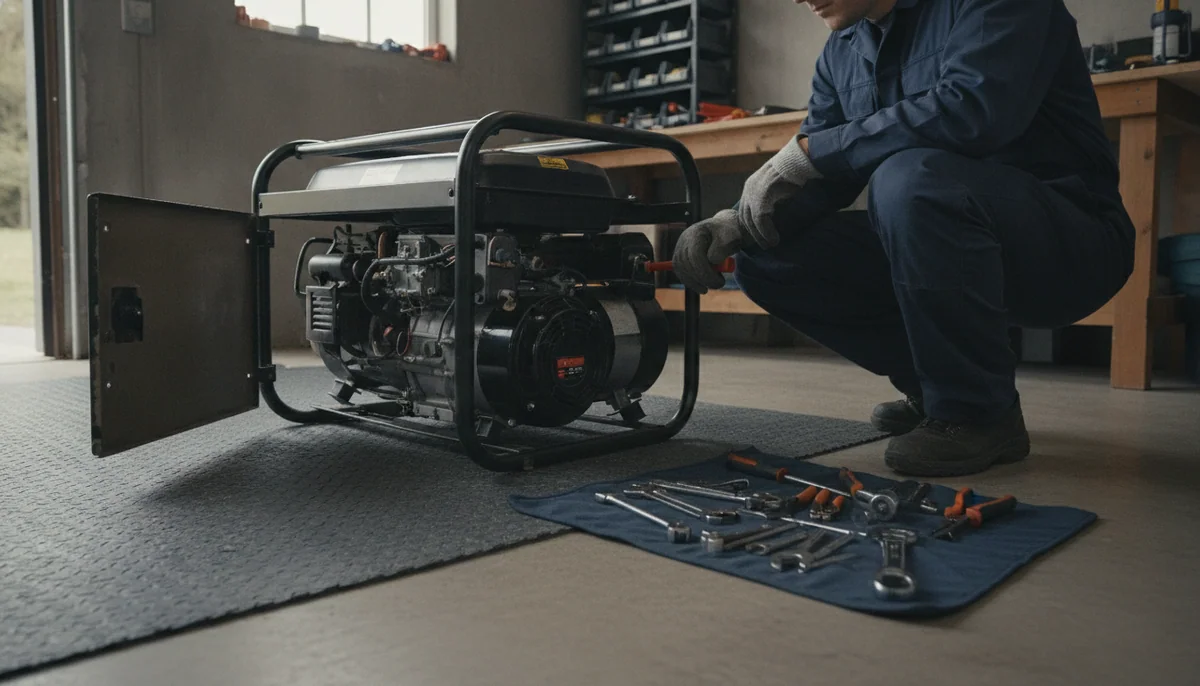
That is not a comforting generalisation, it is what the ownership records look like when you read them end to end. Specific Load has read every customer review on six of these machines for the reviews on this site, and the same four faults keep producing the same symptom on four different brands: a starter battery deliberately unplugged behind a frame rail, a combined fuel and ignition knob that is black on a black panel, a carburettor bowl that has not had time to fill, and a fuel cap vent screwed shut for transport. Not one of those is a broken part. All four read, from the operator's seat, as a generator that has died before it ever ran.
So before anything else, in this order:
- Open the fuel and leave it open. Find the valve or the combined knob, set it fully to gasoline or fully to propane rather than between the two, and wait a full minute before you pull.
- Open the vent on the fuel cap. It ships closed. Closed, the tank pulls a vacuum and the engine starves.
- Check the oil, because it probably has none. Almost everything in this class arrives dry, and the low-oil sensor will refuse to let it start.
- Find the battery plug. If the recoil cord works and the button and key fob do nothing, the starter battery is disconnected inside the case, not flat.
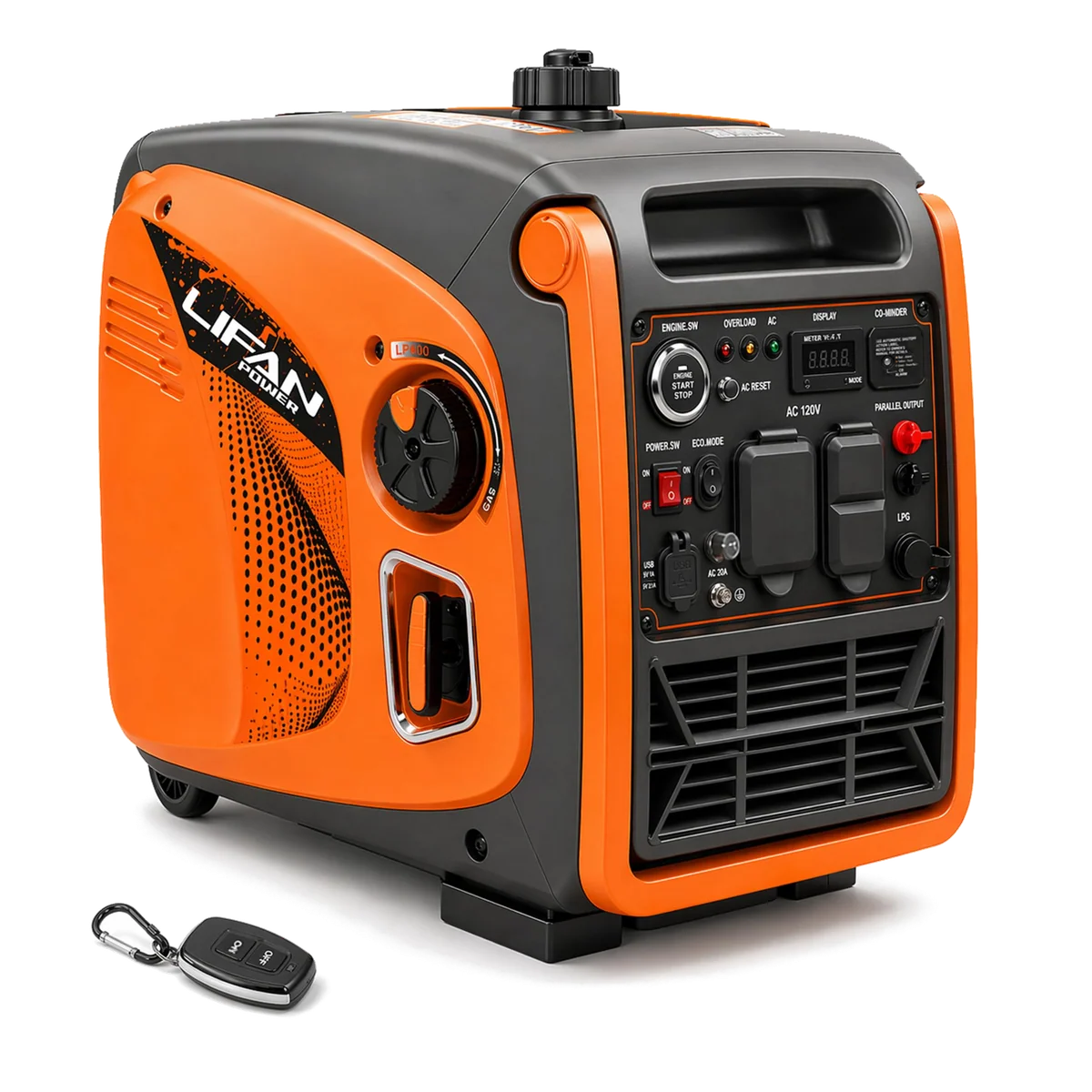
The reason this happens so consistently is not incompetence so much as economics. A generator ships in a transport-safe state, and documentation is the cheapest thing on a three-hundred-dollar machine to cut. Watch how the gap gets papered over: LIFAN's listing now leads its very first bullet with battery setup, repeats it in the fifth, and opens its FAQ with a question written in the voice of an irritated buyer asking whether the unit is defective, and every one of those tells you to connect the battery as shown in the manual. Three separate owners say independently that the manual does not show it. The fix went into the marketing copy, which costs the seller nothing, instead of into the paperwork, which would have cost every buyer nothing.
Read the symptom first, because it narrows things fast
A no-start is not one problem. What the engine does in the four seconds after you pull tells you which half of the machine to look at, and it is worth being precise about that before you start unbolting panels.
| What happens | What it usually means |
|---|---|
| Pulls or cranks freely, never fires at all | No fuel is reaching the carburettor, or the ignition side of a combined knob was never turned on |
| Fires, runs somewhere between two and ten seconds, dies | It burned what was already in the float bowl and got nothing behind it: closed valve, closed cap vent, or a fuel selector left halfway |
| Nothing from the button or the key fob, but the recoil cord starts it | The starter battery is disconnected, uncharged, or its plug was never mated at the factory |
| Turns over willingly with a warning light flashing | It shipped dry, or it has the wrong oil grade in it, or not enough of the right one |
| Runs several minutes, quits, repeats on both fuels | A sensor or a harness, which is a warranty call rather than a driveway job |
The minute the carburettor needs
The most useful sentence anyone has written about starting one of these machines came from an Oxseryn 5000 owner, a 65-year-old woman who fought the recoil from day one and then solved it herself: "if you turn the fuel on and leave it on for a minute or so first… it starts so much faster and easier." That is not a trick. It is a float bowl filling by gravity, and it quietly explains the whole spread of reports on that generator, because every owner who describes a clean two-pull start either primed deliberately or came back to a machine that had been sitting with fuel already settled in it.
That same Oxseryn is worth buying, with the boundary drawn honestly: it is a quiet, unusually frugal camper and outage machine, with owners beating the maker's own runtime claim at the light loads people actually connect, and it is not the home backup unit its title implies, because every outlet on it is 120 volts and there is no way to feed a panel. Its drawback is more specific than the badge: two of the eight substantive owner reviews involve a replacement unit, one of them a fuel shutoff valve that wept from the first day and was only diagnosed seven months later when the owner finally filled the tank. Our full assessment of the Oxseryn 5000 goes through what that does and does not tell you.
The vent that starves the tank, and the one that crushes it
The cap vent is the single most misdiagnosed part on a portable generator. Shut, the tank cannot draw air as fuel leaves it, so the engine runs, stumbles and shuts down as if something expensive has failed. A LIFAN 4800 owner, a mechanic by trade, describes exactly that and is clear that it is operator error rather than a fault. Closed is also, in fairness, the vent's best feature when the machine is being moved: the same owner rates it above his own jerry cans for containing fumes, which matters if the generator travels inside a camper.
Now the part that turns an annoyance into damage. Two Aceup Energy 4000 owners report the internal fuel tank pulling inward and collapsing on itself, and they reach opposite conclusions about why. One calls it a defect and was refused a refund or replacement inside the warranty window even after taking the machine apart and photographing the deformed tank. The other blames physics: cap vent closed, gasoline in the tank, temperature drops overnight, and the vacuum crushes thin plastic. He repositioned it, kept the vent open afterwards, and still recommends the generator, withholding one star purely because the manual never warns you.
Both readings are right, and the collision is in the brand's own instructions: Aceup's shutdown routine has you close the cap vent at the end, which is safe on an empty tank and a slow vice on a full one. The rule that resolves it is one line long. Leave the vent open whenever there is fuel in the tank, and better still, shut the fuel off at the knob and let the engine run itself dry before you put it away.
The battery that shipped disconnected, and the switch you cannot see
If the recoil cord works and nothing else does, stop looking at the battery's charge and start looking at its plug. On the LIFAN 4800 the location is genuinely adversarial: pull the large orange side panel on the oil-fill side, and the battery is the small black box in the front corner near the propane connection, easy to look straight past because it is a lithium pack rather than the lead-acid brick you were expecting. The two-prong SAE connector from the starter motor is obvious. Its mate is not, because it sits around the corner to the left, tucked behind the battery and behind the frame where you cannot see it. You are reaching blind. Three owners lost an hour to this and one titled his review after the starter harness; it is a five-minute job once somebody has told you.
The LIFAN earns a narrow yes on the back of that: a genuine TT-30 socket means a 30-amp trailer plugs straight in, the key fob works, and remote start at this price is rare. The drawbacks are equally narrow and equally real. It is 120 volts only, so a well pump, a dryer and central air are out; no supplier stocks parts for LIFAN's inverter line at all; and the entire public record is six ratings and about two months of ownership, which is a beginning rather than a durability finding. The full review lays out the first hour LIFAN declined to write down.
The Aceup version of this problem is smaller and more infuriating. There is a fuel and run control that presents as a black cap on a black panel, and one owner titled a five-star review around the fact that you cannot see it: his machine would start, run for a moment and shut down, over and over, because the fuel side had never been opened, and he worked it out in pouring rain. That control is the clever 5-in-1 knob the listing is proud of, which combines fuel on, fuel shutoff, choke and ignition so that killing the engine kills the fuel supply at the same time. The design is sound. The visibility is not. Put a dab of white paint or a strip of tape on it before the first outage rather than during it.
On the machine itself, the Aceup 4000 is a good occasional-use outage generator with a control panel well above its class, reporting volts, hertz, amps, load percentage, engine speed and lifetime hours, and it starts first or second pull with unusual consistency. Its honest drawback is the collapsing tank above, compounded by a warranty claim that went nowhere and a "super quiet" title that the only side-by-side listening test contradicted. We set all of that out in the Aceup Energy 4000 review.
It came out of the box dry
Every generator on this page arrives with no oil in it, and the low-oil sensor is not negotiable. Two details catch people out beyond the obvious. First, grade: the LIFAN wants SAE 10W-40 specifically, and its owner had to drive to a parts store because his garage held every weight except that one. Second, quantity, because some listings simply do not publish it. The Oxseryn ships with a funnel, a screwdriver, a socket wrench and a manual, and names no oil grade or capacity anywhere; two separate owners guessed, one settling on roughly twelve ounces after pouring and checking repeatedly.
The AMERISUN 4500 adds a whole first-hour ritual on top. Hands-on accounts of unboxing one describe a foam air filter that arrives dry and wants oiling, a drain plug torqued hard enough from the factory that a wrench is not enough, a choke decal that reads backwards compared with most small engines, and two red shipping blocks bolted to the frame front and rear holding the engine against its rubber mounts. Leave the blocks in and the machine will shake and sound wrong in a way you will blame on the motor. There is a tag warning you. It is worth reading, and the break-in oil change nobody mentions is worth doing on schedule once you are running.
When it really is broken, and how to tell
The honest limit of everything above is that some of these machines arrive dead, and the ladder does not fix those. The clearest example in this whole research is an AMERISUN buyer who purchased in May, unboxed in August, added oil and fresh fuel, got it running on the third pull, moved off choke and watched it shut down after eight to ten seconds, every time. He sent internal photographs and video to the manufacturer, whose engineers determined the wiring harness was faulty, and was then directed to a service centre over thirty miles away that had stopped handling their warranty work. Amazon's window had closed. New units genuinely do arrive with wiring problems, and owners take them to small-engine forums when the seller stops answering.
That is the honest verdict on the AMERISUN 4500: it is more machine than its price band usually delivers when it works, and the one person who load-tested it could not upset it with two portable air conditioners, two saws and a wood chipper, but its 24/7 carbon monoxide monitoring has never been verified by anyone and its after-sales path failed every owner who tried to use it. Buy it only if you will fuel it, oil it and run it under real load inside the return window, because that window is functionally the warranty. The full review explains the bimodal record, and the parent company it shares with PowerSmart is worth knowing before you cross-shop the two badges.
There is one more start-then-quit cause worth naming, because it is a part rather than a mystery. On the GENMAX GM9000iED, an owner whose machine would not run more than a few minutes on either gasoline or propane had the fault traced under warranty to a defective carbon monoxide sensor, after which it ran fine. That sensor is an advertised safety feature and it is also a failure point, and enough owners distrust it that bypass instructions circulate on the forums. Specific Load is not going to tell you to defeat a shutoff that exists because carbon monoxide kills people during outages; the useful finding is diagnostic. If the symptom is minutes rather than seconds, and it repeats on both fuels, call support before you condemn the engine, and consider whether the machine is sited somewhere that is legitimately tripping it, which the distances and enclosures page covers.
The GM9000iED is a qualified buy and the qualification is unusual: it has a good duty-cycle record and a bad dormancy record. A mobile grooming business putting ten hours a day on one reports nothing going wrong, while two of the harshest owner accounts describe machines that failed while stored rather than while working. Buy it if you will exercise it monthly under load and are willing to find and undo its factory neutral bond, which the manual does not document; walk away if the plan is to box it and open it during the storm. Our review of the GM9000iED takes that apart, and if the panel lights up but the sockets are dead, that is a separate fault with its own causes, usually the voltage transfer switch rather than anything failed.
The failure that is a year away
Everything above is about the first hour. The fault that gets you in month nine is different, and the consensus among owners who have had these machines longest is close to unanimous: gasoline sits in the carburettor, turns to varnish and plugs the passages. The argument is not about the cause but the cure, splitting between people who swear by ethanol-free fuel and people who say the load-bearing habit is shutting the fuel valve and running the machine dry before it goes on the shelf. The longest-serving owners in that discussion, eight and ten years on the same machines, credit draining, and one of them has only ever run pump fuel with mandatory ethanol in it. The full storage routine is three minutes of work and it is the difference between a generator that starts in an outage and one that does not.
This is where the Efurden 2800 comes off worst, and it is the one machine on this page Specific Load would tell you to walk away from. The number in the name is the surge figure; continuous output is 2,000 watts, which is a legitimate amount of power and 800 watts less than the title implies. It is gasoline only, so the propane escape from stale fuel is closed. The listing spends one of six marketing bullets and one of four FAQ answers explaining why a new unit smells of gasoline and has residual fuel in it from factory testing, which is a manufacturer pre-empting a question that must be generating returns, and is also a disclosure that the carburettor has had fuel standing in it since before the machine left the building. Add a one-year warranty from a house brand whose catalogue also runs to pool vacuums, a 58 dBA claim nobody outside the company has checked, and a high-altitude adjustment screw that is not in the box, and the case collapses. Two thousand clean, enclosed, hand-carried watts is a real product; buy it from a name with an owner base, and start from the inverter roundup instead.
If none of this describes your machine
Home standby owners are in a different world and the ladder above does not apply. A Generac that will not start is usually the battery it does not ship with, a blown T1 fuse or a controller sitting in the wrong mode, and we have written that up separately in the battery, the fuse and the cold weather kit alongside the red light and the four-digit fault codes. If your machine starts perfectly and then dies the moment you connect something, that is a load problem rather than a starting problem, and the number on the box was never the power you get.
And if the honest conclusion is that you do not want to own a pull cord at all, that is a reasonable place to land. A battery station starts instantly, has no valve, no vent and no float bowl, and cannot varnish itself while you are not looking; what it cannot do is run for days on a bottle of propane. That trade is why a lot of households end up owning both, and our power station picks cover the silent half. If you are staying with an engine, propane costs you output and buys you a fuel that never gums anything up, which is the strongest single argument in the dual fuel roundup. Before you spend anything in this corner of the market, though, read what a budget generator's warranty is actually worth, because on more than one machine here the person who fixes it is you.
Frequently Asked Questions
Why does it fire, run a few seconds and then die?
It burned what was already in the carburettor bowl and got nothing behind it, which means the fuel valve is shut, the cap vent is closed, or a dual fuel selector is sitting between its two positions instead of fully on one.
I cannot find a fuel valve anywhere on the panel.
Many of these machines fold it into a single knob that also handles choke and ignition, and on at least one popular model it is a black cap on a black panel that owners genuinely cannot see in poor light.
The pull cord starts it but the button and the key fob do nothing.
The starter battery is almost certainly still disconnected inside the case for transport rather than flat, and on some models the mating plug is hidden behind the battery and the frame where you have to reach for it blind.
Does the little vent on the fuel cap actually matter?
Yes, in both directions: closed with fuel in the tank it starves the engine and can pull enough vacuum to collapse a thin plastic tank, and closed with the tank empty it is the reason the machine does not stink out your camper.
Does it come with oil, and what happens if I skip it?
It almost certainly ships dry, and the low-oil sensor will simply refuse to let the engine start, which reads convincingly as a dead machine.
Will the manual tell me any of this?
Usually not, because the setup steps that stop these engines starting are precisely the ones the documentation omits, which is why the fixes turn up in owner reviews and marketing bullets instead.
It started fine in spring and will not start now.
That is gasoline left standing in the carburettor turning to varnish, and the cure is prevention: shut the fuel off and run the machine dry every time you put it away.
The recoil cord will not retract or will not catch.
That is the recoil spring or the pawls inside the starter housing rather than anything wrong with the engine, and a machine with electric start will still run while you deal with it.
When should I stop troubleshooting and send it back?
When it repeats the same fire-and-die on both fuels with the valve open, the vent open and oil in it, or when the panel shows no sign of life with a known-good battery connected, and you should do it inside the return window rather than after it because that window is the only warranty that has reliably worked for owners of these brands.
Sources (5)
- Amazon listings and customer reviews
- Owner reports across r/smallengines, r/Generator threads
- Owner and reviewer video, 1 channel
- Woot — Article — tools.woot.com
- Powerequipmentforum — Article — www.powerequipmentforum.com