The battery wins the first night, the engine wins the week, and that is why the shed ends up with both
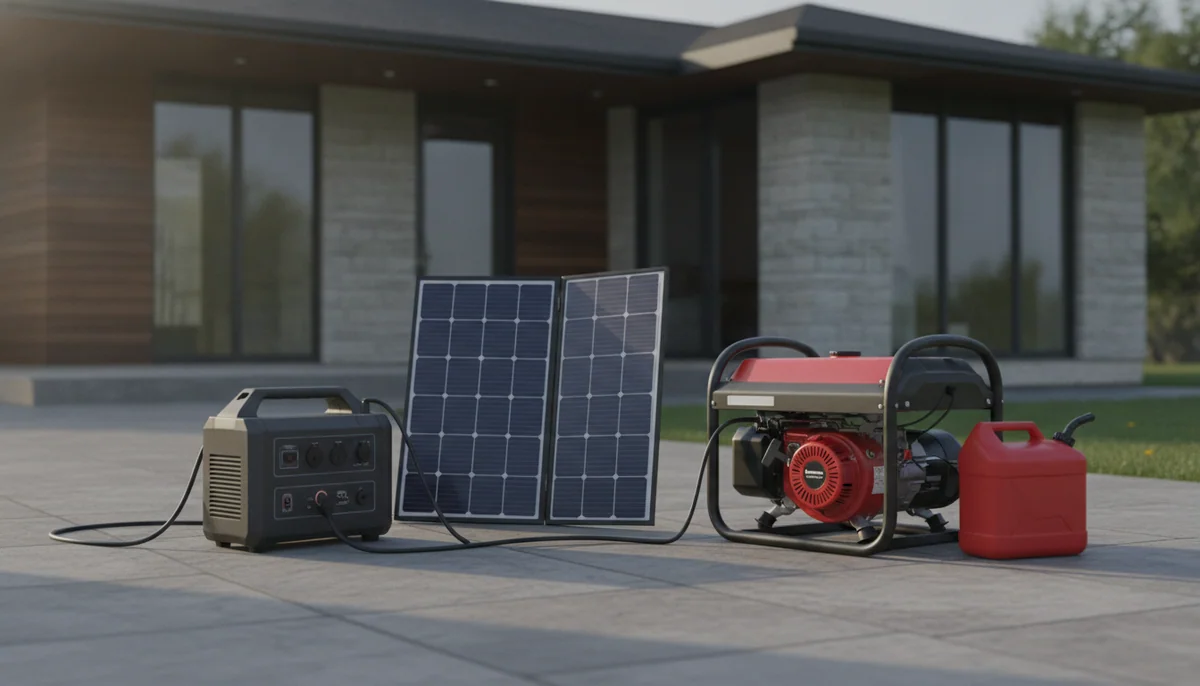
A power cut is two problems wearing one name. The first is the four hours on a Tuesday evening when a substation trips: nobody is in danger, the freezer never gets warm, and what you actually want is for the router, the lamps and the CPAP to carry on as though nothing happened. The second is the fourth morning after an ice storm, when the road is blocked, the fridge has become a cupboard, and what you want is watts that keep arriving from somewhere. A battery is close to perfect at the first job and physically incapable of the second. An engine is the reverse, and it is worse at the first job than its owners tend to admit, because somebody has to walk outside into the weather at two in the morning and start it.
Which is why people who have lived through long outages describe a division of labour rather than a preference. The battery takes the nights, the bad weather and the hours nobody is awake to supervise. The engine takes the days. Owning one of each is not indecision, it is the shape the problem actually has.
- Battery first if
- Your outages are measured in hours, you have nowhere outdoors that an engine can safely and legally run, your neighbours are close enough that a 2am start would be a genuine problem, or the load you care about is a router, a few lamps, a laptop and a CPAP.
- Engine first if
- You are in hurricane or ice-storm country, you have a well pump or a 240V load, you have somewhere outside where an engine can sit well clear of every window and door, and your honest answer to how long the power stays off is counted in days.
- Neither, yet, if
- What you are really trying to do is run central air conditioning and a full panel through a week without thinking about it, because that is standby generator territory and both of these machines will disappoint you at it.
The number that ends most of the argument
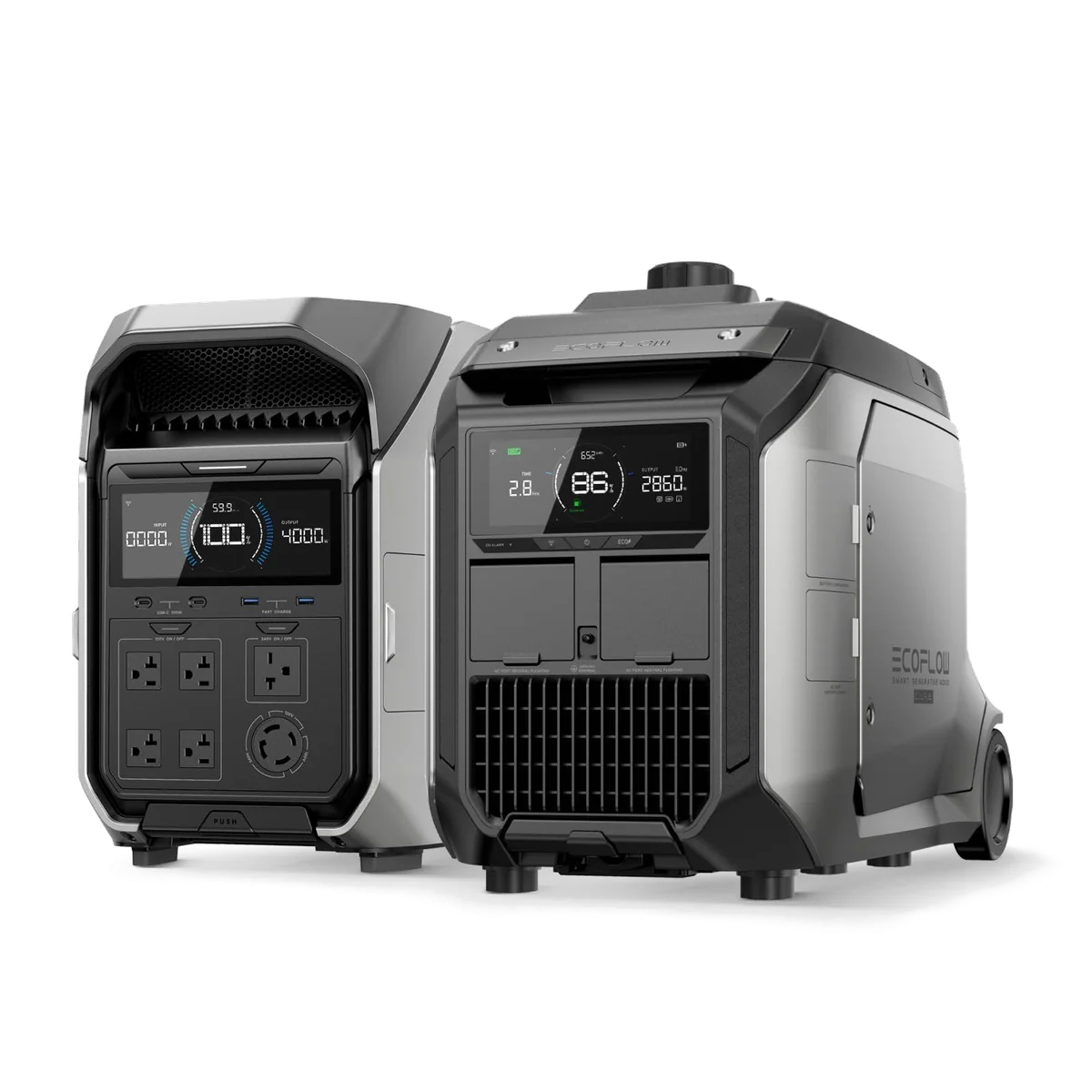
Count containers rather than watts. EcoFlow puts three of them on a single listing page for the Delta Pro 3 bundle, which is more helpful than the company probably intended: 4,096Wh in the battery, about 8kWh out of one tank of petrol, and up to 24kWh from one 20 lb propane bottle.
None of those numbers reaches your appliances intact. On the bench that pack gave up 3,830Wh of its rated 4,096, which is a better showing than most stations manage. EcoFlow's own published runtime chart, multiplied back out, lands nearer 3.3kWh once the inverter has taken its cut, and that derate is normal rather than scandalous. Engines lose their share too, in heat and in the charger. Allow for both and the containers line up like this.
| One container of energy | What it holds | Roughly, at the outlet | What that buys |
|---|---|---|---|
| A full 4,096Wh battery | 4.1 kWh | ~3.3 kWh | One disciplined day of fridge, lights and devices |
| One tank of petrol | ~8 kWh | ~6.5 kWh | Two of those days, then you go looking for petrol |
| One 20 lb propane bottle | ~24 kWh | ~19 kWh | Most of a week, from a cage outside a hardware shop |
Read the bottom row against the top one and the case for the engine finishes itself. A single bottle of gas carries more usable electricity than that pack holds, nearly six times over, and a stacked multi-battery installation costing five figures loses the same comparison to the same bottle. The generator forums make the point in cost per kilowatt-hour instead, and it is not a stupid objection: storage is a brutally expensive way to buy energy when the alternative is a fuel line.
So the battery is a bad way to buy energy. It is an excellent way to buy the first eighteen hours, and the reason has nothing to do with kilowatt-hours.
What you are actually buying when you buy the battery
The engine's real cost is not the fuel. It is that it makes carbon monoxide, and when preppers explain why they keep a battery, that is the first thing they say, ahead of runtime and ahead of noise. Everything else follows from the same fact. The battery lives indoors. It has no exhaust, so it does not need twenty feet of clearance and a wind direction. It makes no noise worth mentioning, so it can run all night in a terrace. It switches over fast enough that a short cut passes almost unnoticed, and it needs nobody standing over it in the rain. There is nothing in it to go stale, and no fuel in the garage waiting to be a problem.
Solar is the part of the story that gets oversold, usually by the box it comes in. The working rule owners use is about 200W of panel for every 1,000Wh of storage. Apply that to Anker's F3800 Plus, a 3,840Wh machine whose whole engineering improvement is a solar input widened to 3,200W across two ports that accept ordinary panels, and the 400W folding panel bundled with it covers roughly an eighth of what the machine was built to swallow. Even holding full nameplate output, which no panel does, that panel needs the better part of ten hours to refill the pack. And the week you need the power most is a storm system, which is precisely the week the sun is not available. Sizing an array properly is worth doing before you assume solar closes the gap, because it mostly does not.
Two more honest debits. Batteries age in ways that are still being learned: a five-year retest of a previous-generation station found it still holding its capacity and charging near its rated speed, but it overloaded and shut down at 3,500W, a hundred watts under its own rating, having been fine there when new. And the savings case people build to justify the price is softer than it looks, since one owner's projected six-year payback on a peak-shaving install was redone at ten years in the replies, with the annual saving apparently coming from tariff arbitrage rather than from solar. Buy a battery for resilience with savings as a side effect, not the reverse.
What the engine is for, and what it charges you for it
Refuellable, weather-proof, cheap per watt, and indifferent to whether the sky is doing anything useful. It also swings loads that a mid-size battery cannot: the GENMAX GM9000iED makes 9,000 peak and 7,600 running watts from a 6.9 gallon tank on either petrol or propane. Even that is not unlimited. A conventional three or four ton condenser wants a soft start before any portable machine will take it, and one owner measured theirs pulling locked rotor draw from 94 amps down to 34, which fits inside the peak with almost nothing spare. The generic version of that arithmetic, a 95 LRA condenser working out near 11kW once you allow for voltage droop, is the reason so many people are disappointed by a generator that met every number they checked. Read what an air conditioner asks for at startup and why the number on the box is not the power you get before you size anything.
The bills come in four places. Noise, where a rating like 62 dBA at 25% load from 23 feet is a real measurement taken under conditions your garden will not reproduce, which we take apart in what those decibel figures are measured at. Siting, because an engine has to be far enough from the house that its exhaust cannot find a window, and a CO sensor is not permission to move it closer. Fuel, which goes off, gums a carburettor and turns a working machine into a no-start, which is why how you put it away decides whether it runs. And wiring, because feeding a house means an inlet, an interlock or a transfer switch, and it means knowing whether your neutral is bonded or floating: the GM9000iED ships bonded with no conversion instructions at all, and an owner had to find the bond himself, on a rail behind the electrical panel near the LPG inlet. Our guide to connecting a portable generator to a house covers the legal half of that.
There is a fifth cost, and it is the one that should change how you buy. Engines punish being ignored. The clearest illustration in our files is that same GENMAX: a mobile grooming business putting ten hours a day on one, five days a week, reports nothing going wrong at all, while two of the harshest owner accounts describe machines that failed while stored rather than while working, one pair assembled in January and dead by spring, another opened eight months after purchase and running only minutes on either fuel. Good duty record, bad dormancy record, sold to buyers whose plan is dormancy.
Who is on shift, and when
| When | On duty | Why |
|---|---|---|
| The first ten seconds | Battery | Nothing else switches over fast enough to matter, and nobody has noticed yet |
| Evening one | Battery | Lights, router, phones and a fridge cycling; a few hundred watt-hours in total |
| Overnight | Battery | An engine running at 3am is a conversation with your neighbours you do not want |
| Morning of day two | Engine | Run it hard for two or three hours, refill the pack, cook, then shut it off |
| Day three onwards | Both, alternating | The engine makes the energy, the battery spends it quietly and unattended |
| The full week | Neither | What decides the week is how much fuel you can get hold of |
Notice what the battery is doing in the middle rows. It is not competing with the engine, it is letting the engine run in short heavy bursts instead of idling badly for twenty hours. Engines are inefficient at light loads and charging a battery is a heavy, steady, well-behaved one, which is the entire architectural argument for the hybrid and the reason even the sceptics concede the design is right.
Three ways to own both
One box that starts the other
EcoFlow sells the Delta Pro 3 with a 3,200W dual fuel generator, and what the premium buys is not capacity or watts but an agreement between them: the station watches its own charge, the engine wakes when the number drops, the station feeds power backwards to the engine's starter battery so a flat starter cannot strand you, and solar gets priority so the thing does not run when it does not have to. That pairing has been confirmed working with this exact station by an outside tester rather than merely claimed. It is the version of the hybrid where nobody has to walk outside at 3am, and for the right household it is worth the money.
The right household is narrow, and the reasons are unflattering. The cable joining the two halves is sixteen feet, it cannot be extended, and it has to bridge the distance between a running petrol engine and wherever you keep the battery: the testers found their own garage already too long. The engine has no choke, and in a twenty-four hour freezer test its automatic start frequently failed on petrol, which is to say it failed in exactly the weather that causes outages, though on propane in the same conditions it started and ran. It is loud, and it vibrates hard enough to wander on its feet for the first ten minutes of a run. The bundle's own listing states a three-year warranty while EcoFlow advertises five years on the station elsewhere, so confirm which term covers which box. Measure the cable run before you spend anything, and read our full review of the pairing and what each fuel costs you in watts, because on this machine the fuel choice settles itself.
Two boxes, and you are the automation
The cheaper and more flexible route is a large station and a separate engine, with your thumb where the app would be. Anker's F3800 Plus is the strongest battery for it, because genuine split-phase 240V at 6,000W out of a single box, without a combiner or a second unit, is the one thing almost nothing else in the class offers and the reason the platform gets recommended for well pumps, dryers and panels rather than campsite kettles. It also has a dedicated generator port, which is the quiet admission that a battery alone does not survive a long outage, and an owner of this exact model already runs the arrangement by hand: charging off-peak from the wall, running the house on the battery through peak hours, and topping up from a 3,600W propane inverter generator when the grid is gone.
Buy the machine, not the bundle. The 400W panel welded to that listing is the weakest part of the package, on a unit whose whole improvement is that it no longer needs Anker's own panels, and the socket sold as a 30A RV outlet is capped at 3,000W, which is why one owner's camper air conditioning trips the unit after about five minutes even with a soft start fitted. It is also a thinly reviewed model with no published instrumented test of its usable capacity. The full review sets out what the spec sheet does and does not deliver, and we have put it head to head against the Delta Pro 3.
For the engine half, the GM9000iED is the machine to beat at this size: pressure-fed oiling with a cleanable screen, a 50A receptacle so the alternator is not strangled by a 30A connector, remote start, dual fuel, and output clean enough that owners watch it hold a steady 60Hz under mixed household load. Buy it only if you will genuinely run it monthly under load, given the dormancy record above, and budget for the fact that warranty service means moving 250 lb to a service centre that may be an hour away. The review lays out both sides, and if you would rather have natural gas out of the box, the Gidrox 11000W tri-fuel and the rest of the dual and tri-fuel field are the alternatives.
One warning specific to this route. Pairing an arbitrary generator to an arbitrary battery is not the plug-and-play operation people assume: the question comes up constantly and gets muddled answers, and one community thread on the subject is titled, accurately, around the odds being against your gas generator being compatible with your power station. Check charge rates, inlet types and whether the station will accept the engine's output before you buy the second box, not after.
A small battery and a modest engine, which is what most people should buy
The version that gets ignored is the cheapest and fits the most households. A small LiFePO4 station covers the loads that must not stop, and a mid-size portable inverter generator covers the fridge and the kettle for a few hours a day. VTOMAN's Jump 600X is a good example of the battery half: 9.92 lb, a 100W USB-C port, a five-mode light and LiFePO4 rated for 3,000 cycles, which is a night of a CPAP with the humidifier off, a working day of a satellite terminal, or a router and phones through a long evening.
Size it honestly, because the listing will not. The 268.8Wh capacity is real and the 1200W figure is not surge in any sense a generator buyer means, it is achieved by reducing output voltage, with sensitive electronics explicitly excluded. The 12V socket cuts out well below 150W, which an owner discovered when a car heater kept shutting the unit off and support told him to use the AC port instead, a limit that appears nowhere in the bullets. And the brand sits at 2.7 on Trustpilot with half its reviews at one star, below every competitor you would cross-shop, so buy it somewhere the retailer rather than the manufacturer owns your return. That is the argument in our review, and more generally in what a budget brand's warranty is actually worth.
Be careful what you buy at the small end, because the word generator is doing a lot of unearned work down here. EcoFlow's TRAIL Plus 300 is a genuinely well-judged object, a 288Wh pack with three 140W USB-C ports, a hooded camping light that owners praise unprompted, and a detachable cable that doubles as the carry handle. It is also DC only, a fact the listing concedes in an asterisk at the end of its sixth bullet, and it cannot be charged from a wall socket at all except through a USB-C brick, which the listing never mentions. Three of the eight owner accounts on record describe an out-of-box fault, including one unit that arrived showing a battery management error. Buy it as a lantern with a large battery attached, which is what it is, and never as the outage machine.
The mismatch runs the other way too. Someone asking for a battery to run a television and a few crock pots for six hours with no fuel involved is off by an order of magnitude, and no surge rating closes that gap. If the load is heat, motors or anything cooking, the engine has that shift. If it is a CPAP, an oxygen concentrator or anything a person depends on, neither of these is a plan on its own and medical backup has stricter rules.
Both of these machines fail the same way, and it is not under load
The saddest failures in the entire record are not units that broke while working. They are units that sat, fully charged and untouched, and were dead on the night they were needed. The engine version of that story is a carburettor full of varnish. The battery version is a pack that shows a charge and will not wake, which is common enough that we wrote a page on the diagnostic order.
The mitigations are boring and they work. Anker publishes its own, and they are worth applying to any station regardless of badge: main power off, stored dry and cool, charge level checked weekly, recharged if it drops below 30%, taken back to 100% every three months. Keep the firmware current while you are at it, since a two-device hybrid can refuse to pair when one half is out of date. For the engine, start it monthly under a real load rather than cranking it for thirty seconds, and run the fuel system dry or treat it. Then buy both from a channel with a returns desk you trust, because the most repeated advice in one manufacturer's own community forum is not about which model to choose but about where to buy it, on the assumption you may need to send it back.
Work out your fridge budget before any of this, because it is the load that decides the size of everything else: usable watt-hours after inverter losses is not the number printed on the box. And if what you want is a machine that starts itself, runs off the gas main and does not care how cold it is, the honest comparison is not with either of these but with a permanently installed standby, at the cost of an installation you cannot take with you. The rest of the field is in our solar generator roundup and our home backup page.
Where that leaves you
Buy the battery first because most outages are short, because it works while you are asleep, and because the thing you are really purchasing is that nobody has to go outside. Buy the engine second because the arithmetic above is not negotiable and no pack you can afford holds a week. If you can only ever own one and your outages run into days, invert that order and accept the noise, the exhaust and the 3am walk. What you should not do is buy one machine and quietly assume it covers both jobs, which is the mistake the marketing on both sides is designed to encourage. Specific Load has not run any of these machines; everything above comes from instrumented tests published by others, from the makers' own figures where they can be checked against each other, and from owners who have been through the outage already.
Frequently Asked Questions
Is a solar generator actually a generator?
No, it is a battery with an inverter and usually a solar input, so it stores a fixed number of kilowatt-hours and gives them back, where a generator makes energy for as long as you keep feeding it fuel.
Which one should I buy first?
The battery, unless you already know from experience that your outages last days, in which case buy the engine first and add the battery when you can.
Can I just charge my power station from a gas generator I already own?
Sometimes, but far less often than people assume, because charge rates, inlet types and output quality all have to line up, and the community threads on exactly this question are full of people discovering that theirs do not.
Will a solar generator run my fridge through a whole outage?
A large one will run a fridge for roughly a day once inverter losses are taken off the nameplate figure, which is why anything longer than that needs either an engine or a great deal more panel than most bundles include.
How much solar do I actually need to keep a station topped up?
Reckon on about 200W of panel for every 1,000Wh of storage, which means a 4,000Wh class machine wants something near 800W of array rather than the single folding panel pictured in the box.
Is it safe to run the generator in the garage if it has a carbon monoxide sensor?
No, the sensor is there to shut the engine down when a dangerous condition already exists, and it is not permission to move the machine closer to the house.
Petrol or propane for the engine half?
Propane for a machine that has to start itself in winter, because it starts more reliably in the cold and one 20 lb bottle carries roughly three times the energy of a petrol tank, at the cost of a few hundred watts of output.
Why will you not tell me what these cost?
Prices in this category move week to week and both of the big battery brands discount hard and often, so any figure printed here would be wrong by the time you read it and the ratios between the options are the part worth reasoning about.
What do I have to do to either machine between outages?
Run the engine monthly under a real load and keep its fuel system clean, and check the battery's charge weekly, top it up if it falls below 30% and take it back to full every three months.
Sources (7)
- Amazon listings and customer reviews
- Owner reports across r/Generator, r/Ecoflow_community, r/AnkerSOLIXCommunity and 3 more threads
- Owner and reviewer video, 3 channels
- EcoFlow — Article — us.ecoflow.com
- Thesolarlab — Article — www.thesolarlab.com
- Cnet — Article — www.cnet.com
- Trustpilot — Article — www.trustpilot.com