Your generator does not care how many BTUs your air conditioner has, it cares about two letters on the data plate
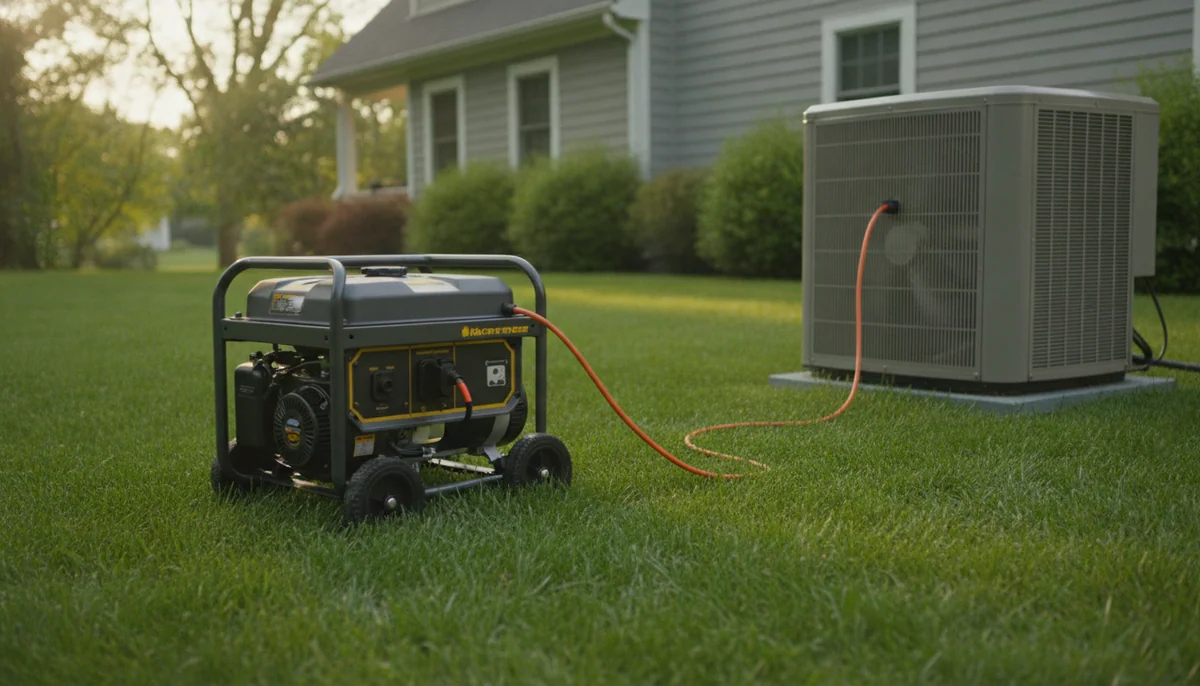
The question gets asked with the wrong noun in it. People ask how many watts their air conditioner needs, because watts are what the generator carton advertises, and watts are what a running compressor consumes. But a compressor does not fail to start because of what it consumes while running. It fails to start because of the half second before it turns, when the rotor is stationary, the motor is effectively a short circuit, and it demands a burst of current several times its running draw. That burst has a name and a number, both of them printed on a sticker on your outdoor unit, and until you have read it you are guessing.
Here is the shape of the answer before the reasoning. A window unit is a non-event for anything on this page. A single rooftop unit on a travel trailer is realistic on a 3,600 to 4,000 watt machine, marginal in real heat, and comfortable with a soft start fitted. A two or three ton residential condenser needs a soft start and a large 240 volt generator, and even then you are spending most of the machine on one appliance. A four ton condenser needs the biggest portable in this class plus a soft start. A five ton condenser is out of scope for every generator on this page, whatever the listing says, and one of these listings says it in so many words.
| If this is your air conditioner | Then |
|---|---|
| A window unit, 5,000 to 12,000 BTU | Any 3,600 watt machine here carries it alongside a fridge and lights. |
| One RV rooftop unit, 13,500 BTU | Buy the soft start with the generator, not after the first failed weekend. |
| Two rooftop units, or a rooftop plus a microwave | Run one at a time, or size up past anything in the 4,000 watt class. |
| An inverter-driven mini split | Easiest case on this page, because a variable-speed compressor ramps instead of slamming. |
| Central air, two to four tons | 240 volts, a soft start on the condenser, and a generator in the 7,000 watt-plus bracket. |
| Central air, five tons | Not with a portable, and a standby unit is the honest conversation instead. |
Everything below is how to check which row you are in using your own equipment rather than somebody else's anecdote, and which machines on this site can honestly hold each one.
The sticker on the condenser outranks every spec sheet
Walk outside to the compressor unit, or climb up to the rooftop unit, and find the rating plate. Four abbreviations on it matter, and only two of them are the ones people quote at each other.
| Marking | What it means | What it decides |
|---|---|---|
| RLA | Rated load amps, the compressor's steady draw once it is turning | Whether the generator can keep it running |
| LRA | Locked rotor amps, the current at the instant of start | Whether the generator can get it turning at all |
| MCA | Minimum circuit ampacity, what the wiring must be sized for | Nothing about your generator, but people misread it as capacity |
| MOCP | Maximum overcurrent protection, the biggest breaker allowed | A rough upper bound on the circuit, not on the surge |
The rough method that circulates in the generator community is to multiply LRA by the supply voltage and treat the product as the surge to be supplied, so a plate reading 95 LRA on 240 volts becomes something like 22,800, which people then discount to roughly eleven kilowatts once they allow for the voltage sagging during the event. That arithmetic overstates true power, because a stalled motor has an appalling power factor and is not consuming twenty-two kilowatts of anything. It is nonetheless the right instinct, because the generator's alternator and inverter stage see current, not your arithmetic, and current is what trips the protection. Treat the multiplication as a way of expressing how far out of scale the moment is, not as a wattage you can look up on a box.
The reason to insist on the plate rather than the BTU number is that two units of identical capacity can have very different starting behaviour depending on age, compressor type and whether anything has been fitted to soften the start. A 1989 rooftop unit and a 2024 rooftop unit of the same rating are not the same load. Nor is a conventional single-stage condenser the same load as an inverter-driven one, which ramps its compressor up instead of throwing it across the line. One owner of a large dual fuel inverter generator ran a two ton inverter air conditioner on 240 volts with no drama at all, and was scrupulous about what that proved: an inverter compressor has essentially no inrush, so the result said nothing whatever about how a conventional condenser would behave on the same machine.
A soft start is the cheapest capacity on the market
If you take one practical thing from this page, take this. A soft start module wired at the compressor limits the inrush by ramping the motor up rather than letting it slam, and the numbers involved are not marginal improvements. One owner who spent over a month researching before buying a nine kilowatt dual fuel inverter fitted one to his four ton condenser and reported it bringing the locked rotor draw from 94 amps down to 34, which is what put the start inside his generator's 37.5 amp peak at all.
Read that as an instruction rather than a statistic. Thirty-four amps fits. Ninety-four does not fit inside anything you can wheel out of a garage. The device costs a small fraction of what the next generator up the range costs, and it changes the answer to this entire question for a three or four ton condenser and for every rooftop unit that sits on the edge. Specific Load's consistent read of the owner record across these machines is that the households who are happy are disproportionately the households who fitted one, and the households who are furious are disproportionately the ones who assumed peak watts would cover it.
Two caveats keep the advice honest. A soft start reduces the inrush; it does not reduce the running draw, so a compressor that needs more continuous watts than your generator makes will still be out of reach once it is spinning. And a soft start on a rooftop unit is not a licence to add a microwave on top. The one owner in this material who ran a 12,000 BTU rooftop unit, a microwave and the trailer's converter simultaneously had the soft start in circuit, and even then the engine audibly ramped and the panel voltage dipped for a couple of seconds before recovering.
Rooftop units: the case where the record actually disagrees with itself
This is where owner accounts stop agreeing, and the disagreement is instructive rather than annoying. One owner of a 4,000 watt rated, 120 volt inverter generator ran a 13,500 BTU rooftop unit dating from 1989 with no soft start at all; it pushed the generator out of eco mode and the machine took the spike without a fault or an overload. Another owner of the same model, in Arizona on the hottest day of the year, watched his generator cut out repeatedly under his travel trailer's air conditioner.
Both accounts are internally coherent, which means the variable is not the generator model. Three things explain the gap. Heat derates an engine and its power electronics, so a peak rating quoted at a bench temperature is not the peak rating available on a 115 degree afternoon, which is precisely the afternoon you need it. Resistance in the connection matters enormously at the moment of start: the Arizona owner had previously had a plug melt on his trailer cord, and a connection hot enough to melt is a connection dropping voltage exactly when the compressor is trying to overcome inertia. And the load next to the air conditioner is rarely nothing.
The other rooftop data points on this site fall in line with that reading rather than contradicting it. A 3,600 watt rated dual fuel machine ran an RV air conditioner for about forty five minutes on propane, following the manual, without complaint. A 4,800 watt headline machine with a real TT-30 socket on the panel carried a 12,000 BTU unit with a soft start. The generalisation that survives all of it is the one an RV owner can act on: a single rooftop unit is a realistic ask for a 3,600 to 4,000 watt machine, it is marginal in extreme heat, and it stops being marginal when you fit a soft start and stop asking the generator to do anything else at the same moment. Our shortlist for travel trailers weighs that question machine by machine, and if you are still working out why a 5,000 watt carton delivers 4,000, the gap between starting watts and running watts is the piece to read first.
One more constraint that catches people out with RV-ready machines. Thirty amps at 120 volts is about 3,600 watts, so on a 120 volt-only generator the RV socket is not a bigger door than the machine behind it, and it is nothing like the 240 volt L14-30 that feeds a house panel. If the plan involved an interlock as well as a camper, read how a portable actually gets connected to a house before you buy on the strength of the word "30A".
Central air is a different question, and mostly a 240 volt one
A residential condenser is a 240 volt appliance. That single fact eliminates a large share of the generators people ask about, before anybody argues about surge. A 4,000 watt inverter generator with a 30 amp RV socket and nothing but 120 volt outlets cannot run a central condenser at any wattage, and neither can a 4,800 watt machine built the same way, because there is no 240 volt outlet on it to plug into. That is a wiring reality, not a capacity judgement, and it is worth checking on the panel of any machine you are considering before you compare a single number.
Where 240 volts does exist, do the arithmetic in amps rather than watts, because amps are what the connector and the breaker measure. A machine rated 9,000 peak and 7,600 running watts is delivering 37.5 amps at the peak and 31.7 amps continuously at 240 volts. That is the real headroom a three or four ton condenser is being offered, and it is why the soft start above was not a nicety for that owner: 34 amps against a 37.5 amp ceiling is a fit with very little to spare. Anything on a 45 amp breaker with a locked rotor figure in the nineties is not being started by a portable without help, and a five ton unit is not being started by a portable at all.
Which brings us to the marketing. One tri-fuel listing on this site claims outright that its 11,000 peak, 9,000 running watts will handle five ton central air conditioning units. That is the least supported line on that page, and it sits awkwardly next to the only owner in its record who describes pushing the machine hard, who reports that it stops working somewhere above 5,500 watts and is really a machine for loads under 5,000. Nobody has independently load tested it. Specific Load's position on that claim is not that it is impossible, it is that it is unproven by anybody and contradicted by the one owner who tried, which is not the evidential footing on which to plan your July.
If keeping a whole house cool through outages is genuinely the requirement rather than a nice-to-have, the honest comparison is not between portables at all. It is between a portable plus a soft start plus a lot of compromise, and what a permanently installed standby unit buys you, which starts by itself, runs off the gas line and does not care what the weather is doing. The 24kW Guardian is the version of that we have written up, and what one costs once installed is the number that decides it.
What each machine on this page can honestly be asked to do
The seven products here span a factor of three in capability, and the air conditioner question separates them more cleanly than any other single load. Here is each one with the drawback that belongs next to it, because a recommendation without the drawback is not a recommendation.
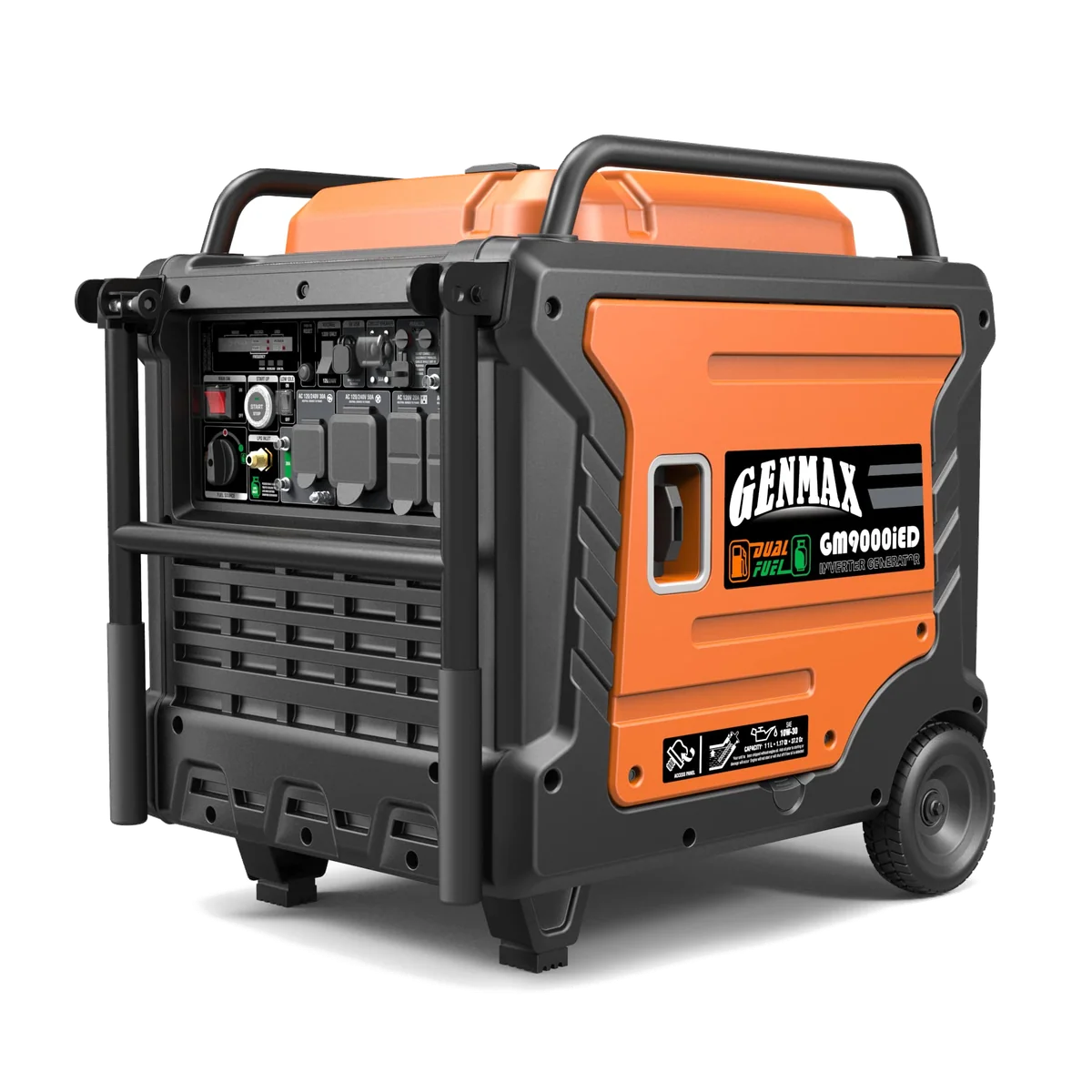
The GENMAX GM9000iED is the machine on this page most likely to carry a real central condenser, on the strength of 7,600 running watts, 240 volts and a 50 amp receptacle so the peak is not strangled by a connector. Its drawback is not capacity but dormancy: the two harshest owner accounts describe units that failed while sitting in storage rather than while working, which is the exact use case an emergency generator exists for, and its neutral ships bonded with no conversion instructions from the manufacturer. Buy it only if you will run it monthly under load.
The Gidrox 11000W tri-fuel has the most headroom on paper, a natural gas hookup that turns a multi-day outage into a non-event, and thoughtful details like a carburettor bowl drain that owners noticed unprompted. Its drawback is that its reputation is about four weeks old, no independent load test exists, and its only load-testing owner reports a wall well below the rating. Treat week one as an acceptance test with a clamp meter, inside the return window.
The Oxseryn 5000 is a genuinely good camper and outage generator, quiet and unusually frugal, and its rooftop record is the split account described above. Its drawback is that it is 120 volts only with no 240 volt outlet and no transfer switch path, so despite the home backup language in its title it cannot back a house, and it is recoil start with a cold-start quirk. The PowerSmart 4400 is the cheapest honest way to get 3,600 rated watts and dual fuel into a garage and every owner who mentions starting says it fires on the first pull, but it is an open frame machine rated by its own listing at 76 dB, one owner's unit threw a false overload with nothing plugged in after three weeks of sitting, and the warranty path begins with you paying freight. The LIFAN 4800W earns its place on the TT-30 socket and the key fob, and its drawback is a starter battery that ships disconnected behind a frame rail the manual never mentions, a record only a handful of owners deep, and no 240 volts.
Then the two battery-first answers, which change the question rather than answering it. The Anker SOLIX F3800 Plus gives genuine split-phase 240 volts at 6,000 watts from one box, silently, with no exhaust to site, which is the only way most people will ever run an air conditioner indoors during an outage. Its drawback is specific and it is exactly on topic: the socket sold as a 30 amp RV outlet is capped well below what a full 30 amp service implies, and one owner reports his camper's air conditioning tripping the unit after about five minutes even with a soft start fitted, leaving him a machine that does everything except the thing he bought it for. Worth knowing before you plan around it: while it recharges from a 120 volt wall socket, only its three UPS outlets deliver anything, which quietly removes most of the panel during a recharge.
The EcoFlow Delta Pro 3 with its 3,200 watt dual fuel generator is the architecture that actually suits air conditioning in an outage: the battery absorbs the compressor's start silently, and the engine wakes on its own to refill the battery instead of running all night. Its drawbacks are the sixteen foot cable joining the two halves, which has to bridge the distance between a battery indoors and an engine legally sited outdoors, and the engine's lack of a choke, which made its automatic start unreliable on gasoline in cold testing. And the engine itself, at 3,200 watts, will not start a residential condenser, so the battery's inverter is the thing doing the work. The trade between the two approaches is set out in solar generator against gas generator, and if runtime is your real constraint, what a power station gives back after inverter losses is the arithmetic to do first.
Why it worked in June and trips in August
A generator and air conditioner pairing that has worked for weeks can start failing without anything breaking, and the reasons are worth knowing before you conclude your machine is faulty.
Ambient heat is the first. Hot air makes the engine and the inverter section less capable at the same time as it makes the condenser work harder, because the pressure the compressor is pushing against rises with outdoor temperature. Both curves move the wrong way on the same afternoon. The second is connections. Long or undersized extension cords, tired plugs and corroded contacts all drop voltage under current, and a compressor trying to start on sagging voltage draws more current, which drops the voltage further. That is why a melted plug is a warning about starting behaviour and not just a cosmetic problem. The third is what else is running: a fridge compressor and an air conditioner compressor that happen to start within the same second are a load your generator never saw during testing. And the fourth is fuel. Propane costs you output against gasoline on every dual fuel machine here, typically a few hundred watts, which is enough to move a marginal start onto the wrong side of the line. What each fuel costs in watts and runtime puts numbers on that trade.
If yours is shutting down rather than merely sagging, work the diagnostic ladder rather than buying a bigger generator: our page on why a generator trips, stalls or shuts down under load covers the order, and the case where the engine runs happily but nothing comes out is a different fault with a different cause.
Do this before you spend anything
Read the plate on your own outdoor unit and write down RLA and LRA. Decide from the table at the top of this page which row you are in. If you are in the rooftop row or the central air row, price a soft start before you price a bigger generator, because the module is cheaper than the difference between generator sizes and it addresses the actual constraint. Then, whatever you buy, load test it in the first week: bring the air conditioner up on the generator with everything else off, watch the voltage readout through the start, then add the loads you actually expect to run alongside it. Do that while the machine is still returnable and while the weather is mild, rather than discovering the answer in a heatwave with the freezer thawing.
Frequently Asked Questions
What does LRA mean on my air conditioner's data plate?
Locked rotor amps is the current the compressor motor pulls at the instant it starts turning, and it is the figure that decides whether a generator can start the unit at all rather than merely keep it running.
Will a 5,000 watt generator run central air conditioning?
No, because a residential condenser is a 240 volt appliance whose starting demand runs into five figures on the usual arithmetic, and most 5,000 watt portables do not even produce 240 volts.
Does a soft start really make that much difference?
Yes, and one owner here measured his taking a four ton condenser's locked rotor draw from 94 amps to 34, which is the difference between a start that fits inside a large portable's peak and one that does not.
Can a portable generator start the rooftop unit on my travel trailer?
Usually, on a 3,600 to 4,000 watt machine, though owner accounts split on extreme heat and one owner's generator cut out repeatedly under that load on the hottest day of an Arizona summer.
Why does it start the air conditioner in the morning but trip in the afternoon?
Heat derates the generator while simultaneously raising the pressure the compressor works against, so the machine has less to give on exactly the afternoon the load asks for more.
Is a mini split easier on a generator than a conventional condenser?
Considerably, because an inverter-driven compressor ramps up instead of slamming across the line and has almost no inrush to supply.
Will a battery power station run an RV air conditioner?
Sometimes, but check the rating of the specific socket rather than the headline inverter figure, since one owner's camper tripped a large split-phase station after about five minutes even with a soft start fitted.
Can I run two rooftop units at once on a 4,000 watt generator?
No, and the realistic plan on a machine that size is one rooftop unit with nothing substantial started alongside it.
Does running on propane change whether it will start my air conditioner?
Yes, because every dual fuel machine gives up output on propane, and on a start that was already marginal those few hundred watts are enough to decide it.
Sources (2)
- Amazon listings and customer reviews
- Owner reports across r/Generator threads