Plan on about three fifths of the number printed on the generator, and buy from there
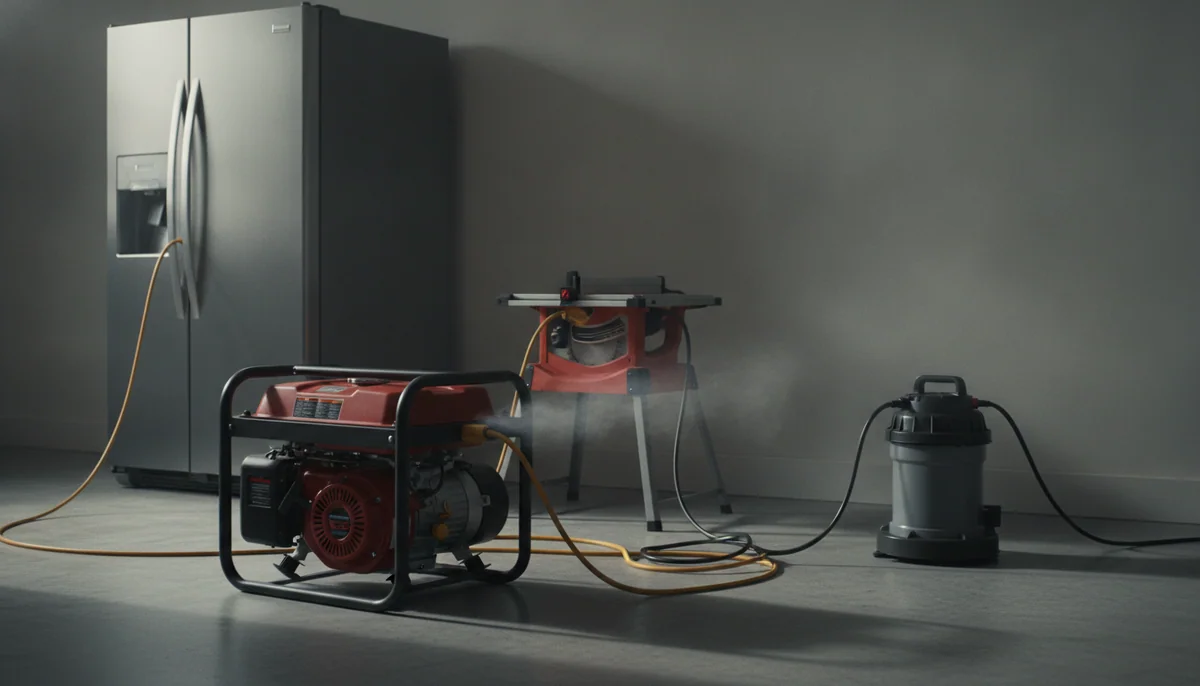
Every generator sold on Amazon carries two numbers, and the listing is built so you read the wrong one. The Efurden badged 2800 watts makes 2000 continuously, which is 71 percent of the headline. The Aceup badged 4000 makes 3200. The PowerSmart badged 4400 makes 3600. The Gidrox badged 11000 claims 9000. Nobody is lying, exactly. The big number is the peak, the surge, the thing the machine can do for a second and a half while a compressor motor spins up, and it is printed at four times the size of the number that governs your evening.
Buyers work this out on their own, usually one purchase too late. Somebody weighing a rival 2800-watt inverter on r/Pecron put it as flatly as it can be put: the surge figure "is always shown in big letters to catch your eye." That thread is also where the trap shows its teeth, because two machines wearing the same 2800 badge do not carry the same load, and the WEN in the comparison runs 2250 continuous against the Efurden's 2000. Same headline. Two hundred and fifty watts of difference in what you can actually plug in, which is a chest freezer.
So here is the whole method before any of the detail. Take the running watts, not the peak. Take 80 percent of that as your continuous budget, because a generator asked to sit at its rating has nothing left when the fridge kicks in. Add up what you genuinely intend to run at the same time and check it fits inside that budget. Then find the single biggest motor on your list and check that its starting surge fits in the headroom between your running total and the peak. If both fit, the machine is big enough. If either does not, no amount of eco mode or wishful thinking will fix it, and the failure will present itself as a tripped breaker at two in the morning rather than as a polite warning.
Specific Load has not run any of the generators discussed on this page, and nothing here is our measurement. What follows is arithmetic, manufacturers' own published figures, and what owners have reported doing with these machines in outages.
The three numbers, and why only one of them is yours
Peak watts belong to the marketing department. Running watts belong to the engineering department. The working budget belongs to you, and it is the one nobody prints.
The working budget exists because a generator held near its ceiling has no reserve. Load one to something that closely approximates full output and the next thing to start will drag the engine down rather than sit there politely, which is the mechanism behind almost every "it trips for no reason" complaint in this category. Somewhere around 90 percent of rated is where the engine begins to complain about load steps. Eighty percent is where you should plan to live.
| Machine | On the box | Rated running | Plan on |
|---|---|---|---|
| Efurden 2800 | 2,800 W | 2,000 W | 1,600 W |
| Aceup Energy AI4000s | 4,000 W | 3,200 W | 2,560 W |
| PowerSmart 4400 dual fuel | 4,400 W | 3,600 W | 2,880 W |
| AMERISUN 4500 | 4,500 W | 3,800 W claimed | 3,040 W |
| Oxseryn 5000 | 5,000 W | 4,000 W | 3,200 W |
| GENMAX GM9000iED | 9,000 W | 7,600 W | 6,080 W |
| Gidrox 11000 tri-fuel | 11,000 W | 9,000 W claimed | 7,200 W |
Read the right-hand column again, because it is the honest shape of this market. A wall of machines advertised between 2,800 and 5,000 watts are all, in practice, two-and-a-half to three-kilowatt generators. That is not a scandal. It is a perfectly good size for what most households actually need in an outage. It is simply not what the buyer thought they were getting when they compared a 4400 against a 4500 and felt they were choosing between similar things.
Two of those rated figures deserve a flag rather than a footnote. The AMERISUN's continuous output appears as 3800 on its own listing and as other figures elsewhere in the brand's material, and nobody has ever instrumented it. The Gidrox's 9000 is contradicted by the only owner who reports pushing it, who wrote that "after 5500Wtts this don't work, this is good for under 5000watts." A rated figure is a claim until someone measures it, and on both of those machines nobody has.
Add up what you are actually going to run
People size generators by imagining their house, which is why they overbuy or, more often, buy a machine that cannot start the furnace. Size it by listing the things that will be plugged in simultaneously, and be honest that you are not running the dryer during a hurricane.
| Load | Running watts | What it asks at the moment it starts |
|---|---|---|
| All the LED lighting in a small house | 100 to 300 | Nothing |
| Router, modem, laptop, phone charging | 100 to 200 | Nothing |
| Full-size refrigerator | 150 to 250 | 700 to 1,200 for a second |
| Chest freezer | 100 to 200 | 600 to 1,000 |
| Gas furnace blower | 600 to 900 | 1,500 to 2,500 |
| Sump pump, third to half horsepower | 800 to 1,050 | 2,000 to 3,000 |
| Conventional window air conditioner, 8,000 BTU | 700 to 1,200 | 1,800 to 2,500 |
| Inverter window unit, U-shape class | 300 to 900 | Effectively nothing |
| RV rooftop air conditioner, 13,500 BTU | 1,300 to 1,800 | 2,800 to 3,500, far less with a soft start |
| Microwave, coffee maker, kettle, air fryer | 1,000 to 1,700 each | Nothing, but they stack fast |
| Central air condenser, three ton | Thousands | Five figures of inrush |
A useful reality check sits at the other end of the cord. A 15-amp household circuit is good for about 1,500 watts continuous, which is why the kettle, the microwave and the air fryer are a queue rather than a group, and why a generator with two 120V sockets is not really offering you two independent kilowatt-and-a-half budgets.
The best available picture of what a small machine does in an actual outage came from someone who borrowed a 2500-watt inverter after a tornado and ran a house fridge, a garage chest freezer, a garage door opener, a sump pump and a surge protector off it. That is around 1,800 watts of honest capacity doing the job people buy generators for. An Aceup owner three days into an outage was running a fridge, a deep freezer and phone charging, non-stop. Neither of them is running a house. Both of them have their food and their basement.
The surge is a separate problem, and it is the one that trips breakers
Everything with a compressor or a pump in it asks for several times its running draw for the fraction of a second the motor gets moving. That figure is locked rotor amps, it is printed on the data plate of your own equipment, and it decides whether the lights dim or the breaker goes.
The arithmetic is brutal once you do it out loud. When somebody on r/Generator asked whether a 5,500-watt machine would start their central air conditioner, the thread ran the plate: a 45-amp breaker implies around 10,000 watts of capacity, and 95 locked rotor amps at 240 volts is 22,800 watts of inrush, still landing near 11 kilowatts once voltage droop is allowed for. An electrical engineer and a former master electrician in the same thread agreed the machine was a long way off, and that a generator that size might keep such a compressor turning without ever being able to start it. If 5,500 watts is not in the conversation, 2,000 is not in the building. Central air is the one load this entire shelf of machines cannot do, and no amount of eco mode changes it. Our page on what an air conditioner actually asks of a generator works through your own data plate with you.
Soft starts change the answer, and they change it by a lot. A GM9000iED owner fitted one to his condenser and took the locked rotor draw from 94 amps to 34, which lands inside that machine's 37.5-amp peak with almost nothing spare. The same physics explains why a modern inverter-driven window unit will run happily off a dedicated 1,000-watt generator while a conventional window shaker of similar cooling capacity will not: the inverter compressor ramps instead of slamming.
RV rooftop units sit right on the line, and the record on this site shows both outcomes. One Oxseryn owner started a 13,500 BTU rooftop unit from 1989 with no soft start fitted, watched it kick the generator out of eco mode, and reported no fault and no overload. Another owner of the same machine, in Arizona on the hottest day of the year, had it cut out repeatedly under his trailer's air conditioner. A PowerSmart 4400 owner ran his RV air conditioner for about forty five minutes on propane without drama. Heat derates an engine, older compressors draw harder, and a marginal load is marginal in exactly the conditions you need it. If the rooftop unit is the whole reason you are shopping, size a rung up and read the RV picks.
Four ways the watts go missing after you have bought
Volts. A machine that makes only 120 volts cannot feed a house panel, no matter how many watts it makes. The Oxseryn's 30-amp socket is a TT-30 trailer connection at 120 volts, which caps near 3,600 watts and is not the 240-volt L14-30 an interlock expects. The AMERISUN is the same story: every outlet 120 volts, despite a 30-amp socket that reads like more. On a 240-volt machine the ceiling is easier to feel in amps than watts, and a GM9000iED owner states it plainly: maximum running output at 240 volts is 32 amps, and the 50-amp plug exists so a long cord does not drop voltage rather than because the machine makes 50 amps. Before you plan around a transfer switch, read how a portable actually connects to a house and how to find out whether your machine's neutral is bonded.
Fuel. Propane costs you output against gasoline, and natural gas costs you more again. The Gidrox is the sharp example: it is sold on tri-fuel and marketed for whole-home backup, and the natural gas output figure, the one most likely to be doing that work, is published nowhere. What each fuel costs you in watts and buys you in runtime is the trade, and it is usually worth making anyway.
Cord. This one gets blamed on the generator constantly. In a long thread about a portable air conditioner that would not run properly, the most upvoted diagnosis was extension cord gauge, on the grounds that 16 gauge is good for roughly 5 amps at 3 percent drop and a hundred-foot run of it under real load is asking for trouble where 12 gauge is not. The thread never fully resolved whether the fault was the cord or the generator's power quality, but the cord argument carried the votes, and a melted plug on an undersized connection is a voltage drop that arrives exactly when a compressor is trying to start.
Runtime. Every hour figure in this category is quoted at a quarter or a half load, and a quarter load is a fridge and some lamps. PowerSmart's own listing manages eleven hours in a bullet and ten in the description beneath it, both at 25 percent of 3,600 watts. Efurden's ten hours is stacked with three hedges in one breath: up to, at 25 percent load, with ECO mode. AMERISUN quotes 6.5 hours at half load. Aceup quotes five hours at half load on 1.32 gallons, and an owner reports eight hours on a light load. The one machine here where owners beat the maker's claim is the Oxseryn, where one reported ten hours on two gallons at a light load overnight. Load the machine harder and the tank empties proportionally, so the runtime figure and the wattage figure are never true at the same time.
The ladder, and what each rung honestly buys
Now the useful part: which machine, given the number you just calculated. Every one of these has its faults on the record, and none of them are hidden here.
Around 1,600 working watts. The Efurden 2800 is enclosed, 40 pounds, gasoline only, and will carry a fridge, a freezer, a sump pump and a laptop through a three-day outage. Specific Load's position on it is walk away anyway, and the reason is not the wattage: it is a one-year warranty from a house brand that also sells pool vacuums, a 58 dBA quiet claim nobody outside Efurden has ever checked, and the awkward fact that the brand's own bigger open-frame unit was selling for less in the same fortnight. Buy the capability from a name with an owner base. If a genuinely small, genuinely quiet machine is what you want, the camping picks cover that job properly.
Around 2,500 to 3,000 working watts. This is where most households actually land. The Aceup Energy AI4000s gives you instrumentation the price class normally deletes, a real 30-amp socket and a starting record owners rave about, and its drawback is specific and physical: the internal fuel tank can pull itself inward if the cap vent is closed with fuel inside, the manual never warns you, and the one owner who documented that failure was refused a replacement inside the warranty window. Leave the vent open, or run it dry, and the problem never arises. The PowerSmart 4400 adds propane, which is the one honest fix for a machine that sits nine months a year, and it starts on the first pull for everybody who uses it; its drawback is that it is an open-frame machine rated at 76 dB by its own listing, that two units owned by the same reviewer both smoke a little oil, and that the most detailed owner in its record left it for three weeks and got a false overload shutdown with nothing plugged in, after which support told him to find a repair shop and pay the freight himself. The AMERISUN 4500 took two portable air conditioners, a table saw and a wood chipper from the one person who loaded it hard, and its drawback is that roughly one owner in six on the largest pool of feedback gave it a single star, with failures clustering in the first days or the first three months and a warranty service network nobody could find. Buy that one only if you will test it under load inside the return window.
Around 3,200 working watts, 120 volts only. The Oxseryn 5000 beats its own runtime sheet, is quiet enough that owners hold conversations beside it, and is a genuinely good camper and outage machine. Its drawback is the badge: the title says home backup and the machine has no 240-volt outlet and no way to feed a transfer switch, two of its eight substantive reviews involve a replacement unit, and nobody publishes what oil it takes.
Six kilowatts and up, with 240 volts. This is the rung where a house, rather than a list of appliances, comes into scope. The GENMAX GM9000iED has the best engineering-per-dollar on this page, including pressure-fed oiling with a cleanable screen and a 50-amp outlet that matches what the alternator can make; its drawbacks are that it ships with a bonded neutral the manual never mentions and buries behind the panel, that its worst owner accounts describe machines which failed while stored rather than while running, and that its parallel claim of 15,200 running watts is capped in practice nearer 12,000 by the single 50-amp outlet the pair runs through. The Gidrox 11000 tri-fuel is the most flexible machine here, with natural gas that never runs out mid-outage and drain tubing that shows somebody read the complaints; its drawback is that it has twenty-five ratings and about four weeks of collective ownership behind it, no published natural gas rating at all, and one owner reporting a wall around 5,500 watts against a 9,000-watt claim. If your answer is genuinely a whole house every time, what a standby unit buys over a big portable and what a Generac 24kW costs once installed are the comparison to make before spending twice on portables.
One structural note, since several of these listings arrive under a category label that describes none of them. A power take off generator is a bare alternator driven by a tractor's driveshaft, and nothing on this page is one; we have written up why Amazon files them there.
When the answer is not a bigger engine
Two loads break the sizing logic entirely. The first is anything medical. A CPAP or an oxygen concentrator is a small continuous draw with almost no surge, so wattage is never the constraint; the constraint is that a recoil-start engine is a terrible thing to depend on at three in the morning, and the better architecture is a battery that runs the device silently with a generator that recharges the battery. The medical equipment page sets that up properly.
The second is the overnight fridge. Batteries are quiet, work indoors, and have no fuel to go stale, which is why plenty of people end up owning one of each and running the engine for a few daylight hours to refill it. Solar generator against gas generator makes that argument, and how long a power station really runs a fridge does the watt-hour arithmetic that is the battery equivalent of everything on this page.
And if you have already bought and the machine is tripping, do not assume you undersized it. Stale fuel, a single overloaded 120-volt leg, a tired cord and a low oil level account for most of it, and the diagnostic ladder is worth walking before you buy a bigger one. A machine that runs with nothing at the sockets is a different fault with different causes.
Frequently Asked Questions
Why does the box say 4400 watts and the manual say 3600?
The larger figure is the momentary surge the machine can supply while a motor starts, and the smaller one is what it can hold continuously, which is the only number worth planning around.
How many watts do I need for a fridge, a freezer and some lights?
Around 1,800 working watts covers it comfortably, which in practice means a machine badged somewhere between 2,500 and 3,000.
Will 5,000 watts run my central air conditioning?
No, because a residential condenser's locked rotor inrush runs into five figures of watts and it is 240 volts besides, which most machines in that bracket do not produce.
How do I find out what my own appliances actually draw?
Put a plug-in power meter on each one for a day rather than trusting a nameplate or a forum estimate, because settings and duty cycles change the answer more than model numbers do.
Does eco mode cost me watts?
No, it drops engine speed to match demand and ramps back up when load arrives, so it saves fuel and noise rather than capacity.
Does a 30-amp RV outlet mean 30 amps of house power?
Not usually, because a TT-30 socket is 30 amps at 120 volts and caps near 3,600 watts, where feeding a panel needs a 240-volt L14-30 and a machine that produces both legs.
Do I lose power running on propane?
Yes, propane typically derates output against gasoline and natural gas derates further still, which is why the missing natural gas figure on a tri-fuel listing matters more than it looks.
Is buying a much bigger generator than I need the safe move?
Only up to a point, since a larger engine burns more fuel to carry the same load and weighs more than one person can move, and the useful margin is headroom for your biggest motor start rather than a doubled rating.
Are these power take off generators?
No, every machine on this page is a self-contained engine with its own inverter, and a real power take off unit is an alternator driven by a tractor.
Sources (2)
- Amazon listings and customer reviews
- Owner reports across r/Pecron, r/Generator threads