Aceup Energy AI4000s review: the control panel is worth the money, the fuel cap is the catch
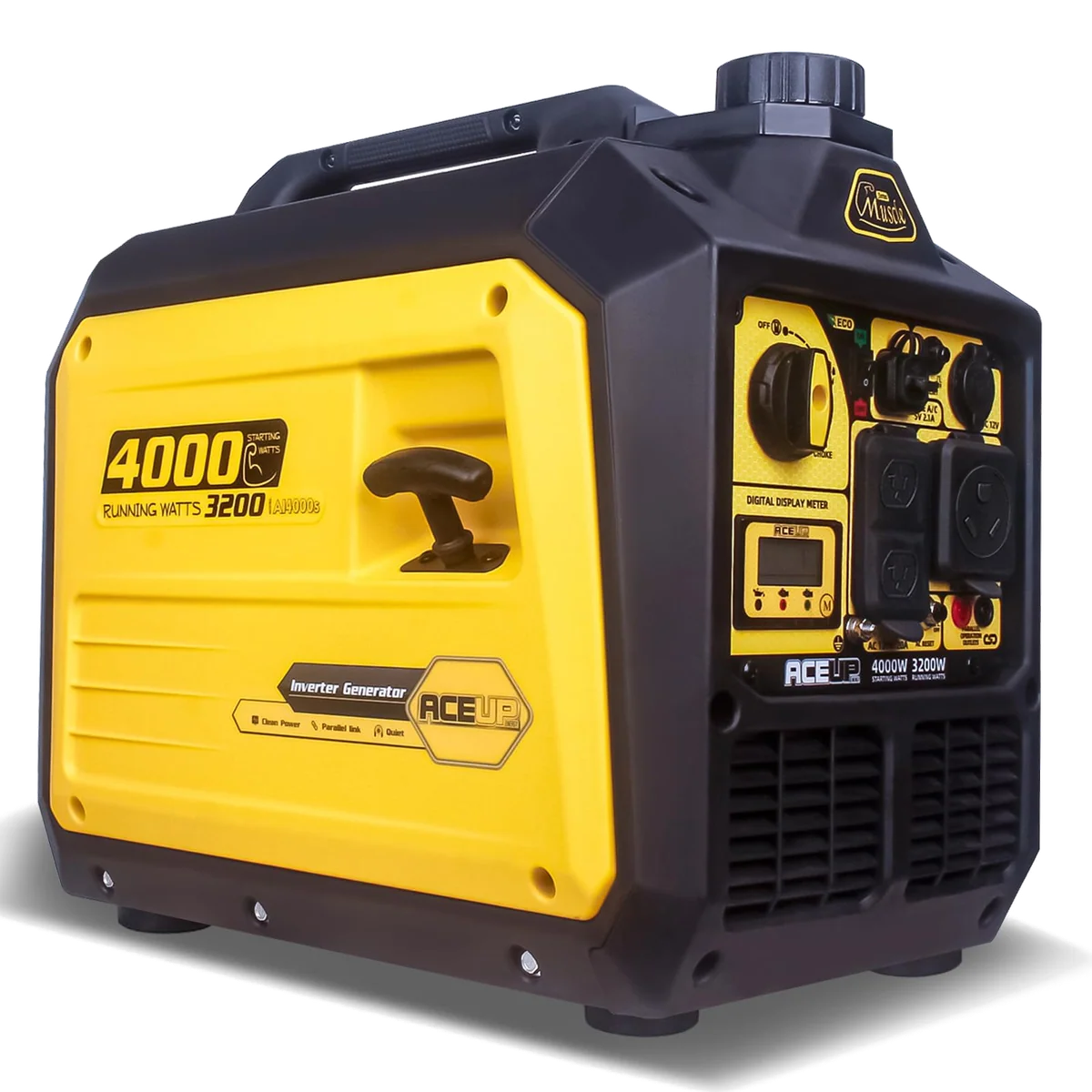
Buy it as an occasional outage machine for a fridge, a freezer, lights and phones, or for an RV's heat and lights, and leave the fuel cap vent open whenever there is fuel in the tank; walk away if you need a quiet campground generator, a whole-house generator, or a manufacturer that will still be arguing your corner in year two.
Based on published owner reports, 3 owner discussions and 1 other source. We have not tested this machine ourselves.
We earn a commission if you buy through our links, which does not affect what we say.
Read how this site works →
Where that leaves it
The Aceup AI4000s is a better-equipped generator than its price suggests and a worse-supported one. Everything mechanical in the record points the same direction: it starts, it runs, owners a year and a half in are still happy, and the panel gives you information that more expensive machines withhold. Everything institutional points the other way: contradictory specifications, a manual missing the one warning that matters, and at least one warranty claim that went nowhere after the customer did the diagnostic work himself.
So buy it the way you would buy a tool you intend to look after yourself. Leave the vent open, run the tank dry before you store it, exercise it under load twice a year, and accept that if something goes wrong you may be fixing it rather than claiming it. On those terms it is a lot of generator for the money. On any other terms, particularly if you were counting on it to carry a house or keep a campsite peaceful, the honest answer is that this is not the machine.
Buy it if you want an inverter with a real digital meter, a 30A RV receptacle and parallel ports, you will run it a handful of times a year, and you are comfortable doing your own oil and spark arrestor work.
Walk away if your plan is a quiet campground, a central air conditioner, or any situation where a warranty claim would be the difference between a working generator and a paperweight.
First, the disambiguation, because the search traffic says people are landing on the wrong machine. This is the AI4000s-1: gas only, recoil start, 149cc, 4,000 peak watts and 3,200 running. There is a dual-fuel 4,000-watt Aceup on a separate listing, and it is a different unit with a different fuel system; one of the reviews sitting on this listing is plainly about that one, praising a propane tank this generator cannot use. If you came here wanting propane, you want the other page.
Second, the category. Amazon files this under power take off generators, which it is not. There is no shaft, no tractor, no three-point hitch, just a pull cord and a carburettor. Specific Load has written up why so many portable inverters end up shelved under that name, and the short version is that the category label tells you nothing about the machine.
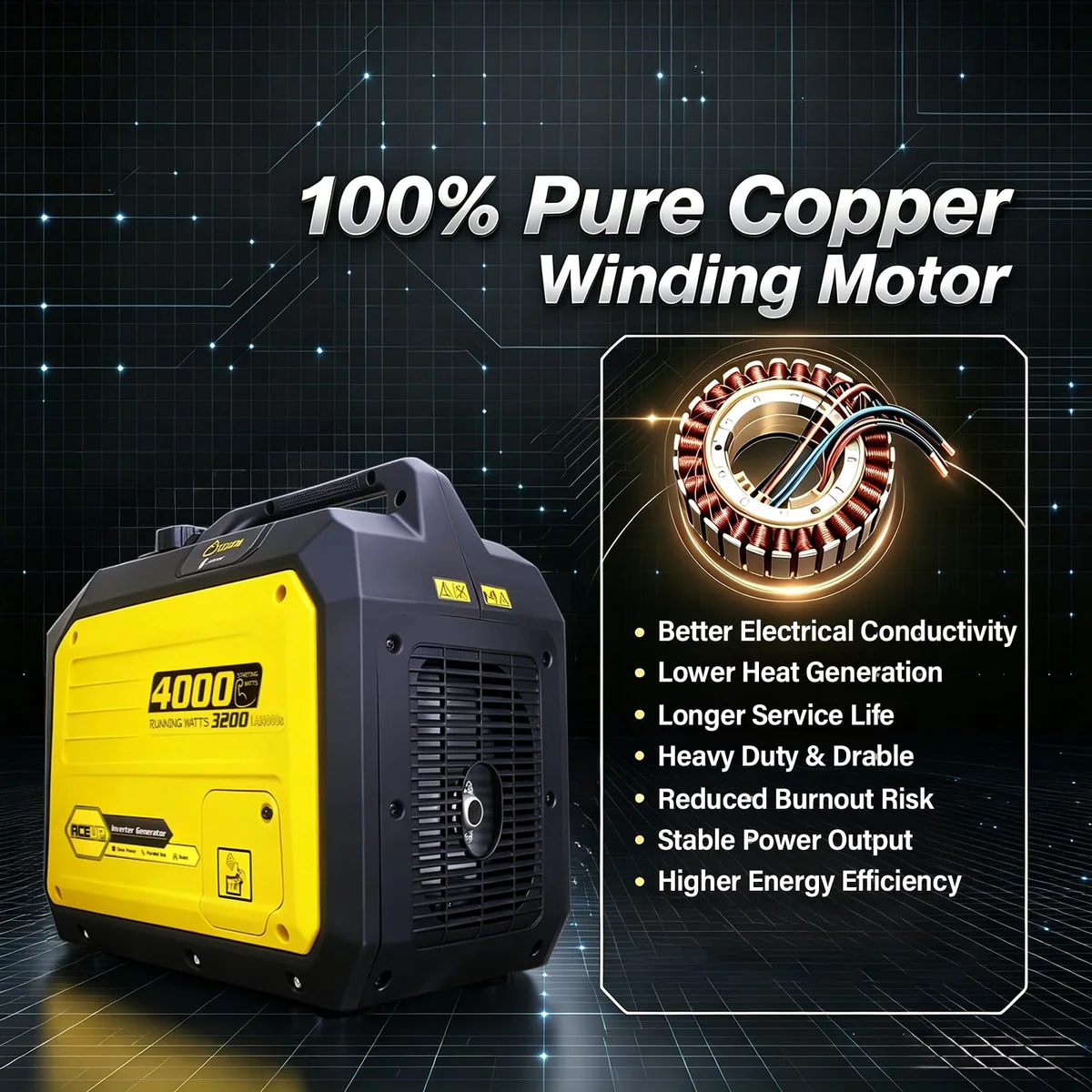
With that cleared, here is the shape of the thing. The Aceup gives you a panel that genuinely belongs on a more expensive generator, an engine that starts with unusual consistency across every owner account in the record, and a documented failure where the internal fuel tank collapses under vacuum after shutdown. The failure has a known cause, a free fix, and a manual that does not mention it. Everything below is an argument about whether that trade is worth taking.
Key Specifications
The panel is the reason to look at this thing
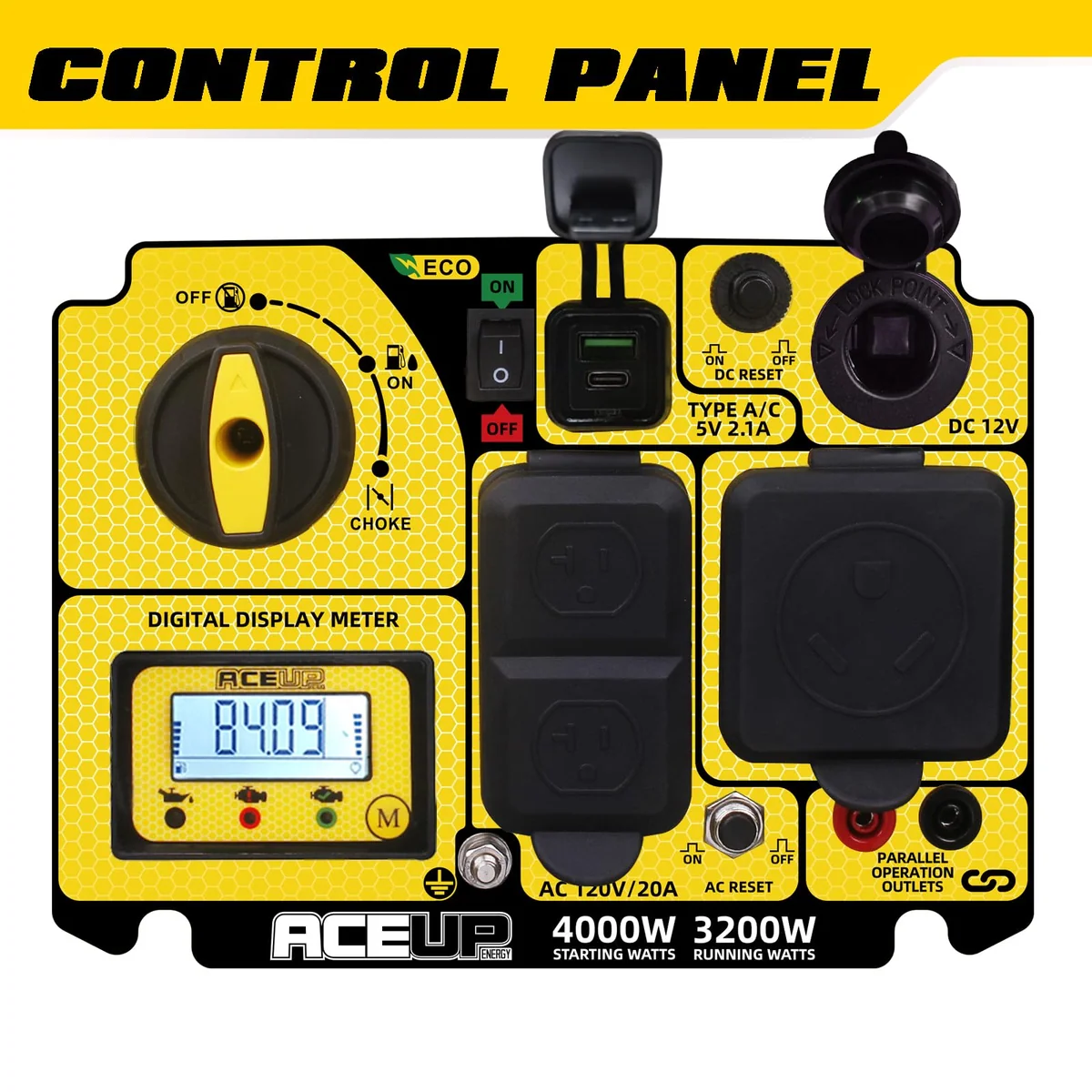
Most generators in this class give you two sockets and a light. This one gives you a digital gauge that reports voltage, frequency, amperage, percentage of load, engine RPM, a fuel level and both session hours and lifetime hours. Lifetime hours is the detail worth pausing on: it means a second-hand unit cannot lie to you about its age, and it means you can actually schedule the spark arrestor clean rather than guessing. The one hands-on walkthrough of this exact model in the public record was filmed on a used unit reading 62.6 hours, which is precisely the sort of thing that meter exists to tell you.
| Item | Detail worth knowing |
|---|---|
| Engine | 149cc four-stroke OHV, recoil start, gasoline only. |
| Output | 4,000 peak watts, 3,200 running, 26.7 amps, 60Hz. |
| Tank | 1.32 gallons, with a strainer in the filler neck and a vented cap that matters more than any other control. |
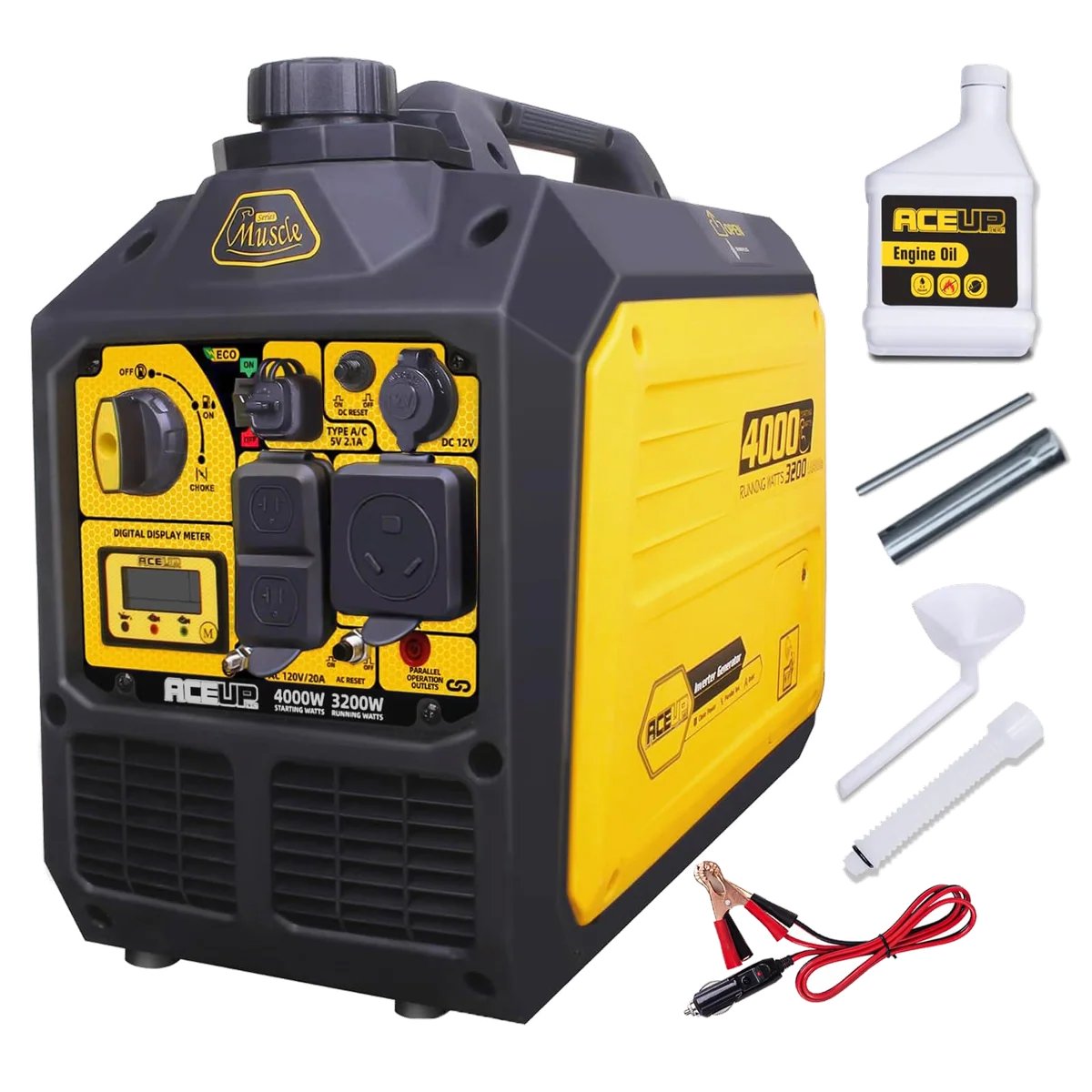
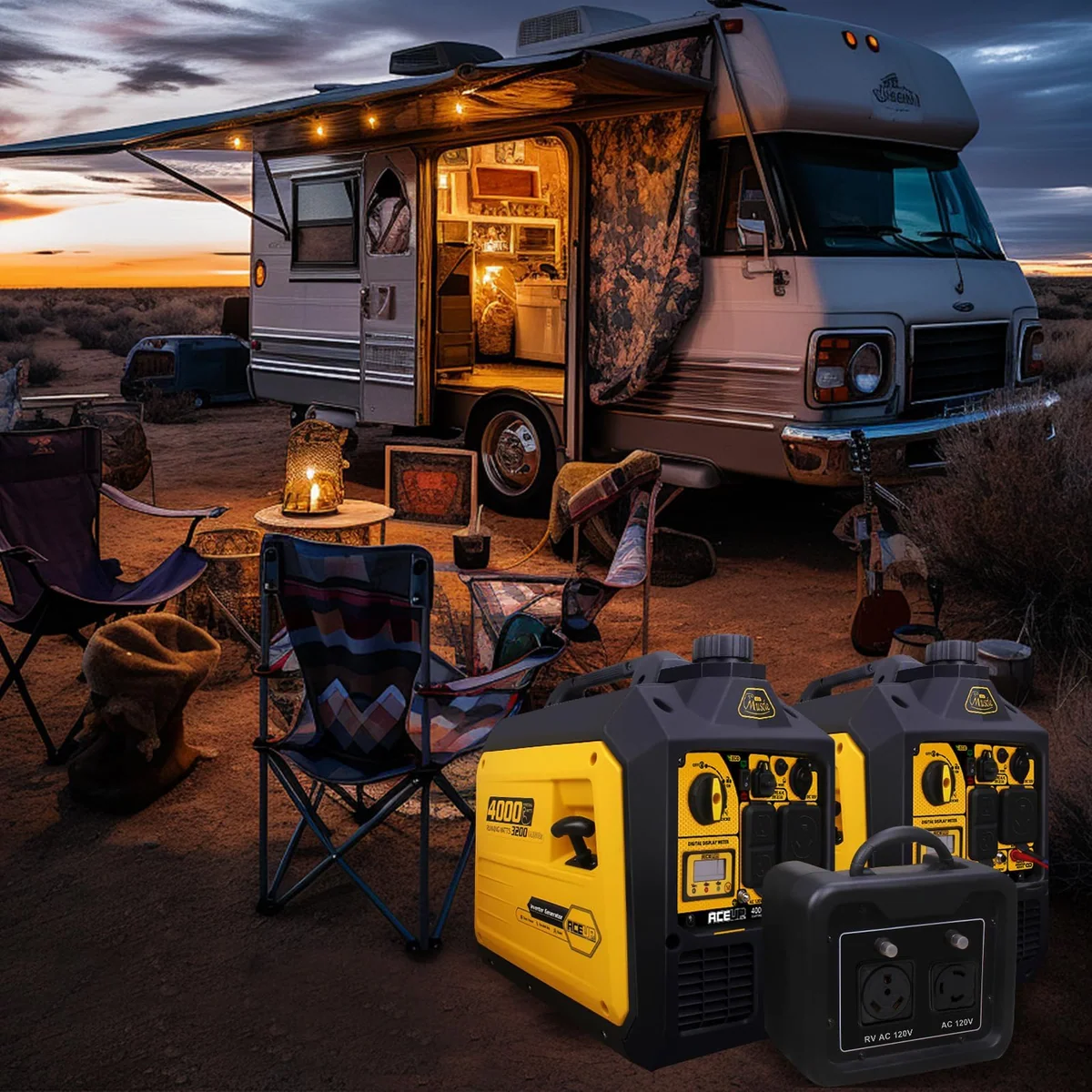
| Outlets | Two 120V household sockets, one 30A RV receptacle, one 12V DC socket, parallel ports. |
| Controls | A five-in-one knob combining fuel valve, engine switch and choke. |
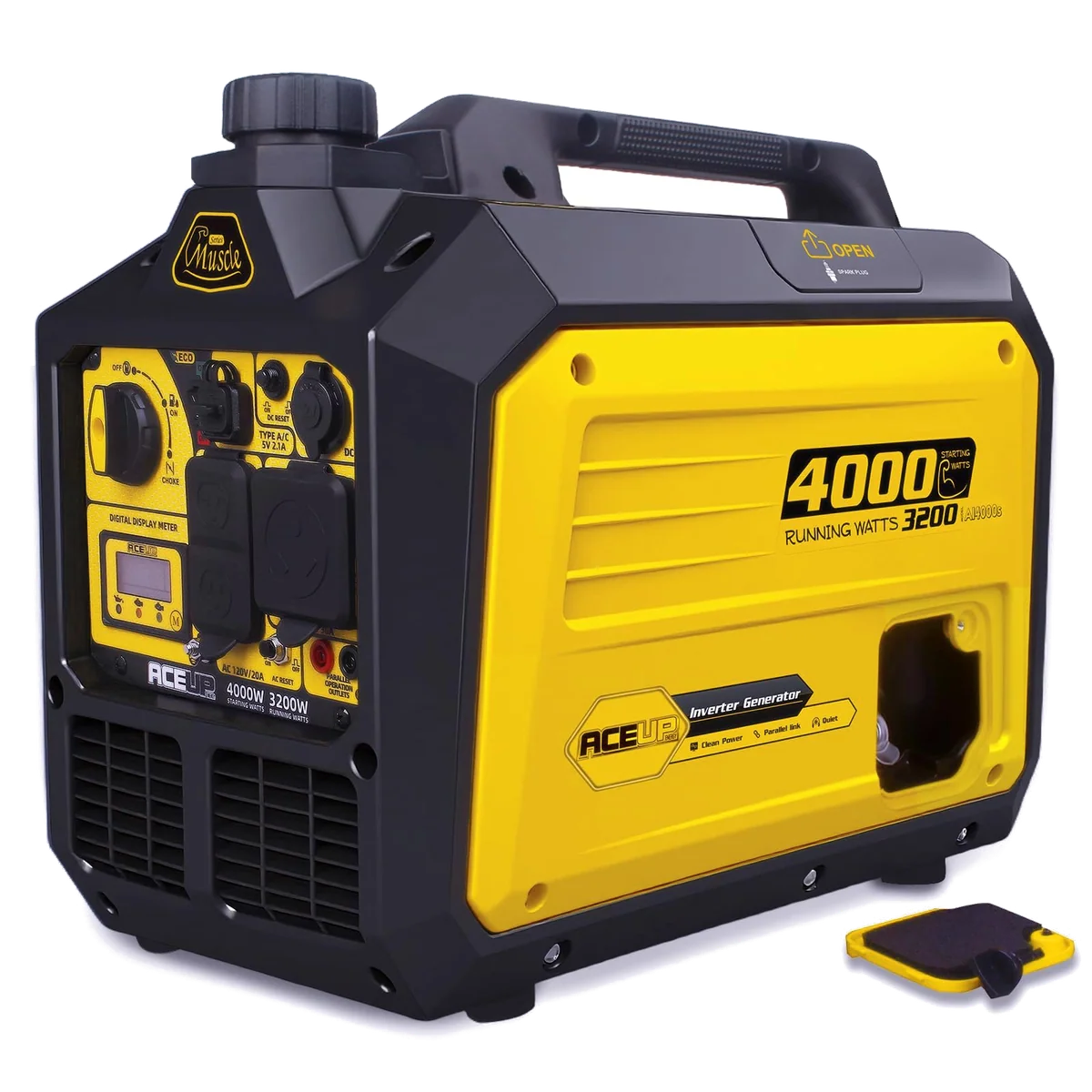
| Service access | Four screws take a side cover off to reach the air filter, spark plug, valve cover and a carburettor drain screw. |
| In the box | 10W-40 engine oil, spark plug wrench, oil funnel, and a magnetic dipstick on new units. |
The RV receptacle is real hardware, not a marketing word, but it is a 30A twist socket and you will need the right adapter for your trailer's cord. The service access is the underrated part. Cheap generators usually bury the plug and the filter behind a sealed shell so that the first maintenance job becomes a plastic-cracking exercise; this one opens up with a screwdriver and leaves room to get a hand in. That is worth more over five years than any of the numbers in the title.
The listing's own bullet points are less careful than the machine. Bullet three claims "120V AC one 20A outlets," which manages to be both singular and plural about a socket count it gets wrong. Bullet six promises a two-year limited warranty while Amazon's own catalogue metadata for the same product says one year. Nothing about this is fatal, but a buyer cannot read that page and know what coverage they hold.
Strengths & Limitations
Strengths
- Starts on the first or second pull with unusual consistency, including on a used unit with 62 hours on the meter and on units a year or more into ownership.
- The digital meter reports volts, hertz, amps, load percentage, RPM, fuel level and lifetime hours, which almost nothing else at this price does.
- A genuine 30A RV receptacle, parallel ports and a 12V DC socket, so the panel matches the way people actually use a 4,000-watt inverter.
- Four screws take the side cover off to reach the air filter, spark plug, valve cover and carburettor drain, so routine maintenance is not a plastic-cracking job.
- Roughly 50 pounds, which one owner rated specifically against wrestling a 100-pound conventional generator into a truck bed.
- Eco mode is the setting two separate owners credit for both the fuel economy and the tolerable noise.
- Oil, a funnel and a plug wrench are in the box, and new units ship with a magnetic dipstick.
Limitations
- The internal fuel tank can collapse under vacuum if the cap vent is closed with fuel inside, and the manual does not warn you.
- The brand's own documented shutdown procedure tells you to close that vent, which is the exact action that causes the failure.
- One owner who took the unit apart and confirmed the deformed tank was refused a replacement inside the warranty window.
- Part of the five-in-one control is a black cap on a black panel that owners cannot see in the dark, producing a generator that starts, runs briefly and dies.
- It is audibly louder and noticeably higher pitched than a Pulsar or a Wen of comparable class, despite the words in the product title.
- The brand publishes five hours and eight hours at the same half load, on two of its own storefronts, so its runtime figures cannot all be trusted.
- Warranty length is listed as one year in Amazon's catalogue data and two years in the seller's own bullet points.
- The listing claims EPA compliance and makes no CARB claim, which California buyers need to check before ordering.
- Carbon monoxide auto-shutoff appears on the brand's landing page for this class of machine and nowhere in this listing's own specifications.
Quiet enough for a driveway, not for a campground
"Super quiet" is in the product title. The brand's own landing pages have variously claimed 57 dBA and 60 dBA for this machine, on the same storefront, which is the first sign that nobody is quoting a measurement so much as a mood. No independent test has published a decibel figure for the AI4000s at all.
What does exist is a careful side-by-side at 23 feet against a Pulsar GD400BN and a Wen 56225i, run at no load, in eco, and at 500W, 1,000W, 1,500W and roughly full load. The finding, in words rather than numbers, is that the Aceup is audibly louder than both, not dramatically, and pitched higher than the Pulsar's deeper note. The reviewer's own summary is the one to carry into a purchase: nobody is going to walk over at a campsite and compliment you on how quiet it is, but tucked along a wood line or sitting on a suburban driveway it will not start a feud with the neighbours.
A meter has been put on the smaller 2300W Aceup, and the numbers there are instructive about the brand's adjectives rather than about this specific engine. That sibling was marketed as sleep-level quiet and read 74 dB at the machine in eco with no load, against 72 dB for a Honda EU2200i; under load the gap widened to five decibels, and at 25 feet the Aceup ran seven decibels above the Honda. Two different testers, on two different Aceup models, independently flagged the same thing: the complaint is the pitch, not the volume. Treat any Aceup decibel claim as the number a generator makes in eco, at no load, at 23 feet, on a good surface, which is what every manufacturer's noise rating actually means.
One free trick from the hands-on comparison, and it applies to any generator you own: thick grass instead of concrete or gravel made a large difference to what the meter read at 23 feet. People arguing about decibels online are frequently arguing about ground cover.
The runtime figures do not agree with each other
This is the clearest case in the file of a brand contradicting itself in public.
| Where it comes from | What it says |
|---|---|
| Amazon bullet points | Up to 5 hours at half load. |
| Aceup's own product page | Up to 8 hours at half load. |
| Amazon brand landing page | 7 hours at 25% load, and separately 8 hours and 5.5 hours in eco. |
| The spec plate on the machine | 7.5 hours at quarter load. |
Five hours and eight hours at the same load off the same tank cannot both be true, and the arithmetic favours the smaller number. The single owner report of an actual measured tank puts it at eight hours on a light load, which lines up neatly with the quarter-load figures and quietly refutes the eight-hour half-load claim. Plan on roughly seven to eight hours running a fridge and a few lights, and closer to five if you are actually leaning on it.
What 3,200 running watts is honestly for
The most convincing owner account on this listing is three days of continuous running through an outage, powering a fridge, a deep freezer and phone charging. That is the machine's real job description, and it is worth noting how modest that load is against the ceiling. A conventional whole-house tally of a furnace blower, fridge, lights, television, sump pump and a window air conditioner lands north of 4,000 running watts before you add the customary buffer, which is comfortably beyond what this unit can do. If you have not run those numbers for your own house yet, do it before you choose a size rather than after.
Air conditioning is the question everybody asks and the one this record cannot answer. Nobody in the public material has put an RV rooftop unit on an AI4000s and reported back. What is known generally is that running a generator at ninety-odd percent of its rated output is a bad place to live, because the engine loses speed on every compressor start and the whole system sags. Our page on what it takes to start an air conditioner goes through locked rotor amps and soft starts; until somebody publishes a real test, treat a 13,500 BTU rooftop on this generator as unproven rather than promised.
On power quality, the brand claims under 3% total harmonic distortion. That is a credible figure for an inverter and nobody has independently metered it here. For scale, when a power quality analyser was put on a cheap non-inverter generator it returned roughly 14% with a visibly jagged waveform, while a Honda inverter came in under 1%. Under 3% would be inverter-class and still three times the Honda's, which is fine for a laptop and a furnace control board and is not a reason to pick this over anything else in the class.
What you are trading away, and what you would trade up to
The case for the Aceup is a straight equipment-per-dollar argument, and it holds. Against a Pulsar of identical rating it wins on the panel outright: two household sockets instead of one, a fuel gauge where the Pulsar has none, a bigger tank, a 30A RV outlet and the digital meter. It loses on noise and on the Pulsar's ability to run propane. One owner reached for a Champion as his mental price anchor and concluded he was getting the same job done for less, which is a fair summary of the whole proposition.
The counter-argument is the one a soundproofing tester made about the smaller model, and it is the fairest framing available. If you need a generator for daily or near-daily work, the premium brands earn their premium in longevity and noise. If you need one for a power cut that lasts a couple of days once a year, the budget machine makes sense, because you can buy several of them for the price of one Honda and the hours you put on it will never test the difference. Where the machine is built matters less to that calculation than people think, since plenty of trusted names manufacture in the same places; what matters is what happens when you need a part, which is the argument in what a budget generator brand actually owes you.
Concrete alternatives on this site, if the Aceup's specific weaknesses are your dealbreakers. If the gas-only fuel system is the problem, the PowerSmart 4400 dual fuel and the LIFAN 4800 with remote start both let you run propane, which sidesteps the whole vented-cap issue because there is no vented tank to collapse. If 3,200 running watts is simply not enough for your list, the Oxseryn 5000 is the next rung up, and our home backup guide covers what it takes to carry a whole house rather than a fridge. If the reason you are shopping is an RV, the RV shortlist is a better starting point than any single review, and if it is a campsite with neighbours, read the quiet camping guide first, because this is not that machine.
And if you have no safe outdoor space at all, no engine is the right answer. A townhouse patio, a balcony or an apartment means a battery, not a carburettor, which is the case laid out in gas against solar for an outage and the shortlist in our power station roundup.
The tank collapse, and why both explanations are correct
Two owners on this listing describe the same failure: the internal fuel tank pulled inward on itself and deformed after the generator had been used and then left sitting. They reached opposite conclusions. One took the unit apart, confirmed the tank was inverted, was told by support that nothing was broken and a part had merely come loose, and was refused a replacement inside the warranty window. The other diagnosed it as a vacuum caused by closing the fuel cap vent with fuel still in the tank as the temperature dropped, repositioned the tank himself after pulling the plastic covers, and left four stars with a single complaint: the manual should have said so.
The second owner is almost certainly right about the mechanism, and here is the part that turns a customer error into a design problem. Aceup's own instructional video for its 2300W generator lists "turn fuel cap vent on" as step two of starting and "turn fuel cap vent off" as step eleven of shutting down. Follow the brand's documented procedure with a half-full tank, park the machine, and let it cool overnight, and you have built exactly the vacuum that crushes the tank. Specific Load's reading is that both reviewers are telling the truth: the collapse is user-triggered, and the instructions trigger it.
The rule to follow instead: leave the vent open any time there is fuel in the tank, and only close it when the tank is empty and you are transporting the machine. Better still, shut it down the way the hands-on reviewer does: close the fuel valve and let the engine run itself dry for two or three minutes, or crack the carburettor drain screw and let the bowl empty. Do that and the vent trap never gets a chance to bite, and you also avoid the varnished carburettor that kills more stored generators than anything else.
The switch you cannot see
The five-in-one knob is a genuinely good idea: one control for the fuel valve, the engine switch and the choke, so you cannot walk away leaving fuel flowing. The execution has a flaw an owner named in his review title. Part of it is a black cap on a black panel, and if you have not turned the fuel side on, the generator starts, runs briefly on what is in the carburettor bowl, and dies. He found this out in pouring rain, which is when you will find it out too, because that is when you use the thing.
Know the symptom and you will save yourself a support call and possibly a return: starts, runs for thirty seconds, stops means fuel, not spark. It is the single most common false alarm in this category, and our guide to the switches and valves that make a healthy generator look dead covers the rest of them.
What the machine looks like after a year
Two owners on this listing are past the twelve-month mark and both are still positive. One reports a year and a half of September-to-April use with no change in behaviour, one easy pull when the unit has been kept indoors, and a couple of tries when it has been stored cold. The other reports a year of light use and first or second pull every time. Starting is, across every source and every Aceup model in the record, the most consistently praised behaviour: even a second-hand unit with 62 hours on the meter fires first pull.
The thing to guard against is not the engine. A generator that runs perfectly and produces no power at the sockets after a long stretch in storage is a well-documented failure mode across cheap machines generally, and it is why a backup generator wants exercising under an actual load a couple of times a year rather than being pull-started once and shut off. If it ever happens to you, the fault is usually recoverable and usually not the alternator.
One more absence worth naming. Aceup's brand landing page advertises carbon monoxide auto-shutoff on its 4,000-watt gas inverter, and this listing's bullet points never mention a CO sensor at all. Do not carry the assumption across from one page to the other. Even with a sensor, a shutoff is a last resort and not permission to move the machine closer, which is the whole argument in where a running generator actually has to sit. No garage, no covered patio, no open window nearby.
Frequently Asked Questions
Is this the dual fuel model?
No, the AI4000s-1 runs on gasoline only, and the dual fuel 4,000-watt Aceup is a separate listing with a separate fuel system.
How long does it actually run on a tank?
Expect roughly seven to eight hours on a light load, which matches the only owner-measured figure and the spec plate on the machine, and closer to five hours at half load despite the brand publishing eight hours for that same load elsewhere.
Where do I find the manual?
One ships in the box and Aceup hosts documentation on its own site, but the warning you most need is not in it: keep the fuel cap vent open whenever there is fuel in the tank.
What oil does it take?
The listing specifies SJ 10W-40 gasoline engine oil and includes a bottle with a funnel and a plug wrench, though the break-in change nobody mentions is on you to schedule.
Will it run my RV air conditioner?
Nobody in the public record has tested a rooftop unit on this generator, and with 3,200 running watts you should treat a 13,500 BTU compressor start as unproven unless you are running a soft start.
Can one of these run a whole RV?
An owner who used it successfully for heat and lights concluded he would need a second unit in parallel to carry the rest of the trailer, which is the clearest answer available.
Who makes Aceup generators?
Nothing in the available record establishes who manufactures them or who owns the brand, only that Aceup sells directly through its own store as well as through the major retailers.
Does it have a carbon monoxide shutoff?
The brand's Amazon landing page advertises CO auto-shutoff for its 4,000-watt gas inverter while this listing's own specifications never mention a sensor, so confirm it on the unit before you rely on it and site the generator outdoors and well away from the house regardless.
Is it quiet enough for a campground?
No, it is audibly louder and higher pitched than comparable inverters, and it suits a driveway or a spot along a wood line rather than a quiet site with neighbours.
Sources (3)
- Amazon listings and customer reviews — Aceup Energy 4000 Watt
- Owner reports across r/Generator, r/smallengines threads
- Owner and reviewer video, 6 channels