A generator that trips, stalls or shuts down under load is rarely telling you it is too small
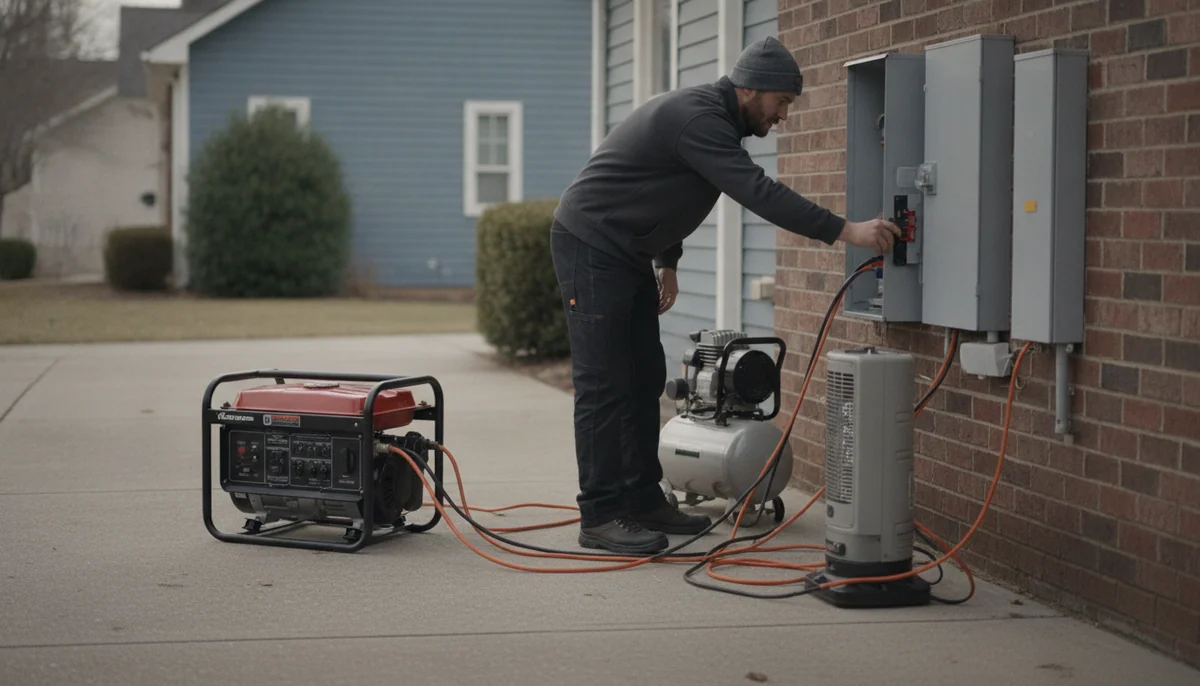
That is not the advice you will get from a listing, and it is not the advice you will get from the person who sold you the generator. Both of them would prefer the conversation be about wattage, because wattage is a number they control. The failures documented by actual owners are duller and cheaper than that. A quart of oil, a bowl of six-month-old petrol, a fifteen-year-old extension cord and a household hanging all its load on one of two legs account for more shutdowns between them than genuine overload does, and every one of those costs nothing to rule out.
So before you read the argument, run the ladder. It takes about ten minutes and needs nothing you do not already own.
- Shut everything off, unplug every cord from the generator, and restart it with no load at all. If it will not stay running with nothing attached, the load was never the problem.
- Check the oil on level ground with the engine cold. Low oil shutdown is the single most reliably working protection circuit on cheap generators, and it does not announce itself politely.
- Look at the fuel. If it has been in the tank since the last outage, it is a suspect, and so is the carburettor bowl underneath it.
- Reset the generator's own breaker and any GFCI button on its receptacles, then confirm the button stays down with nothing plugged in.
- Add one load at a time, directly into the machine, no cord and no power strip. Give anything with a motor a full quarter of an hour before you call it clean.
- Only when a single known-good load makes it quit are you allowed to conclude the generator is undersized, and even then read the section on where its real ceiling sits.
The reason that order works is that the three things people describe as "it quits under load" are three separate machines failing in three separate ways, and they have almost nothing to do with each other. A breaker opening is electrical: the engine is still running and perfectly happy, something downstream is drawing or leaking more current than a device is willing to pass. A stall is mechanical: the engine loses the ability to make the power being asked of it, the note drops, and it dies. A shutdown is neither, it is a decision, made by a controller watching oil, carbon monoxide, temperature or its own inverter, and it can be made for reasons that have nothing whatever to do with what you plugged in. Sort your symptom into the right column and the list of possible causes collapses from twenty to about three.
| The symptom | What is happening | Where to look |
|---|---|---|
| Engine keeps running, outlets dead, a breaker lever has flipped out | Genuine overcurrent on that circuit | The total draw, and whether it is all sitting on one leg |
| Engine keeps running, outlets dead, no breaker moved but a small button on the receptacle has popped | Ground fault, meaning leakage to earth rather than too much current | Cords, damp, and one specific tired appliance |
| Engine keeps running normally, nothing has tripped, and there is no power anywhere | Loss of output, which is a different fault entirely | Our page on a generator that runs but sends nothing to the outlets |
| Engine bogs, the note drops, it dies within seconds of the load going on | Fuel or air delivery, not electrical capacity | Carburettor bowl, stale fuel, choke position, air filter |
| Runs happily for twenty or forty minutes, then stops with a warning light | A protection circuit made a decision | Oil level first, then heat, then the carbon monoxide sensor |
| Stops within a minute showing overload, with nothing plugged in | The control or sensing side is faulting, not the engine | The return window, while you still have one |
| Lights dim, a motor hums and will not spin, then something trips | Inrush is exceeding what the machine can briefly deliver | Locked rotor current, and whether a soft starter is possible |
The three cheap causes, in the order they actually occur
Start with oil, because it is the answer often enough to be embarrassing. An RV owner whose onboard generator faulted out after roughly thirty minutes on nothing more than one air conditioner and some twelve volt lighting went through the entire diagnostic parade, fuel, filters, load, connections, and came back to the group with a two word resolution: it was the oil. Low oil shutdown is deliberately unsubtle, it will let a machine idle for a while and then kill it the moment sustained load raises the temperature and the level in the sump moves, which is why it so convincingly imitates an overload. It also fires on a slope, so a generator sitting on a driveway with a fall to it can read low while the dipstick reads fine on the flat. If you are not sure what yours takes or when its first change was due, the oil grade, quantity and break-in change are worth ten minutes of your evening.
Then fuel, and specifically the small bowl of it under the carburettor. The most common single story in the entire body of owner evidence goes like this: the machine has sat since the last storm, it starts on the second or third pull because the bowl filled while it stood there, it idles beautifully for twenty or thirty seconds, and it dies the instant a house load goes on it. That is not an overload and it is not the engine wearing out. It is a jet varnished narrow enough to feed an unloaded engine and not a working one. Experienced hands converge on it independently every time somebody posts the symptom, and the fix is upstream: shut the fuel valve, let the machine run itself dry before storage, and drain the bowl if the manufacturer gave you a way to. Our page on storing a generator so it starts when the power goes out is the routine, and if yours will not start at all rather than dying under load, the fuel valve, the cap vent and the switch nobody notices is the other page.
Third, the cord. Ground fault receptacles account for an unreasonable share of "it keeps tripping" reports and they fail on a completely different principle from a breaker: a GFCI is watching for current leaking to earth, from moisture, dust, tired insulation or a slowly dying appliance, and a few milliamps is enough. It does not care what the wattage is. One owner of a brand new dual fuel machine spent an entire thread chasing a trip that arrived about five minutes into running nothing but a refrigerator, through two extension cords that were both fifteen years old. That is a textbook profile, and the isolation procedure that resolves it is the boring one in the ladder above: single loads, plugged straight in, then the cord, then the strip, then the real thing, giving motors a genuine fifteen minutes rather than fifteen seconds for leakage to show up.
There is one more configuration trap in this family, and it is invisible until you connect the generator to a building. If the machine has its neutral bonded to its frame and the system it feeds is bonded again downstream, you have created a second path for return current, and a GFCI or a GFCI breaker will do exactly what it was designed to do about that. It is not a fault in either device. Establish which kind you own before you wire anything: bonded versus floating neutral, and how to tell which one you have, and then the transfer switch and interlock question.
Half your generator, sitting idle, while the other half trips
If your machine makes 120 and 240 volts, it does not make one pool of watts. It makes two legs, and the split between them is yours to manage whether you know it or not. A dogbone adapter that turns the 240 volt receptacle into a pair of 120 volt sockets hands everything to one leg unless you deliberately balance it, which means a nine kilowatt generator can trip while doing four and a half kilowatts of work, with the other half of its capacity untouched. Owners chasing intermittent trips find this constantly, and it explains the maddening part of the pattern, that the same set of appliances is fine on Tuesday and not on Thursday.
The same discussion supplies the reason summer is worse. An air conditioner does not draw a fixed number. The hotter the day, the higher the pressure differential the compressor is working against, and the more current it pulls, so the load peaks on precisely the afternoon you most need the machine to cope. A generator that has carried your house through three mild outages is not proof of anything about the fourth one in August.
Breakers, meanwhile, are not scales. Overcurrent protection typically opens somewhere in the region of 110 to 125 percent of its rating, on a time curve that will happily pass a large surge for a few seconds without complaint. That is why a machine can feel completely fine right up until the moment it is not, and why "it never tripped before" is weak evidence about anything. The same troubleshooting logic points at the right remedy for the commonest hard case: when voltage sags as a big motor tries to start, the answer is a soft starter on the motor, not a bigger number on the generator.
The number on the frame was never your budget
Now the part that actually is about load, handled honestly. The conventional guidance is to hold continuous draw at roughly 80 percent of the rated running output, which leaves headroom for the motors that briefly pull several times their running figure. Take that seriously and the arithmetic on the machines this page covers is sobering rather than dramatic.
| Machine | Claimed running watts | 80 percent budget | What the record actually shows |
|---|---|---|---|
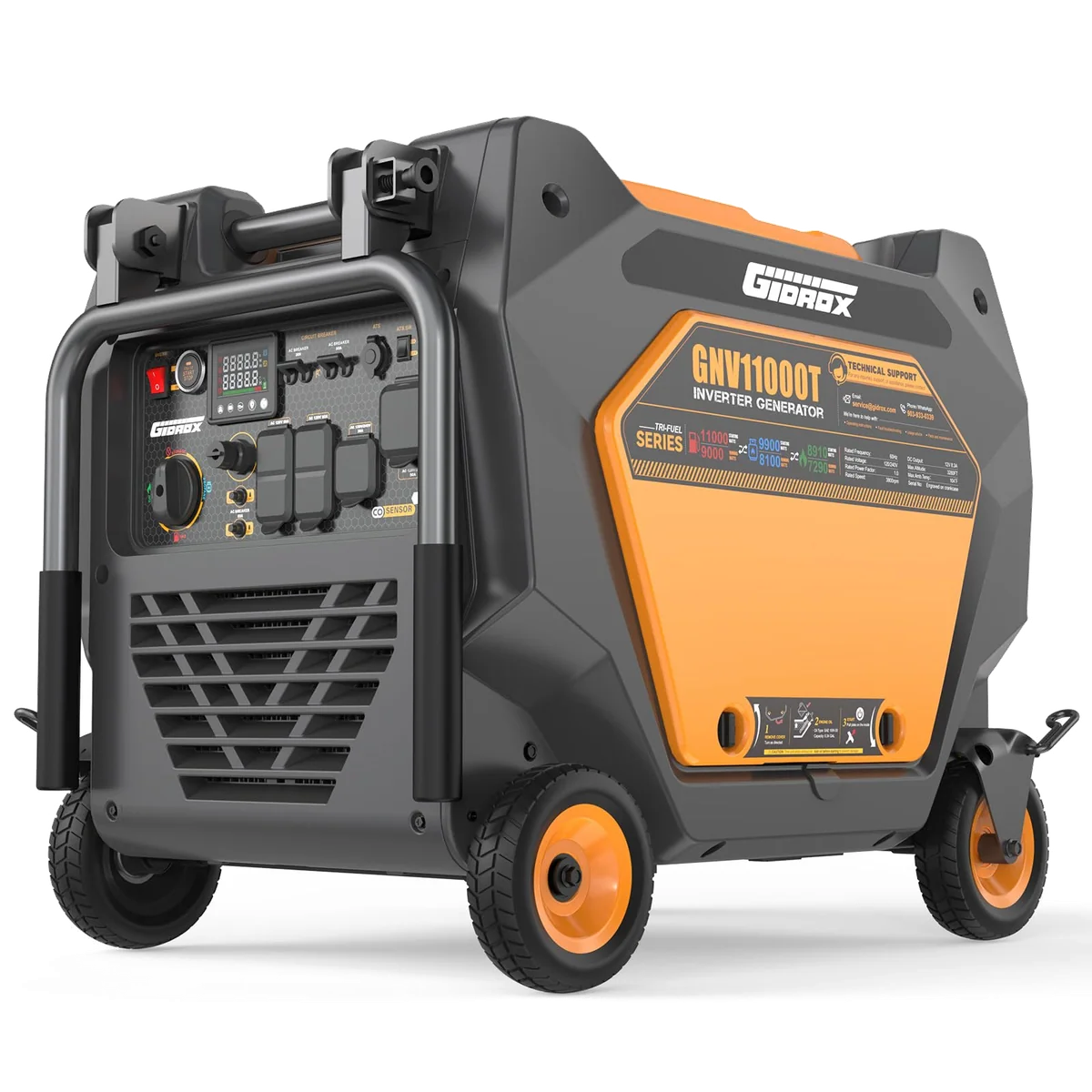
| Gidrox 11000W tri-fuel, on petrol | 9,000 | 7,200 | One owner reports it stopping working above roughly 5,500W |
| Gidrox 11000W tri-fuel, on propane | 8,100 by the maker's own derate | 6,480 | No natural gas figure is published anywhere we could find |
| AMERISUN 4500W | 3,800 | 3,040 | The only hands-on test on record never exceeded about 2,000W |
| PowerSmart 4400W dual fuel | 3,600 | 2,880 | Demonstrated once on an RV rooftop air conditioner, on propane |
The Gidrox line deserves the detail, because it is the clearest published example of the gap this page is about. Its listing sells 11,000 peak and 9,000 running, and offers those numbers in the same breath as five ton central air conditioning. The only owner in its record who describes pushing it writes that after 5500Wtts this don't work
, which is a wall at around 60 percent of the running rating from somebody who was plainly trying to use the machine properly. One owner is not a test, and a second owner says he ran his whole house without trouble. Neither of them measured anything, no independent load test of that generator exists, and our full review of it says exactly that rather than picking the flattering account.
What makes the low figure credible rather than dismissible is that a new machine badly under-delivering against its plate is not exotic. Owners watching a brand new unit from a very large retailer surge straight out of the box spent a thread on it, and one of them pointed at published sound-testing footage where a generator rated at 4,200 watts could not hold 2,500. The plate is a marketing claim until somebody puts a meter on it, and almost nobody does.
The receptacle is not a promise either. Fifty amps at 240 volts is 12,000 watts, which is more than any of these machines makes at peak, so a big socket on a small engine is a connector convenience rather than a capacity statement. An owner on a power equipment forum put the general case better than any specification sheet: he had a 30 amp outlet behind a 30 amp breaker on an engine that would stall long before either of them opened, so the breaker was decorative and the outlet was effectively just a switch. If none of this arithmetic is familiar, why the number on the box is not the power you get is the piece to read before you buy anything at all.
The load that defeats almost everything in this class
Air conditioning is where sizing arguments go to die, and it is worth seeing the numbers once. When somebody asked whether a roughly 5,000 watt machine would start a residential condenser, the thread did the arithmetic out loud and was unanimous: a 45 amp breaker on the plate implies around 10,000 watts of circuit, and 95 locked rotor amps at 240 volts is 22,800 watts of inrush, which even after the voltage droop that always accompanies it still lands somewhere around 11 kilowatts. A former master electrician in the same discussion added the distinction that matters most, that a machine of that size might well keep such a compressor turning once it is turning, and will not get it started. That is why the trip happens at the moment the compressor kicks in and never during the hour before it. An RV rooftop unit is a different and much more realistic ask, particularly with a soft start fitted, and what LRA actually means for your specific unit covers both cases properly.
When the shutdown has nothing to do with what you plugged in
Two protection circuits on modern portable generators will stop the engine for reasons a wattage calculation will never explain.
The first is the carbon monoxide sensor, which is a genuine safety feature and belongs on every machine sold. It is also, on this class of generator, a documented source of stoppages that are not about carbon monoxide at all. An owner running two 11,500 watt tri-fuel machines describes following the instructions to bypass his sensor because it kept shutting the generator down. Take that as evidence that the symptom exists, not as an instruction, and note that he later decided his real problem had been fuel related anyway. Bypassing a sensor removes the alarm, not the exhaust, and the thing that actually keeps you alive is distance: well clear of doors, windows, vents and the air conditioner intake that will otherwise pull the plume back into the house. Where a running generator can and cannot live is blunt about why the sensor is not permission to move it closer.
The second is the inverter or control board deciding, wrongly, that it is overloaded. The most detailed single report in the PowerSmart 4400's record belongs to a buyer whose replacement unit ran an RV air conditioner on propane for about forty five minutes exactly as the manual described, then sat for three weeks. When he came back to it, it ran roughly thirty seconds and cut out with the red overload light lit and nothing plugged in. It repeated with the oil checked, and it repeated on petrol, which is the fuel he had never wanted to use. That last detail is the important one, because it rules out the varnished carburettor that explains most post-storage failures: a fault that follows you across both fuels is on the sensing side, not the fuel side.
An overload light at zero load has skipped every rung of the ladder at the top of this page, and there is no home diagnosis for it. That is a return, and it needs to be a return while you still have one, because what happened next in that case is the ordinary outcome at this end of the market: the manufacturer told him to locate a repair shop himself, ship a sixty pound machine there at his own cost, and hope for reimbursement afterwards if the fault was judged to be a manufacturing problem. A two year warranty administered that way costs more to claim than most people expect. What you are actually buying at this tier makes the same point in more detail.
When it really is the generator, and what to do about it
Sometimes the machine is simply bad, and the honest thing is to say how you would know. The clearest signal is a failure that arrives early and does not respond to any of the cheap causes: a unit that will not hold no-load running, a unit that quits at a fraction of its rating with fresh fuel and correct oil, or a unit that faults with nothing attached. The second clearest is a distribution rather than an average. On the largest pool of owner feedback for the AMERISUN 4500 class, roughly two thirds gave five stars and about one in six gave one, which is not the shape of a mediocre product but of a lottery, with the losing tickets clustering in the first few days or the first three months. One owner there had his machine diagnosed by the manufacturer's own engineers as a faulty wiring harness after it ran for eight to ten seconds and shut off, by which time Amazon's return window had closed and the service centre he was pointed at had stopped doing the work.
Which brings the practical instruction that runs through every product on this page: the return window is the only warranty that has reliably worked for anybody at this price, so load the machine hard inside it. Nobody sells homeowners a load bank, but a water heater, a space heater and a kettle make a serviceable one, and adding load in quarter steps with a clamp meter or a plug-in power monitor watching will tell you in an afternoon what the listing will never tell you. Then keep proving it. The best line anyone has written about backup power came from someone answering a homeowner whose inherited generator gave nothing but silence when the storm hit: You should always test parachutes and generators before you need them. Be happy you are not sky diving.
The three machines this page is attached to, with their own faults stated
The Gidrox 11000W tri-fuel is the only one of the three with a serious answer to a long outage, because a natural gas line does not run out on day three the way a tank does, and its designers fitted an oil drain tube and a carburettor bowl drain, which are the direct countermeasures to two of the failures above. Its drawback is stated plainly in our review and again here: nobody independent has load tested it, the one owner who pushed it reports a wall well below the rating, and there is no published output figure at all for the fuel it is most likely to run on. Buy it only if week one is an acceptance test.
The PowerSmart 4400 dual fuel earns its place on the one thing every owner in its record agrees about, which is that it starts on the first pull, on petrol or propane, and it is cheap enough to be treated as insurance rather than equipment. Its drawback is the false overload above, the support path behind it, and a listing that rates it at 76 dB from 23 feet at a quarter load while calling itself quiet, which is loud by inverter standards even before you put a real load on it. If quiet is the actual requirement, what a decibel figure is measured at explains why those two sentences are not in conflict.
The AMERISUN 4500W is more machine than its price band usually delivers when it works: the one person who put a genuine load on it ran two portable air conditioners together, then a circular saw, then a fifteen amp table saw, then both saws at once, then a wood chipper, and could not upset it. Its drawbacks are the one-in-six failure rate above, a service network that failed every owner who tried to use it, and a detail that catches people out on this exact subject: despite the 30 amp socket, every outlet on it is 120 volts, so there is no second leg to balance across and no path to a whole-house interlock at all.
If those trade-offs are not ones you want, the site has honest neighbours. The GENMAX GM9000iED is the closest thing to the Gidrox with an actual owner base behind it, the LIFAN 4800W and Oxseryn 5000W sit at the size most households genuinely need, and the dual fuel roundup and the inverter roundup line the class up. If the load that keeps tripping things is a CPAP or an oxygen concentrator, stop shopping for engines: a battery does not stall, does not trip and does not shut itself down over carbon monoxide, and the medical equipment picks and the Anker SOLIX F3800 Plus are the right instruments. If you arrived here from a listing filed under power take off equipment and are wondering what that has to do with any of this, the answer is nothing, and why those listings carry that label is its own short story.
The verdict, once more with the receipts in view
A generator quitting under load is a diagnosis, not a purchase decision, and the order in which you test matters more than anything you could buy. Rule out the free causes first, oil and fuel and cords and leg balance, because those are where the evidence keeps landing. Then size honestly against 80 percent of a rating you have personally proved, not against the largest number on the frame. And treat the machines that fault with nothing plugged in as what they are, which is a return rather than a puzzle, handled while the window is open instead of on the night the freezer is thawing.
Frequently Asked Questions
Why would it trip with only a fridge plugged in?
That profile is almost always ground fault leakage rather than overcurrent, and the usual culprit is an old extension cord or a damp appliance rather than the refrigerator's wattage.
The engine runs perfectly but nothing comes out of the sockets, is that the same fault?
No, that is a loss of output rather than a trip or a stall, and it is covered on our page about a generator that runs with no power at the outlets .
How many watts can I actually run continuously?
Plan on about 80 percent of the rated running figure, and plan on considerably less than that until you have personally watched the machine hold a real load without sagging.
Why does it only trip on hot afternoons?
Air conditioning compressors pull more current as the day gets hotter, so the peak demand arrives on exactly the afternoon your margin is thinnest, and an unbalanced pair of 120 volt legs turns that into a trip well below the machine's total capacity.
It starts fine, runs about twenty seconds, then dies the moment I put a load on it?
That is the classic gummed carburettor after storage, where the bowl holds enough clean fuel to idle on and the jet is too varnished to feed a working engine.
Why does it shut down after half an hour when nothing changed?
Check the oil level on flat ground before anything else, because low oil shutdown fires on a delay as the engine heats and load raises consumption, and it convincingly imitates an overload.
The overload light comes on with nothing plugged in, what does that mean?
It means the sensing or control side has faulted rather than the engine, there is no home fix for it, and it is a return while your window is still open.
Can the carbon monoxide sensor shut it down when there is no danger?
Owners in this class do report sensors stopping machines for reasons that turned out to be unrelated to exhaust, but bypassing one removes your warning rather than your risk, and distance from the house is the control that actually protects you.
Will a soft starter fix an air conditioner that keeps tripping the generator?
Often yes, because a soft starter attacks the inrush at the instant the compressor engages, which is the part almost every portable generator fails at rather than the steady running load afterwards.
Does a bonded neutral generator trip GFCI devices?
It can, when the system it feeds is bonded a second time downstream and return current finds a parallel path, which is why knowing which type you own matters before you connect anything to a building.
Sources (8)
- Amazon listings and customer reviews
- Owner reports across r/Generator, r/Generac_Generators, r/HomeMaintenanceAdvice threads
- Owner and reviewer video, 1 channel
- Jubailibros — Article — ng.jubailibros.com
- Facebook — Article — www.facebook.com
- Generatorbible — Article — generatorbible.com
- Powerequipmentforum — Article — www.powerequipmentforum.com
- Woot — Article — tools.woot.com