The best portable inverter generator is the smallest one that covers your load and survives its first week
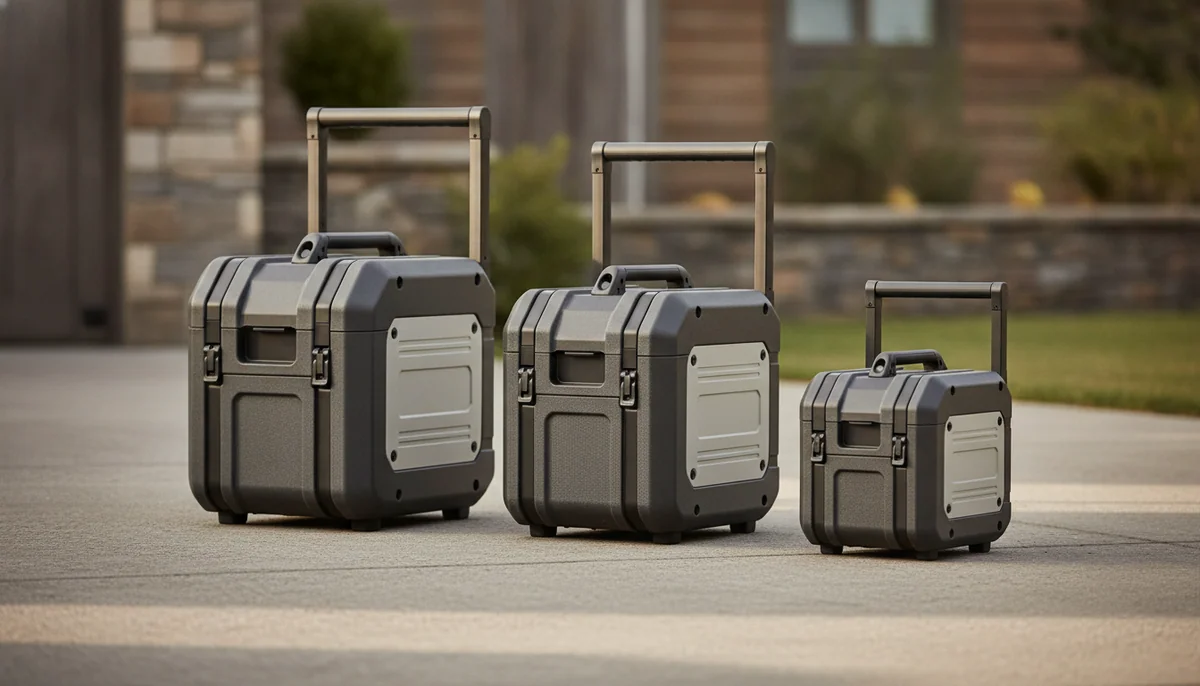
That is a stance rather than a menu, and it is the opposite of how this category is sold. Every listing on this page leads with a peak wattage, and the peak wattage is the number the machine can hold for the second and a half while a compressor spins up. The figure that governs your evening is the continuous rating underneath it, and on these twelve products the gap between the two runs from twenty to twenty-nine per cent. Buyers work this out on their own, and they are blunt about the reason: the surge number is the one printed in big letters because it is the one that catches the eye.
So here is the whole field with both numbers, taken from each manufacturer's own published figures. Nothing on this page has been metered by Specific Load or, as far as we can find, by anybody else outside the companies that make them.
| Machine | Peak | Continuous | What the gap costs you |
|---|---|---|---|
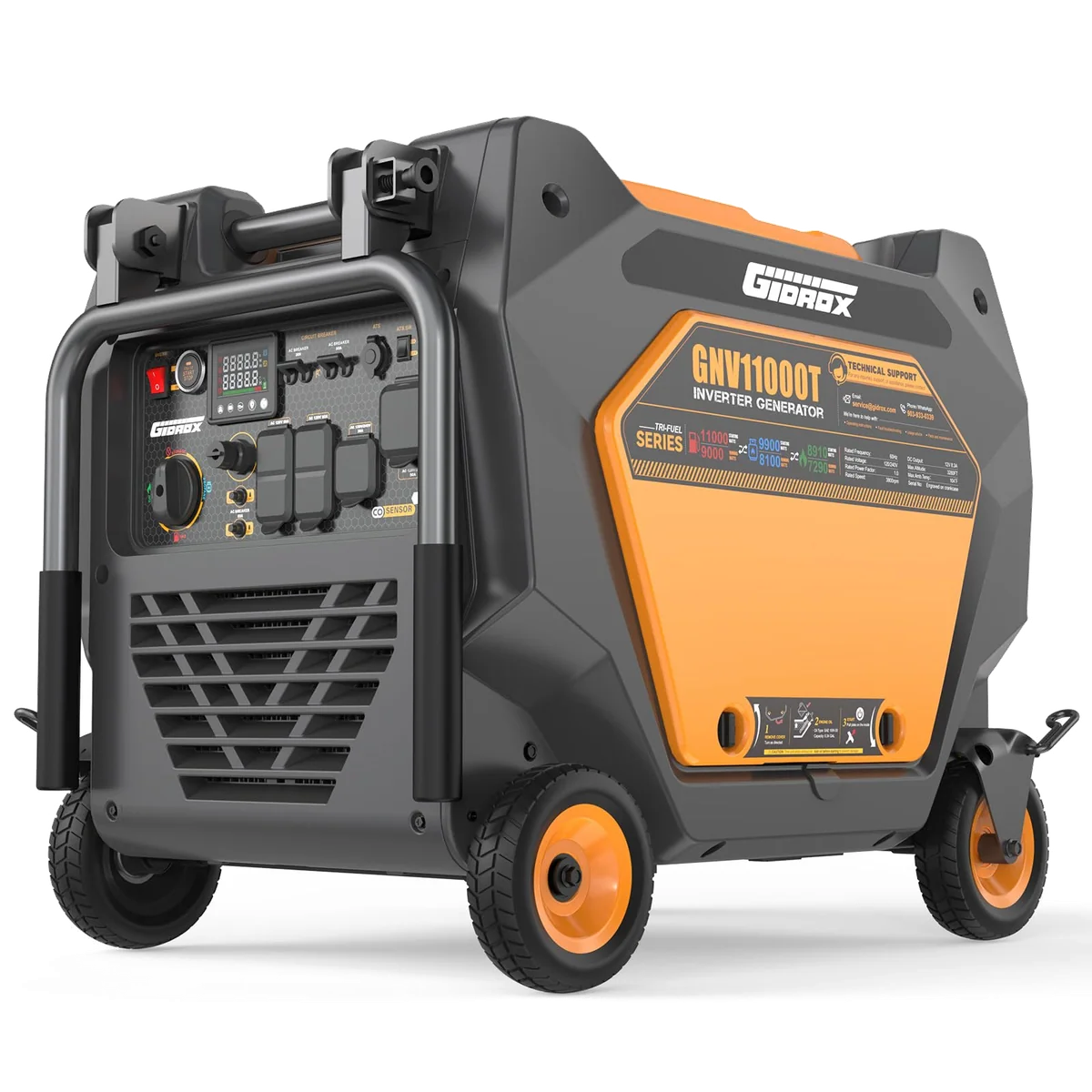
| Gidrox 11000W tri-fuel | 11,000 | 9,000 | 2,000 W, and no published figure at all on natural gas |
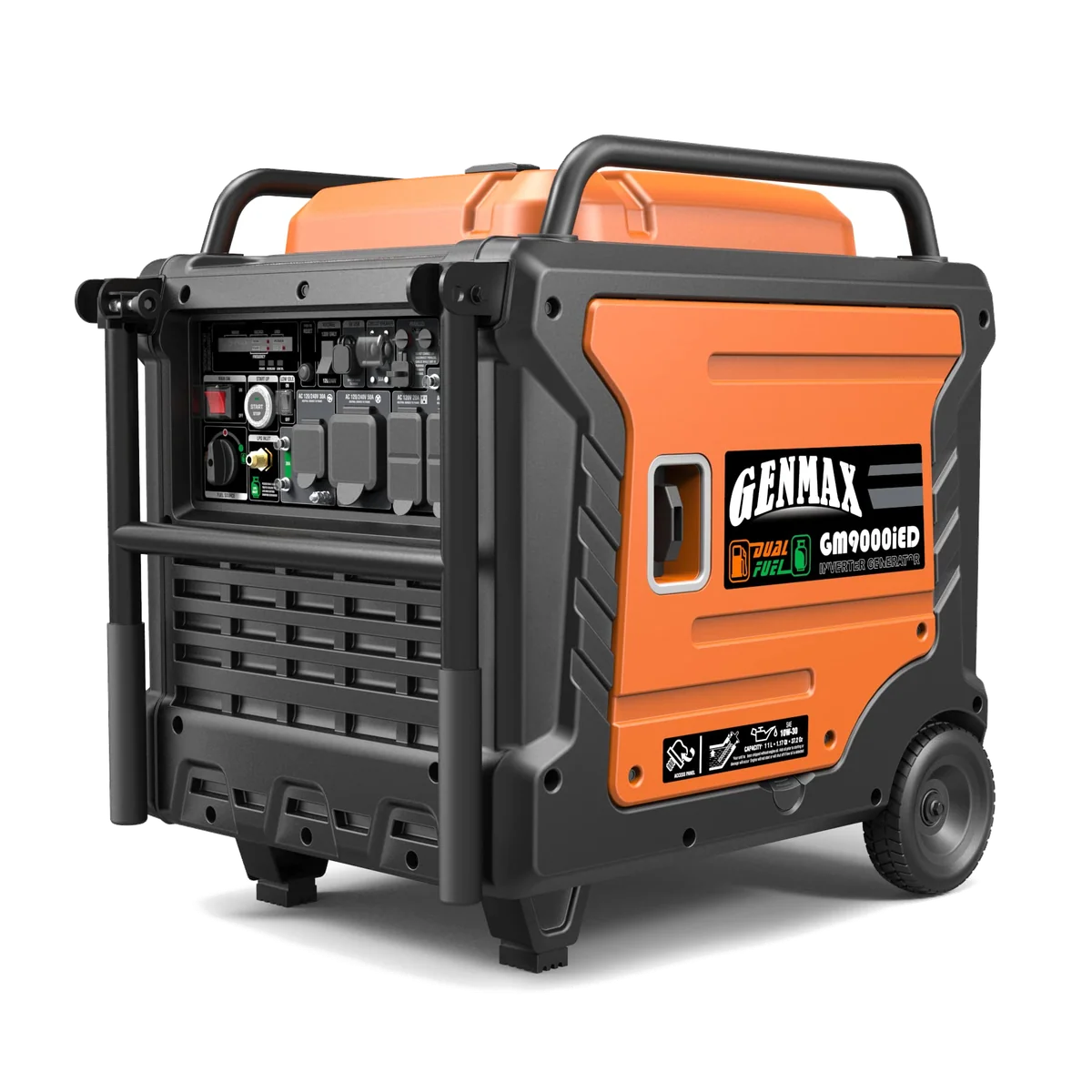
| GENMAX GM9000iED | 9,000 | 7,600 | 1,400 W, or 32 amps at 240 volts rather than 37.5 |
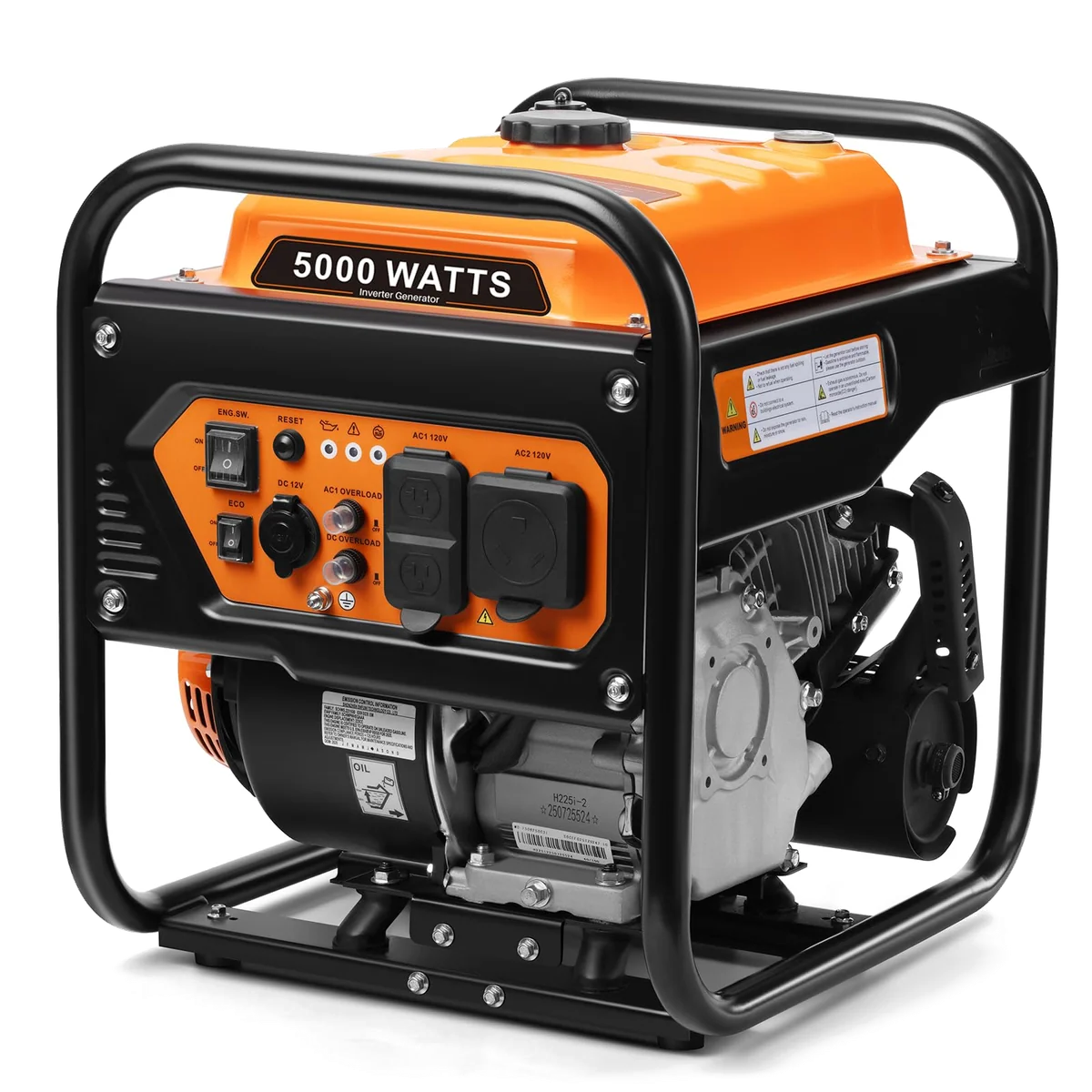
| Oxseryn 5000 | 5,000 | 4,000 | 1,000 W, all of it at 120 volts |
| GENMAX GM4500iSAD | 4,500 petrol, 4,000 propane | 4,000 petrol, 3,600 propane | 500 W on petrol, plus a further derate on propane |
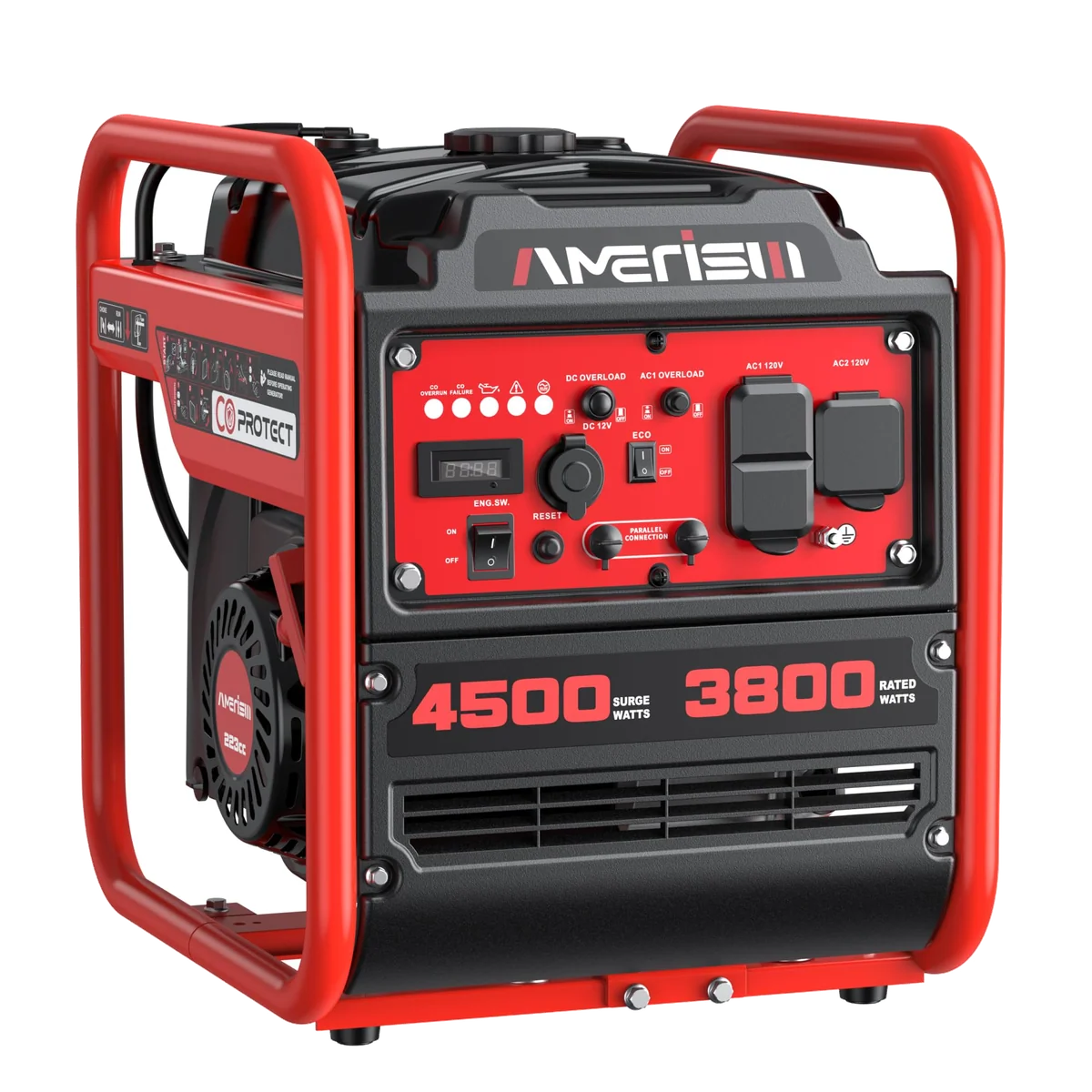
| AMERISUN 4500W | 4,500 | 3,800 | 700 W, and the 3,800 has never been instrumented by anyone |
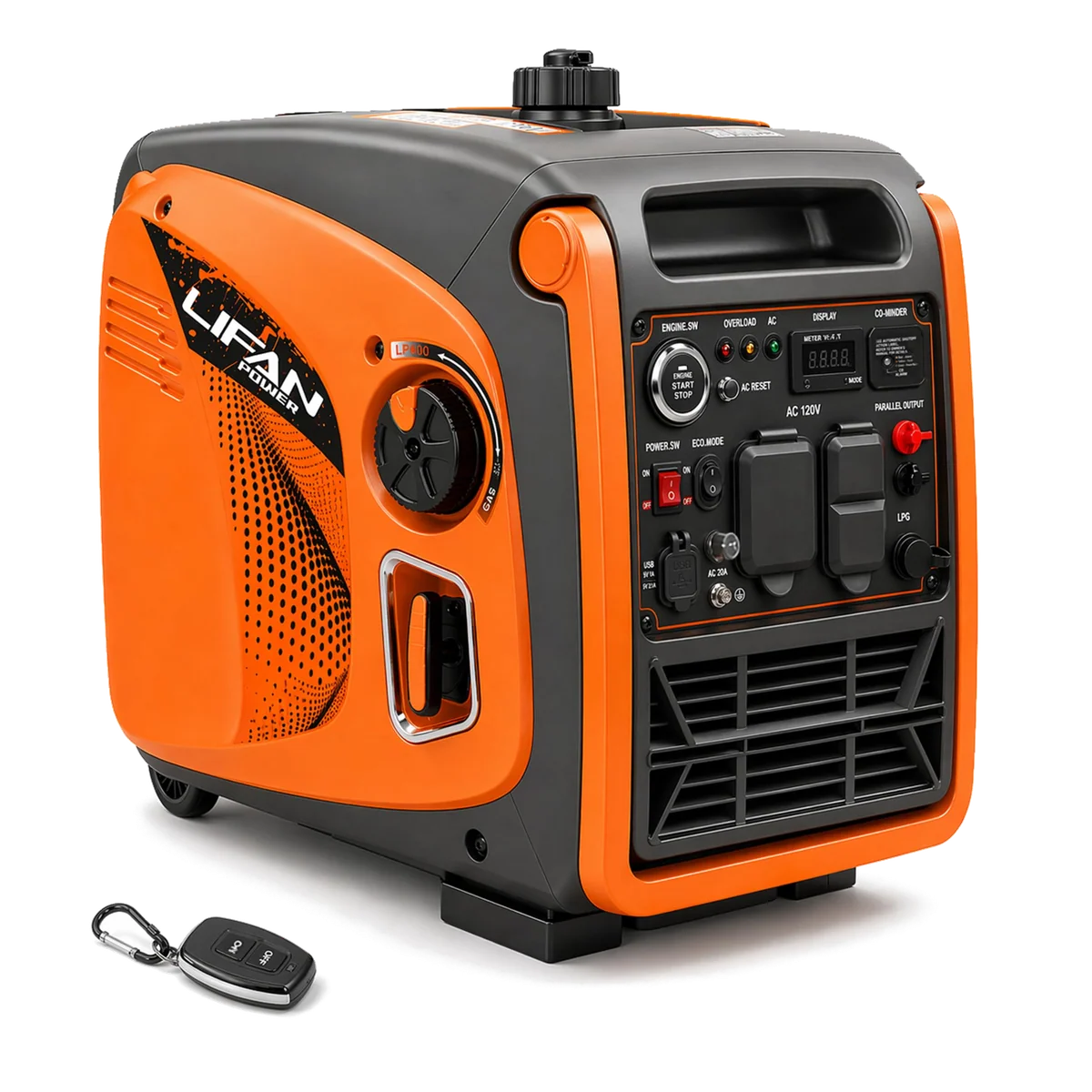
| LIFAN 4800W | 4,800 petrol, 4,300 propane | 3,800 petrol, 3,400 propane | 1,000 W, and the listing quotes the propane figure two different ways |
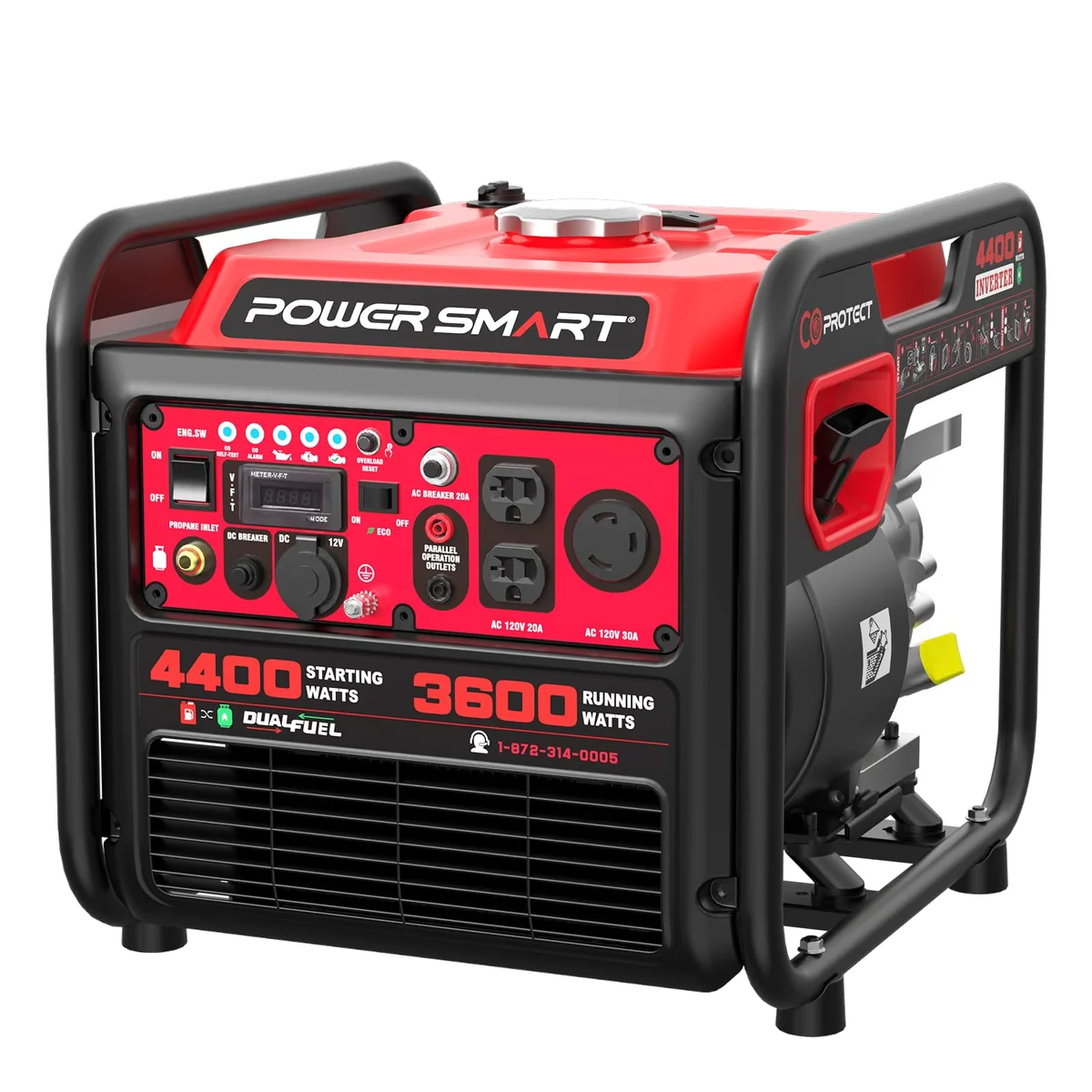
| PowerSmart 4400 dual fuel | 4,400 | 3,600 | 800 W, with no propane rating published at all |
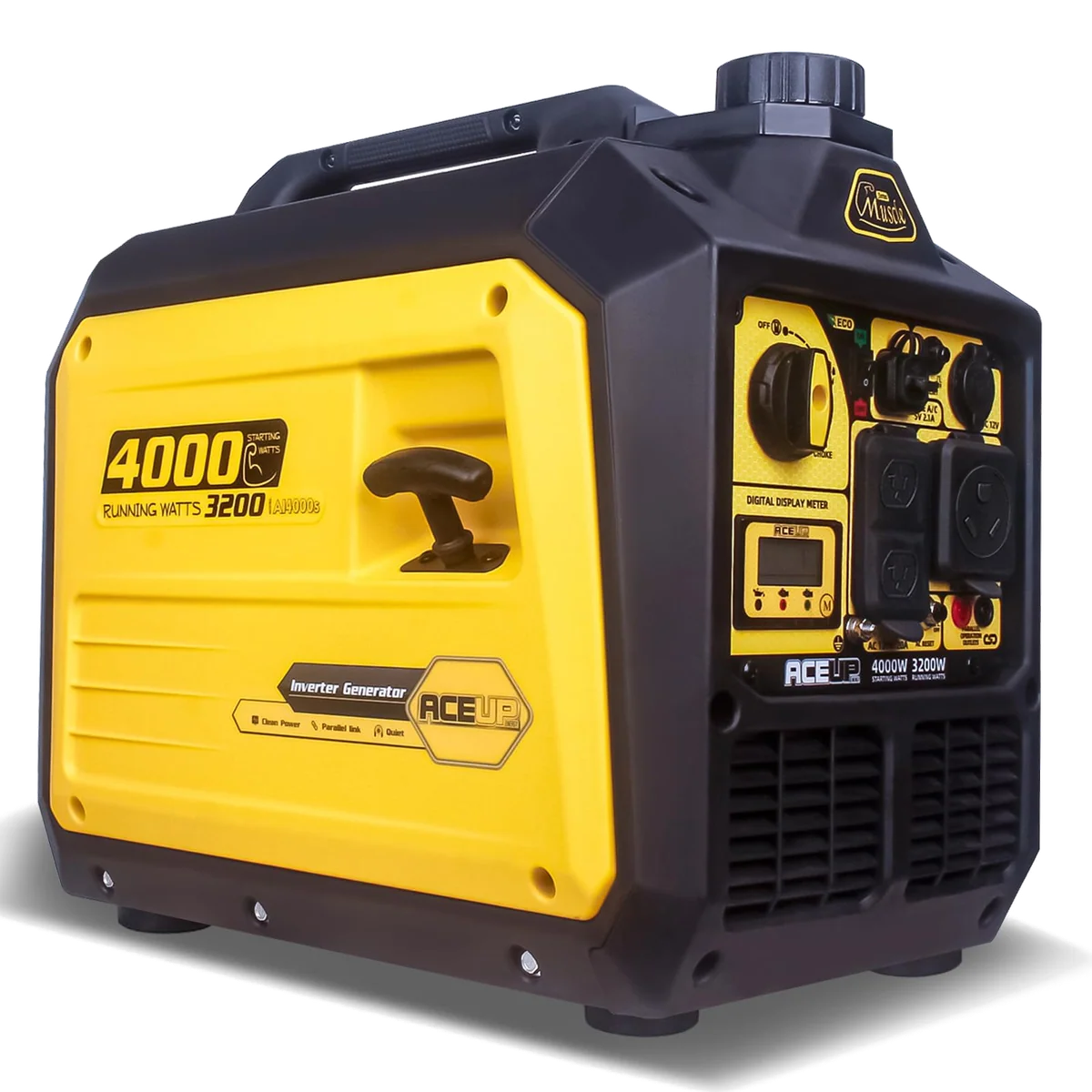
| Aceup Energy 4000 | 4,000 | 3,200 | 800 W, from a 1.32-gallon tank |
| PowerSmart 3800 | 3,800 | 3,200 | 600 W, a gap an owner marked the product down for |
| Efurden 2800 | 2,800 | 2,000 | 800 W, the widest proportional gap on this page |
| RINADURS 2800 | 2,800 | 2,500 | 300 W, the narrowest |
| Aceup Energy 1500 | 1,500 | 1,200 | 300 W, on 0.6 of a gallon |
Those are the makers' own claims and nothing more.
| If this is you | Start here | And accept |
|---|---|---|
| A fridge, a freezer, lights, a router and phones through a two-day outage | The RINADURS 2800 or the Aceup Energy 4000 | Recoil starting, and a tank you will refill in the dark |
| A 30-amp travel trailer with one rooftop air conditioner | The LIFAN 4800W or the GENMAX GM4500iSAD | An hour of undocumented setup on the LIFAN, and under a gallon of tank on the GENMAX |
| A whole house through an inlet and interlock | The GENMAX GM9000iED, or the Gidrox if you have a gas line | A bonded neutral you have to find yourself, or a 9,000-watt claim nobody has verified |
| A tailgate, a market stall or a campsite you carry the thing into | The Aceup Energy 1500 or the PowerSmart 3800 | Small tanks, and roughly a thousand honest watts on the Aceup |
| A sealed box in the garage that you will not touch until you need it | None of them | That the two worst failures documented on this page both happened to machines that were sitting still |
One piece of housekeeping, because it is how a good number of readers arrive. Four of these listings sit in Amazon's power take off generators category, and not one of them is a power take off generator. A real PTO unit is a bare alternator on a driveshaft that bolts to a tractor and borrows the tractor's engine; these are self-contained machines with their own engines, their own tanks and their own pull cords. The category label is an artefact of Amazon's taxonomy rather than a description of anything, and if you came looking for shaft-driven power, we have written up what the real thing is and why these listings carry that name. Judge the machine, not the aisle it landed in.
Quick Picks at a Glance
| Feature | Editor's Pick GENMAX GM9000iED | Gidrox 11000W tri-fuel inverter generator | Oxseryn 5000 watt generator | PowerSmart 4400 dual fuel generator | LIFAN 4800 dual fuel generator | Aceup Energy 4000 watt generator | Amerisun inverter generator |
|---|---|---|---|---|---|---|---|
| Price Range | $1,500–$3,000 | $1,500–$3,000 | $200–$500 | $200–$500 | $500–$1,000 | Under $200 | $200–$500 |
| Finish | Black | Yellow | — | Red+Black | — | Yellow+black | Bright Red & Black |
| Power | 9000 W | 000 W | — | 4400 W | 4800 W | 4000 W | 4500 W |
| Check Price on Amazon | Check Price on Amazon | Check Price on Amazon | Check Price on Amazon | Check Price on Amazon | Check Price on Amazon | Check Price on Amazon |
The twelve machines, and who each one is actually for
Each of these carries a link to its own full review where one exists, and each of them has a drawback stated plainly underneath the reason to want it. Read both lines before you decide. The pattern worth watching as you go down the list is that the capability and the confidence run in opposite directions: the biggest machines here can do the most and are known about the least.
This is the only machine here that can carry a house, if you are the kind of owner who actually runs it.
Pressure-fed lubrication with a cleanable strainer that owners have watched catch metal shavings, a 50-amp receptacle matched to what the alternator can genuinely make, remote start and rock-steady 60 Hz output under mixed household load add up to the most seriously engineered generator on this page.
Its two harshest owner accounts describe units that failed while stored rather than while working, and it ships with the neutral bonded to the frame in a place the manual never mentions.
Buy this one only if a natural gas line is genuinely part of your outage plan.
Tri-fuel with the propane and natural gas hoses in the box, a carburettor bowl drain aimed squarely at the failure that kills stored generators, and a 50-amp outlet make it the most capable machine here on paper, and the gas-line runtime is a real argument the listing barely bothers to make.
Nobody has load-tested it, the only owner who reports pushing it says it stops working somewhere between 5,000 and 5,500 watts against a 9,000-watt running claim, and no natural gas output figure is published anywhere at all.
A frugal, quiet camper and outage generator wearing a home-backup badge it cannot fill.
Owners running the light loads people actually connect report around ten hours on two gallons in eco mode, comfortably beating the maker's own six-hour claim, from a 60-pound frame with a real 30-amp RV socket and a carburettor drain screw that makes proper storage easy.
There is no 240-volt outlet, no electric start and no second fuel, so despite the title it cannot feed a transfer switch, and two of the eight substantive owner reviews involve a replacement unit.
This is the cheapest honest way to get 3,600 watts and two fuels into a garage.
Every owner in the record who mentions starting it says it fires on the first pull, on petrol or on propane, from a 61-pound machine one person can lift into a car.
It is an open-frame generator its own listing rates at 76 dB, one reviewer's two units both smoke and burn oil, and the owner whose machine failed after three weeks of standing was told to locate a repair shop and pay the freight himself.
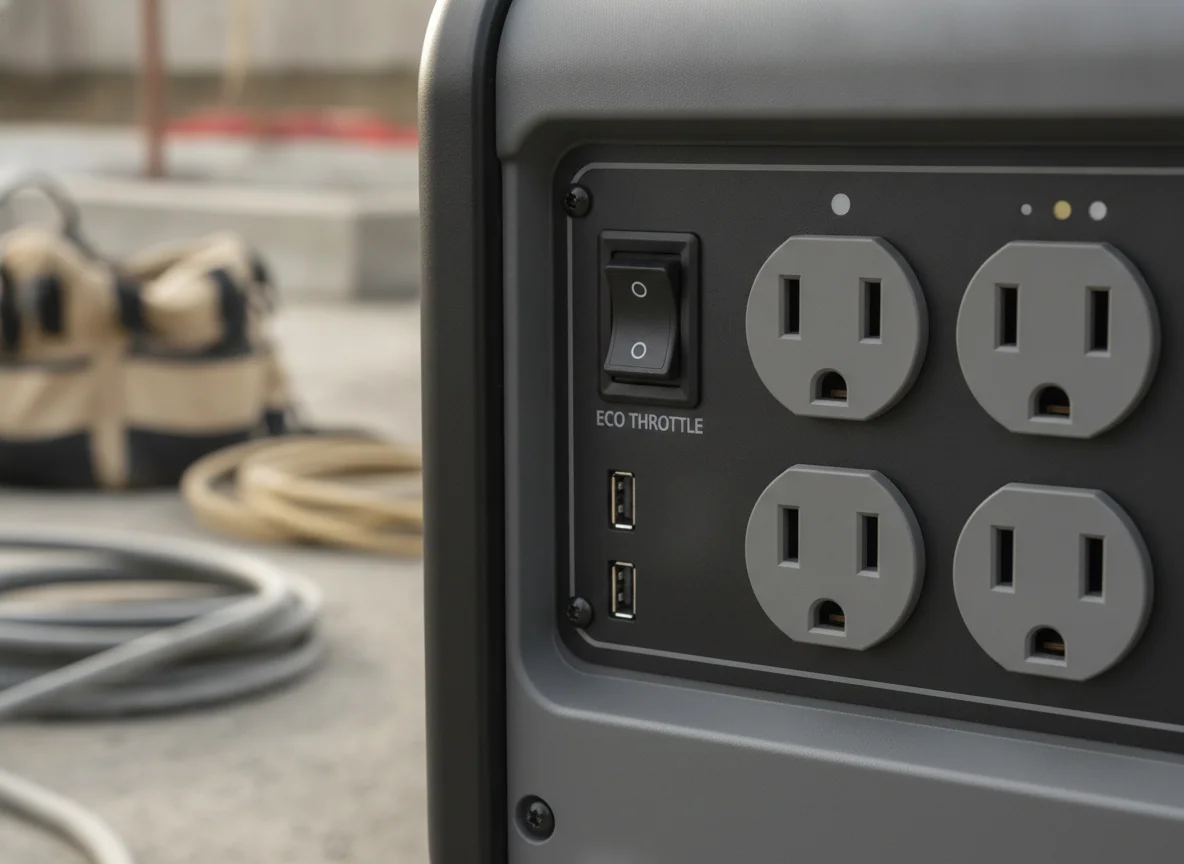
Remote start and a proper trailer socket, at a price the established brands do not offer them at.
A genuine TT-30 receptacle means a 30-amp trailer plugs straight in with no adapter chain, the key fob works, and the one owner who worked it hard ran a rooftop air conditioner, a microwave and the converter together with only a brief voltage dip.
The starter battery ships disconnected behind a frame rail the manual never mentions, it arrives dry and wants 10W-40 specifically, and there is no 240-volt outlet anywhere on it.
The best instrument panel on this page is bolted to a fuel tank that can suck itself flat.
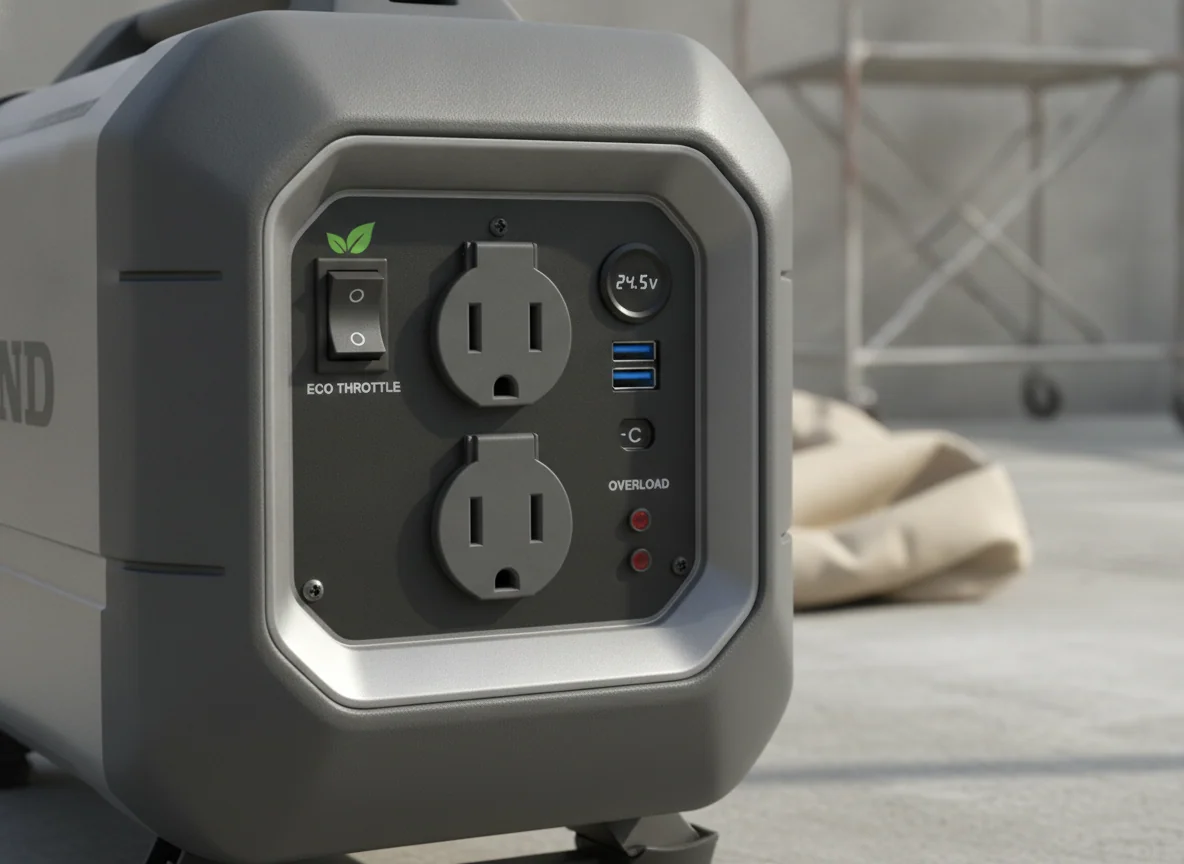
Volts, hertz, amps, load percentage, engine RPM, fuel level and lifetime hours on one display, plus a 30-amp socket, a 12V outlet and a four-screw cover that exposes the carburettor and plug, is equipment this price class normally deletes entirely.
The internal fuel tank has collapsed inward on owners who closed the cap vent with petrol still in it and let the temperature drop, and the manual does not warn you about that at all.
Take this one only if you specifically need forty pounds of enclosed inverter and nothing else will do.
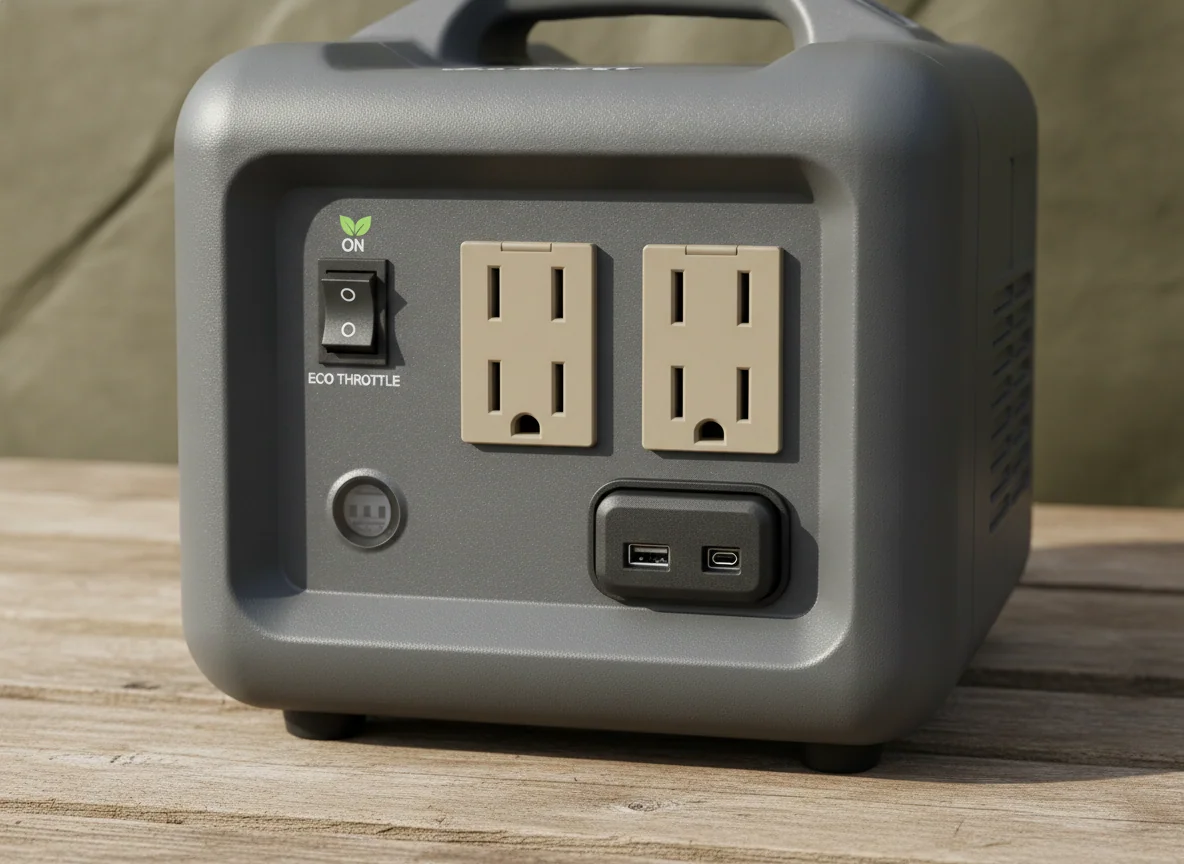
It earns its slot as the most genuinely portable enclosed machine here, 2,000 continuous watts of low-distortion power in a hand-carried body with a fuel gauge and eco mode, which is a real answer for camping and a laptop.
The 2,800 in the name is surge only, the quiet rating has never been checked by anyone outside the manufacturer, the high-altitude jet is not in the box, and it is petrol-only with a one-year warranty on a product designed to sit unused for months.
A competent open-frame inverter attached to a warranty nobody has managed to use.
The one person who genuinely loaded one ran two portable air conditioners together, then a circular saw, then a 15-amp table saw, then both saws at once, then a wood chipper, and could not find a way to upset it.
Roughly one owner in six on the largest pool of feedback for this machine left a single star, the failures cluster in the first days or the first three months, and the owners who tried to claim were routed to a service network that had either moved on or was too far away to reach.
Fifty-one pounds of dual fuel that ran a fifth wheel's rooftop air conditioner for one owner.
An owner ran their 15,000 BTU fifth-wheel air conditioner on this both on petrol and on propane with no trouble, switching fuels easily and getting around six hours per tank across multiple days, from a machine light enough to lift alone.
The tank holds only about nine tenths of a gallon, and a second owner reports it overloading at roughly 2,200 watts and ten amps on propane against a 3,600-watt propane claim.
A 3,200-watt inverter light enough for a market stall, with a headline its own owners correct.
Owners report six to seven hours on eco mode, quiet running against the open-frame machines they traded up from, and a 50-pound body that a petite adult describes lifting alone, with a TT-30 socket and USB ports on the panel.
The 3,800 is surge and the real continuous figure is 3,200, two separate owners marked it down for a tank they consider too small, and one unit started smoking after twelve hours of running.
The tailgate and campsite machine, at around thirty pounds and 1,200 running watts.
It is the easiest thing here to actually carry, and owners report it running a fridge, lights and phone charging through an outage, keeping batteries topped up at a campsite and drawing a crowd at tailgates on how little noise it makes.
One owner's starter cable failed at around thirty hours of normal use, another had to bypass the governor manually to stop it stalling on first start, and a third could not keep it running at a campsite at all.
This is the only generator on this page with a documented owner past three hundred hours.
That owner reports oil still slick at change time, no oil burning, easy starting and around twelve hours per tank in eco mode running lights, a television, a microwave and a pellet stove, which is the single strongest durability finding in this entire comparison.
Two owners received units that ran rough or quit within hours of first use, one of them tracing it to a spark plug that arrived with its porcelain shattered and the wrong heat range fitted from the factory.
Two of those cards deserve a note on how to read them together. The RINADURS and the Aceup 1500 are the cheapest and least powerful machines here, and they are also the two with the clearest evidence of hours on the clock, in one case good and in the other bad. That is not a coincidence. Small machines get bought by people who use them constantly, so their records fill up fast, while the large dual-fuel units get bought as insurance and sit, which is exactly why nobody can tell you what one looks like at five hundred hours.
What we weighed, and what we refused to count
Specific Load has not run any of these generators. Nobody here has pulled a cord, clamped a meter on an output or stood twenty-three feet away with a sound level meter, and no sentence on this page should be read as though we had. What we did was read each product's whole public record: the listing and its specifications, every customer review Amazon retains, the forum threads where owners argue about the same faults, and the manufacturers' own replies where they exist. Where the record is silent, this page says so rather than borrowing a figure from a sibling model.
That method produces an uncomfortable finding, and it is the spine of everything below. Star averages in this category are mostly measuring unboxing. The Gidrox carries a strong average built almost entirely on reviews written within about four weeks of the earliest delivery, and the ones that say anything about running the machine mostly say a version of not yet. The LIFAN has six ratings and one owner who has actually put a load on it. The GENMAX GM4500iSAD has two written reviews in total. None of that makes those machines bad. It makes their ratings close to meaningless, and a page that treats a four-and-a-half-star average from twenty-five buyers as a consensus is selling you a coin toss with a decimal point on it.
So we ranked on evidence of use, and evidence of use is rare enough here to name individually. A mobile grooming business puts ten hours a day, five days a week, on a GM9000iED and reports nothing going wrong. An Aceup Energy 4000 owner is three days into an outage with the machine running non-stop on a fridge, a deep freezer and phone charging. And the single best durability data point anywhere on this page belongs to the smallest serious machine in the set: a RINADURS owner past three hundred hours, reporting oil still slick at change time, easy starting, no oil burning and around twelve hours per tank in eco mode. Nobody else on this page has come close to documenting that.
We weighed failures the same way, by what they tell you about ownership rather than by their star count. The failures that mattered most were the ones that happened to machines being looked after. A PowerSmart 4400 ran an RV air conditioner on propane for about forty-five minutes exactly as the manual described, sat for three weeks, and then cut out after thirty seconds with the overload light on and nothing plugged into it, on both fuels; the manufacturer's answer was to find a repair shop, ship it there at his own cost, and hope for reimbursement. An Aceup Energy 1500 owner's starter cable stopped working at roughly thirty hours of normal use. An Oxseryn buyer smelled petrol from the first day and found seven months later, when he finally filled the tank, that the fuel shutoff valve had been leaking the whole time. None of those are stale-fuel stories. They are machines that were maintained correctly and failed anyway, which is the shape of risk you are actually taking.
What we refused to count: TikTok clips, affiliate video, and the automated review pages that circulate around several of these model numbers. A great deal of the short video content under these brand names is about a different and usually much smaller machine than the one being praised, and at least one generated review of a product on this page manages to name a different manufacturer entirely. We read that material to know what buyers are being told. We did not treat any of it as evidence, and neither should you.
The five decisions that actually matter
Work out your load in amps, not adjectives
The continuous rating in that first table is a ceiling, not a working budget. Hold a portable engine at ninety per cent of its rating and it will sag the moment something else steps on, which is how a fridge compressor cycling takes the lights with it. The conventional figure is eighty per cent, so the Aceup 4000's honest continuous budget is about 2,560 watts, the PowerSmart 4400's is about 2,880, and the Gidrox's is roughly 7,200 on petrol and less than 6,500 on propane. Here is what that buys, using the typical nameplate ranges you plan against rather than readings taken from any of these machines; read the labels on your own appliances, because they vary enormously.
| Load | Roughly, running watts | Verdict |
|---|---|---|
| Full-size fridge | 150 to 250 | Every machine here, including the 1500 |
| Chest freezer alongside it | 100 to 200 | Everything from the Efurden up |
| Gas furnace blower | 600 to 900 | Comfortable from 2,500 continuous up |
| Sump pump, one third to half horsepower | 800 to 1,000 | Fine on its own, tight alongside a fridge on the smallest units |
| Window air conditioner, 8,000 BTU | 700 to 1,200 | One of them, on the 3,200-watt machines and up |
| RV rooftop air conditioner, 13,500 BTU | 1,300 to 1,800 | Realistic on the 3,200-watt units and up, better with a soft start |
| Well pump on 240 volts | Varies | Only the GM9000iED and the Gidrox make 240 volts at all |
| Central air condenser | Thousands, with a brutal start | The GM9000iED with a soft start fitted, and nothing else here |
That last row is where people lose money, and the arithmetic is not marginal. Read your outdoor unit's data plate rather than any wattage table: RLA is the rated load amps and LRA is the locked rotor amps, and it is LRA that decides whether the lights dim or the breaker goes. Ninety-five locked rotor amps at 240 volts works out to something like 22,800 watts of inrush, or roughly eleven kilowatts once you allow for voltage droop, which is why the settled answer in owner communities is that a five-thousand-watt portable is not close and a soft start is not optional. A GM9000iED owner who researched this for over a month measured his soft start dropping a locked rotor draw from 94 amps to 34, which fits inside that machine's 37.5-amp peak with almost nothing spare. We take the whole question apart in whether a portable generator will run your air conditioner, and if the numbers on these boxes still feel slippery, what size generator you actually need is the place to start.
Check whether it makes 240 volts before you plan any wiring
Ten of the twelve machines here are 120 volts only. A 30-amp TT-30 socket is a travel trailer connection at 120 volts, which is about 3,600 watts, and it is not the 240-volt L14-30 that feeds a house panel. Buyers arriving from threads where thirty amps almost always means 240 volts misread this constantly, and the listings do nothing to correct them. Only the GENMAX GM9000iED and the Gidrox produce two legs, and each carries a catch: the GENMAX ships with its neutral bonded to the frame with no conversion instructions supplied, sitting on a metal rail behind the electrical panel near the LPG inlet where it is genuinely hard to reach, and the Gidrox does not state its neutral configuration anywhere at all. Settle that question with a multimeter before the machine ever meets a transfer switch, because continuity between neutral and ground means bonded and that changes what you are allowed to do next. The full picture, including why backfeeding is the thing to avoid, is in connecting a portable generator to your house, and if a house is the real requirement then the machines in our home backup picks are a better starting point than most of this page.
One more piece of arithmetic that catches people on the big machines. A 50-amp outlet at 240 volts is 12,000 watts, which is more than any single generator here makes continuously, so on the Gidrox the receptacle is a connector convenience rather than a promise of fifty amps. On the GM9000iED it is the opposite and genuinely useful, because 9,000 watts at 240 volts is 37.5 amps, which is over a 30-amp connector and about right for a 50. The same limit governs paralleling: two machines joined through one 50-amp outlet are capped by that outlet at around 12,000 watts, whatever the listing's combined figure says.
Treat every decibel claim as a claim
Six of these listings use the word quiet in the title, and the numbers behind it range from 55 to 76 dB. Nothing on this page has been independently metered. What can be said is that the ratings are taken at twenty-three feet, usually at a quarter load, which is the quietest condition the machine has and not what an outage looks like, and that open-frame units are a different animal from enclosed ones no matter what the sticker says. The PowerSmart 4400 is rated by its own maker at 76 dB, which is loud by any standard, and the word quiet on that listing is graded against contractor generators rather than against inverters. Owners of these machines are consistently more careful than the copy: the adjective in the reviews is almost always hedged, and eco mode gets named again and again as the setting that makes any of them tolerable. If a campground or a neighbour is the constraint, read what a 58 dBA at 23 feet rating is actually measured at first, and look at the quiet camping picks rather than trusting a title.
Assume you are the warranty
Warranty terms on this page run from one year to three, and the term is not the variable that matters. What matters is whether there is anybody behind it. The pattern in the record is consistent enough to plan around: the AMERISUN owners whose machines died were sent to a service centre that had stopped taking the work, the PowerSmart owner was told to arrange and fund transport himself, the Aceup owner whose fuel tank had physically deformed was told nothing was broken and refused a replacement inside the warranty period, and the GENMAX owner with two dead units was directed to a centre over an hour away and asked to prepay the diagnostics. Against that, an Oxseryn buyer with a leaking fuel valve was simply shipped a whole new generator and told not to bother returning the old one, and a GENMAX buyer with a faulty carbon monoxide sensor had it honoured. It is a lottery, and the return window is the only coverage that has worked reliably for anybody. That is the entire argument in what you actually buy with a no-name inverter generator, and it is why the practical instruction on this page is to fuel it, oil it and load it in the first week rather than the first outage. If parts are your worry, note that PowerSmart and AMERISUN share a parent company, which we go through in who makes PowerSmart and Amerisun generators.
The habit that decides whether it starts at all
Ask experienced owners what kills these machines and almost nobody blames the engine. They blame the carburettor, and not because the carburettor is bad: petrol sits in the bowl, turns to varnish and plugs the passages, so the machine fires on what is left in the bowl, runs twenty or thirty seconds, and dies the moment you ask it to work. There is a genuine split about the cure, with one camp swearing by ethanol-free fuel and the other insisting that what actually matters is shutting the fuel valve and running the machine dry before it goes on the shelf, and the longest-serving owners in that argument, at eight and ten years on the same machines, both credit draining. Draining is the load-bearing habit. Several machines here are unusually well equipped for it, with fuel shutoffs, in-tank filters and carburettor drain screws, and the Gidrox ships tubing specifically for emptying the bowl before storage. Our guide to storing a generator so it starts when the power goes out is the procedure, and on any of these I would treat it as mandatory rather than optional. The other half of that argument is fuel choice, since propane does not go stale in the bottle at all, and what each fuel costs you in watts and runtime lays out the trade the dual-fuel machines here are asking you to make.
Two related habits while you are at it. Change the oil early, because the first change on a new small engine carries out the break-in swarf and it is the change nobody tells you about. And put the machine outdoors, well away from doors, windows and vents, with the exhaust pointed away, regardless of whether it carries a carbon monoxide sensor; a sensor reacts to a condition that already exists and is not permission to move the thing closer, which we are blunt about in running a generator outside.
When it is not the generator
Two faults get blamed on these machines constantly and usually are not their fault. A generator that runs perfectly while nothing comes out of the sockets is almost always a switch, a breaker or a voltage transfer selector rather than a dead alternator, and one GM9000iED owner had exactly that on his 50-amp outlet and was talked through it by a technician in a couple of minutes; the sequence to check is here. And a machine that trips or stalls under a load it should carry is usually oil level, then stale fuel, then a tired extension cord, then all the load sitting on one leg, and only then a genuinely undersized generator; we walk that ladder in order. If it will not start at all, the fuel valve, the cap vent and the switch you cannot see account for most of it, and the Aceup's invisible black-on-black fuel knob is a textbook example.
Finally, the option that is not on this page at all. A good number of people reading this are choosing between a cheap petrol machine and a battery, and for overnight silence, indoor use, a CPAP or an oxygen concentrator, the battery is the better instrument; the generator's advantage is that it runs indefinitely on refills. That is why so many households end up owning both, an argument we make in solar generator versus gas generator, with the hardware in the power station picks and the medical case in backup power for a CPAP or concentrator.
Frequently Asked Questions
What is the quietest 4,000-watt generator?
Nobody has metered any of these independently, so the honest answer is that the enclosed machines here beat the open-frame ones by a wide margin regardless of what the stickers claim, and eco mode does more for the noise than the badge does.
What is the largest portable generator on this page?
The Gidrox tri-fuel at 11,000 peak watts, though its 9,000-watt continuous claim has never been verified by anyone and one owner reports it giving up well below that.
Can any of these back up a whole house?
Only the GENMAX GM9000iED and the Gidrox make 240 volts at all, and even the GM9000iED tops out at 32 amps at 240 volts continuous, so your condenser's data plate decides the answer rather than the number on the carton.
Are Aceup Energy generators any good?
The 4000 has the best instrument panel here and owners past a year who report first-pull starting, but the fuel tank can collapse if you close the cap vent with petrol inside and the one documented warranty claim was refused.
Is LIFAN a good generator brand?
LIFAN is a long-established Chinese engine maker whose motors have a decent reputation and whose fuel-system plastics and documentation have a poor one, so the risk you are taking is about paperwork and parts rather than the engine.
Are PowerSmart and AMERISUN the same company?
Yes, AMERISUN is PowerSmart's parent, and machines sold under the two badges are frequently the same hardware with different stickers, which we go through in our page on the brand .
Where do I find the manual and the oil specification?
Several of these listings never publish an oil grade or capacity at all, so use whatever ships in your box rather than a figure borrowed from a sibling model, and expect the documentation gap to be the norm in this corner of the market.
Why does my generator start and then shut off after a few seconds?
On a machine that has been standing, that is the signature of a gummed carburettor feeding the engine only what was left in the bowl, and on machines with a carbon monoxide sensor a faulty sensor has been documented causing exactly the same symptom.
Why does the generator trip its breaker when the load should be within range?
In the field it is usually oil level first, then stale fuel, then a tired or undersized extension cord, then everything hanging off one 120-volt leg, and only then the machine being genuinely too small.
Are these actually power take off generators?
No, none of them attach to a tractor, and the category label is an Amazon taxonomy artefact rather than a description of the product.
Our Top Pick
The GENMAX GM9000iED is our #1 recommendation.
Check Price on Amazon: GENMAX GM9000iEDSources (3)
- Amazon listings and customer reviews
- Owner reports across r/Pecron, r/Generator threads
- Powerequipmentforum — Article — www.powerequipmentforum.com