Rain is not what will kill your generator, and the shelter you build for it might
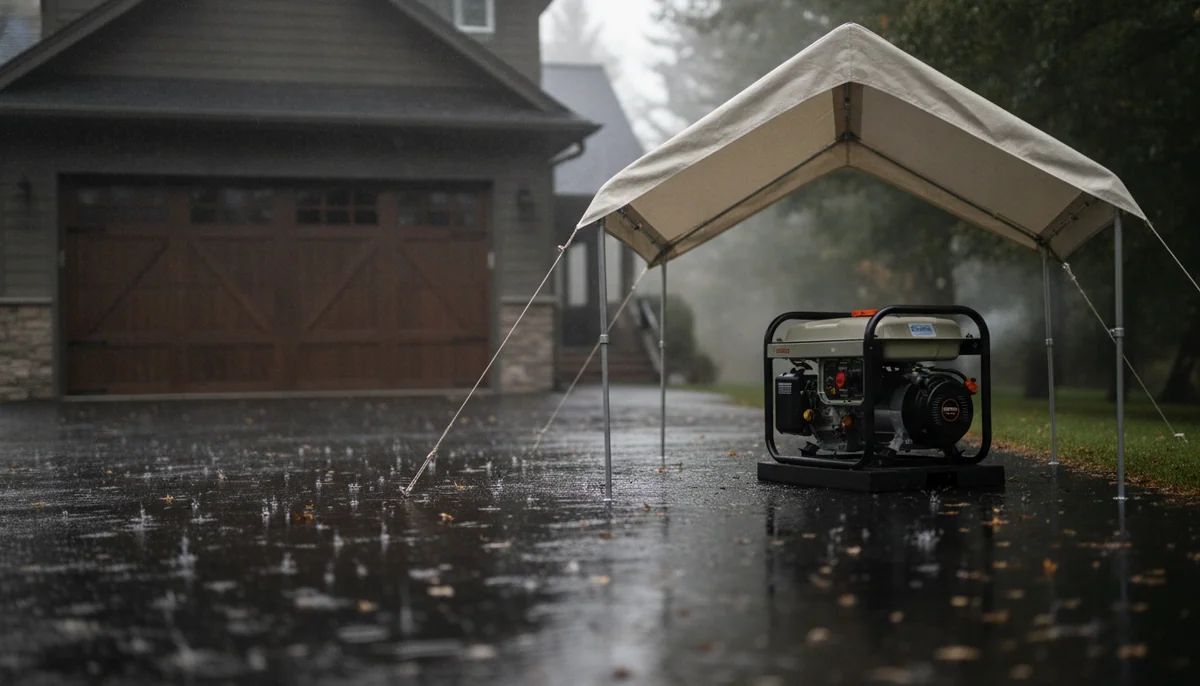
Two questions bring almost everybody to this page, and they deserve opposite answers. Can it get wet is a question about equipment, and equipment is replaceable. How close can it sit is a question about a colourless gas that has no smell, mixes into the air rather than sinking out of it, and goes wherever the air goes, which on any evening your bathroom fan or your dryer is running is straight into the house. The first question has a workaround. The second one does not, and the failure is not the kind you get to learn from.
So, the short version, before any of the argument below. Put the machine on something rather than in the puddle. Give it twenty feet of open ground with the exhaust aimed away from every door, window, vent and soffit. Cover it with something that keeps rain off the panel and leaves all four sides and the top open to moving air. Run one heavy cord, not four thin ones through a cracked window. Treat the carbon monoxide cutoff as the thing that catches you when you have already made a mistake.
| Do this | Not this |
|---|---|
| Twenty feet or more of open ground, exhaust facing away from the building | Under a deck, in a window well, in a breezeway, or against a wall with a soffit vent above it |
| An open-sided canopy with generous clearance above and around the machine | A tarp over the frame, a plastic bin, a shed, or anything with three or more walls |
| One heavy cord, or an inlet box and interlock, so distance costs you volts and not safety | Moving the generator closer because the cord is short or the rain is horizontal |
The listings do not help. AMERISUN sells its carbon monoxide shutdown as protection "for outdoor nearby-home use," which is marketing doing the exact reasoning this page exists to interrupt. GENMAX's version is more honest about what it is, a device that turns the engine off once an unsafe level has already been detected. That is a backstop, and a backstop measures the air the machine is standing in, not the air beside your pillow at four in the morning.
The fair objection to all of this is that twenty feet is a nuisance. It costs voltage, it costs cord, and it means a walk through the rain to refuel. Plenty of people have run a generator under an overhang for years and are fine. That is a survivorship argument, and it is the only argument on the other side, which is why Specific Load will not soften the distance.
Rain: what actually gets wet, and what it costs
A running generator is a warm object moving a large volume of air, so most of the water landing on the cabinet of one runs off or evaporates. The parts that care are the receptacle panel, the cord ends lying in the grass, and the cooling intakes that are pulling in whatever is in the air around them. Gidrox is unusual in addressing the first of those directly, advertising sealed rubber covers over the outlets and ground fault protection on an enclosed cabinet. That is the panel dealt with. It says nothing about the vents, and neither does anybody else.
Open-frame machines have less between the weather and their internals, and every one of them is standing on the ground where the water collects. The Oxseryn 5000 is sixty pounds of open frame by its own listing, and the PowerSmart 4400 is the same shape despite the word quiet in its title. Put either on a pallet, a couple of blocks or a rubber mat. A metal frame sitting in standing water is how a ground fault outlet starts tripping on you for reasons that have nothing to do with the load, and chasing that at night is miserable; the ladder for it is in why a generator trips, stalls or shuts down.
Connections are where rain turns from an inconvenience into a hazard. One Oxseryn owner had the flat prong on his trailer's power cord melt against the generator's outlet. Heat at a connection is resistance, and resistance is exactly what a loose, corroded or waterlogged plug gives you under a real load. Use cords rated for outdoor use, keep the joins off the ground and up out of any puddle, and if a plug ever comes out of a socket warm, that pair is finished.
The part nobody plans for is operating the thing in weather
An Aceup Energy owner spent his first outage in pouring rain fighting a machine that would start, run for a moment and die, over and over. The cause was a fuel and run control presented as a black cap on a black panel that he could not see. Nothing was wrong with the generator. Everything was wrong with learning a control panel in the dark with water running into your eyes.
So do the whole sequence once, in daylight, dry, before you need it: fill it, start it, put a real load on it, shut it down the way the manual says. Mark anything you could not find by feel with a strip of tape. That same dry run is where you would discover a machine that is not going to work at all, and the causes are dull and fixable if you meet them on a Sunday afternoon rather than at midnight, which is what the fuel valve, the cap vent and the switch you did not see is for.
Rain also encourages people to close things up, and on at least one machine here that is actively harmful. Aceup owners have had the internal fuel tank pull itself inward and deform, and the reading that holds up is that the cap vent was shut with fuel in the tank while the temperature dropped. Leave the vent open when there is fuel in it. Better, shut the fuel off at the knob and let the engine run itself dry, which is the same habit that keeps a carburettor clean through nine months of standing and is the whole subject of storing a generator so it starts when the power goes out.
Twenty feet, and why the number never moves downward
Distance is dilution. That is the entire mechanism, and it explains which twenty feet count. Twenty feet of open lawn is twenty feet. Twenty feet along the ground to a spot underneath a deck, inside an L of the building, in a window well or in a breezeway is not, because the air above the machine is not going anywhere and the house is more than happy to breathe it in the moment something inside pulls a slight negative pressure.
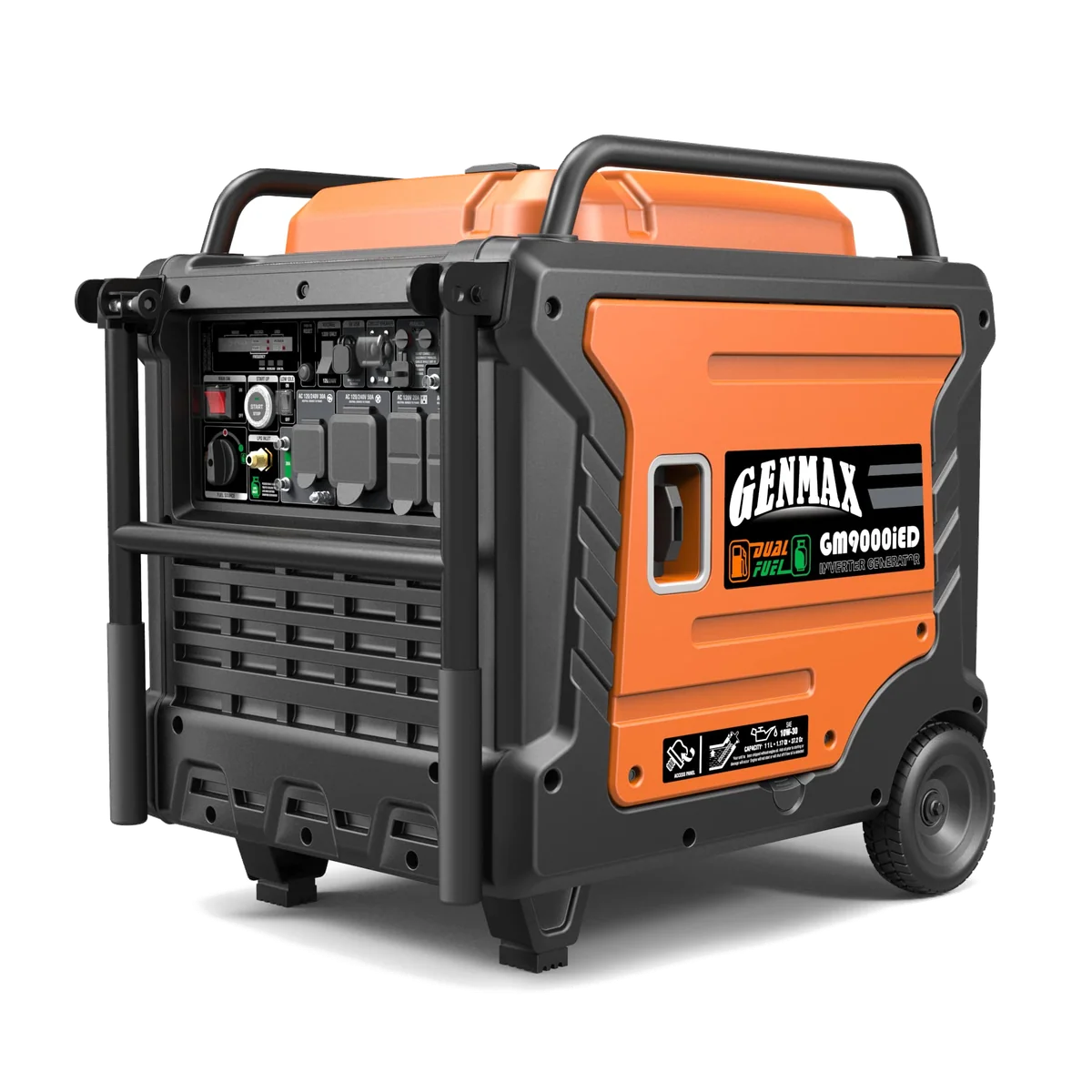
Exhaust direction is a real variable, not a detail. GENMAX puts the exhaust out of the back of the GM9000iED, which one owner named as a genuine advantage because the machine lives near the patio. The same owner ran it on a covered patio and noted he could hear it inside the house. Take that seriously as evidence about air rather than about noise: if the engine is audible indoors, the air outside the machine and the air inside your living room are well connected, and sound is the cheapest possible proxy for that connection.
The garage is the classic. An open door does not make a garage outdoors; it makes a room with one wall missing and a ceiling that holds everything the engine produces. One GENMAX owner removed his machine's carbon monoxide sensor entirely, on the reasoning that these detectors have a limited life and that his living spaces already carry their own. Whatever you think of that decision, his own description of why the sensor exists is the clearest statement of the failure mode anyone has written: so somebody does not run a generator in a garage or right next to an open bedroom window.
Worth noticing that placement is contested even where a professional did it. Owners of permanently installed standby units argue the same question in the same terms, measured clearance from openings and staying clear of the air conditioner that will otherwise pick the exhaust up and push it into the eaves. If a bolted-down installation with a permit attached still gets argued over, a portable you carry out in the dark deserves at least as much thought about where it lands.
The enclosure question, which is where most of the actual danger is
Separate two things that get searched as though they were one. Storing a generator outdoors is easy: cold, drained, covered, off the ground, and the only real enemy is stale fuel. Running one inside a structure is a different engineering problem with three requirements, and hobby enclosures usually satisfy none of them. The engine needs a large and continuous supply of combustion air. It rejects a great deal of heat that has to leave the box faster than it arrives. And the exhaust has to be conducted out of the structure and away from the house rather than allowed to fill the space and drift.
The evidence that a homemade enclosure is failing usually arrives as the machine refusing to run. One owner asked a power equipment forum how to bypass the carbon monoxide cutoff on his GENMAX, because the machine lives in a vented doghouse a hundred feet from the house, a space nobody could climb into to investigate. Read that the other way around. The sensor was not malfunctioning; it was reporting the enclosure. When a cutoff trips inside a box you built, the box is the finding, and the fix is on the outside of it.
What does work is boring: an open-sided canopy or a purpose-made running cover, tall enough and wide enough that air moves freely on every side and above, with the machine on a dry base. If you genuinely need a permanent housing, you are building a small equipment room with ducted exhaust and forced ventilation, and you should price that honestly against a fixed installation, which is the comparison in what the extra money buys over a big portable.
The motive matters here, because most enclosures are built for noise rather than for weather, and noise is exactly the wrong reason. The machines people most want to muffle are the open-frame ones that need the most air. PowerSmart rates its 4400 at 76 dB from twenty-three feet at a quarter load, which is its quietest condition. Oxseryn quotes 70 dB at the same distance. Distance is the answer to both problems at once, and one Oxseryn owner demonstrated it without meaning to: thirty feet behind the camper, barely audible inside, conversation possible outside. If noise is your constraint, buy quieter rather than building a box, and read what a rating at twenty-three feet is actually measured at first.
What the sensor does, and the night it stops your engine for no reason
A carbon monoxide cutoff is a shutdown device. It acts after the gas exists, at the machine, and it is the last line rather than the plan. It also fails in three directions, all of which are in this page's own evidence.
It fails and stops a healthy engine. One GENMAX owner's unit would not run more than a few minutes on either fuel; the fault was a defective carbon monoxide sensor, replaced under warranty, after which the generator ran normally. That is worth carrying as a diagnostic: on a machine that starts and then quits, the sensor is a leading suspect and a warranty part, so call before you conclude the generator is dead.
It trips correctly and gets blamed anyway, which is the doghouse case above. And it goes unverified, or is simply absent. Nobody in the entire public record has confirmed that the AMERISUN 4500's sensor does what its listing promises, while the Aceup Energy 4000 and the Oxseryn 5000 never claim one in their bullets at all.
There is a fourth confusion worth pre-empting. In the dark you will not be able to tell which protection stopped the engine. The most detailed PowerSmart 4400 report on record is a machine that had run an RV air conditioner correctly for about forty-five minutes, sat for three weeks, then ran roughly thirty seconds and cut out with the red overload light on with nothing plugged in, repeatedly, on both fuels. Overload, low oil and carbon monoxide all end the same way from where you are standing, which is one more argument for learning the panel while it is light out.
The six machines this page hangs off, and where each of them should stand
Several of these listings sit in Amazon's power take off category, which is a filing artefact rather than a description; none of them bolts to a tractor, and the real thing is a different machine entirely. What differs between them, for the purposes of this page, is whether the exhaust is aimed, whether the cabinet is enclosed, and whether there is a cutoff behind you at all.
| Machine | The call | What comes attached |
|---|---|---|
| GENMAX GM9000iED | Buy it if you will exercise it monthly under real load and are willing to deal with the factory neutral bond yourself; the rear-facing exhaust and 50A outlet suit a machine that lives far from the house. | The two worst owner accounts describe units that failed while stored rather than while running, one unit's carbon monoxide sensor was itself the fault that stopped the engine, and warranty service means moving 250 pounds. |
| Gidrox 11000W tri-fuel | The only one here with a natural gas story for a multi-day outage, an enclosed cabinet, and a panel advertised with sealed outlet covers. | Nobody has load-tested it, the one owner who pushed it reports it giving up somewhere between 5,000 and 5,500 watts against a 9,000 watt rating, and ATS-ready means a port rather than an installation. |
| PowerSmart 4400 dual fuel | Cheap dual fuel that every owner in the record says fires on the first pull, on gas or propane. | An open frame rated 76 dB by its own listing, a recoil rope already fraying on one unit, and a false overload after three weeks standing answered by being told to find a repair shop and pay the freight. |
| AMERISUN 4500W | More machine than the price implies, but only for a buyer who will load it hard inside the return window. | Roughly one owner in six on the largest pool gave it a single star, every outlet is 120V, and its carbon monoxide sensor has never been verified working by anyone. |
| Oxseryn 5000W | A frugal, genuinely quiet camper and light-outage machine that beats its own runtime claim. | No carbon monoxide cutoff claimed anywhere, an RV rooftop air conditioner sits right at its edge in heat, and a replacement unit turns up in a quarter of its substantive reviews. |
| Aceup Energy 4000W | A well-instrumented occasional-use machine for a fridge, a freezer and the lights, with better serviceability than its price suggests. | No carbon monoxide protection claimed in its bullets, a fuel tank that can collapse if the cap vent is shut with fuel inside, and a run control owners cannot find in the dark. |
Two of the six, then, have nothing behind you. That is not a reason to reject them, and Specific Load has recommended both within their limits. It is a reason to be exact, because on those machines the distance between the exhaust and your back door is the entire safety system. On the four that do carry a cutoff, the distance is still the safety system; the sensor is what catches the night you get it wrong.
If your site cannot give you the distance, the honest answer is that no petrol generator fits it. A balcony, a shared courtyard, a townhouse with six feet of side yard: none of these become acceptable because a machine has a sensor. What fits is a battery, which makes no exhaust and can sit in the room with you, and the trade in runtime and refills is worked through in solar generator versus gas generator and priced in our power station picks. If the load in question is a CPAP or an oxygen concentrator, start at the medical equipment page instead, because silence and certainty matter more there than watts.
The cord is the other half of the distance
Distance is only free if you have a way to carry it. This is the real reason a big connector matters more than the number of sockets: one GM9000iED owner points out that the machine's maximum running output is 32 amps at 240 volts, and the 50 amp outlet exists so he can run a fifty foot cord with minimal voltage drop rather than because the alternator makes fifty amps. The connector buys you the fifty feet. One heavy cord over a long run loses less than a thin one over a short one, which is why people who skimp on cable end up dragging the generator closer to the house, which is the move this page exists to prevent.
The permanent version of that is an inlet box and an interlock, so a single cord goes out to the machine and the house is fed through its own panel. It also removes the thing that quietly undoes all of your careful siting, which is the window or door cracked open to pass four extension cords through. A Gidrox owner running his house on propane with a transfer switch on order is doing the sequence in the right order. Before you wire anything, read inlet, interlock and why backfeeding is the thing to avoid, and settle whether your machine's neutral is bonded or floating, because that answer differs by model and is frequently missing from the manual.
One last piece of arithmetic that belongs in a siting decision. The machines here run between 3,200 and 9,000 rated watts, and none of them will start a residential central air condenser, so the fantasy of tucking a generator close to the house to reach the air handler is solving a problem that does not have this solution. Size honestly with running watts versus the number on the box, and if air conditioning is the whole reason you are shopping, what a compressor actually asks for comes first.
What this comes down to
Weather is a maintenance problem and you can engineer around it with a base, a cover that breathes, decent cords and one dry rehearsal. Placement is not a maintenance problem. It is the whole of the safety case, it is free, and it is the only element here that has never failed for anybody who actually did it. Twenty feet, exhaust away, open sky above the machine, one heavy cord back to the house, and the sensor left to do the job it was designed for, which is catching the mistake you did not intend to make.
Frequently Asked Questions
Can I run a generator in the rain?
Yes, under an open-sided cover that keeps water off the control panel and out of the cooling intakes while leaving every side and the top free to breathe, and never under a tarp draped over the frame.
How far from the house does it actually need to be?
Twenty feet of open ground is the working minimum, with the exhaust aimed away from every door, window, vent and soffit, and more is better on a still night.
Can I run one in a shed, a doghouse or a purpose-built housing?
Only if the exhaust is ducted out of the structure and the ventilation through it is deliberate rather than hopeful, which is a build most people should not attempt.
Is storing it outside the same question?
No, storing a cold generator with its fuel system drained under cover outdoors is straightforward and has nothing to do with where the machine may run.
Does a carbon monoxide sensor mean I can move it closer?
No, because the sensor measures the air the machine is standing in rather than the air in your bedroom, and it acts only once the gas already exists.
Why does my generator shut down as soon as I put it under cover?
Take the shutdown at face value: the cover is holding exhaust or heat around the machine, and the fix is moving it into the open rather than defeating the cutoff.
Can I run it in the garage with the door up?
No, an open door makes a room with one wall missing rather than an outdoor space, and this is the most common way people are poisoned during an outage.
Which of these machines has no carbon monoxide cutoff at all?
The Aceup Energy 4000 and the Oxseryn 5000 never claim one in their listings, which makes their placement entirely your responsibility.
Will a longer cord cost me power?
Yes, which is exactly why a 30 amp or 50 amp connector is worth more than an extra pair of household sockets: it lets one heavy cord carry the distance that keeps the machine where it belongs.
What should I do before the first outage?
Start it, load it and shut it down once in daylight and dry weather, marking with tape any control you could not find by feel.
Sources (3)
- Amazon listings and customer reviews
- Owner reports across r/Generac_Generators threads
- Powerequipmentforum — Article — www.powerequipmentforum.com