EcoFlow Delta Pro 3 and its 3,200W dual fuel generator: you are buying the handshake, not the watts
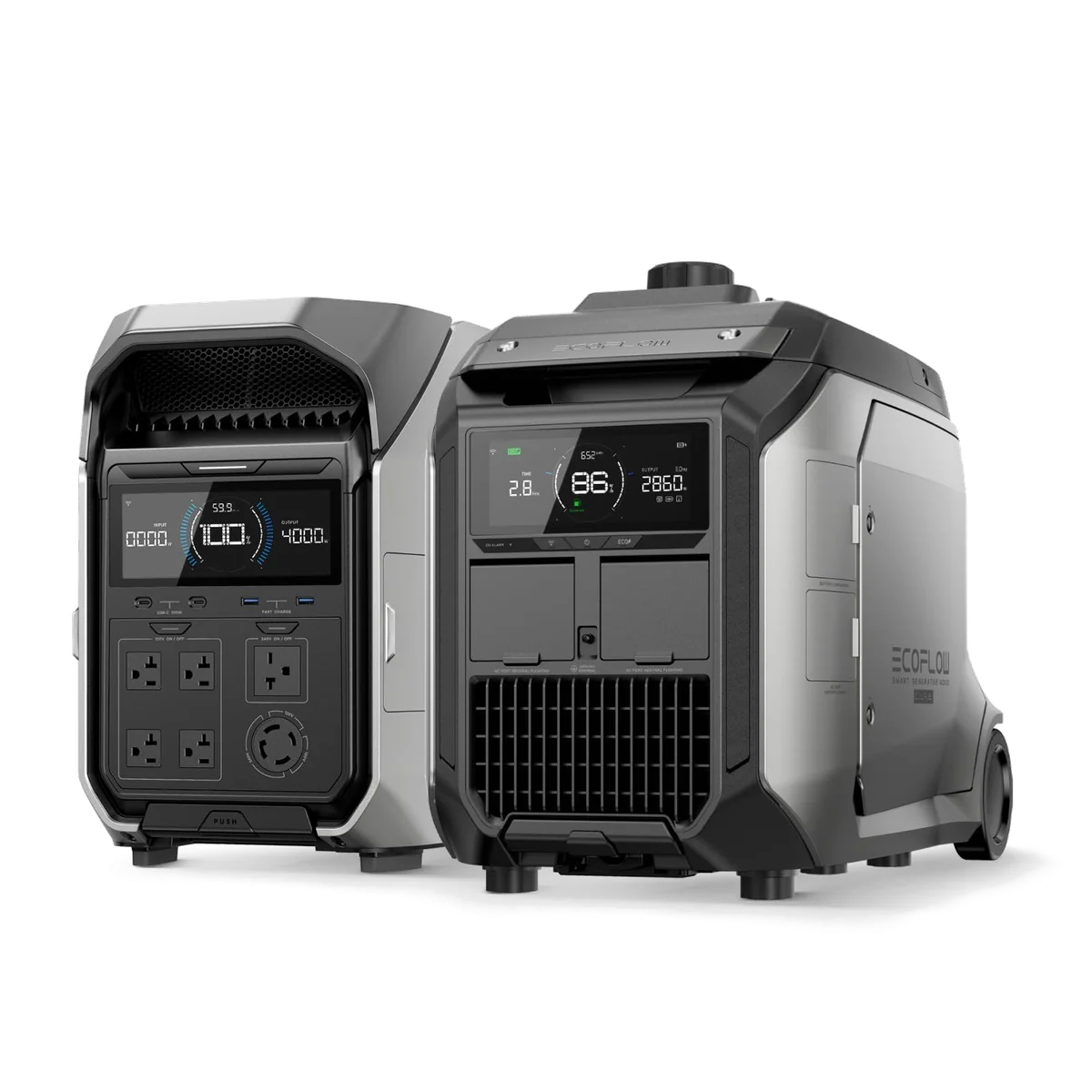
Buy this bundle only if you can safely park a running engine within sixteen feet of wherever the battery lives and you plan to run it on propane, because that cable and that fuel choice are what the entire four-figure premium rests on.
Based on 8 owner ratings, 12 owner discussions and 5 other sources. We have not tested this machine ourselves.
We earn a commission if you buy through our links, which does not affect what we say.
Read how this site works →
Where that leaves you
This is a good idea, competently built, sold at a price that only makes sense to a specific person. The battery is one of the more honest large stations on the market, delivering nearly all of what it advertises and holding its voltage where cheaper inverters fold. The engine is cruder than the battery is, loud and shaky and short of a choke, but it does the one thing nothing else in the box can do: it turns a fixed number of kilowatt-hours into an indefinite supply, and it does it without anybody going outside.
The specific person is the one with a fuel-burning position within sixteen feet of a battery position, a plan built around propane, and outages long enough that a single overnight charge was never going to be the answer. For them this is worth the premium, and I would not talk them out of it. Everyone else is buying half a good machine and half a machine they cannot deploy, at a price that would buy a large station and a capable conventional generator with room left over. Measure the cable run first. If it does not reach, nothing else on this page matters.
And whatever you buy, exercise it twice a year. The saddest story in the entire record is not a unit that broke under load. It is a unit that was fully charged, untouched, and dead on the night it was needed.
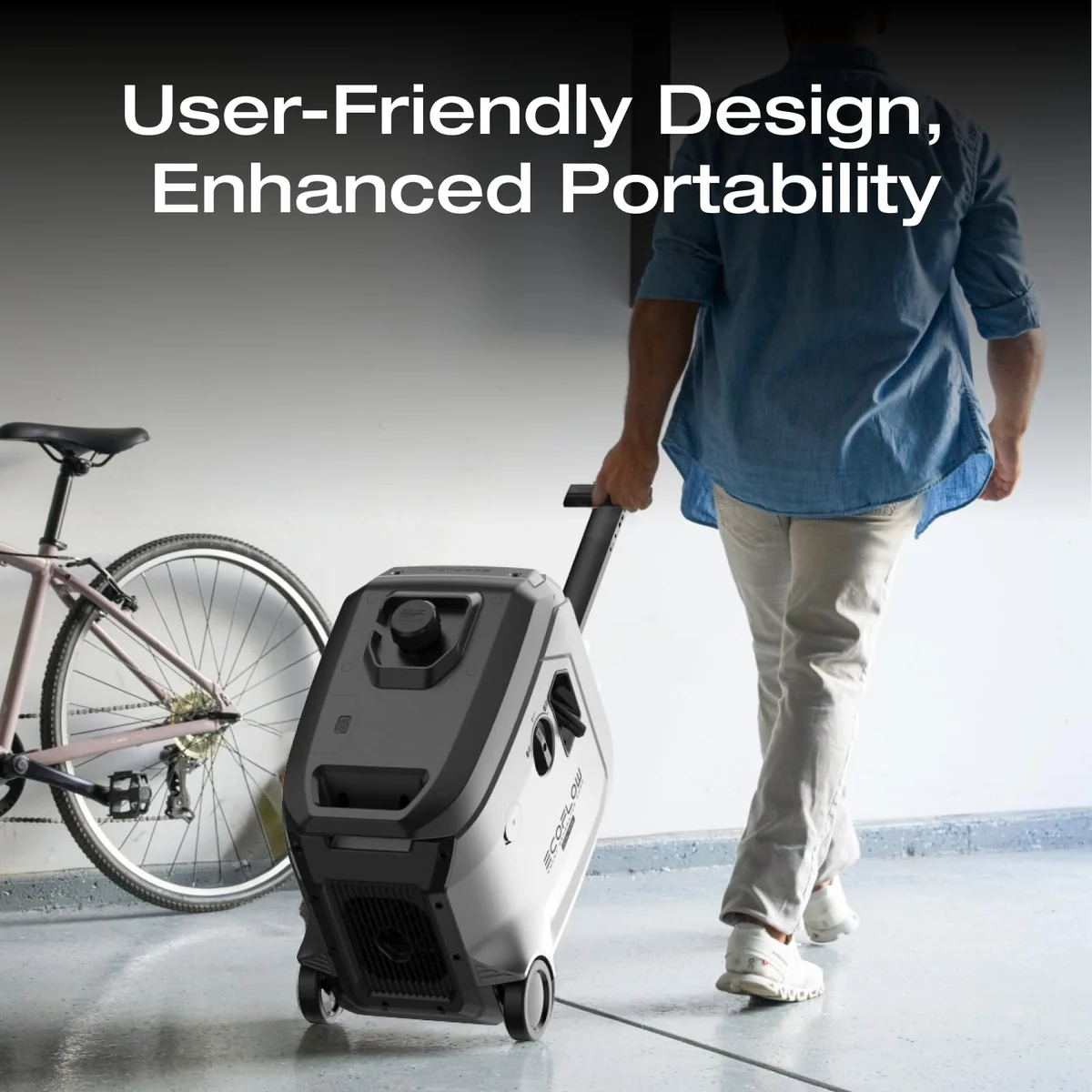
Two packages arrive, and the listing tells you so in its fourth bullet rather than its first. One holds a 4,096Wh lithium iron phosphate battery on wheels, around 113 lb of it. The other holds an 83 lb engine that burns petrol or propane and weighs about as much as a large dog that does not want to go in the car. Sold together, they cost a great deal more than either.
What that premium buys is not capacity and it is not watts. You can get both cheaper. It buys an agreement between the two boxes: the station watches its own state of charge, the engine starts itself when the number drops, the station feeds power backwards into the engine's starter battery so a flat starter cannot strand you, and solar gets priority so the thing does not run when it does not have to. That is a genuinely good idea, and independent bench testing confirms it works with this exact station rather than merely being claimed for it.
It also has a leash. The cable that ties the engine to the station is sixteen feet, it is not the sort you can splice and extend, and a petrol engine has to live a long way from a house because of what comes out of the back of it. Sixteen feet is not a long way. That single number, more than the price and more than the star rating, is what decides whether this bundle is a clever piece of engineering or an expensive pair of unrelated objects sitting in your garage.
- Buy it if
- You have an outage problem measured in days rather than hours, a place outdoors where an engine can legally and safely run within sixteen feet of where you want the battery, and you are content to keep a 20 lb propane bottle as the primary fuel. Hurricane country, ice-storm country, and rural properties on a long feeder all qualify. It also earns its price if you already own EcoFlow batteries or a Smart Home Panel, because the automation is the part you cannot buy from anyone else.
- Walk away if
- Your only outdoor space is a detached garage, a shared driveway, or anywhere more than five metres from the battery. Walk away too if you want silence, if you want a machine that starts itself reliably in a January cold snap on petrol, or if you were mainly buying a very large power station and treating the engine as a bonus. In that last case you are paying roughly half the ticket for a bonus, and you would do better with the station on its own.
One thing to get out of the way, because you will look at it: the star rating on the listing is 3.6, and it is built from eight ratings. Eight. That is not a verdict, it is noise, and Specific Load will not pretend to read it. Nor is there any body of owner testimony for this bundle specifically. What follows leans on instrumented tests of each half, on EcoFlow's own published figures where those can be checked against each other, and on a large and unflattering record of how this brand behaves after the sale. Where that record is about a sibling product rather than this one, it says so.
Key Specifications
Two boxes, one job
Amazon files this under Outdoor Generators, which is loose even by the standards of a category where the name on the listing frequently describes something the product is not. Half of this bundle genuinely is a generator. The other half stores energy and gives it back. The forums have been arguing about the word for years, and the argument is not pedantry: it is the difference between a device with a fuel tank you can refill at a filling station and a device with a fixed number of kilowatt-hours in it.
Which is why the bundle exists. A battery is the right tool for the first night of an outage: silent, no exhaust, no one standing in the rain at 2am, and a switchover fast enough that the freezer never notices. A fuel-burning engine is the right tool for the third day, when the battery is a brick and the sun is behind a weather system. Owners who have lived through long outages tend to end up with both, and describe the division of labour in almost identical terms: the battery covers nights and bad weather and unattended hours, the engine covers indefinite runtime.
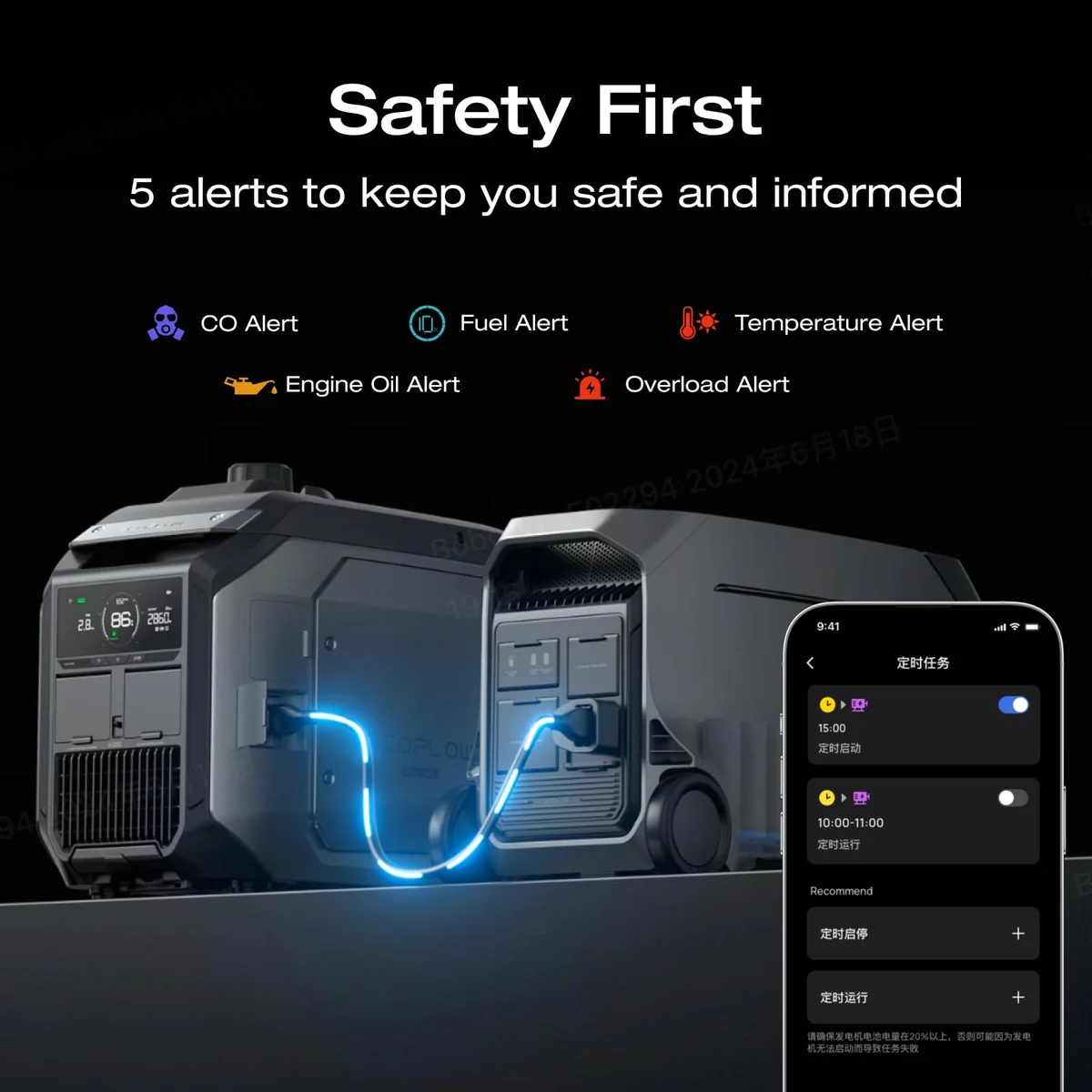
The usual way to own both is to buy them separately and press the button yourself. What EcoFlow sells here is the button pressing itself. In the app you set a floor and a ceiling: below the floor the engine wakes and runs, at the ceiling it stops. It reads the station's remaining charge continuously, and it holds off if solar is coming in. There are four ways to start it in total, counting the pull cord, the electric start and the remote start in the app.
The efficiency argument EcoFlow makes for this arrangement is worth understanding and worth not swallowing whole. Engines are inefficient at light loads; they like running near their sweet spot. Charging a battery is a heavy, steady, well-behaved load, so the engine runs hard and briefly rather than idling badly all night, and the battery handles the trickle of a router and a couple of lamps. EcoFlow puts a number on this, up to forty percent more efficient than a generator alone. That figure is theirs, on paper, and no independent tester in the record has reproduced it. The architecture is sound; the number is marketing.
It is telling that the sharpest EcoFlow sceptics in the generator forums, the ones who describe the brand's products as expensive boxes of parts you cannot fix, still concede the hybrid design is right and object only to the price. That is a useful shape for an argument to have. The idea is good. The question is what the idea costs and how well it survives cold weather.
If your interest is the wider question rather than this specific pairing, the site has a longer piece on why people who take outages seriously usually end up owning both.
Strengths & Limitations
Strengths
- Bench testing drew 3,830Wh of the rated 4,096Wh out of the pack, a better capacity result than most stations in this class manage.
- The inverter held 117 to 118 volts through roughly 4,000W of resistive load without sagging.
- The automatic handshake between the engine and this specific station was confirmed working by an outside tester rather than only claimed by the maker.
- On propane the engine starts dependably in the cold, and one 20 lb bottle carries roughly three times the energy of a full petrol tank.
- The station feeds power backwards to wake the engine's starter battery, so a flat starter cannot leave you stranded.
- The app is the most capable in this category for setting charge floors and ceilings, input current limits and generator thresholds.
- A 30A 12V outlet and a native RV socket make it genuinely useful away from the house, not just in the garage.
Limitations
- The cable joining the two halves is sixteen feet, cannot be extended, and has to bridge the distance between a running engine and wherever you keep the battery.
- The engine has no choke, and in freezer testing its automatic start frequently failed on petrol in exactly the weather that causes outages.
- It is loud and it vibrates violently for its first ten minutes, which matters more than usual on a machine designed to start itself in the middle of the night.
- Running the fuel that behaves better costs you about 300 watts of output.
- The bundle listing states a three-year warranty while EcoFlow advertises five years on the station elsewhere.
- The engine drops its own front outlets while it is charging the station, so you cannot count on running tools from it at the same time.
- Roughly a fifth of the pack's rated capacity never reaches your appliances, by EcoFlow's own runtime figures.
- The brand's after-sale support is the weak point owners name most often, and the retailer they recommend as insurance is not a marketplace.
- The star rating on this listing rests on eight ratings, so there is effectively no crowd verdict to lean on.

What the meters say
Start with the good news, because there is a lot of it and it is measured rather than claimed. Drained through a steady 800W load from full, the Delta Pro 3 delivered 3,830Wh of its rated 4,096Wh, which is 93.5 percent. Most stations that go through the same test land somewhere between seventy-five and eighty-five percent. This one is unusually honest about the number on its own box.
Loaded to roughly 4,000W with a kettle, a heat gun and a space heater together, the inverter held 117 to 118 volts and ran without complaint. That matters more than the headline output figure. Plenty of machines will hit their rated number and then sag, and sag is what browns out a fridge compressor. Cooling fans reach about 55 dB when the thing is being thrashed, and drop back to something quieter than a normal room within half a minute of the load coming off. USB-C hits its full 100W.
Two ports deserve specific mention. The 12V outlet is rated 30A rather than the 10A most stations offer, which is the difference between running a tyre compressor and not, and it is the port to use for a 12V fridge if you want the runtime you were hoping for, since going through the inverter costs you real energy. The catch is that it is an Anderson Powerpole connector, so unless you already live in that world you are buying an adapter before you can use it. There is also a NEMA TT-30R on the front, which makes this one of the few stations you can plug an RV into without an adapter chain.
The generator half is a rougher machine
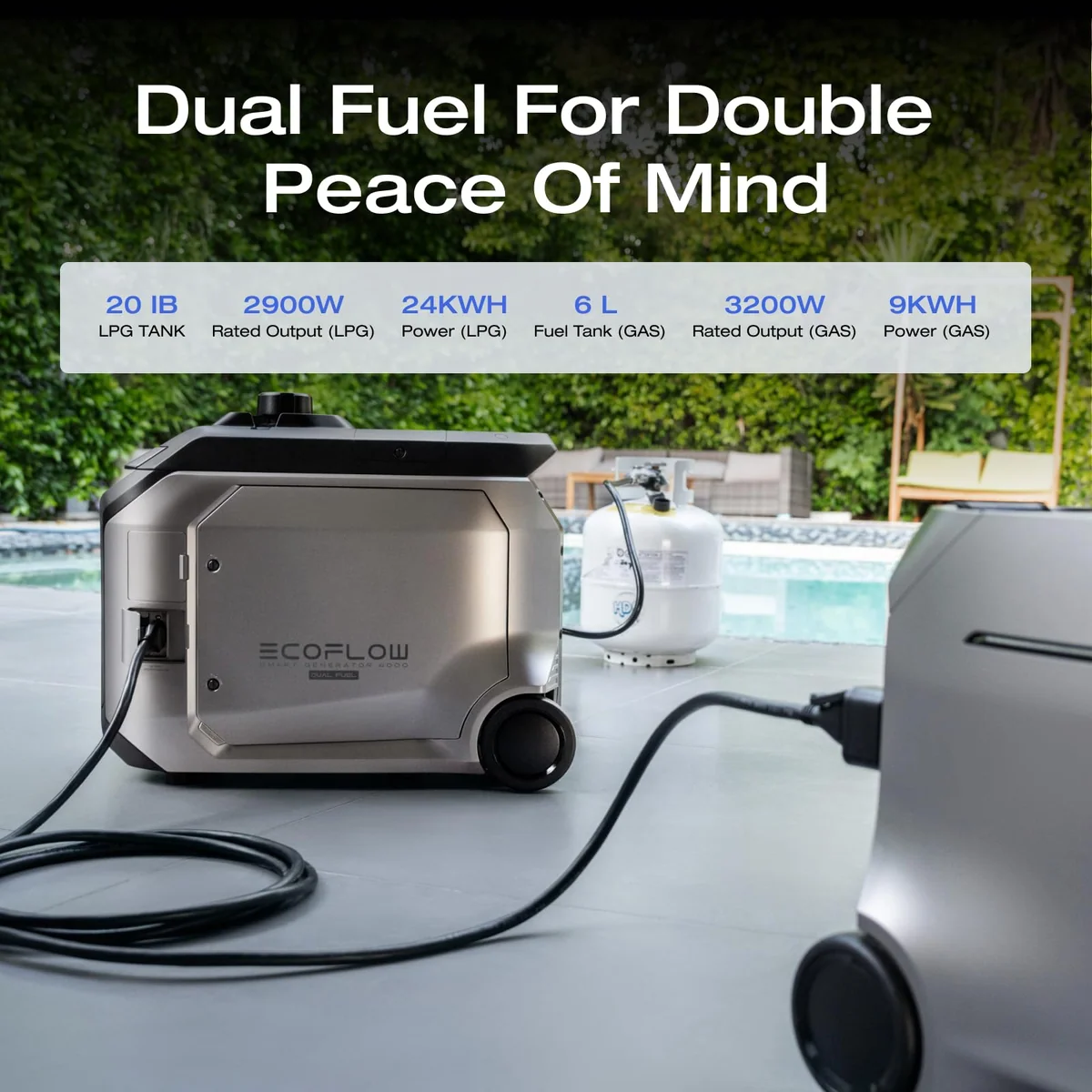
It produces 3,200W on petrol and 2,900W on propane. EcoFlow quotes a higher figure using X-Boost, which works by shaving voltage to resistive loads; testers who have measured it treat it as a marketing number and stick with 3,200W, and so should you. There is a 30A socket on the front, but it does not hold 3,600W consistently enough to be trusted as a true 30A supply.
Three findings from putting one in a freezer for twenty-four hours are the ones that should change your buying decision. First, on petrol it was a struggle to start at all, and the automatic start frequently failed, because the engine has no choke. Second, on propane in the same conditions it started after a few primes and ran steadily. Third, it is loud and it vibrates hard, wandering about on its rubber feet for the first ten minutes of a run.
Read those three together and the practical instruction is unavoidable: buy this intending to run it on propane. That gives up about 300W of output, and it is worth every watt, because the automatic start is the entire reason you are paying extra, and on petrol in freezing weather the automatic start is exactly what stops working. Outages cluster in winter storms. A machine that will not wake itself in the cold is a machine you have to go outside and pull-start, which is what you were paying not to do. Our page on what each fuel costs you in watts and runtime covers the general trade; here the cold-start behaviour settles it on its own.
The noise is not a footnote either. A generator that starts itself is a generator that can start itself at three in the morning, and this one is loud even measured against ordinary petrol generators. If you have neighbours within earshot, set the battery floor low enough that the engine only runs when it genuinely must, and think hard about where it sits. One more limitation to plan around: while the engine is charging the station, it tends to shut down its own front outlets rather than share, so do not count on running tools from it at the same time.
The sixteen feet
The connecting cable is sixteen feet and cannot be extended. The people who tested it found their own garage, twenty-two feet from the back wall to the door, already too long. Now add the reason a battery is attractive in the first place, which every prepper who recommends one names before anything else: no carbon monoxide. Bolting a petrol engine back onto that arrangement reintroduces the hazard, and the CO alarm on the app with automatic shutdown is a genuine safety feature rather than a bullet point. But an alarm is not permission to bring the engine closer, and the distance an engine needs from a house does not negotiate with a cable length.
Measure the run before you buy. From the safe engine position to the battery position, around corners, not across the lawn as the crow flies. If that measurement comes back over sixteen feet, this bundle does not do the thing it is sold for.
"So it only lasts four hours?"
Somebody asks this under every video about a big power station, and it deserves a straight answer rather than a wince. Take EcoFlow's own published runtime chart for this station and multiply each figure back out:
| Load they list | Hours they publish | Energy that implies |
|---|---|---|
| Wi-Fi router, 10W | 340.8 | 3,408Wh |
| Television, 110W | 29.8 | 3,278Wh |
| Desktop PC, 500W | 6.6 | 3,300Wh |
| Coffee maker, 1,000W | 3.3 | 3,300Wh |
| Induction hob, 1,800W | 1.8 | 3,240Wh |
Every row lands between roughly 3,240Wh and 3,410Wh out of a nominal 4,096Wh pack. That is EcoFlow's own arithmetic admitting an inverter and conversion loss of about twenty percent, which is normal and not a scandal, and it is not on the box. Plan your outage around 3.3kWh per charge and you will never be disappointed. It is also worth noting that the FAQ further down the same page does the sum without any derate at all, dividing capacity straight by watts, so the company's marketing copy is more optimistic than the company's own spec table.
So yes, at a full kilowatt the battery alone gives you a bit over three hours, and the honest answer to the four-hour question is that the battery was never meant to be the whole answer. That is what the fuel is for:
| Source | Energy produced | Full recharges of the pack | Roughly, at the outlet |
|---|---|---|---|
| Battery alone, from full | 4.1kWh stored | n/a | ~3.3kWh |
| One 6-litre petrol tank | ~8kWh | ~2 | ~6.5kWh |
| One 20 lb propane bottle | ~24kWh | ~6 | ~19kWh |
That table is the whole product in three rows. It is also why the "two to four days of whole-home backup power" in the listing needs reading carefully: 3.3kWh is roughly one disciplined day of fridge, lights and router, not a house. Two to four days requires the engine, expansion batteries, or both. To be fair to EcoFlow, the engine is exactly what they have put in the box.
One thing 3,200W will not do is start a central air conditioner. A condenser on a 45A breaker wants something in the region of eleven kilowatts at the moment the compressor turns over, even after allowing for voltage droop, and no soft start makes 3,200W into that. If cooling the house is your reason for buying, read what an air conditioner actually asks for at startup and why the number on the box is not the power you get before you spend anything. An RV rooftop unit with a soft start is a different and much more achievable proposition.
If you want to feed circuits rather than extension leads, the station will do 120V and 240V from a single unit, and reaching whole-house territory means the Smart Home Panel 2, which is a separate purchase and a subpanel, with the permits and the electrician that implies.
What you are paying for the automation
Prices in this category move constantly and EcoFlow discounts hard and permanently, so nothing here is a quote and you should check both items separately before you commit. What is stable enough to reason about is the ratio. At the reference prices in the record, the engine accounts for something close to half the bundle's ticket, and the bundle came in around a fifth below the two items bought apart. The bare station has separately been recorded at roughly half what the bundle was recorded at.
Two conclusions follow. The bundle is a real discount rather than a markup, so if you want both halves, buying them together is the sensible way. And if you do not want the engine, you are looking at the wrong listing by a very large margin.
Then there is the comparison that stings. The people who tested the engine say plainly that the alternative is to pair the station with any ordinary generator and a cable, and that what the premium buys is the threshold logic and the app, not the watts. That is correct. A well-regarded conventional inverter generator costs a fraction of what this engine does, and if you are prepared to walk outside and press a button when the battery gets low, you can build the same capability for much less. What you give up is the three in the morning case, the away-from-home case, and the confusion case: pairing a third-party generator to an EcoFlow at the right charge rate is a question people ask constantly and get muddled answers to, and this bundle is the version where you do not have to work it out.
Three honest alternatives, all of which have their own page here. If what you actually want is indefinite runtime and you can live without any battery at all, the GENMAX GM9000iED dual fuel inverter gives you nearly three times the output for a fraction of the money and asks you to do the thinking yourself. If you want the battery-first architecture with a company whose support record is the one everyone else in this space gets measured against, the Anker SOLIX F3800 Plus is the direct rival, and we have set the two head to head for whole-home backup. And if your outages are frequent and long enough to justify it, the honest comparison may not be with either: a permanently installed standby generator starts on its own, runs as long as the gas supply lasts, and does not care how cold it is, at the cost of an installation you cannot take with you. The forum objection to expensive battery systems is always the same arithmetic, that cost per kilowatt-hour is brutal when you compare storage against a fuel line, and it is not a stupid objection.
The most brutal version of that arithmetic is worth stating in full, because it is the ceiling on what any battery can do. A single 20 lb propane bottle carries more electrical energy, through a decent engine, than the pack in this station holds nearly six times over. A fully stacked multi-battery Delta Pro installation costing five figures is outlasted by one bottle of gas from a hardware store. Solar helps, but solar is a power source of opportunity, and a November storm system is precisely when the opportunity is not there. This is not an argument against the bundle. It is the argument for it, and it is the reason a battery sold alone as emergency backup is being sold slightly dishonestly.
If solar is part of your plan, budget properly: the working rule owners use is about 200W of panel for every 1,000Wh of storage, so keeping this station genuinely self-sufficient means somewhere near 800W of array, and a single folding panel is nowhere near it.
One last piece of price context. EcoFlow flagships depreciate hard. The previous Delta Pro launched at a figure close to what this bundle was recorded at and has since been found for well under half that. There is nothing wrong with buying a product that gets cheaper, but there is something wrong with paying full price for one on the assumption it will hold value.
The part that worries me
The hardware is not the problem with this purchase. The company is, or at least the company after the sale is, and at this price that is not a minor consideration.
Begin with something you can check in thirty seconds. The listing for this bundle states a three-year warranty. EcoFlow's own storefront advertises five years on the station. That gap is probably the engine's shorter term pulling the blended figure down, but it is a gap, it is on the page you are buying from, and you should confirm which term applies to which box before your money leaves.
Now the record. In EcoFlow's own community forum, the most repeated piece of advice to anyone buying into the ecosystem is not about which model to pick. It is about where to buy it, and the answer is always a retailer with a generous, open-ended returns policy, because owners have concluded they are likely to need one. The reasoning they give is unsentimental: front-line support is scripted and shallow, the engineers who can actually fix things answer by email ticket from another time zone, ownership of a case passes between people, and email threads get long. Reported replacement cycles run into weeks and, in the worst accounts, months. Buying on a marketplace instead gives you a different lever, the platform's own dispute process, and at least one owner has said outright that they only got a resolution by threatening to use it.
The failure mode that should frighten a backup-power buyer more than any other appears in these accounts repeatedly, and it is not a unit that dies under load. It is a unit that sat in a cupboard for a year, fully charged, and was dead when the storm arrived. That is the specific way a product like this betrays you, and the mitigation is boring and unglamorous: exercise it. Run it down and charge it back up on a schedule, keep the firmware current, and know how to work through a station that shows charge but will not switch on before the wind picks up rather than during.
Firmware deserves its own warning here, because this is a two-device product. When testers tried to charge a five-year-old Delta Pro from the current smart generator, it simply refused, and the reason was that the station's firmware was out of date. Update both halves before you rely on the automation, and update them again after a long period of storage. The flip side is genuinely creditable: EcoFlow was still shipping firmware to a station five years old, which is more platform support than most consumer electronics get.
How well does the hardware age? The only long-run instrumented data available is on the previous generation, so treat it as lineage rather than as this product's record. At five years that older station still held its capacity, charged at close to its rated speed and lost about 21W to idle draw, all respectable. But it failed one test badly: asked to run at 3,500W, a hundred watts under its own rating, it overloaded and shut down, having previously been fine there. The testers noted it was the first power station they had ever seen fail beneath its own maximum. Capacity ageing is well understood in these packs; sustained-output ageing is less so, and that finding is the one open question I would want answered before treating any station of this family as a decade-long asset.
Two structural risks round it out. The first is parts. When something inside fails you cannot open it without voiding the warranty, and the accounts from people who handle these in volume describe a consistent shortage of replacement parts for previous generations, down to cables. A conventional engine is the opposite: parts availability is the thing that decides whether a machine has a second life, and a carburettor is a carburettor. The second is the walled garden. Expansion batteries, panels and the home panel are EcoFlow-only, the official compatibility chart is disputed by owners who have found entries that need an undocumented adapter and other entries that work fine despite being listed as incompatible, and the same testers who confirmed this generator pairs correctly with the Delta Pro 3 also found it would not pair with a Delta Pro Ultra that EcoFlow's own support insisted it should. Take compatibility claims as a starting point for a question, not as an answer.
None of that is the whole picture, and it would be dishonest to leave it there. Plenty of people have run these hard for years without trouble: film and television crews use them as standard kit, off-grid owners run houses off stacked Delta Pros, and one of the fairest comments in the whole record points out that satisfied owners rarely bother to post. The RMA volume account that is hardest on the brand also says support has improved. The single best one-line summary of EcoFlow I have read comes from an owner who runs a big installation and would nonetheless choose differently next time: easy, and good when it works. Whether that is an acceptable risk is a function of how much of your comfort you are handing over to it.
One outside data point for balance: Consumer Reports has tested the previous-generation Delta Pro, and their score sits behind a membership wall so this page will not report one. What is visible on the free page is the comparison strip, and the older EcoFlow does not appear among the four highest-ranked of the six solar generators in its group. That is an inference from a widget, about a different model, in a category that mixes bundles at wildly different prices. It is worth exactly as much as those caveats allow, which is not nothing, given how uniformly warm the enthusiast coverage of this brand tends to be.
Frequently Asked Questions
Is this the same thing as the 3,600Wh Delta Pro people keep mentioning?
No, that is the previous generation, and the differences that matter are 4,096Wh rather than 3,600Wh, 120V and 240V from a single unit instead of needing two paired, expansion to 48kWh rather than 25kWh, and a quieter machine overall, at the cost of the 12V car charging input the older one had.
Which fuel should I actually run it on?
Propane, unless you have a specific reason not to, because it starts reliably in the cold, runs and smells cleaner, and carries far more energy per container, and the 300W of output you give up is a small price for an automatic start that works in winter.
Will it run my central air conditioner?
No, a 3,200W engine cannot start a residential condenser whose inrush runs into five figures of watts, though an RV rooftop unit fitted with a soft start is a realistic target.
How much solar do I need to keep it topped up?
Reckon on roughly 200W of panel for every 1,000Wh of storage, so about 800W of array for this station, which is considerably more than the single folding panel most bundles picture.
Is the warranty three years or five?
The listing for this bundle says three years while EcoFlow's storefront advertises five on the station, so confirm in writing which term covers which box before you buy.
Where is EcoFlow from?
EcoFlow is a Chinese company based in Shenzhen, and the "EF" you see in front of the name on Amazon listings is simply a brand prefix rather than a separate manufacturer.
Does Consumer Reports rate this one?
They have tested the previous-generation Delta Pro rather than this bundle, and their score is behind a membership wall, so anyone quoting you a Consumer Reports number for this product is quoting you something else.
Can I use it as a UPS for a desktop or a NAS?
The station is specified with a fast changeover and a pure sine output, but EcoFlow's own guidance is unusually candid that most portable stations do not meet true UPS timing, and the models they name as qualifying do not include this one, so test it with your own hardware before you trust it with unsaved work.
Sources (6)
- Amazon listings and customer reviews — Ecoflow Delta Pro 3
- Owner reports across r/Generator, r/Ecoflow_community, r/OffGrid and 3 more threads
- Owner and reviewer video, 4 channels
- Thesolarlab — Article — www.thesolarlab.com
- EcoFlow — Article — us.ecoflow.com
- Consumerreports — Article — www.consumerreports.org