Propane costs you about a tenth of your watts, and it is still the best deal in this category
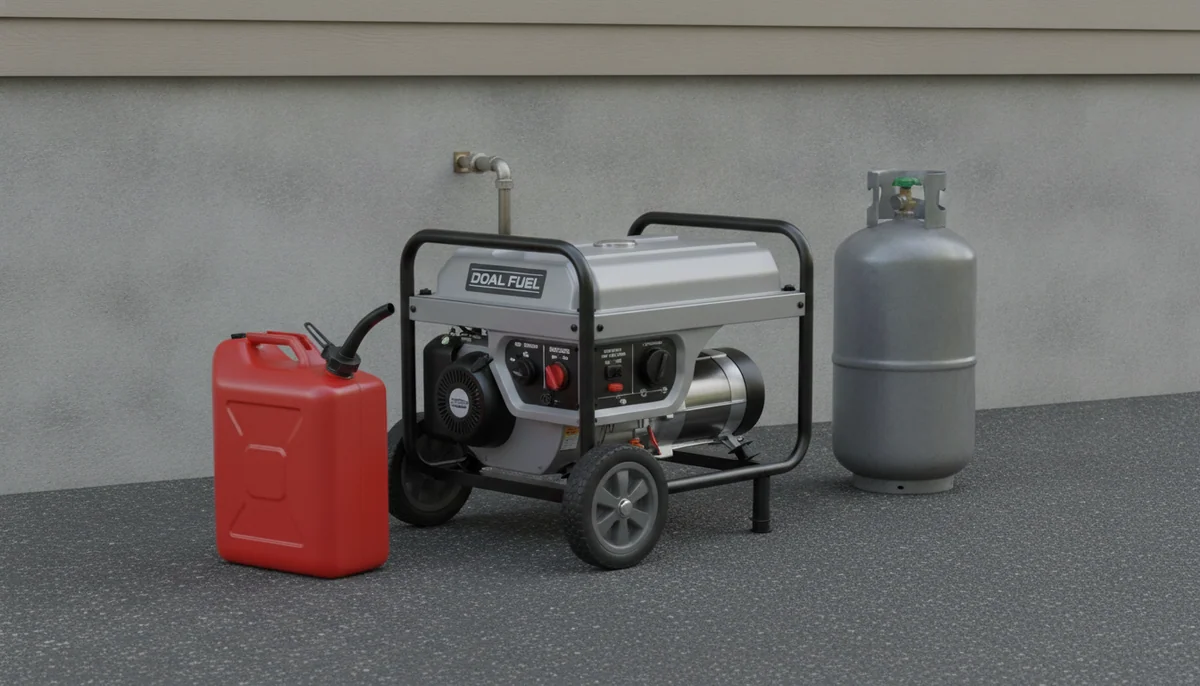
The derate is not a mystery and it is not a secret. Two of the machines Specific Load has read end to end publish both numbers on the same page. The GENMAX GM4500iSAD is rated 4,500 peak and 4,000 running on gasoline, and 4,000 peak and 3,600 running on propane. The LIFAN 4800 is 4,800 and 3,800 on gasoline against 4,300 and 3,400 on propane in its bullets, although the FAQ two scrolls down the same listing says 3,500, because the page cannot keep its own arithmetic straight. An independent bench test of EcoFlow's 3,200W smart generator found the same shape: 3,200 watts on gasoline, 2,900 on propane. Three machines from three companies, and all three land within a couple of points of a tenth.
So the question is never whether propane costs you power. It does, and the number is small and knowable. The question is what you get back, and the answer is a fuel that does not turn into varnish inside a carburettor while your generator sits in a shed for eight months, does not have to be rotated twice a year, does not stink out the back of a car, and, on at least one machine in this set, starts in the cold when gasoline will not. That last one is not a preference. In a twenty-four hour freezer test, the EcoFlow generator's automatic start repeatedly failed on gasoline because the engine has no choke, and started dependably on propane in the same conditions. Outages arrive with weather. A fuel that fails in the weather is not a fuel you own for backup.
The honest counterweight, before you go any further: the published derate is the manufacturer's derate, and the only substantial owner complaint about propane output in this whole record is far worse than a tenth. One of the two people who has written about the GM4500iSAD reports that on propane it manages roughly 2,200 watts and ten amps before it overloads, against a published propane rating of 3,600. One owner is not a pattern, and the other owner ran a 15,000 BTU rooftop air conditioner on both fuels without trouble, but the disagreement is real and you should settle it on your own machine inside the return window rather than on a listing page.
Buy dual fuel and default to propane if the generator's job is to sit still and be ready: house backup, a camper that gets used six weekends a year, a machine that lives in a garage between storms. Keep a couple of bottles, rotate nothing, and accept the smaller number.
Stay on gasoline if you are running the machine hard and often and you need every watt it makes, if you are working a jobsite where fuel comes out of the same can as everything else, or if the load you sized for leaves you no headroom, because a tenth of your capacity is a lot when you were already at the ceiling.
Go to natural gas only if there is already a gas line where the generator will stand, you are prepared to pay for the plumbing and the electrical work, and your real problem is duration rather than output.
What the derate looks like on machines you can actually buy
Here is every published figure across the generators covered on this site, with the gaps left as gaps.
| Machine | Gasoline, peak / running | Propane, peak / running | Natural gas |
|---|---|---|---|
| GENMAX GM4500iSAD | 4,500 / 4,000 | 4,000 / 3,600 | not offered |
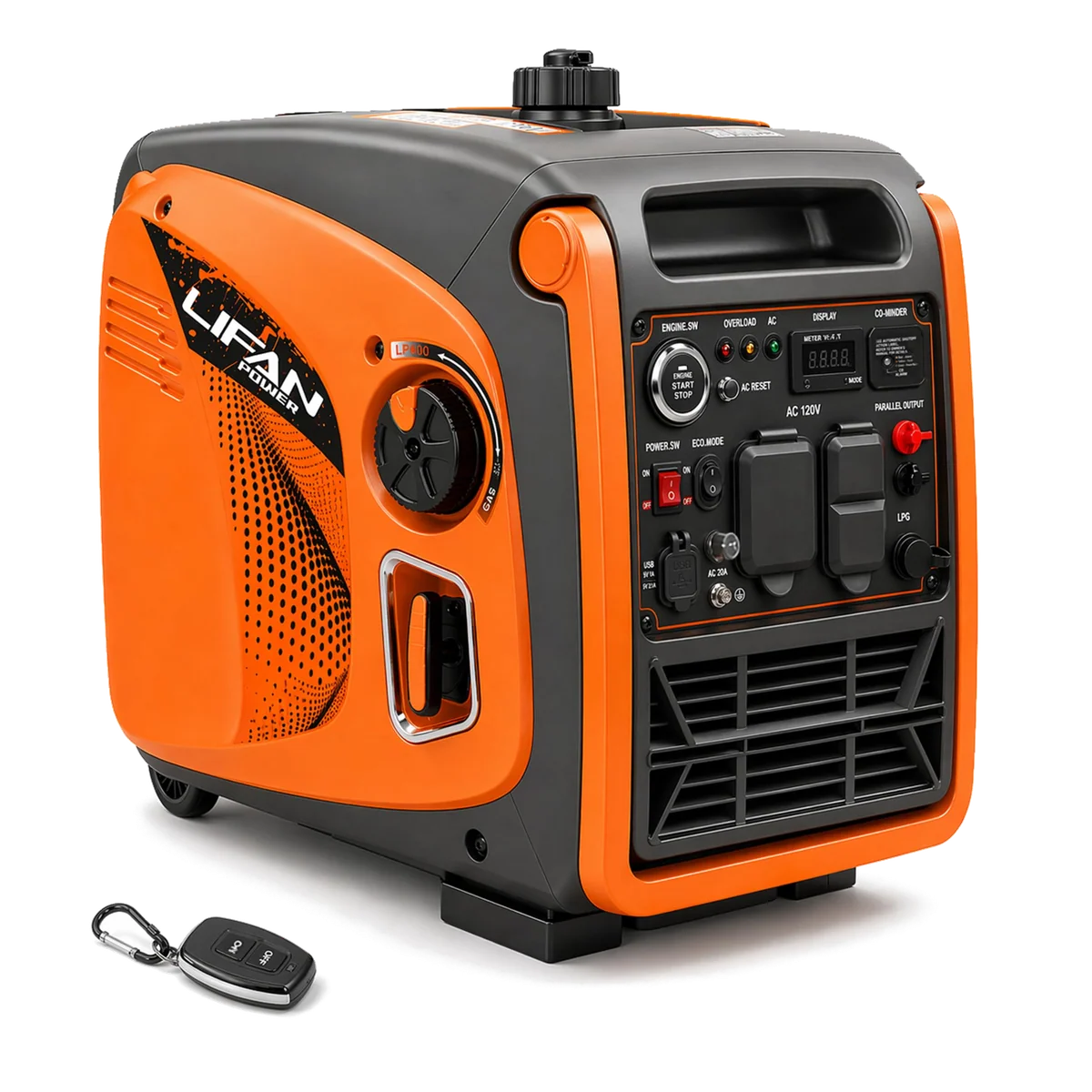
| LIFAN 4800 | 4,800 / 3,800 | 4,300 / 3,400, or 3,500 in the FAQ | not offered |
| EcoFlow 3,200W smart generator | 3,200 running | 2,900 running | not offered |
| GENMAX GM9000iED | 9,000 / 7,600, with no split between the two fuels | owner conversion only | |
| PowerSmart 4400 | 4,400 / 3,600 | never published | not offered |
| Gidrox 11000W tri-fuel | 11,000 / 9,000, with no fuel named against it | never published | |
Read the bottom half of that table rather than the top, because the bottom half is where the industry actually lives. The GM9000iED sells dual fuel in its title and gives you one pair of numbers for both fuels, leaving you to guess which one they describe. PowerSmart puts dual fuel in the product name and then publishes a starting wattage, a rated wattage, a runtime and a tank size that are all gasoline figures, with nothing at all for LPG. Gidrox goes one better: it ships a natural gas hose in the box, markets the machine on whole-home backup, and never states what it makes on natural gas anywhere on the listing you buy from. Its own site does carry a propane derate, to 9,900 peak and 8,100 running, which is a tenth again and reassuringly ordinary. The point is that you had to leave the shop to find it.
If a maker will not print the number for the fuel you intend to use, treat the fuel as unrated and size for the smaller figure you can find. That is not cynicism, it is just what you have. And none of it rescues a machine that was too small to begin with: switching fuels moves your ceiling by a few hundred watts, while a central air conditioner's compressor asks for something in five figures at the instant it turns over, which is a different order of problem entirely. The gap between the number on the box and the power you get is the calculation to do first, and what an air conditioner really demands at startup is the one that kills most fuel-switching fantasies.
Why the second and third fuels cost you anything at all
An engine makes power by burning air and fuel together in a fixed volume. Gasoline arrives as a fine liquid mist that takes up almost none of that volume. Propane arrives already a vapour, so it occupies space in the cylinder that air would otherwise have used, and every cylinder full is therefore a slightly smaller charge. Natural gas is thinner still, carrying meaningfully less energy per cubic foot than propane and arriving at whatever pressure your house line happens to deliver, which is why it always lands below propane rather than beside it.
The consequence worth planning around is that natural gas has a second ceiling nobody prints: your meter and your line. A 499cc engine asking for gas at the far end of a run sized for a furnace and a hob is a question your gas fitter answers, not one the generator answers. That is the honest reason this fuel is the one everybody advertises and nobody rates.
Runtime is where the ranking flips completely
Everything above says gasoline is the strongest fuel. Everything below says it is the weakest one to own, and the numbers come from the makers themselves.
EcoFlow publishes both halves for the same engine: one full gasoline tank produces about 8 kWh, roughly eight hours of household appliances at a quarter load, and a single 20 lb propane bottle produces up to 24 kWh. That is three to one in favour of the thing you can buy at a hardware store, swap in thirty seconds, and leave in a garage for five years without a stabiliser. The owner accounts land in the same place from a different direction. A LIFAN owner reckoned a full 2.64 gallon tank plus 40 lb of onboard camper propane was worth something like forty hours at half load, which is a long weekend with the air conditioner running. A GM4500iSAD owner got about six hours per tank running a 15,000 BTU rooftop unit from a 0.9 gallon tank, and described a 20 lb bottle as lasting a really long time by comparison.
| Container | What it gives you | What it costs you to keep |
|---|---|---|
| One gasoline tank, 0.9 to 8.7 gallons depending on the machine | Hours, and the highest output the engine makes | Rotation roughly twice a year, a stabiliser, and a carburettor that resents being left full |
| One 20 lb propane bottle | Around three times the energy of a full tank on the same engine | Nothing, for years, other than somewhere legal to store it |
| A house gas line | Runtime that stops being a number | A permit, a gas fitter, an electrician, and a machine that no longer travels |
One warning about published runtimes generally, because they are the most abused figure in this category. Gidrox advertises up to 21 hours from an 8.7 gallon tank, which works out at about 0.41 gallons an hour. That is a quarter-load number on a 499cc engine, not a backing-up-your-house number. Every runtime claim you read is quoted at the lightest load the machine has, and the honest way to use one is to halve it and then ask whether you still like the answer.
The argument that actually decides it, which is storage
Ask experienced owners why cheap generators die and the answer converges without much argument: gasoline was left sitting in the carburettor, it turned to varnish, and the machine that started fine every spring for three years did not start on the fourth. Their prescriptions are consistent too. Shut the fuel valve and run the bowl dry before storage, use ethanol-free where you can get it, or step around the whole problem and burn propane. There is genuine dissent, and it deserves stating: plenty of owners report a decade of trouble-free running on ordinary pump fuel with a stabiliser in it, so this is a probability rather than a certainty. But the probability runs one way, and a backup generator that has only ever tasted propane is a backup generator with one entire failure mode removed. Our page on storing a generator so it starts when the power goes out is the procedure either way.
The maintenance load differs too. If you keep gasoline for a machine that runs three times a year, you are rotating it about twice a year, on top of the oil changes the engine wants anyway. Nobody rotates propane. That is a small chore removed from a list you were probably not going to keep up with, which is exactly why it matters.
Two limits, plainly. Propane does not make a generator immortal, and it is worth remembering the PowerSmart owner whose machine sat three weeks and then cut out after thirty seconds with a false overload: it did that on propane and on gasoline both, so the fuel was never the fault. And propane has one weather problem of its own. A bottle vaporises by chilling itself, so in hard frost a single 20 lb cylinder feeding a large engine at heavy load can frost over and starve the regulator; the standard answer is a 40 lb bottle, or two bottles on a tee, before winter rather than during it. Even getting a propane run started takes a beat longer, as the Gidrox owner who needed three attempts to purge the air out of his supply line before it caught can tell you.
Natural gas, and what it is really asking of you
Natural gas is the fuel that makes the outage stop being about fuel. Nothing to fetch, nothing to lift, nothing to ration, and no evening spent working out whether the queue at the filling station is worth joining. When a storm outage runs to five days, that is not a convenience, it is the entire difference between an inconvenience and a project. It is also why one GM9000iED owner bought a conversion kit made specifically for that model, wanting a machine that could run for weeks.
What it costs is everything the other two fuels do not ask for. A hose into a gas line is a plumbing job with a permit attached. A generator that lives permanently beside the house is a siting decision with clearances and an exhaust path, which is the same conversation as how far a running engine has to stay from the building. Feeding circuits rather than extension leads is an electrical job, and the standard of that work varies enough that electricians circulate photographs of installations they will not touch. Read the honest comparison of transfer switches, interlocks and backfeeding before you commit to a method, and check whether your machine's neutral is bonded or floating before anything gets wired, because a portable that arrives bonded and undocumented is a discovery you want to make on a Saturday.
And once you have accepted the permit, the fitter and the electrician, you should at least ask the honest question, which is whether you have talked yourself into a standby unit the long way round. A permanently installed machine starts itself, runs on the same line, and does not need anybody to go outside in the rain. What the extra money actually buys and what a 24kW install really costs are the two pages to read before you spend on hoses. If the answer is that you want the machine to stay portable, then tri-fuel is the right compromise and you should treat the natural gas leg as your slowest, weakest, most patient setting.
Which fuel for which job
For a camper, run gasoline out of the tank on the way to the site and propane once you are there. That is not theory: it is the strategy the most thorough LIFAN owner uses, filling at home, burning the tank first, then feeding the generator off the trailer's onboard propane through a quick-disconnect on the standard 3/8 inch SAE flare fitting, bypassing the supplied regulator entirely. It also means no jerry cans in a vehicle you sleep in. The same owner reports no noticeable difference in noise between the two fuels, so nothing is lost on that front either, and the RV shortlist is where to compare machines that take a 30 amp cord directly.
For house backup, keep both. Households working through multi-day outages describe running a fridge, a freezer in stints, lights, a router and one substantial appliance at a time, which is a load any of these machines carries comfortably and which propane will hold for days on a pair of bottles. Keep a can of gasoline as well, because in a regional emergency the thing you can find is the thing you burn, and the whole point of dual fuel is that you are not fussy. Our home backup picks assume exactly that posture.
For a jobsite, buy gasoline and stop thinking about it. The machine runs weekly, the fuel never sits long enough to varnish, and the tenth of your output that propane costs is a tenth you are actually using.
For anything medical, the fuel is the least of it: what you want is silence, instant transfer and no exhaust anywhere near a person, which is a battery's job rather than an engine's. The medical equipment page makes that case properly, and why serious owners end up with both a battery and an engine is the longer version of the same argument.
The machines, and what each one teaches about its fuel
The GENMAX GM4500iSAD has no review of its own on this site, so take it here as the clearest published derate in the set: GENMAX prints both fuels in the same bullet and asks a straightforward ten percent for the privilege, in a 51 lb package with an RV outlet on the panel. The drawback is the tank, which holds nine tenths of a gallon and turns gasoline into a two-hourly errand, and the record behind it is three ratings deep with one owner reporting an overload at around 2,200 watts on propane. Treat that machine as a propane machine with a small emergency gasoline reserve, and test it hard in week one.
The LIFAN 4800 is the best worked example of the trade anywhere in this record, because one owner has genuinely used both fuels and written it down, and because the TT-30 socket means a 30 amp trailer plugs straight in. Its drawback is the listing around it: three different weights, two different propane outputs, and a starter battery that ships disconnected behind a frame rail with no mention in the manual, which is why the first evening belongs to the hidden battery plug and the closed cap vent rather than to camping.
The PowerSmart 4400 is the cheapest way to own the propane option at all, and every owner who mentions starting it says it fires on the first pull, including the one who runs it on nothing else. Its drawback is precisely the subject of this page: it sells dual fuel in the title and publishes not one propane figure, so if LPG is your plan you are buying an unrated machine, and it is an open frame unit its own listing rates at 76 dB.
The GENMAX GM9000iED is the one in this set that does 240 volts and a house, and the one with a documented owner path to the third fuel. The drawback is that it arrives with its neutral bonded and no instructions for changing that, and the worst owner accounts describe units that failed while stored rather than while working, which is an ugly trait in a machine bought for emergencies. If you buy it, break it in on gasoline and switch to propane afterwards, which is the conservative order one owner followed without issues.
The EcoFlow Delta Pro 3 with its dual fuel generator is the only product here where the fuel choice is also a reliability choice, because the engine's automatic start is the entire reason for the premium and that start works on propane and frequently does not on gasoline in the cold. Its drawback is the sixteen feet of cable between the engine and the battery, which cannot be extended and has to bridge the distance between a running engine and wherever you want the power, and the 300 watts you give up choosing the fuel that behaves.
The Gidrox 11000W tri-fuel is the only machine here that brings the third fuel in the box rather than sending you to a hardware store for hoses, and for a household with a gas meter that is a genuinely strong argument. Its drawback is that the best reason to buy it is the one number the company will not publish, and that the only owner who reports pushing it says it stops working somewhere between 5,000 and 5,500 watts against a 9,000 watt running claim. If you buy it, load test it before the return window closes.
All six sit together in the dual fuel and tri-fuel roundup, and if the brand names here are unfamiliar to you, what a warranty is worth without a parts channel behind it is worth reading before the fuel question gets your attention at all.
So, what to actually do
Pay the tenth. On every machine that publishes both numbers the propane derate sits between eight and eleven percent of rated output, and what it buys you is three times the energy per container, a fuel that never goes stale, one less chore in the calendar and, on at least one machine, an engine that starts in January. Size the generator on its propane figure rather than its gasoline figure and you will never be surprised by the smaller number, because you never planned around the bigger one.
Keep gasoline anyway, in a can, rotated, for the day the bottles run out and the depot is shut. And add natural gas only when the problem you are solving is measured in days rather than watts, because that fuel gives you the least power and the most time, and it charges you a permit for the privilege.
Frequently Asked Questions
How much output do you actually give up on propane?
Between eight and eleven percent of rated watts on every machine in this record that publishes both figures, which is roughly 400 watts on a 4,000 watt generator.
Which fuel gets you the longest run from one container?
Propane by a wide margin, at roughly three times the energy of a full gasoline tank on the same engine according to EcoFlow's own published figures.
Is natural gas weaker again than propane?
Yes, it carries less energy per cubic foot and arrives at whatever your house line delivers, and since none of these makers publish a natural gas rating you should treat any figure you have not seen in writing as unknown.
Does running propane really stop the carburettor gumming up?
It removes the varnish problem entirely on the fuel side, which is the single most common reason a stored generator will not start, though it protects nothing else on the machine.
Will a 20 lb bottle keep up in freezing weather?
Not always under heavy draw, because a bottle chills itself as it vaporises, which is why people running big winter loads use a 40 lb cylinder or two bottles joined with a tee.
Can I convert a dual fuel generator to run on my house gas line?
Third-party kits exist for specific models, and one GM9000iED owner bought one made for that machine, but it is an owner modification and the consequences of it are entirely yours.
Does the fuel change how loud the generator is?
Not meaningfully, according to the one owner in this record who has run the same machine hard on both, and what a 23 foot rating is measured at matters far more than which fuel is in it.
Should I break a new generator in on gasoline or propane?
Gasoline, then switch, which is the order one GM9000iED owner followed through the five hour break-in with no issues afterwards.
Is tri-fuel worth paying for if I have no gas line?
No, because the third fuel is the one that needs a meter, a fitter and a permit, and without those you are paying for a hose you will never connect.
Sources (3)
- Amazon listings and customer reviews
- Owner reports across r/Generator, r/electricians, r/Hawaii threads
- Thesolarlab — Article — www.thesolarlab.com