A "58 dBA at 23 feet" rating is measured at a quarter load, seven metres away, and sometimes averaged with the quiet side of the machine
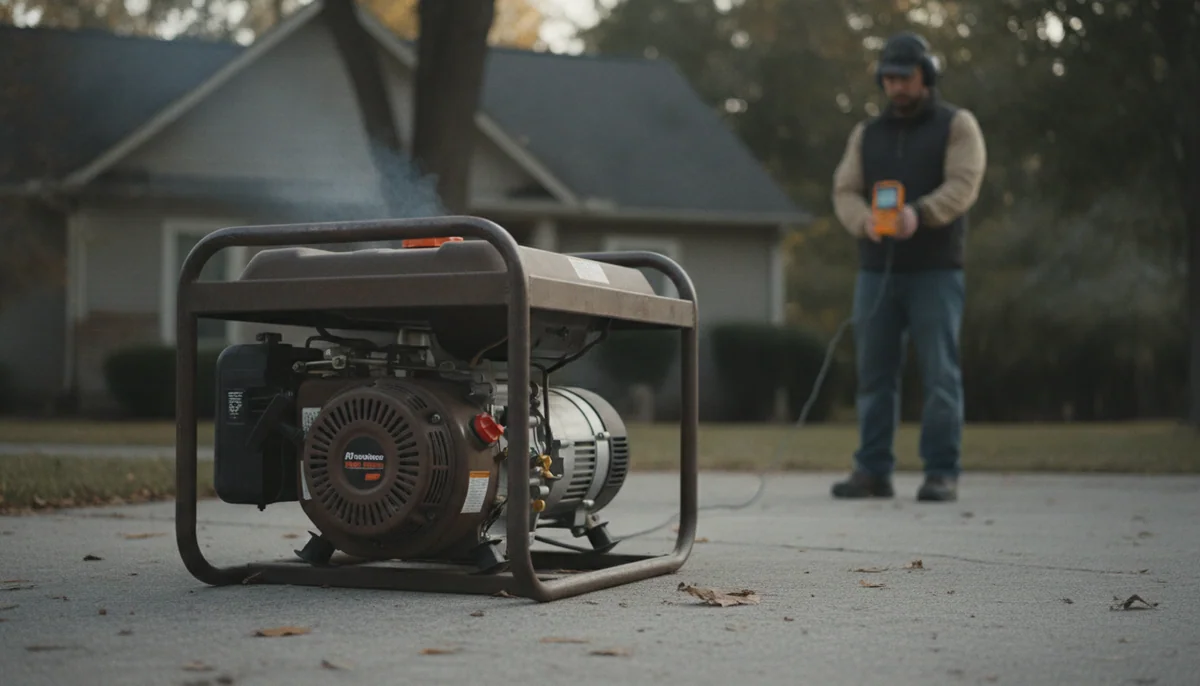
Here is the whole problem in one sentence, and it is not ours. PowerSmart's fourth marketing bullet on its 4400-watt generator reads: "SUPER QUIET OPERATION: Operating at a sound pressure level of 76 dB from 23 feet at 25% load, this generator is designed to be quiet." Seventy-six decibels is not quiet. It is at the loud end of the portable class, it was measured seven metres away, and it was measured with the engine loafing at a quarter of what it can do. Every word in that bullet is defensible on its own and the sentence as a whole is misleading, which is the exact trick this page is about.
A decibel rating on a generator is a single reading taken under four conditions the manufacturer chooses: how far away the meter was, how hard the engine was working, which end of the machine the meter faced, and what the machine was standing on. Change any one of them and the number moves by more than the difference between two competing generators. Three of the four are usually left out of the marketing copy entirely.
So the working rule, before you read another word. Add somewhere between fifteen and eighteen decibels to a 23-foot figure to get what you will hear standing beside the thing, add more again once it is carrying a real load, and disregard the adjectives completely; "super quiet" appears on machines that publish 76 dB and on machines that publish nothing at all. If your constraint is a neighbour thirty feet away or a quiet campground, buy an enclosed inverter and size it so it never runs near its ceiling, because a machine loafing is a different animal from the same machine straining. If your constraint is that somebody is sleeping in the same room, no generator on this page is the answer and a battery is.
The four conditions hiding inside the number
Distance. Twenty-three feet is the conventional measuring distance across the industry, and there is nothing dishonest about it in itself; it is roughly seven metres, which is about where a neighbour might stand. It is dishonest only when the distance goes unstated. Sound pressure in the open falls by about six decibels every time you double your distance from the source, so between arm's length and 23 feet you lose something on the order of fifteen to eighteen decibels before the engine has done anything differently. That is why nobody has ever been surprised by a generator at 23 feet and everybody is surprised by one at three.
Load. The good listings say "at 25% load" and the ones that leave it off are hoping you do not ask. A quarter load on a 3,600-watt machine is around 900 watts, which is a fridge and some lamps. An outage is not a quarter load. This is the single largest variable in the whole business and the one buyers consistently underweight, which is why how much of the number on the box you actually get is worth reading alongside this page.
Direction. A generator is not a point source. The exhaust end is loud and the far end is not, and Lifan, asked directly how it arrives at its figures, said it takes a meter at 23 feet from the exhaust end and from the opposite end and averages the two readings. That is worth pausing on, because it is a manufacturer explaining its own method in writing and because the method is entirely legitimate. It is also why the suspicion you read on RV forums, that the tester simply walked backwards until the number looked good, is misplaced. The softening happens in the averaging, and it means half the published figure was taken from the side of the machine you are least likely to be standing on.
The ground. The one tester who put three machines side by side at 23 feet noted that the surface underneath changes the result meaningfully at that distance, with grass behaving very differently from concrete or gravel. Nobody publishes what they measured over.
| The condition | What the rating assumes | What it costs you |
|---|---|---|
| Distance | 23 feet, occasionally unstated | Roughly six decibels per halving of that distance as you walk toward it |
| Load | 25 percent, or nothing at all | The gap widens as the engine works, and the published figure never shows it |
| Direction | One end, or an average of both | The exhaust side is louder than the number, by an amount nobody publishes |
| Surface | Unstated everywhere | Grass, gravel and concrete give different readings from the same machine |
| Pitch | Not measured at all | Two machines can read the same and one of them will drive you indoors |
The people who actually held a meter
There are very few of them, and their findings are worth more than every listing on this page combined.
A soundproofing channel metered a 2300-watt Aceup, sold with the phrase "sleep level quiet", against a Honda EU2200i. At the machine, in eco mode with no load, the Aceup read 74 dB against the Honda's 72. Loaded, the gap widened to about five decibels, and at 25 feet the loaded readings were roughly 71 against 65. The tester's own note was that the Aceup's noise was considerably more high pitched. Hold that 74 dB against the marketing phrase and you have the honest scale of the problem: not a lie, not a rounding error, but a machine described in language borrowed from a bedroom while a meter at arm's length reads like a busy road.
The AMERISUN evidence is better still, because it looks at first like a flat contradiction. One tester got under 50 dB at thirty-five feet from an enclosed 2500-watt unit and called it the quietest machine of its size he had metered all summer. Another got 87 dB directly behind the same model and 75 dB at ten feet. Both are correct. The first was taken with no load, the second under about three-quarters load during break-in. That pair of readings is the clearest demonstration anywhere in this record that the load qualifier is doing almost all of the work in a published figure, and that a machine can be genuinely impressive at idle and simply a small petrol engine working hard the moment you use it.
The third measurement is the three-way comparison: an Aceup AI4000s against a Pulsar GD400BN and a Wen 56225i, at 23 feet, across no load, eco and up to roughly full load. The Aceup was the loudest of the three, audibly but not dramatically, and higher pitched than the Pulsar's deeper tone. Note what that tells you and what it does not. It tells you that machines in the same class, all sold as quiet, are separated by a few decibels. It does not tell you which one your ears will hate, because both testers who went out of their way to complain about a machine complained about its tone rather than its reading.
One more finding, and it is the least glamorous and most useful on this page. An owner of a 5000-watt AMERISUN traced a rattle he had blamed on the engine to the carry handle jostling against the frame, and lifting it away made the machine noticeably quieter. Before you conclude your generator is louder than advertised, put a hand on the handle.
Decibels do not add the way you expect
Two things about the scale, both of which change how you should read a spec sheet. Three decibels is a doubling of acoustic energy, so running two identical generators in parallel adds about three decibels rather than making the noise twice as loud; the second machine is far less punishing than intuition suggests. Ten decibels is roughly what people perceive as twice as loud. So the difference between a listing claiming 58 and one claiming 61 is close to nothing you would notice from a deckchair, while the difference between 58 and 76 is enormous, and every one of those numbers is only as good as the conditions attached to it.
That is why the pitch finding matters so much. Two independent testers, on two different brands, both said the machine they disliked was not louder so much as sharper. A meter reports a single weighted number and your irritation does not work that way. If you have the chance to stand near the machine you are considering, that is worth more than the sticker; if you do not, an enclosed machine with a lower running speed is the better bet than a marginally lower published figure.
Seven listings, seven claims, and what sits behind each one
These are the machines this page covers, read purely on noise. Two of them are filed by Amazon under power take off equipment, which none of them are, and if that label is what brought you here, it is a taxonomy artefact rather than a description.
| Machine | The claim | What sits behind it |
|---|---|---|
| Efurden 2800, enclosed | 58 dBA from 23 feet | No load stated, and no measurement by anyone outside the brand |
| LIFAN 4800, enclosed | 58 dB at 23 feet at 25% load, then 58 dB with the load qualifier dropped further down the same page | Averaged between the exhaust end and the quiet end by the brand's own account, and an owner reports the documentation showing 64 |
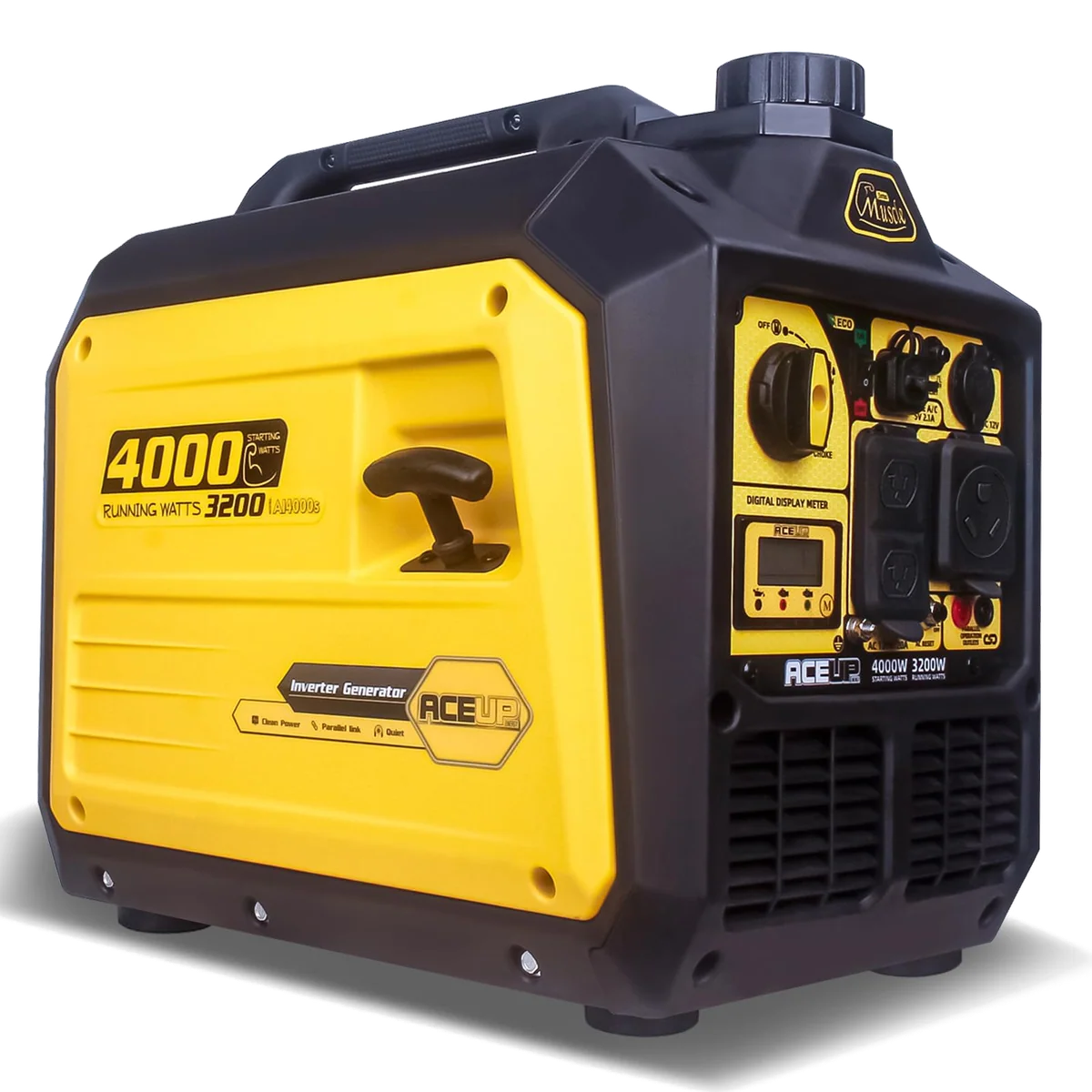
| Aceup Energy 4000, enclosed | "Super Quiet" in the title, "fully-enclosed design reduces noice level" in the bullets, no figure anywhere | The only three-way listening test at 23 feet called it the loudest and highest pitched of the three |
| Oxseryn 5000, open frame | 70 dB at 23 feet | No load stated, no independent measurement, and owners who volunteer that it is quiet at thirty feet |
| PowerSmart 4400, open frame | 76 dB at 23 feet at 25% load, under a heading that says super quiet | The most honest number on this page, on a machine whose title never uses the words open frame |
| AMERISUN 4500, open frame | No noise claim at all | The metered figures circulating under this badge belong to the enclosed 2500, which has a shell this one does not |
| Gidrox 11000, enclosed | 62 to 65 dB, "quieter than a normal conversation" | No distance, no load, and a normal conversation is about 60 dB, so the comparison fails on its own arithmetic |
Read down that table and the pattern is plain: the two lowest figures come with the fewest verifiable conditions attached, and the highest figure comes from the listing that states its conditions most fully. A low published number is weak evidence of a quiet machine and strong evidence of a confident copywriter.
Which of these to actually buy, if noise is the constraint
The enclosure is the only structural feature that reliably moves the needle, so if quiet is the binding requirement, four of the seven are worth discussing and three are not. That still leaves each of them with a real fault, and none of these faults is about sound.
Aceup Energy 4000. Owners hedge every time they describe it, saying relatively quiet, fairly quiet, quiet enough, and they name eco mode specifically as the setting that makes it tolerable. That is an accurate description of a decent enclosed machine and not of a silent one, which matches the meter. The drawback has nothing to do with noise: the internal fuel tank can pull a vacuum and collapse if you close the cap vent with fuel inside, and the manual does not warn you, which is set out in full in our review of it. Leave the vent open, or run it dry at shutdown, and it is a sound occasional-use outage machine.
LIFAN 4800. This has the most useful noise report of the lot, and it is not a number: from inside a trailer with the rooftop air conditioner running, the same owner says the air conditioner drowns out roughly ninety-eight percent of the generator and he sometimes has to stop and work out whether he is on shore power. For an RV that is close to a complete answer to the question. The drawback is the first hour rather than the running: the starter battery ships disconnected and hidden behind a frame rail, the manual does not tell you where it is, and six ratings is not a durability record, all of which the review works through.
Gidrox 11000. Enclosed, and the one owner with other generators to compare it against called it noticeably quieter than his own. Against that, the noise claim is the least disciplined on this page, and the machine's own record contains an owner reporting that it stops working somewhere between 5,000 and 5,500 watts against a 9,000-watt running rating, on a listing four weeks old. Load-test it inside the return window before you trust it with anything.
Efurden 2800. Specific Load's position on this one is walk away, and the quiet claim is a large part of why. The 58 dBA figure has been checked by nobody, the enclosure and the 40-pound weight are the entire premium you are paying, and the running output behind the 2800-watt headline is 2000 watts. Paying extra for an unverified adjective is a bad trade when the wider inverter field contains machines with owner bases behind them.
The three open-frame machines are a different purchase, and worth being clear-eyed about. The Oxseryn 5000 is the one where owners volunteer that it is quiet without being asked, describing it sitting thirty feet behind a camper, barely audible inside, with a conversation possible outside at normal volume. That is a better real-world report than its 70 dB claim implies, and the drawback is that two of the eight substantive reviews on its record involve a replacement unit, one of them after a melted trailer plug. The PowerSmart 4400 publishes the honest 76 and its owners still call it quiet, because their comparison class is contractor generators rather than inverters. Its drawback is what happened to the one owner who let it sit three weeks: it cut out at thirty seconds with a false overload on both fuels, and support told him to find a repair shop and pay the freight himself. The AMERISUN 4500 publishes nothing at all about noise, shares a parent company with PowerSmart, and carries roughly one one-star review in six on the largest pool of owner feedback for that machine class, with a service network the unlucky owners could not reach. If the badge question is what brought you here, the two brands are the same company, and what that means for a warranty claim in year two is its own subject.
If the honest answer to your situation is that none of these is quiet enough, that is a legitimate finding rather than a failure of shopping, and the camping shortlist exists for people whose neighbours are twenty feet away in a field.
Where the decibels actually go
Four things move the number you experience, and only one of them costs money.
Distance is free and it is the biggest lever you have: every doubling of the gap between the machine and your window buys roughly six decibels, so moving it from twenty feet to forty feet does more than any brand switch in this price class will. The limit is cable, not physics; a long run needs heavy gauge or you trade noise for voltage drop. Direction is free too, and the exhaust end is the loud end, so pointing it away from the house and away from the neighbour is worth doing deliberately rather than by accident. Surface is nearly free, since grass absorbs where concrete and gravel reflect. And load is the one you buy: a generator loafing at a third of its rating in eco mode is quieter than the same machine at ninety percent, which means buying more capacity than you need is also buying quiet.
What does not work is the thing everyone tries. Boxing a generator in restricts the cooling airflow the engine depends on and relocates the exhaust to somewhere you did not choose, which is how carbon monoxide finds its way into a building. Distance is the control, not the enclosure, and not the CO sensor either; where a running generator can and cannot live is the page to read before you build anything. If the real requirement is a machine that makes no noise at all because it lives indoors, a battery does that and a petrol engine never will.
Frequently Asked Questions
What does a rating of 58 dBA at 23 feet actually mean?
It means a meter was read seven metres from a machine running at a quarter of its rated load or none at all, which is close to the quietest condition that generator will ever produce.
How loud is a portable generator when you are standing next to it?
Sound pressure falls about six decibels per doubling of distance in the open, so a machine rated in the high fifties at 23 feet is typically in the mid seventies at arm's length, which is roughly what a metered comparison of a small Aceup against a Honda EU2200i found.
Is 76 dB quiet for a generator?
No, that sits at the loud end of the portable class, and it is published under a bullet headed super quiet operation while being measured at the machine's easiest condition.
What is the quietest 4000-watt generator?
Nobody has metered this class head to head, so the honest answer is that an enclosed machine running well below its rating will beat an open-frame one of the same wattage whatever badge is on it.
Does eco mode genuinely make a difference?
Yes, because it drops engine speed to match demand, and it is the setting owners name unprompted when they describe their generator as bearable.
Do two generators in parallel sound twice as loud?
No, two identical machines add about three decibels, which is a real increase but nothing like a doubling of perceived loudness.
Why does my generator sound louder than the identical one my neighbour runs?
Surface, exhaust direction, distance and load all move the reading, and the one tester who compared three machines at 23 feet found that grass instead of concrete or gravel mattered on its own.
Can I build a box around it to quieten it down?
Not safely without engineered ventilation, because an enclosure starves the engine of cooling air and moves the exhaust somewhere you did not choose.
Does a low decibel rating mean it will be quiet under load?
No, and that is precisely what the rating does not tell you, since two metered tests of the same enclosed machine read under 50 dB at thirty-five feet unloaded and 75 dB at ten feet at about three-quarters load.
Why do two machines with the same reading sound so different?
Pitch, because both testers who disliked a machine on this record complained about a higher-pitched tone rather than a higher number.
Sources (4)
- Amazon listings and customer reviews
- Owner and reviewer video, 5 channels
- Walmart listing
- Woot — Article — tools.woot.com