A running engine with dead sockets is almost never a dead generator
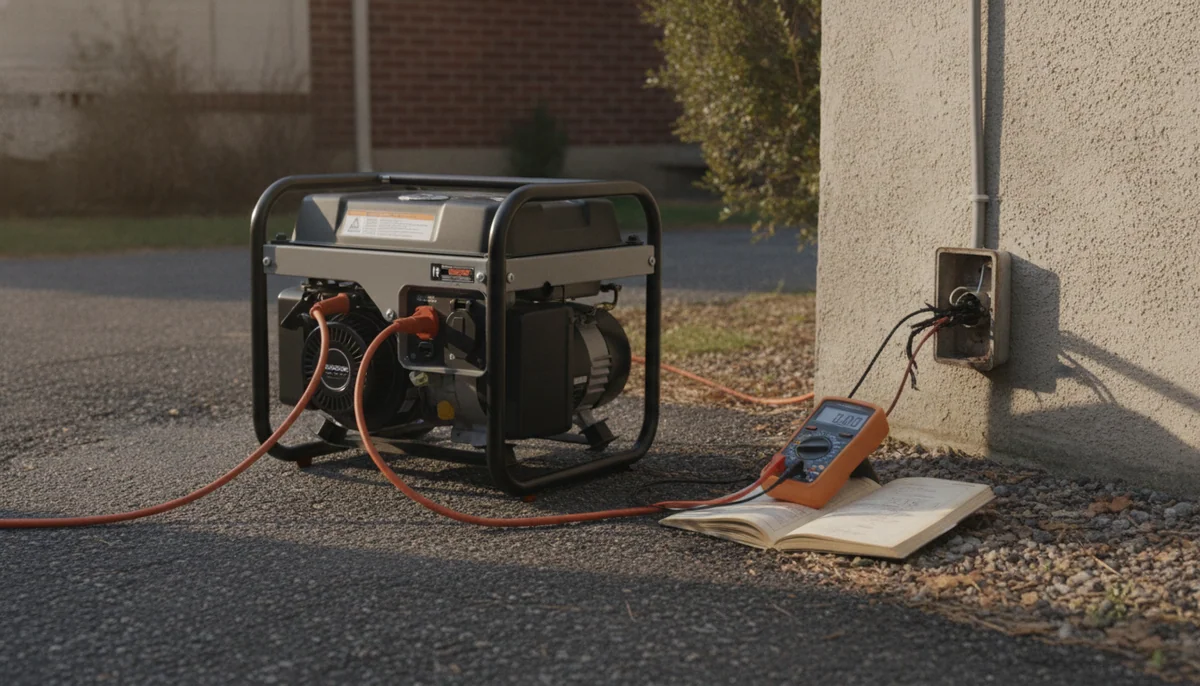
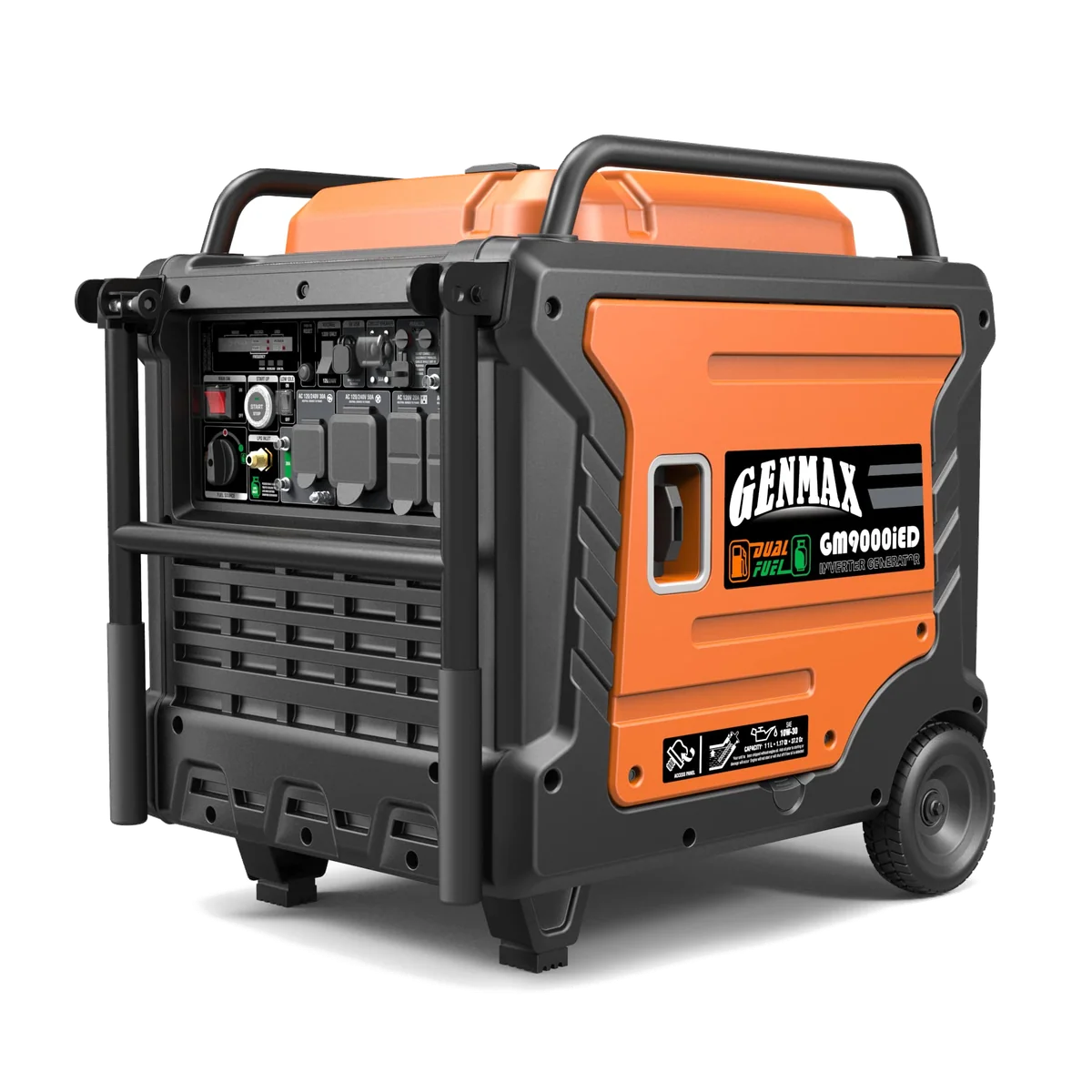
An owner of a GENMAX GM9000iED had an electrician do some work around the house, went out to start the generator afterwards, and found the 240 volt 50 amp receptacle stone dead. The manual was no help. He called support, got an answer in a couple of rings, was handed to a technician, and had the machine running correctly a few minutes into the conversation. Nothing was broken. Nothing was replaced. The fix was a control on the panel in front of him that the documentation never bothered to explain.
That is the shape of this fault far more often than people expect, and the diagnostic gift is the display. A member of Power Equipment Forum described a machine showing 121 volts on one leg and 243 across both while every receptacle read zero. Read that carefully and it tells you where to look: the inverter is making electricity, the meter can see it, and the thing standing between the meter and your extension cord is a breaker, a selector and a few inches of wiring. Expensive parts are at the far end of that list, not the near end.
| What you are seeing | What it usually is | Do this |
|---|---|---|
| Display reads normal voltage, every socket is dead | The voltage selector is in the wrong position, or a main breaker has popped | Unplug everything, cycle the selector, reset every breaker, restart with no load |
| The 240 volt socket is dead, the household sockets work | The machine is in its 120 volt mode, or it never had 240 volts to give | Check the selector first, then check whether your model actually makes 240 volts at all |
| One socket dead, the others fine | That circuit's breaker, or a GFCI that has tripped and not been reset | Press the reset on the receptacle, then move the load to another socket to prove it |
| Generator fine, appliance dead | The cord, an adapter, or the transfer gear inside your RV or house | Plug a lamp straight into the generator before you blame the generator |
| Never made power since it was unboxed | A build fault, and it is not yours to fix | Photograph it, report it, return it while you still can |
What follows is that sequence at length, plus the two symptoms people confuse with this one, plus the point at which the honest answer is that you need a different machine.
Work the panel in the order the current takes
Start by taking everything off the machine. A breaker that has tripped under load will trip again the instant you reset it with the load still hanging on, and you will conclude it is broken when it is doing its job. Pull the cords, reset every breaker on the panel, restart, and add loads back one at a time, biggest first. If it holds until a particular appliance goes on and then dies, you do not have a dead generator, you have a sizing problem, and the way starting surges eat headroom is worth understanding properly in why a generator trips its breaker or shuts down under load.
Then find the selector. On dual-voltage machines there is a switch that decides how the alternator's output is arranged, and on the GENMAX it is sold as a paralleling feature: the listing's fifth bullet describes a voltage transfer switch that lets you run at 120 or 240 volts. What the bullet does not say, and what the owner above discovered the hard way, is that the same switch decides which of your receptacles are energised. Put it in the 120 volt position and the big 50 amp socket has nothing to give you, no matter how well the engine is running. This is the single most common non-fault in the whole category, and it is the first thing to touch after the breakers.
Paralleling has its own version of this. When an owner asked how to tie a GM9000iED to a DuroMax XP9000iH, the answer was to take the load out of one machine's 50 amp outlet, tie L1, L2 and ground across, and let the GENMAX provide the neutral return. In that arrangement the second machine's own sockets are not where your power comes out, and finding them dead is the setup working rather than failing. Worth knowing before you spend an evening testing the wrong panel.
Eco or idle mode is not a cause of dead sockets, but it produces the anxiety that sends people looking for one. The engine sits at low revs doing nothing audible until a load asks it for something. Plug in a heater, listen for the engine to pick up, and you have learned more in ten seconds than any amount of staring at the display will tell you.
Half the time the fault is not in the generator at all
Before you open anything, prove the machine in isolation. One lamp, one short cord, straight into a 120 volt socket on the generator. If the lamp lights, the generator is making power and everything you have been fighting lives between that socket and the appliance: the extension cord with a broken conductor, the adapter that only carries one leg, the GFCI that has tripped and sits there looking normal until you press reset, or the transfer gear inside your trailer or your house. If you are feeding a building, the inlet, interlock and transfer switch have their own failure modes and they are all upstream of your outlets rather than in them.
The other half of that is knowing what the socket in front of you actually is, because the shape tells you the voltage and people routinely assume wrong.
| Receptacle | What it delivers | Where people go wrong |
|---|---|---|
| 5-20R household | 120 volts | Assuming a tripped GFCI on one of these means the whole machine is dead |
| TT-30R, the three-pin RV socket | 120 volts at 30 amps | Reading "30 amp" as 240 volts, which it is not |
| L14-30R twist-lock | 240 volts, split into two 120 volt legs | Expecting it on a machine that has no 240 volt capability |
| 14-50R | 240 volts at 50 amps | Forgetting it goes dark when the selector is set to 120 volts |
The AMERISUN 4500 is the clean example of why the shape matters. It carries a 30 amp RV outlet, standard household sockets and a 12 volt DC port, and every one of them is 120 volts. There is no 240 volts anywhere on the machine, so a buyer who arrives with a dogbone adapter and an interlocked panel in mind finds nothing at all, and nothing is exactly correct. Owners of that model have also reported the 12 volt conversion simply not working, which is a genuine dead output rather than a misunderstanding.
The neutral question, and why a GFCI can refuse to hold
This one is more consequential than it looks. The GM9000iED ships with its neutral bonded to the frame, GENMAX supplies no instructions for converting it to floating, and an owner who worked it out alone left the map for everyone else: it is bonded on a metal rail mounted behind the electrical panel, lower left as you face the machine, near the LPG inlet, in a place he described as very difficult to reach. Do not assume the answer carries across a product line, either. When an owner asked about a sibling model, the thread turned up different panel text on different revisions of the same listing and a buyer who could not get an answer out of the company at all.
The practical consequence is that a generator whose neutral arrangement does not match what the rest of your system expects can behave like a machine with nothing at the sockets: a protected receptacle that will not hold, a breaker that opens as soon as a load appears, an inlet that feeds a panel and lights nothing. That is a wiring mismatch, not a defect, and the way to settle it before you ever need the generator is a multimeter across neutral and ground. Continuity means bonded. Which one you have and what to do about it is worth ten minutes on a dry afternoon rather than a torch-lit hour during an outage.
Flashing the field is a real repair, and almost certainly not yours
Search this symptom for long enough and someone will tell you to spin the engine with a drill to restore residual magnetism. That advice is genuine and it belongs to a different generation of machine: an older brushed or capacitor-excited alternator relies on a small amount of magnetism retained in the rotor to start generating, and if the machine has sat unused for years that magnetism can decay until the alternator has nothing to bootstrap from.
An inverter generator does not work that way. The alternator feeds a rectifier, the output is reconstructed by an inverter board, and there is nothing in that chain for a drill to re-magnetise. All three machines this page discusses are inverters, as is nearly everything sold as quiet or as suitable for electronics. If yours is one, skip the folklore: the useful checks are the breakers, the selector, the cord, and then the board, which is a warranty conversation rather than a driveway one.
The symptom next door: it starts, then quits
Worth separating, because the two get filed together and their causes have nothing in common. If the engine dies rather than the outlets, you are looking at fuel or a safety cutout.
On the GENMAX, one owner bought in June, left the carton sealed until February, and got a few minutes of running on both fuels before it stopped. GENMAX honoured the warranty, and the fault turned out to be a defective carbon monoxide sensor; after that it ran fine. The CO detection on that machine is advertised to cut the engine when it sees an unsafe level, so on a machine that starts and quits it is a leading suspect and it is a warranty part. Call before you conclude the generator is finished.
On the Aceup 4000 the cause is more embarrassing and more common. Its 5-in-1 knob combines fuel on, fuel shutoff, choke and engine on/off in one control, which the listing sells as simplification. One owner titled a five-star review around the fact that the control presents as a black cap on a black panel that you cannot see; their unit started, ran a moment and shut down, over and over, because the fuel side had never been opened, and they worked this out in pouring rain. That is the classic signature of a closed fuel path: the engine burns what is in the carburettor bowl and stops when the bowl empties. Put a strip of tape or a dab of paint on that cap now. If you are chasing a no-start rather than a stall, the fuel valve, the hidden battery plug and the closed cap vent is the sequence, and if the machine has been stored a while, varnish in the carburettor is the likeliest reason it will not run cleanly.
When it really is the machine, the question becomes who picks up
Some of these are hardware. The difference between brands is not whether they occasionally ship a bad unit, because they all do; it is what happens next.
GENMAX comes out of this well, and the evidence is specific: the phone answered in a couple of rings and a technician who solved the problem on the call, plus a warranty claim honoured on the faulty CO sensor. By August 2026, r/Generator points owners at a US phone line and email out of Ontario, California, with parts held there. That does not solve the physics of moving a 250 pound machine to a service centre, but it means someone competent answers.
AMERISUN is the counter-example, and it is the reason this page keeps telling you to test early. In the largest pool of owner reviews for that 4500 watt machine, which sits under a different listing of the same generator, a buyer purchased in May, unboxed in August, got it running on the third pull and watched it shut down after eight to ten seconds every time. He sent photographs and video, the manufacturer's own engineers determined a faulty wiring harness, and he was then declined a replacement and pointed at a service centre thirty miles away that had stopped handling their warranty work. Amazon's window had closed. A second owner exercised his weekly, kept it fuelled and oiled, watched it die at about three months, sent the seller the photographs it asked for, and never heard back. Aceup has its own version: an owner whose internal fuel tank collapsed inward documented the damage after taking the machine apart, and was refused a refund or replacement inside the warranty period.
Specific Load has not had any of these generators on a bench. Nobody here has metered an output, pulled a cord or timed a runtime, and every account above belongs to an owner, a forum member or a manufacturer's own listing. Where the record runs out we say so rather than filling the gap, and the gap that matters most here is that nobody has published a systematic teardown of a dead-output unit in this class. What the record does support is the ordering, and the ordering is what saves you an evening. What you are actually buying with a budget inverter generator is the wider version of that argument, and it is mostly an argument about who answers the phone.
If it is time to replace it rather than fix it
Three machines sit behind this page, and each is a different answer to a different problem.
The GENMAX GM9000iED is the one to buy if you want a house-scale machine and will actually run it. It has a 50 amp receptacle that matches what the alternator can make, pressure-fed oiling with a cleanable screen, clean output and remote start, and its worst owner accounts describe units that failed while sitting rather than while working: one buyer found both of his dead after a few months of storage, and a mobile grooming business putting ten hours a day on one reports nothing wrong at all. That is a good duty-cycle record attached to a poor dormancy record, which is awkward for a machine sold as outage insurance, so buy it only if you will exercise it monthly under real load and are willing to settle the neutral question in advance. Our full review of the GM9000iED works through the rest, including why paralleled output is capped nearer 12,000 watts than the figure on the box. It also sits at the top of Amazon's power take off category while being nothing of the sort, a mislabelling we untangle in what a PTO generator actually is.
The Aceup Energy 4000 is the one to buy if your outage plan is a few essential circuits. One owner was three days into an outage with it running non-stop on a fridge, a deep freezer and phone charging, and owners at a year and eighteen months report it starting on the first or second pull. The drawbacks are real and specific: 3,200 running watts covers essentials and not a household, the fuel tank can collapse if you close the cap vent with fuel inside, and the one warranty claim visible in the record was refused. Leave that vent open, read our review of the AI4000s before you order, and size the job honestly using running watts rather than the number on the carton.
The AMERISUN 4500 is the cheapest way onto this list and the one with the most conditions attached. The hardware is more capable than its price band suggests when it is good, and the failures cluster in the first hours or the first three months with a support structure behind them that failed every owner who tried to use it. Buy it only if you will fuel it, oil it and load it the week it arrives, because the return window is the only warranty that has worked for anybody, and remember that every socket on it is 120 volts. The full case, both halves of it, is on its own page.
If none of that appeals, the machines with service networks behind them live in our portable inverter roundup, the whole-house end of the problem is covered in the home backup guide, and if what you actually want is something that cannot have a carburettor problem or a dead-outlet mystery in the first place, the battery-versus-petrol argument is the one to read next.
Frequently Asked Questions
The display shows voltage but nothing at the sockets works, so what does that tell me?
It tells you the alternator and inverter are producing electricity and the fault sits between the meter and the receptacle, which means breakers and the voltage selector before anything expensive.
Should I flash the field with a drill?
Not on an inverter generator, where the output is rectified and rebuilt electronically and there is no residual magnetism for that trick to restore.
Why is my 240 volt socket dead when the household ones are fine?
Nine times out of ten the voltage selector is sitting in its 120 volt position, and the rest of the time the machine never made 240 volts in the first place.
My RV socket says 30 amps, so is it 240 volts?
No, a TT-30 is a 120 volt socket rated at 30 amps, and plugging a 240 volt appliance chain into it through adapters will get you nothing useful.
Can a bonded neutral stop my outlets working?
It can look exactly like that, because a bonding arrangement that does not match your transfer gear or a protected receptacle will open the circuit rather than pass power.
Does the carbon monoxide sensor cut the outlets?
No, it cuts the engine, so if the motor is still running the sensor is not what is standing between you and your power.
Where do I find the manual for one of these?
It ships in the carton and lives on the maker's own site, but the page you actually need is the control panel diagram, which is the only place the selector switch is explained.
How do I find parts when the brand will not answer?
Read the engine's own model number off the block or the emissions label and search for that instead of the badge on the frame, because the generic part is usually cheaper and far easier to obtain.
Is a repair worth paying for on a budget machine?
Rarely, once you add a diagnostic fee and the cost of moving a heavy machine to a shop that may not want the work, which is why proving a new unit inside its return window matters more than any warranty length printed on the box.
Sources (4)
- Amazon listings and customer reviews
- Owner reports across r/Generator threads
- Powerequipmentforum — Article — www.powerequipmentforum.com
- Woot — Article — tools.woot.com