The panel in the bundle is not sized to the battery in the bundle
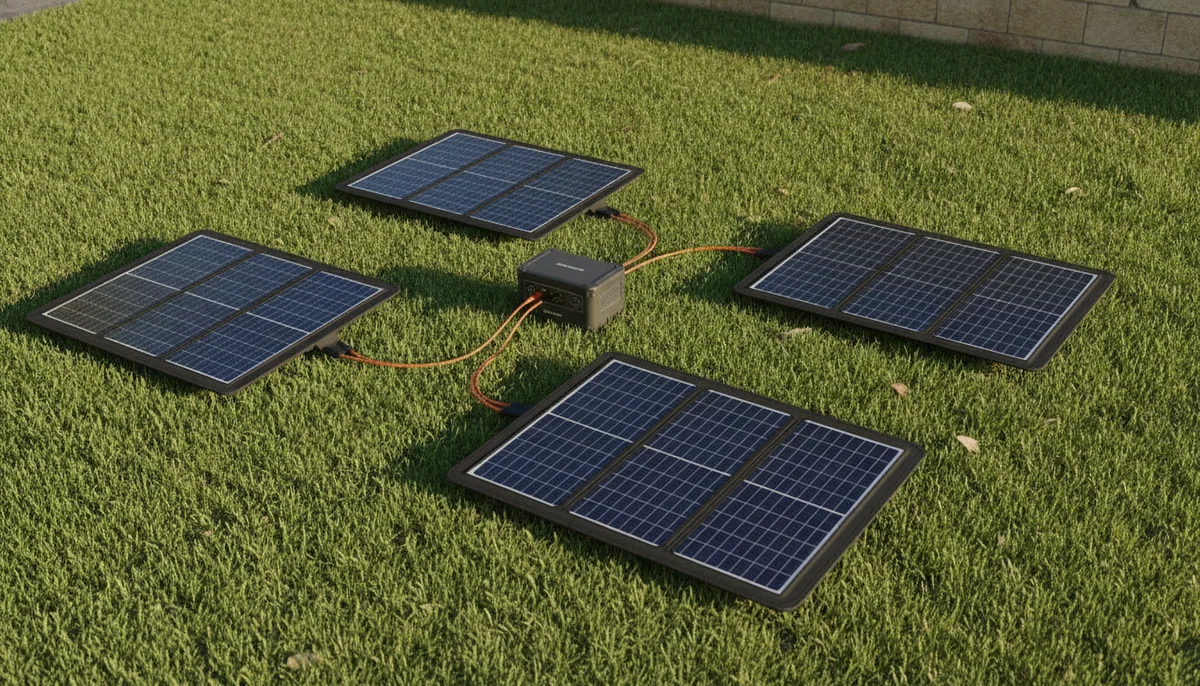
Two numbers decide whether solar will actually refill your power station, and only one of them is printed on anything. The first is the panel's rating, which is a laboratory figure measured under a standard test lamp at a standard temperature. The second is how many hours a day your panel gets to behave as though that lamp were still on, and the answer is not twelve. The sun climbs, crosses and sets, the panel is rarely square to it, the cells get hot and lose voltage, and haze and dust take their cut. A clear summer day in most of the continental United States is worth something in the region of four to five hours at nameplate. Call it four once the charge controller has taken its share, and you have a planning figure you can do arithmetic with.
That gives the only rule of thumb worth memorising here: a watt of panel for every four watt-hours you want back before sundown. A 1,000Wh station wants about 250W. A 2,000Wh station wants about 500W. A 4,000Wh station wants a kilowatt, and a kilowatt of folding panel is not an accessory, it is a second purchase roughly the size of the first. That number is not a fringe opinion either: in a thread about a battery a quarter the size of the big units on this page, an owner made the point that 400W of solar is severely limiting even there, and that 1,000W is where solar starts doing real work.
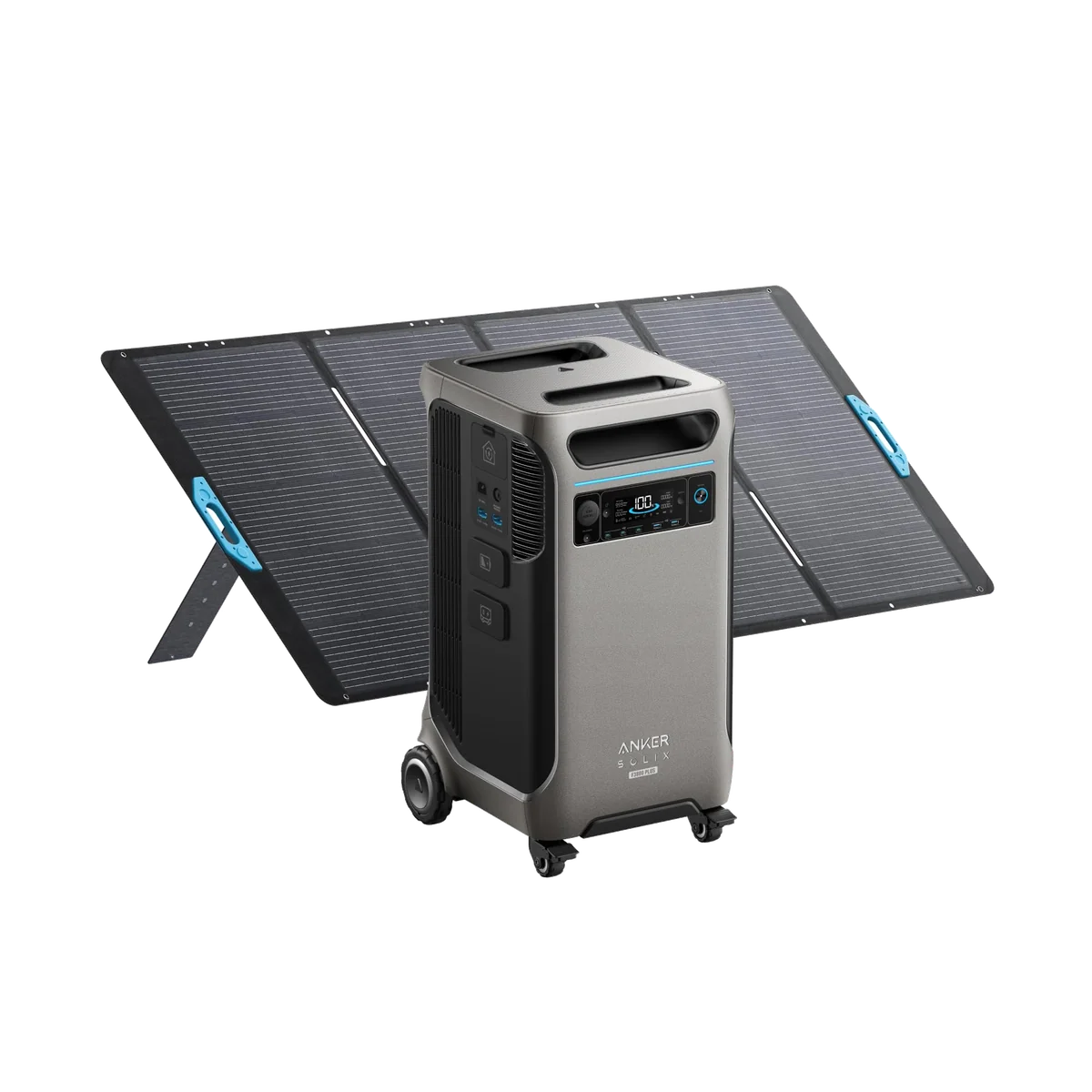
Now hold the Anker bundle against it. The battery is 3,840Wh, the panel is 400W, and four hundred watts across four effective hours is about 1,600Wh a day, so the panel in the box needs roughly two and a half cloudless days to refill the battery in the box. Anker's own marketing for that model talks about a full recharge in under two hours in optimal sunlight, which is a statement about the input port rather than about anything in the carton. The port is not the constraint. The port on that machine will swallow 3,200W across two inputs, each of them happy with 11 to 165V at up to 17A, which covers most ordinary MC4 arrays. Anker widened the door and then handed you a very small parcel to carry through it.
What saves this page from being a straight complaint is the other end of the market. The little stations are sized honestly, not because their makers are more virtuous but because a 288Wh battery genuinely is a 100W panel's day's work. Specific Load did the sum on all five machines here, and the three cheap ones pass it comfortably while the two expensive ones do not come close.
Five machines, one sum
| Station | Battery | What the solar input will take | Panel in the box | Panel for a same-day refill |
|---|---|---|---|---|
| Anker SOLIX F3800 Plus | 3,840Wh | 3,200W over two ports, 11 to 165V and 17A each | 400W folding | about 960W |
| EcoFlow Delta Pro 3 with dual fuel generator | 4,096Wh | Not established anywhere in our record | None, an engine instead | about 1,020W |
| EcoFlow TRAIL Plus 300 DC | 288Wh | 110W | None | about 70W |
| VTOMAN Jump 600X | 268.8Wh | 120W with MPPT | None | about 70W |
| DaranEner R100 | 89.6Wh | 40W over a DC5521 barrel, 10 to 30V at 3A | None | about 25W |
Read down the right-hand pair of columns and the pattern is the opposite of the one the marketing implies. The bigger the battery, the worse the relationship between what ships and what is needed, and the more expensive the gap is to close. The smallest machine here is the only one whose input port is smaller than the panel you would sensibly buy for it.
What that means for each of them
The Anker SOLIX F3800 Plus is the right big machine to put solar on and the wrong package to buy it in. The single best thing about this generation is that it stopped needing Anker's own low-voltage panels and started accepting normal arrays, which makes buying it with an undersized branded panel a peculiar way to spend the premium. Its honest drawbacks are not solar-related and you should know them anyway: the socket sold as a 30A RV outlet is capped at 3,000W, one owner reports his camper's air conditioning tripping the unit after about five minutes even with a soft start fitted, and at 136 pounds it goes where you first put it and stays there.
The EcoFlow Delta Pro 3 sold with its 3,200W dual fuel generator is this page's most interesting answer, because EcoFlow looked at the same arithmetic and shipped fuel instead of panels. The station's logic gives solar priority and only wakes the engine when the battery falls through a floor you set, which is the correct hierarchy: free watts first, expensive noisy watts as the backstop. The drawback is a piece of string. The cable joining the two halves is sixteen feet and cannot be extended, so unless you can safely park a running engine that close to wherever the battery lives, you have bought two unrelated objects; the engine also has no choke, and in cold-weather testing its automatic start frequently failed on petrol while working on propane. If it is the battery half you actually want, we have set it against the Anker head to head for whole-home backup.
The EcoFlow TRAIL Plus 300 DC is the one station here where the solar figure on the listing is a figure an owner reports actually hitting, regularly, with matched panels. At 288Wh against a 110W ceiling it is the best-proportioned machine on the page, and if your kit is USB-C and 12V it will genuinely live off a single folding panel. Its drawback is severe and has nothing to do with the sun: there is no AC outlet, and less forgivably no way to charge it from a wall socket at all unless you feed it through a USB-C brick, so solar is not a bonus here but one of only three ways in. Three of the eight owners on record also received a unit with an out-of-box fault, which is a small sample and an alarming proportion of it.
The VTOMAN Jump 600X takes up to 120W with MPPT against a 268.8Wh battery, which is a sensible ratio, and one long-term owner says her units charge fast enough from panels to come back up to speed within a day's light. Two catches. The panel is sold separately despite the words Solar Generator sitting in the title, and the listing does not publish an input voltage window, so a generic panel is a question rather than a purchase until you have asked. The larger drawback is the company behind it: VTOMAN sits at 2.7 on Trustpilot with half of all reviews at one star, below every rival you would cross-shop, which is why we say buy it somewhere the retailer owns your return. The comparison against EcoFlow's River 3 Plus is the direct version of that decision.
The DaranEner R100 is the machine on this page where solar sizing is not a judgement call, because the port decides it for you. The input is a DC5521 barrel rated 10 to 30V at 3A, 40W maximum, and DaranEner recommends a panel of roughly 22.5V and 3A with an open-circuit voltage between 18 and 35V. One 40W panel refills 89.6Wh in a morning and a second panel is actively the wrong move, for reasons the next section explains. The drawback is scale: this is a laptop, phone and camera battery with an AC socket bolted on, its AC output shuts off with 10% still in the pack, and no panel or solar cable comes with it.
Volts and amps decide before watts do
This is the part that turns a confident purchase into a returned parcel. An input port is not rated in watts alone. It has a voltage window and a current ceiling, and both have to be satisfied at once, in cold weather as well as warm.
Wiring panels in series adds their voltages and keeps the current the same. Wiring them in parallel adds their currents and keeps the voltage the same. On the Anker, with 165V of headroom but only 17A per port, series is the arrangement that gets you near 3,200W and parallel is the arrangement that hits a wall at a third of it. The trap in series is that a panel's open-circuit voltage climbs as it gets colder, so an array that measures comfortably inside the window on a warm afternoon can overshoot it on a bright frozen morning, which is the one condition where you most wanted the charge.
On the DaranEner the same arithmetic runs the other way and lands on a single panel. Two of the recommended 22.5V panels in series come out near 45V open circuit, above a port rated to 30, and the same two in parallel come out at 6A against a 3A limit. There is no legal way to put more than one sensible panel into that socket, and the honest reading is that the R100 is a device you keep topped up rather than one you run a camp from.
Connectors are the last of it, and they cost money rather than watts. Anker dropped the XT-60 that everybody's existing leads use in favour of its own snap-lock, which means adapters and more cable in the pile for anyone already equipped. The small units use barrel jacks and USB-C. Budget for the adapter before you discover you need it on a Friday night.
The station drinks before your appliances do
Sizing an array against the number on the battery's label quietly ignores two losses that both land on the solar side of the ledger.
The first is the inverter's own standby consumption. An independent test of Anker's F3000 measured idle draw at 20.5W, which was better than Anker's own claim and is respectable for the class. Run that for twenty-four hours and it is roughly 490Wh gone before you have plugged anything in, which is more than a 100W panel produces on a clear day. A station left switched on can outrun a small array doing nothing whatsoever, and that is the likeliest explanation for the owner of an older F3800 who got about twenty-four hours of fridge out of it, an average draw near 160W that no fridge alone accounts for.
The second is conversion. Bench testing pulled 3,830Wh out of the Delta Pro 3's rated 4,096Wh at a steady 800W load, which is an unusually honest 93.5% and better than most of the class manages. Multiply EcoFlow's own published runtime chart back out, though, and every row lands between roughly 3,240Wh and 3,410Wh, an admission of about twenty percent lost across the range of loads people actually run. Both figures are true, because efficiency is worst when the load is small and the fixed overhead dominates, which is precisely the off-grid trickle case. Our page on what a power station really delivers to a fridge after inverter losses works through the same gap from the discharge side.
So the practical correction is to apply the watt-per-four-watt-hours rule to the energy you intend to take out, plus the station's own overhead for the hours it is awake, rather than to the number moulded into the case. In round terms, add fifteen to twenty percent to your array, or switch the thing off between uses and reclaim it that way.
Why the branded folding panel costs what it costs
Reviewing the Anker bundle, The Solar Lab set a high-quality bifacial 415W rigid panel against Anker's own 400W foldable, called the price gap ridiculous, and finished with an instruction: "Unless you're 100% committed to brand loyalty, skip their panels. Use the MC4 ends and plug in your own for a fraction of the cost." Community advice to first-time buyers runs the same way, which is to use ordinary panels and keep the difference.
Two things in the branded panel's defence, because the comparison is not quite like for like. A foldable panel you can throw in a car boot and unfold at a campsite is a different product from a rigid bifacial that wants a rack, a roof and a permanent address, and paying something for the folding is reasonable. And a bundle's built-in discount is usually smaller than what the same maker charges for the panel bought alone. What is exactly like for like is the watts, and watts are the only thing the battery counts.
Do not buy the array expecting it to pay for itself quickly, either. When an owner posted a projected saving of four hundred dollars a year from an Anker installation, the thread's replies redid the arithmetic at ten years rather than six, and someone else pointed out that the saving appeared to come from shifting load onto cheap overnight tariffs with no solar contribution counted at all. Panels buy you independence from the grid and the fuel queue. Treat any payback as a bonus.
The week solar cannot cover
Here is the uncomfortable part, and it is the reason the most serious bundle on this page contains an engine instead of an array. The weather that takes your power out is the weather that flattens your solar. A hurricane band, an ice storm or a stalled November low is a lid over the whole array for exactly as long as the outage lasts, and short winter days at northern latitudes are a fraction of what the same panel gives you in July. Sizing for a clear day is fine for a camper and dishonest for a backup plan.
Owners of the big Anker have already improvised the correct architecture rather than waiting to be sold it: charge from the wall on cheap overnight rates, run the house off the battery through the expensive hours, and top up from a propane generator when the grid is gone. EcoFlow simply put that arrangement in a box and automated the trigger. Anker's answer was to add a dedicated generator port to the Plus. Neither company would have bothered if panels alone were sufficient, and neither of them says so out loud.
That is not an argument against buying solar. It is an argument for knowing what your array is for. A properly sized array covers your daily consumption in decent weather, buys you indefinite runtime on a campsite, and stretches a battery from one day to several during an outage that happens to be sunny. It does not, at any size a household will realistically buy, guarantee a full pack on the fourth grey morning. Our longer piece on why people who take outages seriously end up owning both kinds of machine covers the trade, and if runtime through a genuinely long outage is the actual requirement, the fuel-burning options are the honest answer. The whole class of batteries is ranked in our roundup of solar generators and power stations, and if the word generator on these listings has been doing more work than it should, we have written about that habit too.
Frequently Asked Questions
How much panel does a 1,000Wh station actually need?
About 250W to have it full again by evening on a clear day, and roughly half that if you only need to cover what you consume while the sun is up.
Can I use panels that are not the same brand as the battery?
Usually yes, provided the array's open-circuit voltage and current both sit inside the station's published input window, which is the specification to check before you look at the wattage.
Will a 100W folding panel recharge a 2,000Wh station?
Not in any useful sense, because a clear day at that size buys you roughly 400Wh and the station's own standby draw takes a share of it before your appliances get any.
Does a panel bigger than the input rating charge any faster?
No, the station clamps at its rated ceiling and the extra watts are simply not collected, although an oversized array does reach that ceiling sooner on a hazy morning, which is a real reason to overshoot slightly.
Can I put two panels in series into a small power station?
Only if their combined open-circuit voltage stays under the input's limit, which on a barrel-jack input rated to 30 volts it very often will not.
Why does my panel never make its rated wattage?
Rated output is a laboratory figure and real panels lose to heat, haze, angle and dust, which is why an owner of the Anker bundle reported that his two panels never produced the advertised output even aimed into full sun.
Should I buy the bundle or the bare unit and my own panels?
Buy the bundle when the battery is small enough that a matched panel genuinely fills it, and buy bare above roughly a kilowatt-hour of capacity, where the same money spent loose buys several times the array.
Does leaving it connected to a panel keep a stored station healthy?
No, and both makers on this page ask you to bring a stored unit back to full every three months regardless of what the sun has been doing, which is also the first thing to check on a pack that refuses to wake up .
Can solar alone carry me through a multi-day outage?
Only if the weather cooperates, which is precisely what it is not doing during the storm that caused the outage, and that is why the serious backup bundles now ship an engine rather than more panels.
Sources (6)
- Amazon listings and customer reviews
- Owner reports across r/prepping, r/Portable_PowerStation, r/AnkerSOLIXCommunity threads
- Owner and reviewer video, 1 channel
- Ankersolix — Article — www.ankersolix.com
- Thesolarlab — Article — www.thesolarlab.com
- EcoFlow — Article — us.ecoflow.com