The VTOMAN Jump 600X is a good nine-pound battery with four misleading words printed on it
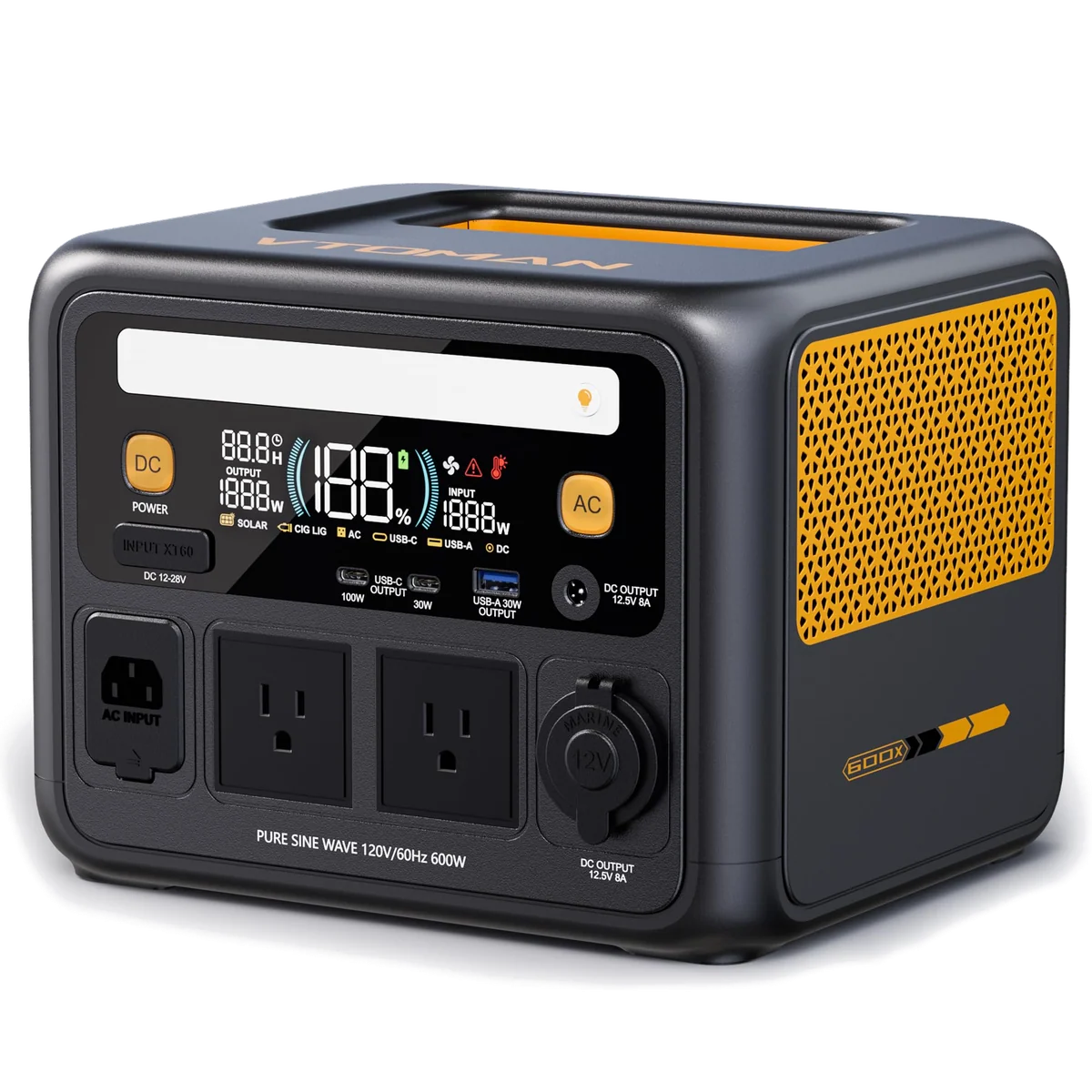
Buy it as a light LiFePO4 battery for a laptop, a router, a CPAP or a night of camp lights, and buy it through a retailer whose returns desk you trust more than the brand's; walk away if the name has you expecting a jump starter, a panel in the box, or power you would stake a medical device on.
Based on published owner reports, 2 owner discussions and 6 other sources. We have not tested this machine ourselves.
We earn a commission if you buy through our links, which does not affect what we say.
Read how this site works →
Where that leaves it
A capable, well-made little battery attached to a listing that oversells it in four directions at once and a company whose reputation depends entirely on which side of its own bimodal service record you land. Size it as a 268.8Wh device, run anything over about a hundred watts on AC rather than DC, expect the fans, buy it somewhere the return is not your problem to negotiate, and it will do exactly the job an outage or a campsite asks of it. Buy it because it says Jump, 1200W and Solar Generator on the front, and you will be disappointed by all three before the first weekend is out.
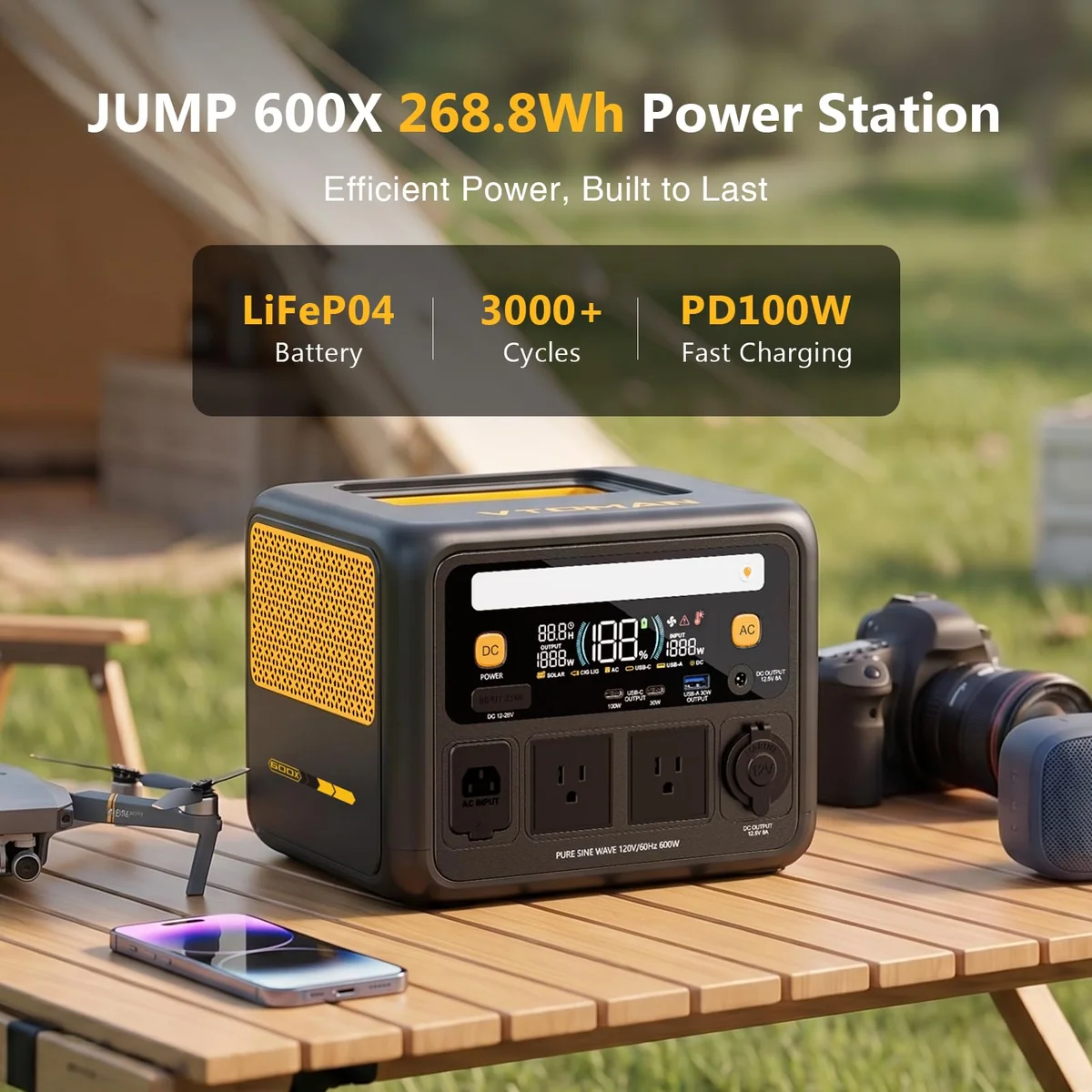
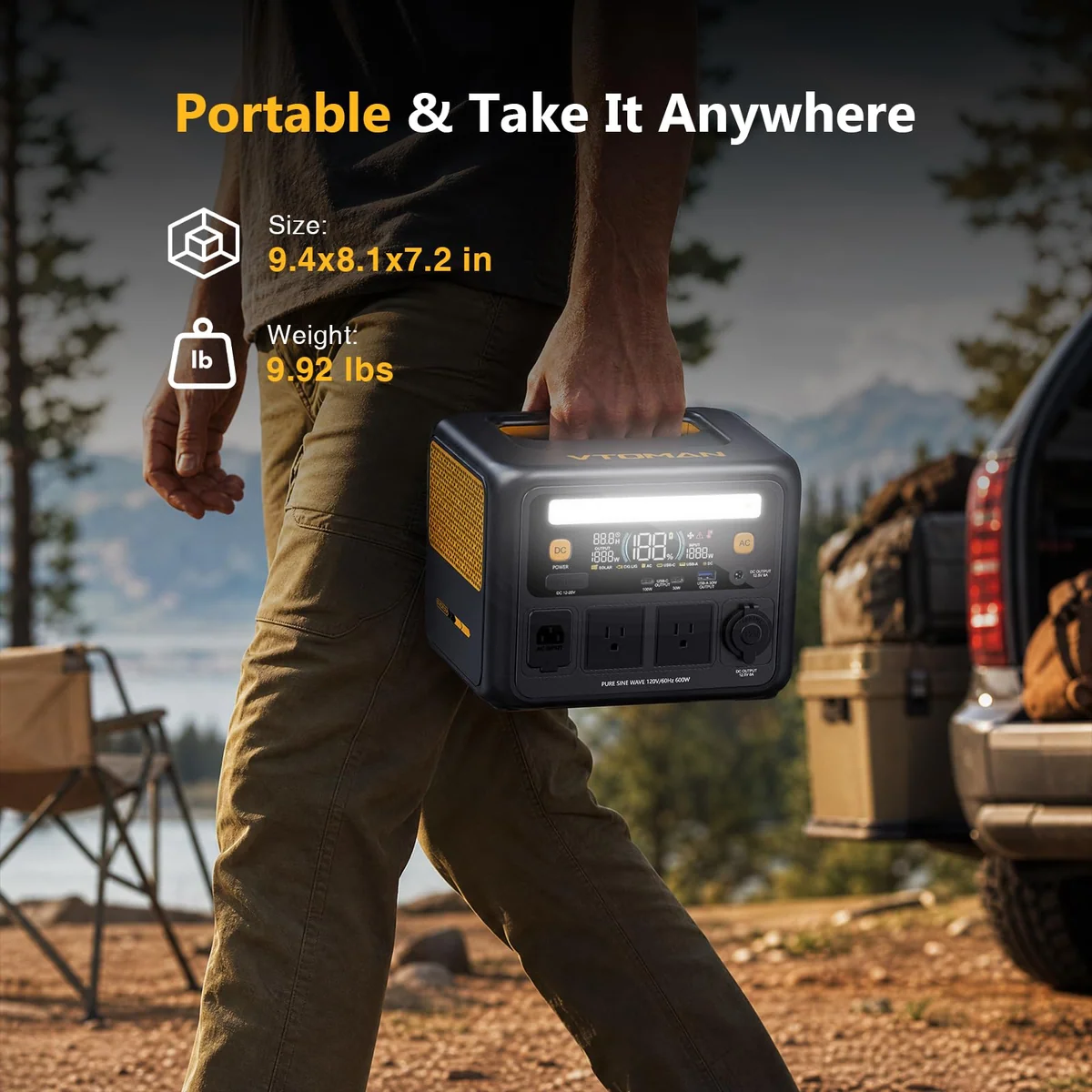
Almost everything wrong with this product happens before it is switched on, in the ninety seconds a buyer spends reading the listing. The name says Jump. The category says Outdoor Generators. The title says Solar Generator, says 600W, says 9 Ports, and says LEP, which is a typo for LFP, the lithium iron phosphate chemistry inside. Read all of that quickly and you picture a small gas-free generator that jump-starts your truck and comes with a panel. What ships is a 268.8Wh battery in a 9.92 lb box with a wall cable, a USB-C cable and a car cable in the carton with it.
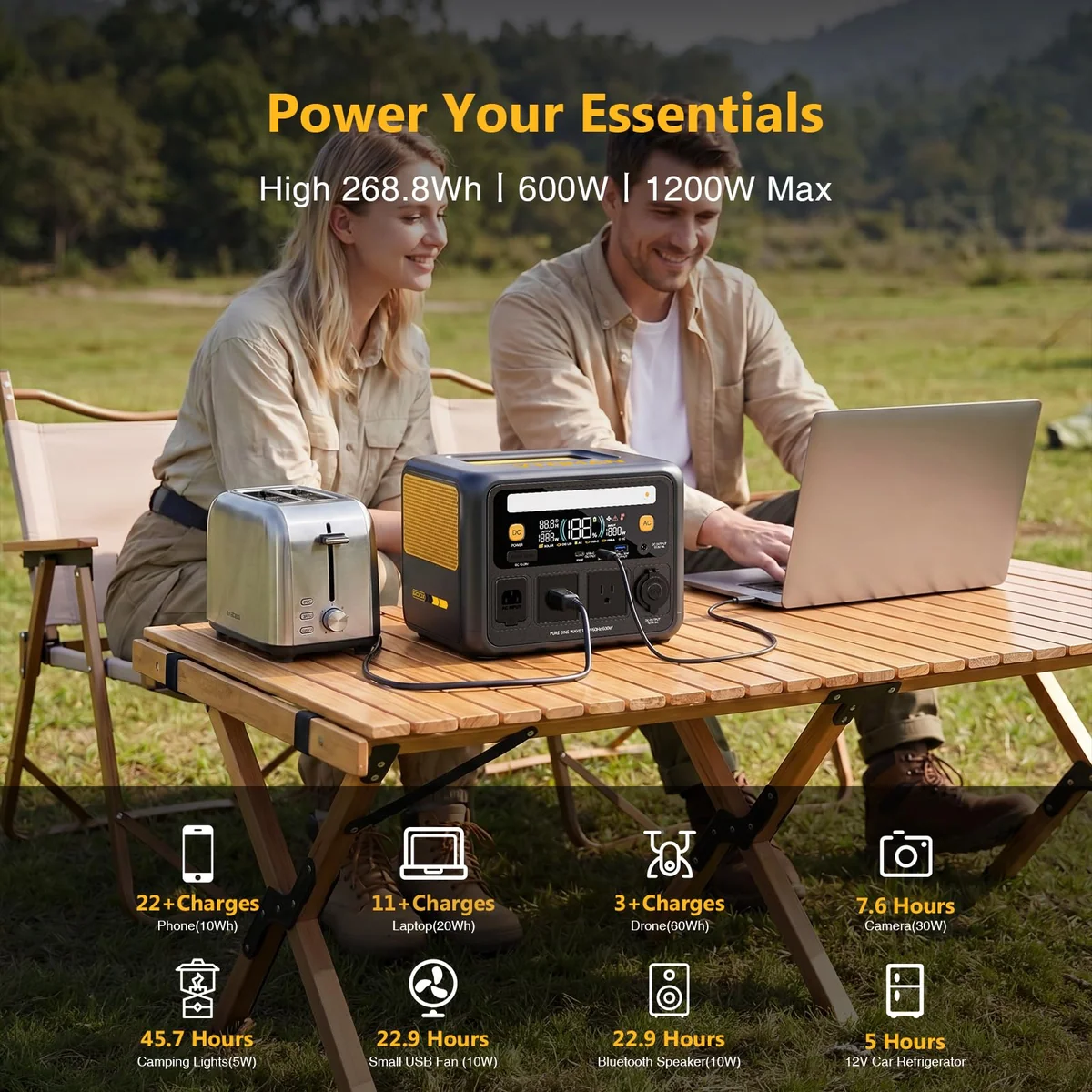
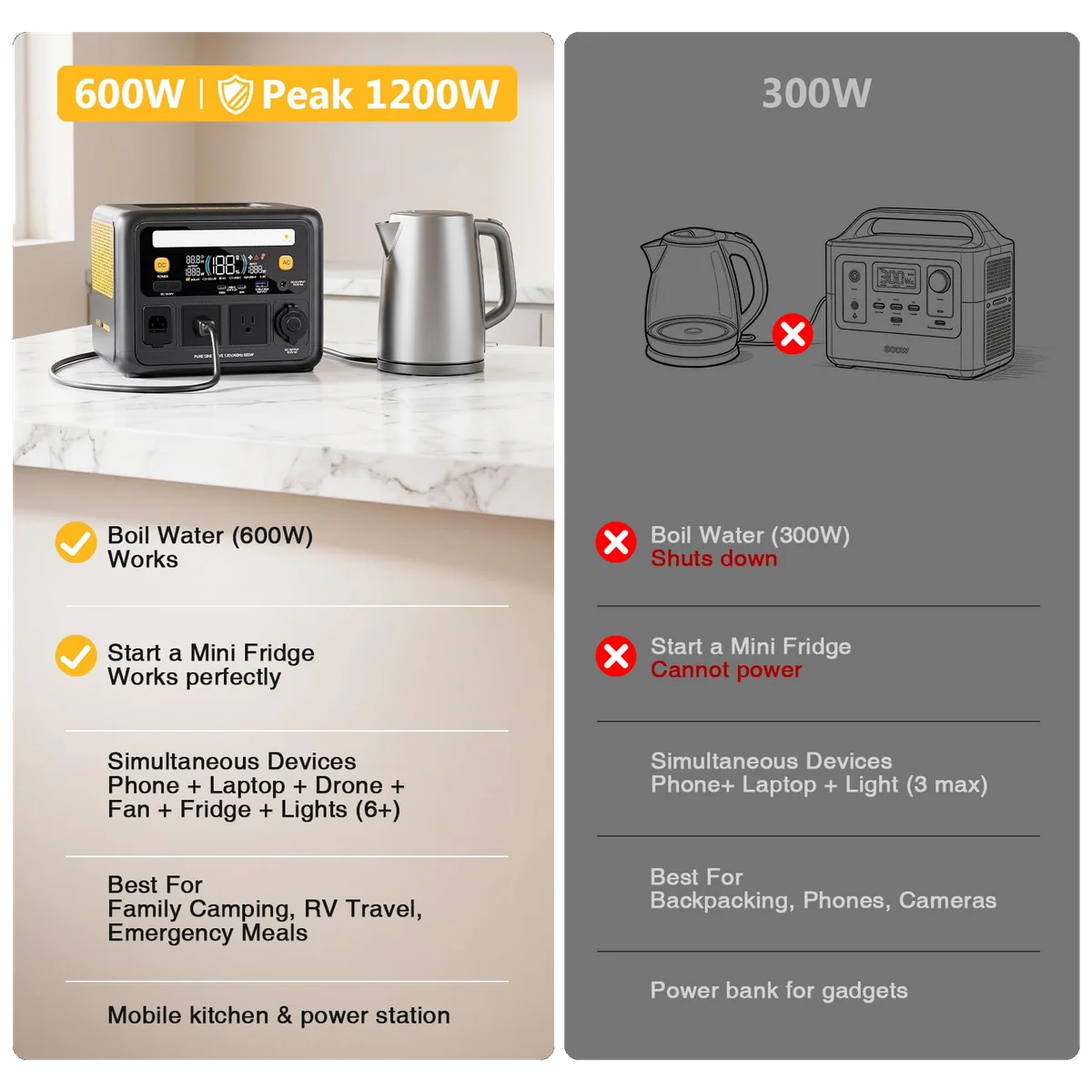
Sized honestly, that is a genuinely useful object. Two hundred and sixty-eight watt-hours is a night of a CPAP without the humidifier, a working day of Starlink Mini, two or three full laptop charges, a router and phones through a long evening outage, a 12V cooler for most of an afternoon. One owner puts the boundary better than any spec sheet: run a Starlink Mini, a portable refrigerator, a small LCD TV or a PC and you will be happy, and if you want an air conditioner or a space heater, buy something else entirely.
The people who will hate it are the ones the marketing recruits. If you are the tailgater who wants a TV and a few crock pots going for six hours with nothing to refuel, this is off by an order of magnitude and no amount of surge rating closes the gap. If you want a fridge alive through a multi-day storm, you want something like the Anker SOLIX F3800 Plus, or a gas machine, or both, and our note on why people end up owning one of each is the argument in full. This box is a bridge over a short outage and a way to have mains-shaped electricity somewhere there is none.
Key Specifications
The four claims on the lid, checked one at a time
600W, surging to 1200W. The 600W continuous pure sine figure is real. The 1200W is not surge in the sense a generator buyer means it, and VTOMAN says so in writing in the first bullet: V-Beyond supports certain resistive appliances rated between 600W and 1200W by reducing output voltage, and for sensitive electronics you should keep the total load inside the rated 600W. Reduced voltage means reduced actual power, which means your 1000W kettle is a slow kettle, and anything with a motor or a switching power supply is outside the exemption entirely. It is the most misreadable number on the page, and it is misreadable in the direction that costs the buyer. If the vocabulary here is new, the difference between the number on the box and the power you get is worth ten minutes.
Jump. The current listing copy never claims jump-starting: no jumper cables in what you get, no starting bullet, nothing. The name is inherited from a product family whose reputation was built on jump starters, and buyers carry the assumption across; one Amazon owner describes jumping a large truck in three seconds using cables bought separately to go with the unit. Separately is the operative word. Treat jump-starting as an accessory purchase you have not yet made, and read the section on those cables below before you make it.
Solar Generator. The listing supports up to 120W of MPPT solar input and states plainly that the panel is sold separately. Nothing dishonest in the fine print, everything misleading in the title. If solar is the reason you are buying, our page on how much panel it actually takes to refill a station will save you from the classic mistake of pairing a big battery with a hopeful little panel.
9 Ports. Specific Load could not verify the count from the listing itself, which is an odd thing to have to write. The bullets name three USB ports specifically, a 100W USB-C, a 30W USB-C and a 30W USB-A, and then refer to AC and DC output in general terms without ever enumerating nine of anything. The count may well be right once you total the AC receptacles and the 12V outputs. It is simply not something the copy lets you confirm, and one of those DC outputs behaves in a way the copy also does not mention, which is the next section.
Strengths & Limitations
Strengths
- Genuinely light at 9.92 lb, which is the whole reason to prefer it to a bigger box for the same outlay.
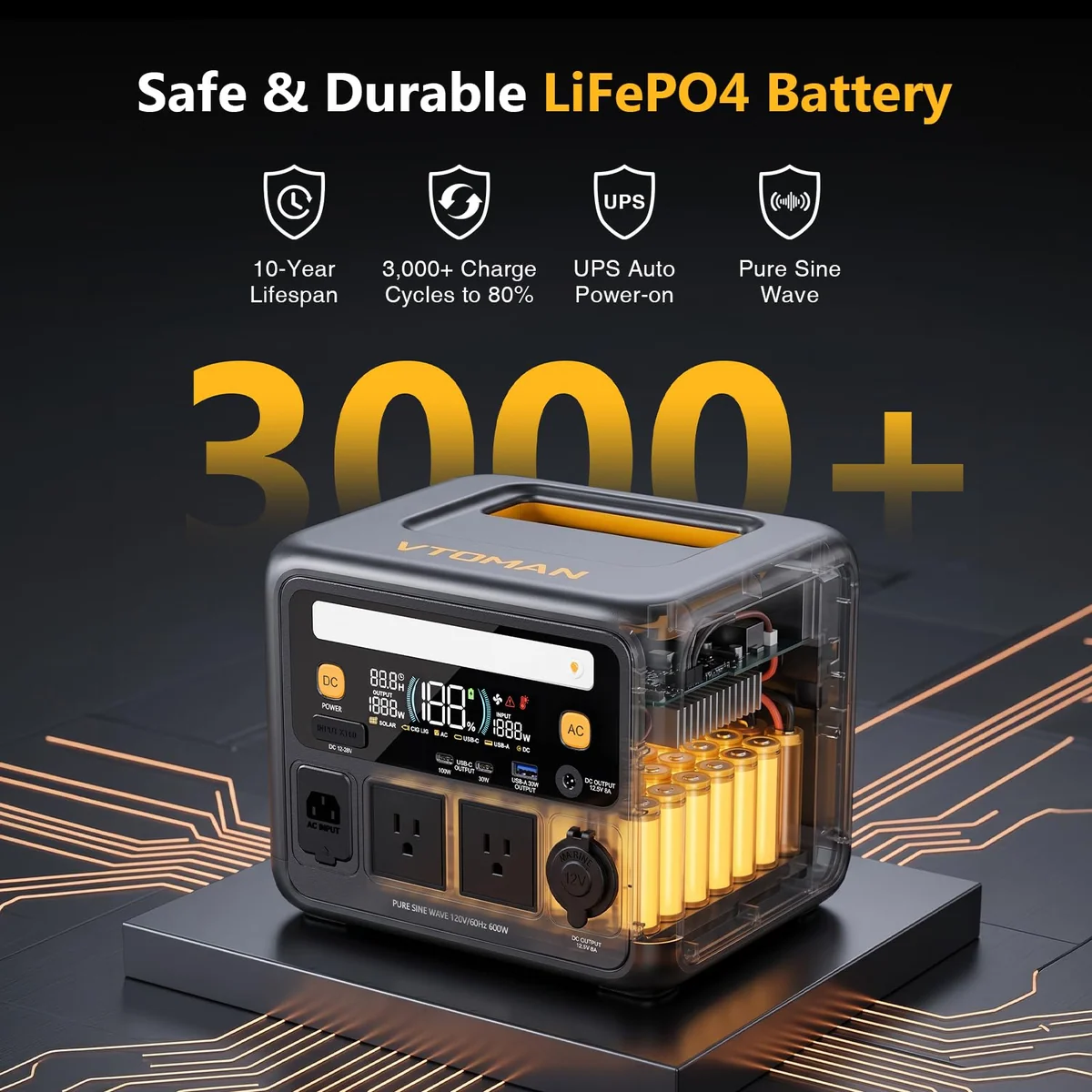
- LiFePO4 rated for 3,000 cycles to 80% capacity, at a price where cheaper chemistry is still common.
- A 100W USB-C output that charges a working laptop rather than just slowing its discharge.
- An onboard power display that measured accurately against an external meter on VTOMAN hardware.
- Five-mode LED light that owners repeatedly name as the feature that won them over from bigger brands.
- Clean pure sine AC that an owner running a video projector found no fault with.
Limitations
- The 1200W figure is a voltage-reduction trick with sensitive electronics explicitly excluded, not usable surge output.
- The 12V output cuts out well below 150W, and nothing in the listing tells you where its ceiling is.
- The seventy-five minute recharge depends on AC and DC inputs summing, which the previous generation's single charging circuit did not do.
- The fans are loud enough that an owner gave up on charging it overnight at a campsite.
- No app and no Bluetooth, on a unit whose nearest rival has both.
- The brand sits at 2.7 on Trustpilot with half its reviews at one star, below every competitor you would cross-shop.
- A recurring reported fault where a healthy charge reading collapses to LOW and cuts the load without warning.
- Nothing in the box jump-starts anything, despite the name, and the cables sold to do it are reported by three separate sources as too short to reach a car battery comfortably.
What 268.8 watt-hours really gets you, and the port that will surprise you
Nameplate capacity is not what comes out of the socket. The only lab-style measurement anyone appears to have published on VTOMAN hardware was done on the larger Jump 1800, where AC discharge efficiency landed around 79%, varying roughly between 70% and 85% depending on the load. Apply that to this battery and you get somewhere near 212Wh at the AC outlet, call it 190 to 230 depending on what you plug in. The table below is arithmetic on that figure, not a stopwatch: Specific Load has not had one of these on a bench, and any site telling you otherwise about a product with this little independent coverage should be read carefully.
| Load | Typical draw | Roughly |
|---|---|---|
| Router and two phones | 15–25W | Overnight and then some |
| CPAP, humidifier off | 30–60W | One night, not two |
| Starlink Mini | 25–40W | Most of a working day |
| Laptop, hard charging | 60W | About three hours, or two to three full charges |
| 12V cooler, duty cycled | ~35W average | Most of an afternoon |
| 150W car heater | 150W | Under ninety minutes, and see below |
| Kitchen appliance or space heater | 1000W+ | No |
That 150W car heater row is the most valuable single finding in this product's whole public record, because an owner documented the fault, chased the answer and published it. The heater kept shutting the unit off. VTOMAN's own support, an agent named John, told him the DC port will not run something at 150W but the AC port will, at which point the review went back up to four stars and stayed there. So there is a ceiling on the 12V output that sits meaningfully below 150W, it is nowhere in the bullets, and anyone planning to run a cooler, a tyre pump or a car heater off the cigarette socket needs to know it exists. Run those loads on AC instead, accept the inverter tax on your runtime, and the problem disappears. It is a documentation failure rather than a hardware one, but a buyer who never phones support just concludes the unit is broken.
The charging story is the strongest thing on the listing and the claim with the most riding on an unverified assumption. VTOMAN says 80% in fifty minutes and full in seventy-five, but only with AC and DC charging simultaneously; AC alone is a 170W input and about two hours. Do the sums and the fast number requires the two inputs to genuinely add together, because 268.8Wh in seventy-five minutes needs well over 200W of average input. On the older Jump 1800, the Gadgeteer found a single charging circuit behind two DC inputs, so a 330W brick and a 220W panel connected together did not deliver 550W. If ChargeCore really does sum the two, that is a real generational improvement and VTOMAN deserves the credit. If it is the same architecture, the headline recharge time cannot happen. Nothing in the material available to this page settles it, and the older-generation owner reports of three hours and even eight to twelve hours to fill are the baseline the new claim is answering rather than evidence against it.
Two smaller things from the same measured review that carry across the family. The fans are loud, around 80 dB, which a year-old owner elsewhere describes as sounding like a vacuum cleaner and impossible to leave charging overnight at a campsite. And the onboard wattage display proved accurate against an external meter, which is worth more than it sounds: you can trust what the screen tells you about draw, even if the remaining-time estimate near a full charge runs pessimistic.
You are paying for the weight, not the watt-hours
Per watt-hour, this is expensive energy. It costs well over double what the big warehouse-club bundles work out to, and roughly three times what the value-brand 1800Wh boxes ask. That is not a scandal, it is how the category works: small stations always cost more per unit of storage, because you are paying for the enclosure, the inverter, the BMS and the ports, and those cost nearly the same whether there are two cells behind them or twenty.
What you actually get for the premium is the 9.92 lb, the LiFePO4 chemistry with its 3,000-cycle rating rather than the cheaper lithium that fades in a couple of years, a 100W USB-C port that will keep a modern laptop moving forwards rather than merely slowing its decline, and a five-mode light that owners keep mentioning unprompted as the reason they picked it over a Jackery. Those are real advantages and they are the honest reason to buy this rather than more capacity for the same outlay.
Where it gets uncomfortable is that the obvious rival at nearly the same money brings an app and a stackable expansion battery to the fight, neither of which exists here. We have put the two side by side on the Jump 600X against the EcoFlow River 3 Plus page. If you want less capacity and more ruggedness for a pack rather than a car boot, the EcoFlow TRAIL Plus 300 is the DC-focused version of this idea, and the wider field is laid out in our solar generator and power station roundup.
One thing nobody's spec sheet advertises: there is no water or dust rating claimed for this station anywhere in the record. The panels in this category are the IP-rated part; the box with the inverter in it is not. A surprise overnight shower turns any of them into an expensive doorstop, and the owners who learn this learn it once.
The thing that actually decides this purchase
Not the box. What happens when the box stops working.
VTOMAN's own US site sits at 2.7 out of 5 across more than 400 Trustpilot reviews, with fifty per cent of them at one star and thirty-seven per cent at five. Read the distribution rather than the average: that is not a mediocre company, it is a bimodal one. People either get a unit that works and help that arrives, or they get a dead unit and silence. For calibration, on the same platform Jackery sits at 4.3, Anker's SOLIX operation at 4.1 and EcoFlow at 3.6. VTOMAN is below every direct competitor a buyer of this thing would also be looking at.
There is one failure signature specific enough to name. A battery reports a healthy charge, runs a small fridge or cooler for a while, then drops to LOW and cuts out with nothing recoverable. It shows up in an Amazon owner's account of waking to a dead unit and a warm fridge after going to bed at 45 to 75 per cent, in a one-year owner's account of 100% collapsing to LOW mid-trip, and in a buyer who had two units fail inside a month with charge dropping from 80% to zero in under a minute. Different models, different platforms, same shape, which makes it a pattern rather than an anecdote and points at state-of-charge estimation or cell balancing rather than bad luck. If you meet it, our page on a station that reads full but will not run or wake covers what to try before you write it off.
Against that, the good service in this record is genuinely good. The same agent, John, is praised by name by two different customers on two different platforms, one of whom got a technical answer inside 24 hours that the manual did not contain. Another owner had a charging port fault on one of two units and was sent a replacement battery with a return label before returning the faulty one, which is better than most large brands manage. The horror stories cluster somewhere specific: the direct channel, multi-box orders and warranty claims made months after purchase, including split shipments where one parcel arrived and the other never did. One customer's summary is blunt enough to quote: It seems that Vtoman only respond to bad reviews on review sites.
So the practical rule that falls out of the evidence is not buy or do not buy, it is buy it where the retailer, not the manufacturer, owns your return. That single decision converts most of the downside in this file into an inconvenience. It is the same logic we set out in what a budget brand's warranty is actually worth, and it applies with force here.
One group should not apply that rule, they should apply a different one. If a CPAP, a BiPAP or an oxygen concentrator is the reason you are shopping, understand that a 600-class station will run a BiPAP and a small fan for a night and will not run an oxygen concentrator at all, and that at least one disabled customer has documented a warranty channel that failed them at exactly the wrong moment. Medical loads want redundancy and a company you can reach on a bad day; start with our medical backup page instead of this one.
Frequently Asked Questions
Is VTOMAN a brand worth trusting?
Trust the hardware more than the company: the units are decent when they work, but a 2.7 Trustpilot average with half of all reviews at one star puts VTOMAN below Jackery, Anker and EcoFlow on the one thing that matters when something fails.
Will the Jump 600X run a refrigerator?
A 12V cooler or a small portable fridge, yes, for a matter of hours; a full-size kitchen fridge through a real outage, no, and our page on usable watt-hours shows why the arithmetic never gets there.
Does it jump-start a car?
Nothing in the box does, the listing never claims it, and the cables sold to add the function are described by three separate sources as too short to reach a battery without balancing the unit on the engine.
Does it come with a solar panel?
No, and the listing says so in the same bullet that promises up to 120W of MPPT solar input, despite the title calling it a solar generator.
Who makes VTOMAN power stations?
They are sold by Shenzhen Futeman Technology, with a US-facing office in City of Industry, California, and the brand describes its own team as running from Silicon Valley to Shenzhen.
Does the Jump 600X have an app?
No, there is no app and no Bluetooth on this unit, so the screen on the front is the only readout you get.
Why does it show a charge and then suddenly die?
Multiple owners across two models report a full-looking reading collapsing to LOW under a modest load, which points at state-of-charge estimation or cell balancing rather than a flat battery, and it is the fault most worth testing for while your return window is open.
Should I buy this or a small gas generator instead?
If you need silence, indoor use or no fuel to store, this wins by default; if you need hours of real wattage, a portable inverter generator does a job no 268.8Wh battery can approach.
Sources (7)
- Amazon listings and customer reviews — Vtoman Jump 600x
- Owner reports across r/tailgating, r/Jackery threads
- Owner and reviewer video, 4 channels
- Walmart listing
- the Gadgeteer — Article — the-gadgeteer.com
- Trustpilot — Article — www.trustpilot.com
- Outsidebozeman — Article — outsidebozeman.com