PowerSmart and Amerisun are one company, and the answer is printed on their own product pages
PowerSmart says it on its own listing, in the block of description text under the bullets that nobody reads: "PowerSmart is founded by Amerisun Inc. headquartered in Itasca, Illinois, specializes in small engine equipments, such as lawn mowers, snow blowers, generators." That is not an inference drawn from packaging similarities or a guess from a parts diagram. It is the manufacturer's own statement of who it is, and it settles the question people keep asking: one company, two badges, one catalogue of mowers, blowers, washers and generators.
Itasca is a Chicago suburb, which is where the other half of the story comes from. The AMERISUN listing opens by calling the company "Proudly American-born and made in the USA" and then describes exactly the same product range: generators, lawnmowers, snow blowers and pressure washers. The American-born part is the address in Illinois. Nothing in the public record supports the made-in-the-USA part, and the machines themselves are imported units with bought-in clone engines, which is the ordinary arrangement for everything in this price bracket and only becomes a problem when a listing pretends otherwise.
So the comparison most people are running when they land here is not a comparison. If you have the AMERISUN 4500 open in one tab and the PowerSmart 4400 in the other, and you are trying to work out which brand to trust, you are choosing between two colours of decal applied at the same source. The engines are the same displacement, the frames are within an inch of each other, and the warranty phone number leads to the same company. Whatever risk you thought you were spreading by picking the other one, you are not spreading it.
- You came for the corporate answer: you now have it, and the rest of this page is what it costs you at the checkout.
- You are choosing between the two badges: pick on hardware, because the dual fuel PowerSmart 4400 and the gas-only AMERISUN 4500 differ in ways the names do not signal.
- You were counting on the warranty: read the service section below before you buy anything under either name, because that is the part of this business that has failed people.
- You want quiet more than watts: the enclosed PowerSmart 3800 is the only machine in this family whose listing publishes a decibel figure and a distortion figure you would want to see.
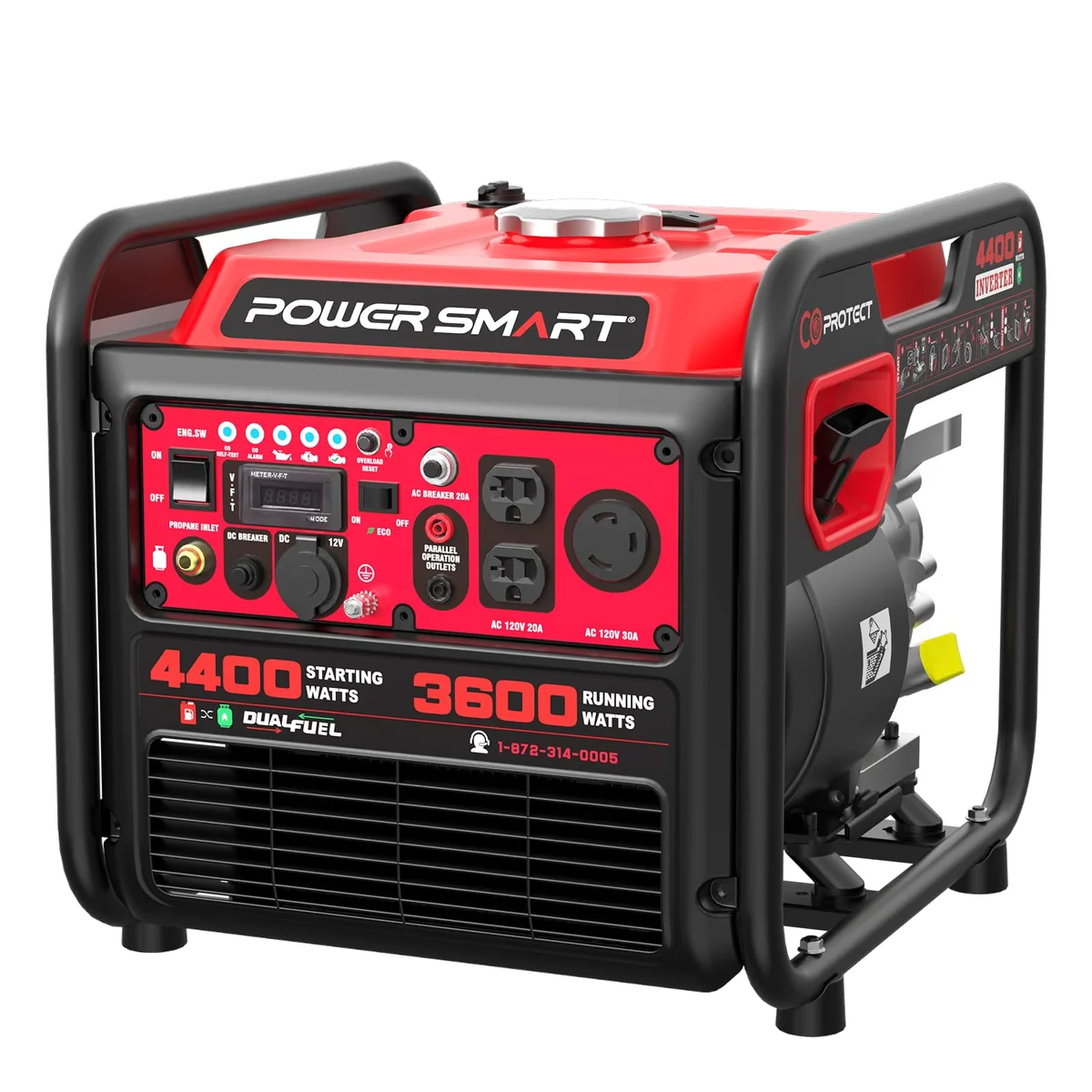
Specific Load has written the two flagship machines up individually already, and this page does not contradict them: the PowerSmart 4400 dual fuel review and the AMERISUN 4500 review reach the same conclusion from opposite ends of the same parts bin.
The badges cross over in public, and not just on generators
If the listing text were the only evidence, it would still be enough. But the crossover shows up wherever these machines get taken apart by people who own them. A teardown of a self-propelled mower that failed inside a year names it in the title under both brands at once, as an Amerisun and a PowerSmart, because that is what the machine is. A mower is not a generator and none of its specific faults transfer to one. What transfers is the shape of the business: the same hardware appears under whichever name is currently carrying less damage, and buyers who search one name reasonably expect the other to be a separate company.
That renaming pattern matters more than it sounds, because it breaks the one research method most buyers rely on. You look up a brand, you read a few hundred reviews, you decide. When the badge is younger than the machine, the review history you are reading is not the machine's history. It is the sticker's.
One more naming trap before the hardware. PowerSmart is also a Briggs and Stratton product line name, so a search for PowerSmart generator reviews will return results about an entirely different manufacturer's equipment mixed in with these. If the review you are reading mentions a dealer network, a Briggs engine, or a price band well above this one, you are reading about someone else's product.
Two badges, one 223cc machine, three sets of numbers
Here is the family laid out from what the three listings themselves publish. The blanks are not omissions on our part; they are figures the listings do not state.
| Claim | PowerSmart 4400 dual fuel (HB5040DC) | AMERISUN 4500 (AM5020C) | PowerSmart 3800 (DB5068) |
|---|---|---|---|
| Engine | 223cc four stroke | 223cc four stroke OHV | Not published |
| Starting / running watts | 4400 / 3600 | 4500 / 3800 | 3800 / 3200 |
| Frame | Open, though the title never says so | Open, and says so | Enclosed |
| Weight | 61.29 lb | 68 lb | 50 lb |
| Noise | 76 dB at 23 ft, 25% load | Not published | 59 dBA at 23 ft at 25% load, 70 dBA at full |
| Distortion | Not published | "clean sine wave" | Under 3% THD |
| Fuel | Gasoline or propane | Gasoline | Gasoline |
| 30A RV outlet | Not published | Yes, TT-30, 120V | Yes, 120V |
| 240V | Not published, so assume no | No, every outlet is 120V | No |
| Warranty | Two year manufacturer | Two year | Two year limited |
Sources for that table are the three product pages themselves. Read down the first two columns and the family resemblance is impossible to miss: the same displacement, roughly the same mass, the same open frame, the same CO sensor, the same 120V-only output. Read across the wattage row and the resemblance becomes the problem. The same size engine is rated at 3600 continuous watts under one badge and 3800 under the other. Those two numbers cannot both be careful.
An owner of the 3800 did the arithmetic the manufacturer should have done and knocked a star off for it, pointing out that the running figure is 3200 and the 3800 is surge only, and that most machines print both on the side with the continuous number first. He is right, and the listing agrees with him in its own first bullet. The lesson generalises across the whole family: the number in the product title is the number the machine can hold for a second or two, and our page on why the number on the box is not the power you get is the ten minutes that stops people buying a generator one size too small.
The service claim, and what happened to the people who used it
This is the part of the business that should decide your purchase, and it is the part almost nobody checks. The PowerSmart listing makes an unusually specific promise for a brand at this price: "PowerSmart has 500+ certified repair center in U.S. & provide full replacement parts through IL headquarters. Any issue just contact with us please." Five hundred certified centres and parts direct from Illinois is a real support structure, and if it exists as described it is worth paying for.
Set that against what the record shows happening when owners tried to use it. A buyer whose 4400 ran an RV air conditioner for about forty five minutes on propane, sat for three weeks, and then cut out after thirty seconds with the overload light on and nothing plugged in was told by PowerSmart to find a repair shop himself, ship the generator there at his own expense, and hope for reimbursement afterwards if the fault was judged to be a manufacturing problem. On the AMERISUN side, an owner whose unit shut down after eight to ten seconds sent photographs and video of the internal wiring to the manufacturer, whose own engineers agreed it was a faulty harness, and was then declined a replacement and pointed at a service centre over thirty miles away that had stopped handling the brand's warranty work.
Two owners, two badges, one outcome. Neither of them found the five hundred centres. Specific Load's position is that you should price every machine in this family as though it carries no warranty at all, because functionally, for the people who tested the claim, it did not. That is not a reason to refuse to buy one. It is a reason to buy it somewhere with a return process you trust, run it under real load inside that window, and treat the return period as the actual warranty. The wider version of this argument is in what a cheap no-name inverter generator actually buys you.
The failure timing is what makes the advice non-negotiable. The bad units in this record do not wear out; they announce themselves in the first hour or the first three months. The buying habit that gets punished is the ordinary one: order it in spring, leave it boxed, discover the fault in an outage, months after every window has closed.
Parts, when it comes to that
People searching for parts under either name are a visibly frustrated group, and the listing's answer is that replacement parts come through the Illinois headquarters. The faster route, when the brand is slow or silent, is to ignore the badge entirely. These are bought-in engines that carry their own manufacturer's model number stamped on the block and printed on the emissions label, and searching that number rather than the brand on the frame usually turns up a generic part at a fraction of the price. Carburettors, coils, recoil assemblies and air filters in this class are rarely proprietary. Bodywork and control boards are, and those are the ones that will strand you.
Given all that, which one is actually worth buying
The corporate answer does not make these bad generators. It makes them a single bet placed three ways, and the three ways are genuinely different machines.
PowerSmart 4400 dual fuel: the one Specific Load would pick, with conditions
Every owner in its record who mentions starting says it fires on the first pull, on gasoline or on propane, and on a recoil-only machine that consistency is worth more than any number on the box. Dual fuel is the real reason to choose it over its own sibling: propane does not go stale in a shed, which removes the single most common way cheap generators die between outages, and what each fuel costs you in watts and runtime explains the trade you accept in exchange.
The drawbacks are not small. Its own listing rates it at 76 dB from 23 feet at a quarter load, which is the quietest condition it has, so the word quiet in the title is graded against contractor generators rather than against inverters. One reviewer who owns two of them marked both down because both burn a little oil and smoke from the exhaust, which makes that a build characteristic rather than a bad sample, and another found the recoil rope fraying early on a machine with no electric start to fall back on. Add the three week failure and the support answer above, and this is a machine for an owner who will run it for twenty minutes every quarter, not one who will trust a sealed box. If that owner is you, it is the most capability in this family for the money, and the storage routine is the habit to adopt on day one.
AMERISUN 4500: the cheapest way in, and the biggest coin flip
When it works it is more machine than the price band usually delivers. The only hands-on load test anywhere in its record fed it two portable air conditioners together, a circular saw, a 15-amp table saw, both saws at once and then a wood chipper, and could not upset it. That is a competent 120V inverter generator with a TT-30 socket, and for a travel trailer on shore power it is exactly the right shape; the rest of that class is in our RV generator guide.
The drawback is the distribution behind it. On the largest pool of owner feedback for this machine, roughly one buyer in six left a single star, and the complaints are not gripes about noise: they are units dead in the first week or dead at three months on owners who oiled them, fuelled them and exercised them weekly. Every outlet is 120V despite the 30-amp socket, so there is no path to an interlock or a transfer switch, and anyone planning to feed a panel should read how to connect a generator to your house before assuming otherwise. Buy this one only if you will unbox it and load it hard the week it lands.
PowerSmart 3800: the quiet one, and the one nobody has owned for long
This is the only machine in the family whose listing publishes the figures a careful buyer wants: 59 dBA at 23 feet at quarter load, 70 dBA at full, under 3% distortion, a 30-amp RV receptacle and 50 pounds in an enclosed case. Owners describe it as genuinely liftable by one person and quiet enough for a market stall, with six to seven hours out of it on eco mode. If your load is sensitive electronics or a campground with neighbours, it is the sensible pick of the three, and the alternatives sit in our quiet camping list and the explainer on what a 23-foot rating is measured at.
The honest drawback is that its record is nearly empty. It carries a strong average across a very small number of ratings, which is a number that can move a long way on a handful of bad units, and within the small set of reviews that exist one owner reports it smoking after twelve hours of running. Several owners flag the small tank, which is the price of the low weight and is stated on the listing. Nobody has owned one long enough to say anything about year two, and given the support record above, that is the piece of information you are buying without.
If none of that appeals
There are honest ways out at similar money. If the recoil rope is what bothers you, the LIFAN 4800W dual fuel with remote start removes it as a failure point, and the Oxseryn 5000W sits a step up in output; both are lined up properly in the dual fuel roundup and the inverter roundup. If the load in question is a CPAP or an oxygen concentrator, do not buy on a wattage number at all, because the missing distortion figure on two of these three listings is the whole issue; go to the medical equipment page instead.
The 1200 watt one you saw on TikTok is not any of these
Almost all of the short video content circulating under the PowerSmart name right now is affiliate material for the 1200W PS50, a small two stroke machine that runs on premixed fuel, never gets an oil change and has a single AC outlet. It is a fundamentally different product from the 223cc four stroke machines on this page, and none of its praise or its complaints belong to them. If a clip is why you are here, check the wattage on the frame in the video before you carry any impression of it across to a machine three times the size.
The same caution applies to the number in any PowerSmart title. The 4400's own description wanders off mid-page into a list that includes "4450W Dual Fuel Generator" and, on a 4400 watt product, "7000-Watt Generator". That copy is written for a search index rather than for the person who will own the thing, which is worth knowing before you treat any figure on it as a specification.
What this page is built from
Specific Load has not run any of these generators. Nobody here has pulled a cord, put a meter on an output or held a sound meter at 23 feet, and nothing above is written as though we had. What this is built from is the public record: the three Amazon listings and their own descriptions, the customer reviews Amazon retains on two of them, the larger owner pool for the AMERISUN 4500 on a second retailer, and the video record where people have taken these machines and their siblings apart.
Two limits are worth stating. The corporate relationship is established by the manufacturer's own words and is not in doubt; whether any two specific units share a specific part is not established anywhere, and this page does not claim it. And the failure reports quoted here are a minority of a mostly satisfied owner base, which is exactly why the recommendation is about when to test the machine rather than whether to buy it. More on how we work is on the about page.
Frequently Asked Questions
Are PowerSmart and Amerisun the same company?
Yes, and PowerSmart says so itself: its listing states that PowerSmart was founded by Amerisun Inc, headquartered in Itasca, Illinois.
Where are these generators actually made?
The company address is in Illinois and the machines are imported units built around bought-in clone engines, which is why the AMERISUN listing's made-in-the-USA line is the one claim on it that nothing in the public record supports.
Is this the same PowerSmart that Briggs and Stratton sells?
No, PowerSmart is also a Briggs and Stratton product line name, so a share of the reviews you find under that heading belong to a completely different manufacturer's equipment.
Does buying the other badge spread my risk?
It does not, because the same parent, the same factory sourcing and the same support process sit behind both names.
Which of the three is the one to buy?
The PowerSmart 4400 dual fuel, if you accept an open frame machine at 76 dB and will exercise it quarterly, because propane storage is the one feature in this family that solves a real problem.
Is the two year warranty worth anything?
Price the machine as though it has none, because the owners in this record who tried to claim were sent to find and pay for their own repair shops.
Why does the same engine get a different wattage on each badge?
Because those figures are marketing rather than measurement, which is why an owner of the 3800 had to point out in a review that its continuous output is 3200.
Where do I get parts for one?
Find the engine manufacturer's own model number on the block or the emissions label and search for that instead of the badge on the frame, because the generic part is usually cheaper and far easier to actually obtain.
Is the 1200 watt PowerSmart from the videos one of these?
No, that is the PS50, a two stroke premix machine with a single outlet, and nothing said about it applies to the four stroke generators covered here.
Can any of them run my house through a transfer switch?
No, because every outlet across this family is 120V and an interlock or transfer switch expects both legs of 240V.
Does the CO sensor mean I can run one closer to the house?
No, a carbon monoxide shutdown is a backstop for a mistake rather than permission to move the machine, and it still belongs well away from doors, windows and vents.
Sources (3)
- Amazon listings and customer reviews
- Owner and reviewer video, 3 channels
- Woot — Article — tools.woot.com