The LIFAN 4800 is a decent generator wrapped inside a genuinely bad first hour
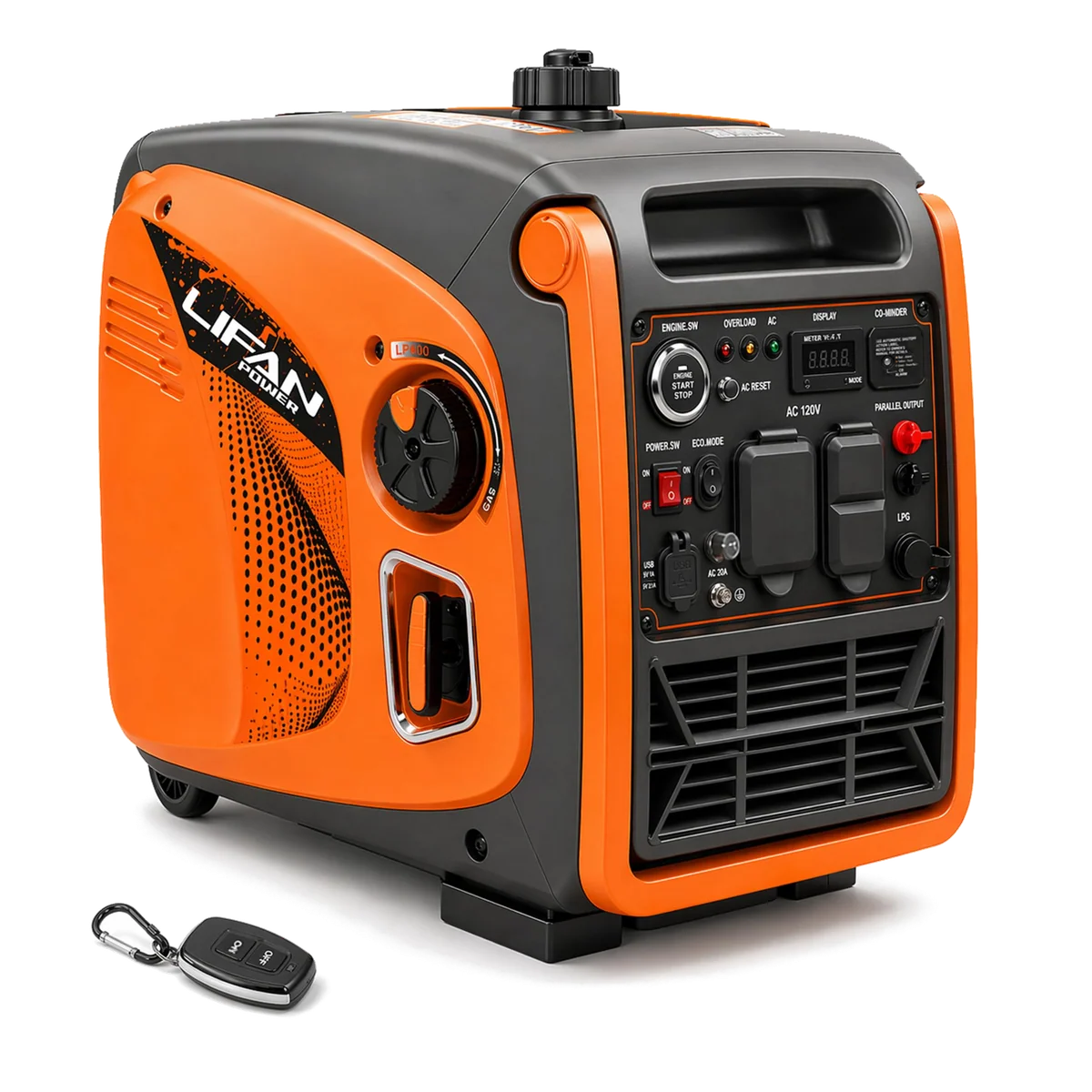
Buy it if you are powering a 30-amp travel trailer and you are willing to pull a side panel off a brand new machine before it will start, and walk away if you want something that works out of the box, needs 240 volts, or is meant to sit untouched for two years until the lights go out.
Based on 6 owner ratings, 6 owner discussions and 6 other sources. We have not tested this machine ourselves.
We earn a commission if you buy through our links, which does not affect what we say.
Read how this site works →
So, yes or no
Yes, if you are the trailer owner described at the top, and no for almost everybody else, at least until this listing has accumulated a real record. The machine underneath the packaging appears to be competent: it carries a 30-amp trailer, it starts from the fob, it runs on either fuel, and it is quiet enough that the air conditioner it is powering will drown it out. What you are buying alongside that is an hour of your own labour on day one, a company that publishes contradictory weights and a manual missing the one page that matters, and an installed base too small to have generated a repair community.
Some of that is what a low price buys, and it is a fair trade if the price is genuinely low. The owner who loved this generator loved it at half the cost of a Predator. Ask yourself what discount you are actually being offered, and whether it covers the afternoon you will spend reaching around a frame rail in the dark.
Best for: Rv
The LIFAN LF4800iE-Y001 arrives with six ratings and a 3.2 average behind it. Five of those six left written reviews. Specific Load read all five, and four of them are about the unboxing rather than the generator: a starter harness nobody could find, a battery nobody could reach, a fuel selector that would not select, and a box with no oil in it. Exactly one review describes what the machine does with a load on it. That imbalance is not a footnote to the review. It is the review.
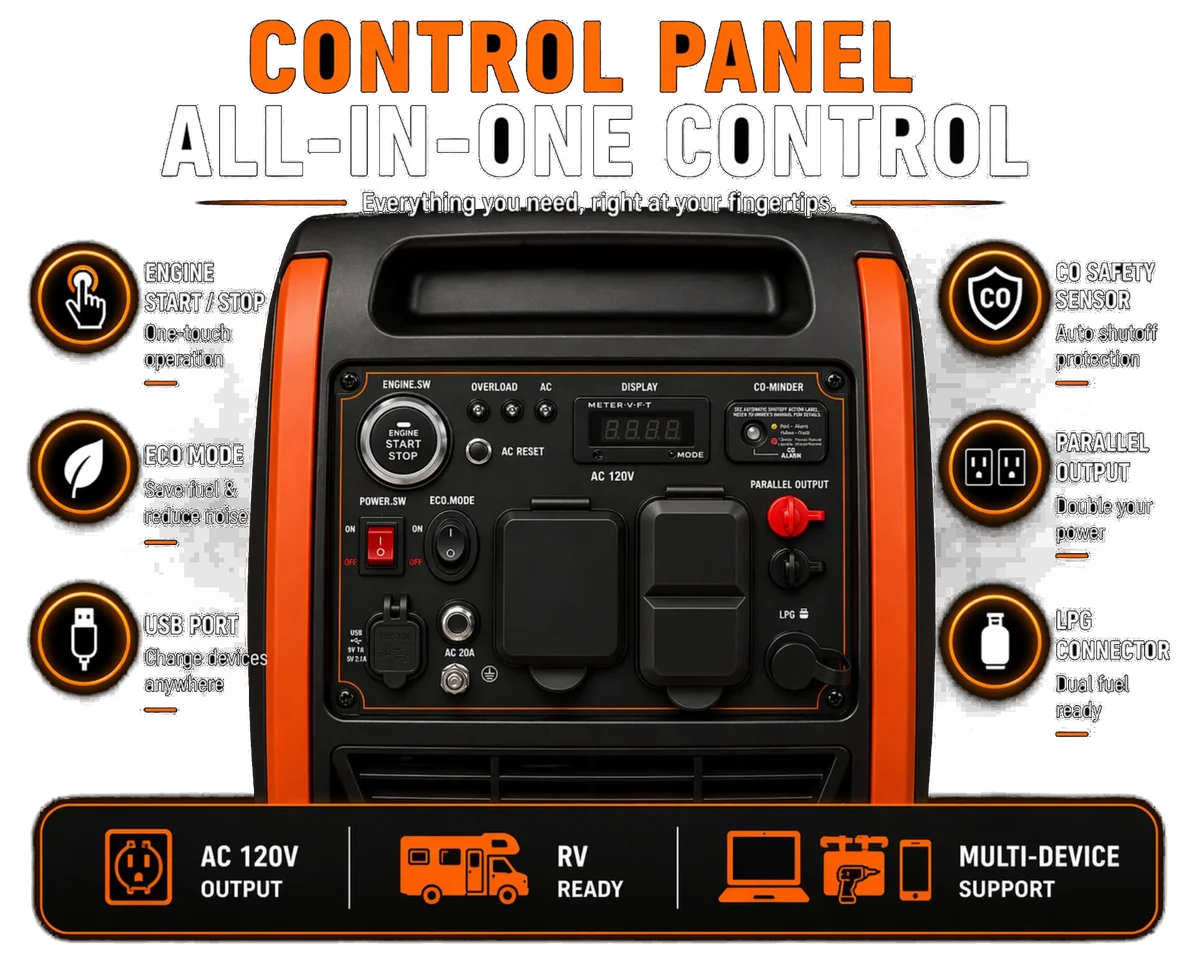
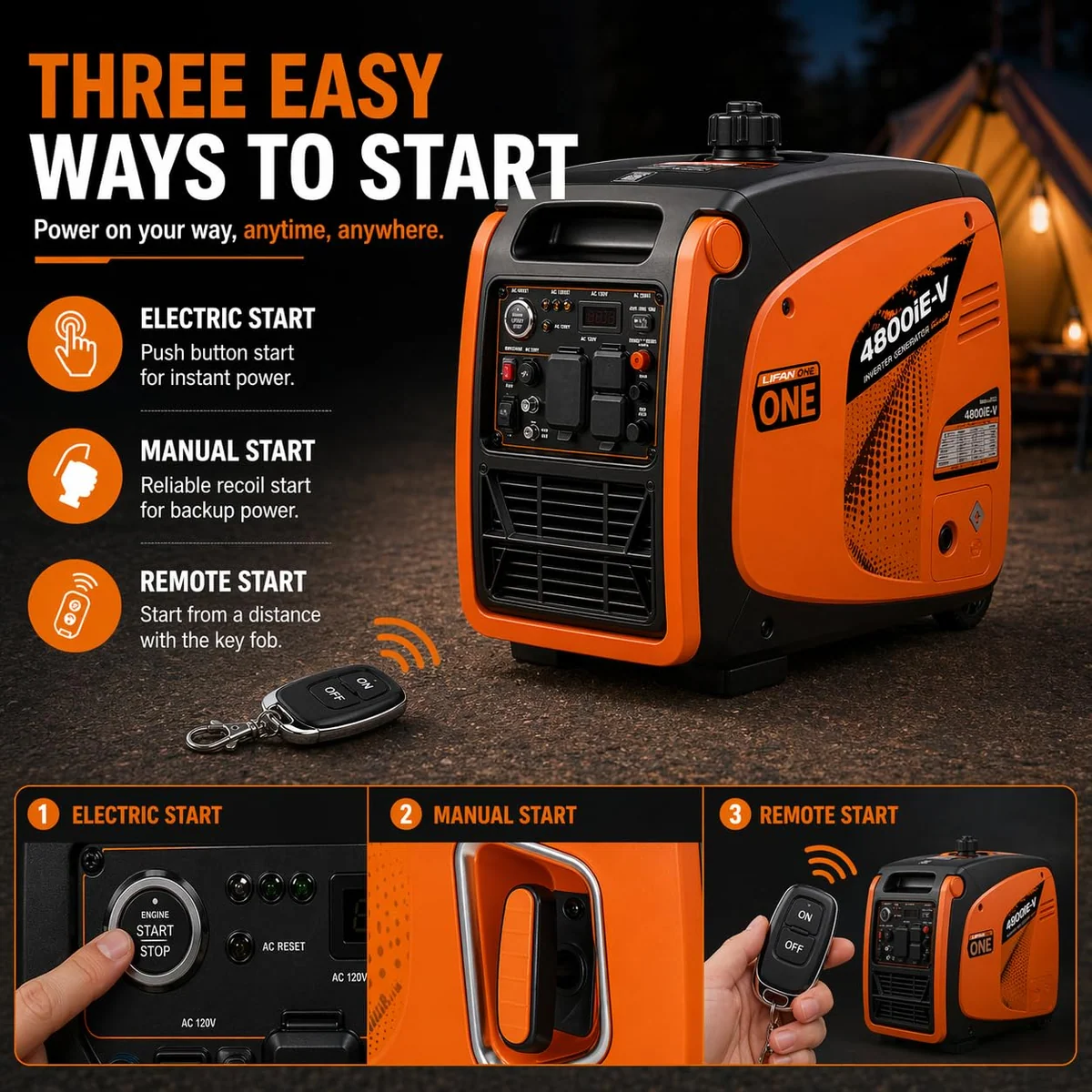
The good news first, because it is real. The one owner who has genuinely worked this thing ran a 12,000 BTU camper air conditioner on high, a microwave and the 12V converter at the same time, with a cheap soft-start capacitor fitted to the AC, and watched the panel voltage sag a little for a few seconds before recovering. It has a TT-30 receptacle on the front, so a travel trailer cord goes straight in with no dogbone and no adapter stack. The key fob works. It runs on propane as happily as on gasoline. For a 30-amp trailer, that is the whole job description, and this machine does the job.
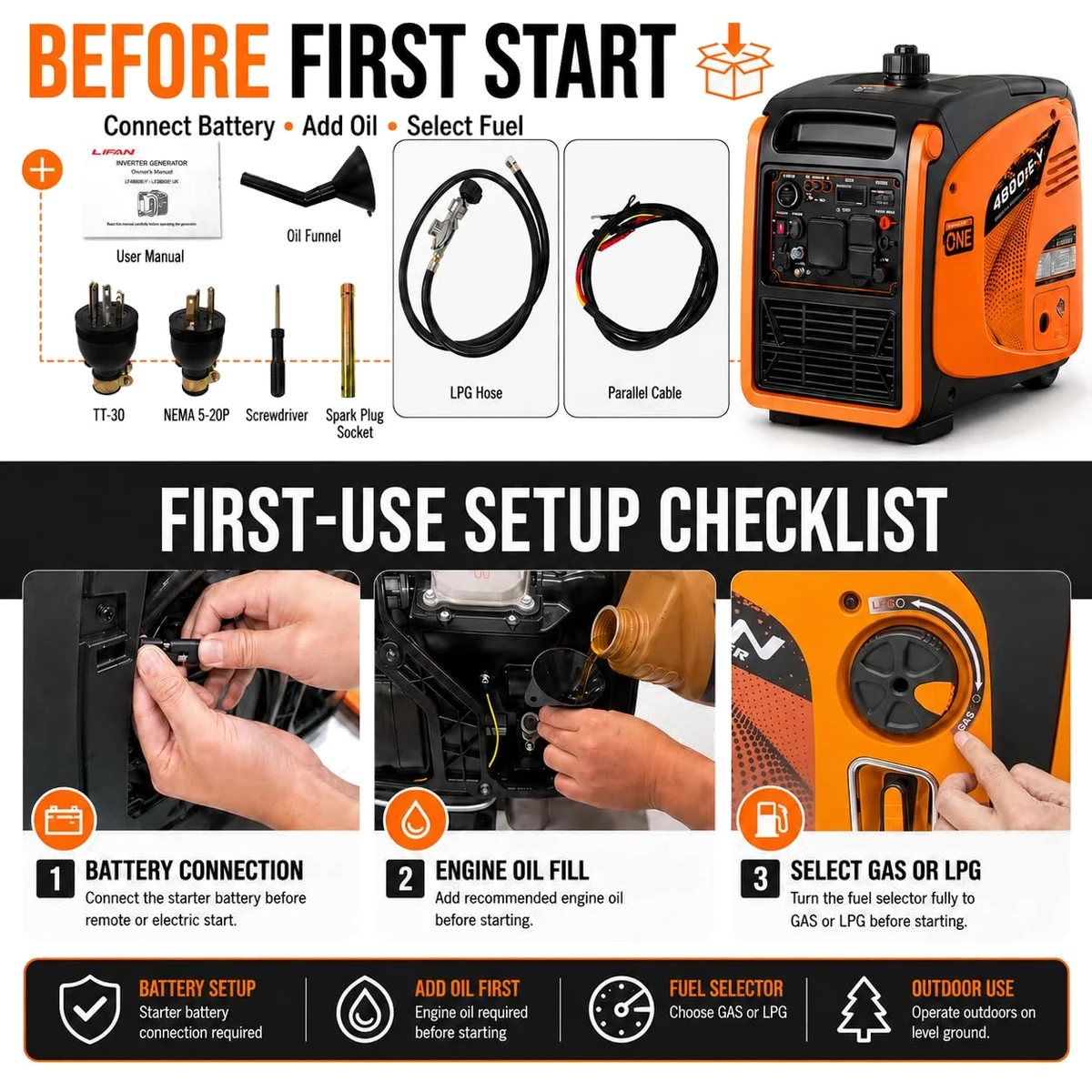
The bad news is that Lifan shipped the fix for its own worst problem in the marketing copy instead of in the manual. The starter battery comes disconnected, its plug hides behind the frame, and three separate owners lost time hunting for it. The listing's first bullet tells you to connect the battery "as shown in the manual," and the manual is the one document in the box that does not show it. A company that knows about a defect well enough to pre-empt it in a bullet point and in its own FAQ could have printed one paragraph and a photograph on page four.
Buy it if
- You have a 30-amp travel trailer, a rooftop AC in the 12,000 to 13,500 BTU range, and you camp where propane is easier to carry than gasoline.
- You are comfortable removing a panel, tracing a two-pin SAE connector and buying your own oil, and you would rather save money than be coddled.
- You want partial home backup for a fridge, a freezer, lights, a router and a window unit rather than a whole house.
Walk away if
- Anything you need to power runs on 240 volts, which includes a drilled well pump, an electric range and central air.
- You want a machine with a long, boring track record, because this listing does not have one yet and the six ratings on it are statistically meaningless.
- You want to be able to order a carburetor for it in three years, which today you cannot.
Key Specifications
The first hour is where this generator loses people
Four of the five written reviews describe the same ninety minutes of frustration, and every one of those problems has a cheap answer once you know it. So here is the answer, up front, before anything else.
The starter battery. It is a small black box in the front corner of the machine, near the propane connection, and it is small enough that people look straight at it without recognising it as a battery. Pull the large side panel on the oil-fill side, then reach around the corner to the left: the mating half of the two-pin SAE connector sits behind the battery and behind a frame rail, out of sight from every angle you would naturally look from. The owner who traced it is a mechanic by trade and said it took them far longer than it should have. If you cannot find it, the recoil pull start works regardless, and plenty of people run electric-start generators for years without ever hooking the battery up.
The oil. The unit ships dry and the engine asks for SAE 10W-40, which is not the weight most garages happen to stock. The low-oil sensor will block starting until you fill it, so buy a quart before the box arrives rather than making a parts-store run on the day. Our guide to what oil a portable generator takes and the break-in change nobody mentions covers what to do at the fifty-hour mark, which on a machine this new nobody has reached yet.
The gas cap vent. This is the one that will look like a fault and is not. The fuel cap has a screw vent, and with it closed the engine will start, run, and then die of fuel starvation as vacuum builds in the tank. Propane is unaffected, so the symptom presents as "runs on propane, will not run on gas." The vent is a genuinely good feature the rest of the time, since a sealed cap means the generator can ride inside a vehicle without filling it with fuel smell.
That last symptom matters because one owner reported exactly it and blamed the fuel selector knob, describing a switch behind the knob that was not making contact. Both causes are live. Check them cheapest first.
| Symptom | Check this first | Then this |
|---|---|---|
| Key fob and electric start do nothing | The battery lead, unplugged behind the frame on the oil-fill side | A battery that will not take a charge, which one owner reported |
| Engine cranks but will not fire, or refuses to crank | Oil, because the box does not contain any and the sensor blocks starting | Fuel valve and choke, the usual suspects |
| Runs on propane, stalls or will not run on gasoline | The screw vent on the fuel cap, which must be open | The fuel selector, which has a dead spot between positions |
| A panel flaps open while it runs | The spark plug access hatch on top, whose clip does not hold | Nothing, this is just how it is |
If none of that helps, the failure is probably one of the ordinary ones rather than anything Lifan-specific, and our walkthrough of the fuel valve, the hidden battery plug and the closed cap vent covers the sequence in more detail.
Strengths & Limitations
Strengths
- The onboard TT-30 receptacle takes a travel trailer cord directly, with no dogbone and no adapter stack.
- Dual fuel is the feature that matters most on a machine that will sit unused for months, because propane cannot turn into carburetor varnish.
- The key fob, panel button and recoil backup all work once the battery is connected, and the fob drew no complaints from anyone.
- The fuel cap vent screws shut, so it can travel inside a vehicle without the fuel smell most generators bring with them.
- It is noticeably narrower than the Predator-class competition at the same height and length, which is the difference between fitting a camper storage bay and not.
- Under a rooftop air conditioner plus a microwave plus the converter, the panel voltage dipped only briefly before recovering.
Limitations
- The starter battery ships disconnected with its plug hidden behind a frame rail, and the manual does not mention it anywhere.
- No oil is in the box and the engine wants 10W-40, a weight most home garages do not stock.
- Small inboard wheels and a handle that will not open to a full ninety degrees make it easy to tip onto its side on gravel and awkward to pull upright.
- The listing publishes two different weights for the same machine, 68 lbs in one place and 42 lbs in another.
- One owner's fuel selector would not run the machine on gasoline at all, and Lifan's own copy warns about a partial position, which suggests the switch is a known weak point.
- The spark plug access hatch does not clip shut properly and vibrates open in use.
- There is no 240V outlet, which rules out a well pump, an electric range and central air permanently.
- Six ratings, no owner with a season behind them, and no parts listed anywhere for the inverter line is a thin foundation for a purchase this size.

What it will actually carry, and what it will not
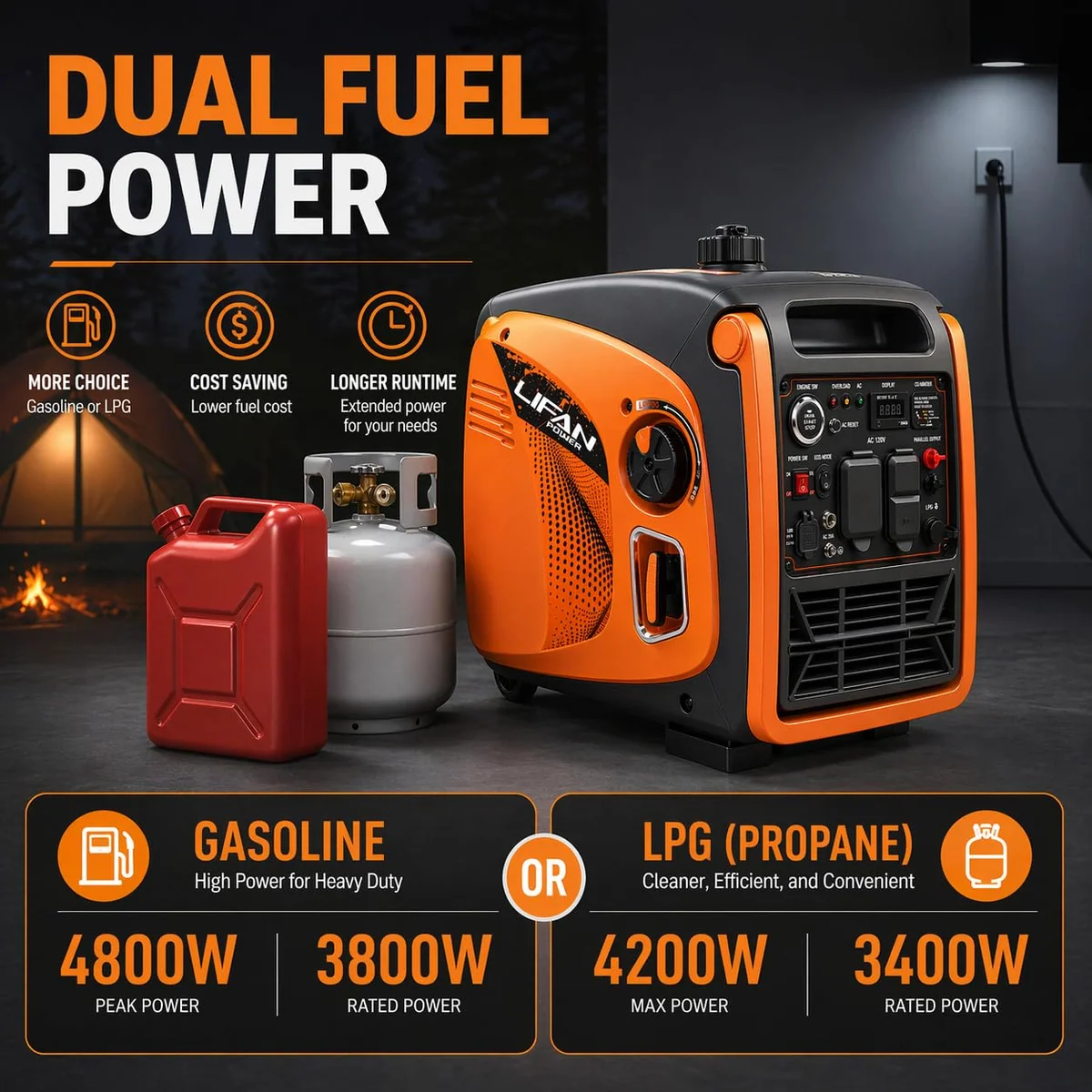
Lifan claims 4800W peak and 3800W running on gasoline, dropping to 4300W peak on propane. The listing then quotes propane running watts as 3400W in a bullet and 3500W in its own FAQ, which tells you something about how carefully this copy was assembled. Either figure lands in the same place practically: this is a machine for a 30-amp trailer or a partial house, and the gap between peak and running is the number that decides whether an air conditioner starts, which is worth understanding before you buy anything in this class. We explain that gap in why the number on the box is not the power you get.
The single real-world load account in the record is a 12,000 BTU rooftop unit plus a microwave plus the converter, with a soft start on the AC, and it held. The same owner believes the generator would start an RV AC without a soft start and says so plainly, but did not test it, so treat that as their opinion rather than a result. Lifan's claim that it handles a 13,500 BTU unit is unconfirmed by anybody. If your rooftop is the bigger size, read what LRA actually means for a rooftop unit before you assume the headline wattage covers you, and budget for a soft start.
Eco mode does what eco mode does: it idles the engine down under light loads, which is what you want when the generator is charging phones off the 15A outlets and emphatically not what you want with an air conditioner cycling. Running any generator close to its rated output is where these machines fall down, and the standing advice from people who own several is to stay well below the number on the sticker rather than treat it as a target.
The noise claim, unpicked
Lifan says 58 dB at 23 feet. That distance is not the trick some people assume it is, since 23 feet is the industry standard measurement position. The softening happens elsewhere. First, the 58 dB figure attaches to 25 percent load, which the listing states in its FAQ and then quietly drops in the A+ copy where the same 58 dB is claimed alongside running a 13,500 BTU air conditioner. Second, Lifan's own published method, given years ago in response to a customer on another model, is to take a reading from the exhaust end and a reading from the opposite end and average the two. Averaging the loud end with the quiet end is a legitimate way to arrive at a low, useless number.
The owner account is more honest than either. They read this unit as a few decibels louder than the comparable Harbor Freight inverter, they can hold a conversation standing next to it if they raise their voice, and from inside the camper the rooftop AC drowns out almost all of it. That is the resolution: the marketing claim is inflated, and if the thing you are running is an air conditioner, it does not matter, because the air conditioner is louder. If you are camping quiet, read what a dBA rating is really measured at first.
It is a 120-volt machine
No 240V receptacle appears anywhere in the bullets, the FAQ or any owner account, and a TT-30 outlet is 120V by definition. Specific Load reads this as a 120V-only generator, which is an inference from the absence of evidence rather than a measurement, but it is a confident one. The consequence is hard: a drilled well pump needs 240V and this will not turn it, and central air is not remotely in reach for a machine this size regardless of voltage. Buyers shopping for whole-house backup are being steered toward 240V dual-fuel portables in the 9,000 to 11,000 watt class for exactly this reason. If a transfer switch is in your plan, how to connect a generator to your house explains what you can and cannot do with a 120V-only unit.
The wheels are the real complaint
Small inline-skate wheels, mounted inboard toward the rear, on a body that is unusually narrow for its height. The result, in the words of the one owner who has moved it around a campsite, is a machine that flips onto its side on gravel or dirt with very little provocation, and a folding handle that seats into a curved nose, does not open to a full ninety degrees, and drags the back of the generator on the ground if a six-foot-one adult stands upright to pull it. You stoop, or you carry it by the moulded side handles. The narrowness that causes this is also the reason it fits in a camper storage bay where a Predator-class unit will not, so it is the same fact pointing both ways.
And on that subject: the listing states 68 lbs in bullet four and "weighs just 42lbs" in the A+ description, for the same machine on the same page. The owner estimate lands near the higher figure. Assume 68 and treat the 42 as copy pasted from something smaller.
The arithmetic that made one owner call it a no-brainer
Read the five-star review closely and its reasoning is explicitly conditional on price. The owner bought during a Prime Day promotion that put this machine at almost exactly half the cost of the Harbor Freight Predator 5000 inverter, and that gap is what "no brainer" refers to. At list, the gap narrows considerably, and the argument does not survive the narrowing intact. Half the price of a machine with a decade of feedback behind it is a real bargain. Eighty percent of the price of it is a bet.
The comparison most buyers are running is against WEN's 4800W dual fuel, which is the same wattage, the same fuel arrangement, the same RV-ready outlet and the same CO shutoff, with hundreds of reviews rather than six. We do not cover it, so make of that what you will, but you should know the asymmetry exists rather than discover it after purchase. Inside our own coverage, the PowerSmart 4400 dual fuel sits in the same size class and answers a similar brief, the Oxseryn 5000 is the gas-only alternative with slightly more headroom, and anyone who actually wants to back up a house should be looking at the GENMAX GM9000iED instead, which has the 240V outlet this machine lacks. Our dual fuel roundup and RV generator guide place all of these against each other.
The battery station in the room
This generator's price lands squarely on top of the mid-size lithium power stations, which is why so many people end up agonising between the two. A 1.5 kWh station with a solar panel was recently bundled at close to what this machine costs. The comment sections on those deals are unsparing about it, and the objection is correct: a battery that size will not carry a 13,500 BTU rooftop air conditioner through a hot weekend, and a 3,800W running generator with a propane hose attached will. The reverse objection is equally correct, because a battery is silent, lives indoors and does not need a fuel run. These are different tools whose prices happen to collide; our comparison of solar versus gas for an outage explains why a lot of people give up and buy one of each.
Worth knowing what the actual outage load looks like, too. When people describe getting through 72 hours without power, the pattern is a fridge and a freezer run intermittently rather than continuously, phones and lanterns charged in batches, and water boiled. That duty cycle is comfortably inside this machine's range, and it is a long way from the whole-house fantasy that generator marketing sells.
Nobody has put a season on this machine yet
This is the honest limit of everything above. The earliest owner in the record bought in June 2026 and did not add oil until late July. Nobody has hours on it, nobody has stored it over a winter, nobody has had to buy a part for it. There is no durability evidence here in either direction, and any review that tells you otherwise is inventing it.
What can be said comes from Lifan's older machines, and it should be labelled as such. Across a decade of feedback on the legacy open-frame and suitcase units, one fault repeats: fuel leaking out of the box, usually at the carburetor or a tank fitting, on first fill. Lifan's own explanation to one of those customers is more useful than the complaints, because the company admitted the cause outright: an EPA-mandated tank vent tube passes through a drilled hole in the fuel tank, sealed with a nut and gasket, and units were reaching customers without that seal being tested properly. A manufacturer describing its own QC escape in that much detail is worth more than a hundred star ratings. It is also why two of the seven things people type after "lifan generator" are about the tank. Nobody has reported a leak on this inverter model, but you should still fill it outdoors and look underneath before you walk away.
The other legacy pattern is documentation. A 2018 review of an older Lifan opened with a complaint about horrible assembly instructions and missing bolts. Eight years later, three owners cannot find a battery. The engines get praised across all of it; the fuel-system plastics and the paperwork get complained about across all of it.
Parts, and the number that should worry you
Specific Load went looking for what you would actually be able to buy if something broke. The independent parts suppliers who stock Lifan carry carburetors, recoil starters, ignition coils, gaskets and fuel tanks for the old open-frame and pump engines, at genuinely cheap prices. For the inverter line, and specifically for the LF4800iE-Y001, there is nothing. The reputation that Lifan parts are cheap and available is real, and it belongs to machines from ten years ago.
The secondary market says the same thing more bluntly. Filter eBay's generator category by brand and Lifan returns a couple of dozen listings against several hundred for WEN, DuroMax, Firman and Predator, and a thousand-plus for Honda and Generac. That is an installed-base number, and it predicts how easy it will be in three years to find a used part, a donor unit, or somebody online who has already fixed the thing you broke. Lifan is a Chinese engine and motorcycle manufacturer with a US arm in Arkansas, which is not a strike against it in itself. But it does mean the ordinary calculus of cheap-brand ownership applies, and that calculus is set out in what you actually buy with a budget inverter generator. One year of limited warranty is what you get.
The one marketing claim that fully survives
Lifan says propane stores indefinitely and sidesteps ethanol carburetor problems. That is true, and it is corroborated by owners of entirely different generators who arrived at it independently: the near-unanimous advice for a machine that sits unused most of the year is to run it on propane, or at minimum to shut the fuel valve and let it run the carburetor dry before storage. Dual fuel is not a gimmick on a backup generator, it is the feature that decides whether the thing starts in two years. Pair it with the storage routine that keeps a carburetor clean, change the oil at fifty hours as owners of every brand recommend, and read what each fuel costs you in watts, because propane trades roughly ten percent of your peak output for that peace of mind.
One practical note from the field, for RV owners: the propane connection is a standard 3/8 inch SAE flare, so a quick disconnect and a 90 degree swivel adapter let you run the generator off the trailer's onboard propane through an extension hose, bypassing the supplied regulator and the jerry cans entirely. Just remember the same tank runs your fridge and your stove.
Frequently Asked Questions
Is Lifan a good generator brand?
Lifan is an established Chinese engine and motorcycle manufacturer with a US operation in Arkansas, and the consistent pattern across a decade of its machines is that the engines earn praise while the fuel-system plastics, the quality control and above all the documentation earn complaints.
Why won't the electric start work on a brand new unit?
Almost certainly because the starter battery ships disconnected: remove the large side panel on the oil-fill side and reach around the corner to the left, where the two-pin SAE plug hides behind the battery and behind the frame.
Does it come with oil, and what type does it take?
It ships completely dry and calls for SAE 10W-40, so buy a quart before the machine arrives, because the low-oil sensor will refuse to let the engine start until you fill it.
Will it run a 13,500 BTU RV air conditioner?
Lifan says yes, and the only owner who has tried started a 12,000 BTU rooftop unit with a soft start fitted and then added a microwave on top, so the larger claim is plausible but nobody in the record has confirmed it.
Can it back up a house?
It will carry a fridge, a freezer, lights, a router and a window air conditioner comfortably, but with no 240V outlet anywhere in the specification a well pump, an electric range and central air are permanently out of reach.
How many hours will it run on a gallon of gasoline?
Lifan's ten-hour figure is quoted with no load attached, which against the 2.64 gallon tank works out to roughly 3.8 hours per gallon under whatever light load produced that number, so plan on considerably less with an air conditioner running.
Can you get spare parts for it?
The independent suppliers who carry Lifan stock plenty for the older open-frame generators and nothing at all for the inverter line, so treat this as a machine you cannot currently order a carburetor for.
Is it really as quiet as a conversation?
No: the 58 dB figure is measured at 25 percent load and, by Lifan's own account of its method, averaged between the exhaust end and the quiet end, and the one owner who commented says you have to raise your voice standing beside it.
Sources (8)
- Amazon listings and customer reviews — Lifan 4800 Dual Fuel
- Owner reports across r/Generator, r/Jackery, r/Hawaii threads
- Owner and reviewer video, 2 channels
- Walmart listing
- Goodsam — Article — community.goodsam.com
- Electricdirtriders — Article — electricdirtriders.com
- Everestpartssupplies — Article — www.everestpartssupplies.com
- Ebay — Article — www.ebay.com