The PowerSmart 4400 starts on the first pull, which is not the same thing as being there when you need it
Buy it if you want a fridge, a freezer, fans and an RV rooftop air conditioner covered cheaply on either gas or propane and you are honestly the sort of owner who will start it every three months; walk away if you want a quiet generator, a 240 volt one, or a warranty that does not begin with you paying freight to a repair shop you had to find yourself.
Based on 360 owner ratings, 3 owner discussions and 1 other source. We have not tested this machine ourselves.
We earn a commission if you buy through our links, which does not affect what we say.
Read how this site works →
So, yes or no
Yes, if you are the owner this machine needs. That owner keeps propane on hand, runs it for twenty minutes every quarter whether or not anything is wrong, expects to adjust valves and change oil on a cheap engine's schedule, keeps it well away from the house while it runs, and has decided that fridge, freezer, fans, lights and one air conditioner is what backup power means in their household. For that person this is a lot of capability for very little money, and the starting record is the best evidence on the page.
No, if you were planning to buy it, put it in the shed, and trust it. The one owner in this record who tried something close to that found out the hard way, and then found out what the warranty is worth. That is the trade, stated plainly: a machine that has never failed to start for anybody who uses it regularly, sold with a support process that punishes anybody who does not.
There is one thing this generator does that nobody in its record disputes. It starts. "Single pull start every time," writes one owner. "Starts on 1st pull," writes another, who runs his exclusively on propane. A third owner who has two of them says both start well. On a pull-cord machine with no electric start to fall back on, that consistency is worth more than any number on the box, and it is the most solidly evidenced fact about the product.
The problem is what happens between starts. The single most detailed report in the entire record belongs to a buyer whose first unit arrived damaged in shipping, whose replacement ran an RV air conditioner for about forty five minutes on propane exactly as the manual described, and which then sat for three weeks. When he came back to it before a trip, it ran roughly thirty seconds and cut out with the red overload light on, with nothing plugged in. It did it again. It did it a third time with the oil checked. It did it on gasoline too, which is the fuel he had never wanted to put in it. He bought a different generator for his trip.
That is one unit out of 360 ratings, and Specific Load is not going to pretend it is the typical outcome. But it is the exact failure a backup generator exists to not have: it sat, and then it was not there. Everything else on this page is an attempt to work out how much weight that story should carry against the four owners who are quietly delighted, and the answer turns out to depend almost entirely on what kind of owner you are.
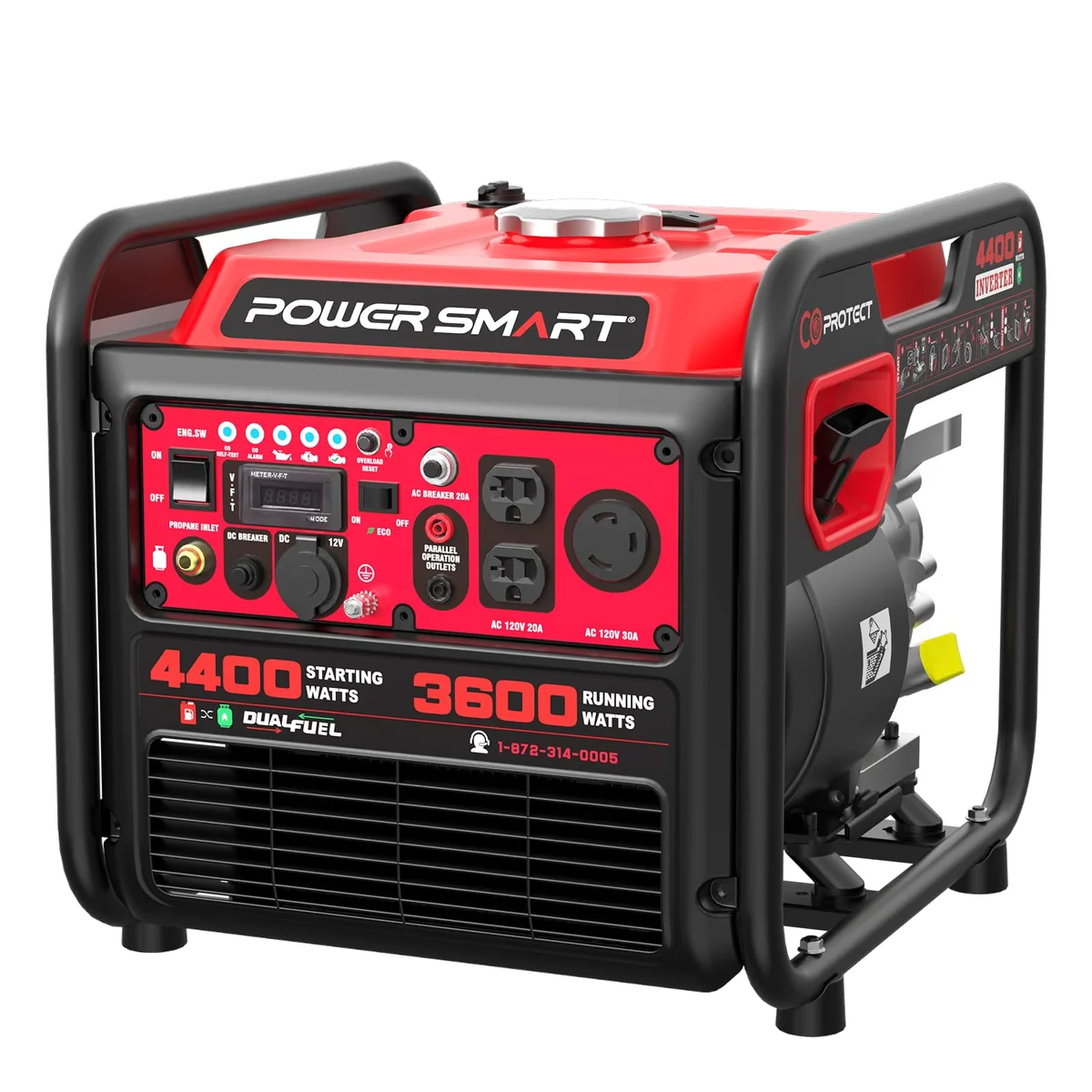
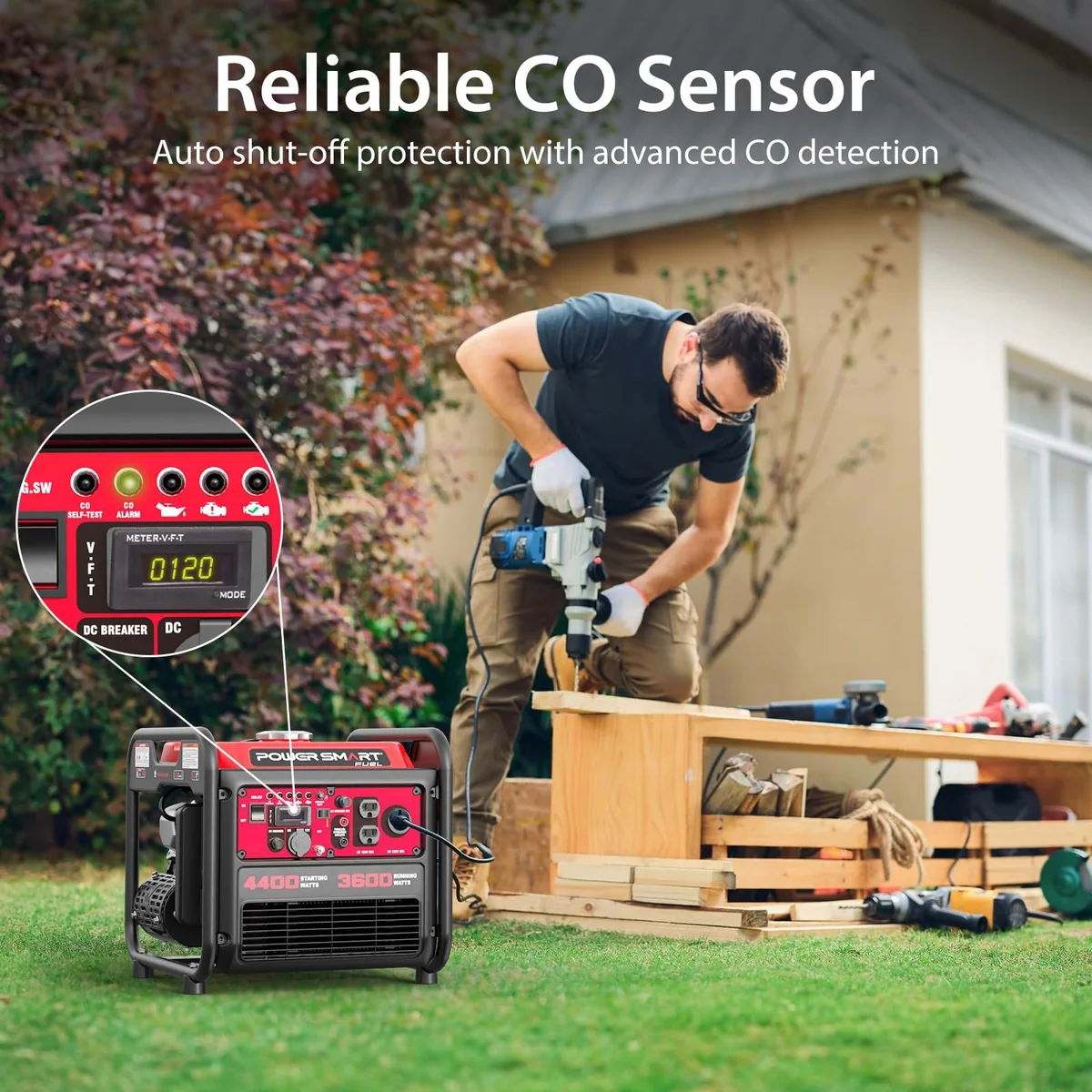
Buy it if you want an outage machine for essential circuits, you can run it outdoors and far from the house, you accept a pull cord as the only way to start it, and you will put a quarterly reminder in your phone to run it for twenty minutes. On paper it is 4400 starting watts and 3600 rated, 223cc, about 61 pounds, with CO detection, low oil shutdown and overload protection.
Walk away if you are buying it to sit untouched in a shed until the lights go out, if your plan involves central air conditioning or anything on 240 volts, if you live in a townhome with shared walls, or if the phrase "quiet inverter" is what sold you. On all four counts this is the wrong machine, and the reasons are on its own listing.
Key Specifications
The listing cannot keep its own story straight
Read the page carefully and it argues with itself inside a single screen. Bullet two promises eleven hours of runtime at 25 percent load from the 1.6 gallon tank. The description directly below promises ten hours from the same tank at the same load. Further down, the copy stops addressing a buyer at all and becomes a list: "4450W Dual Fuel Generator", "4400W GasPowerd Generator", and, sitting there in plain sight on a 4400 watt product, "7000-Watt Generator".
None of that makes the generator worse than it is. It does tell you what tier of the market you are shopping in, where the listing is written for a search index rather than for the person who will own the thing. It also means the specification you most want is frequently the one that is absent. Here is what the page claims, and what Specific Load thinks each claim is actually worth.
| What the listing says | What it is worth |
|---|---|
| 4400 W starting, 3600 W rated | Plan around 3600, and around less than that once you leave headroom for motor starts. |
| Ten hours at 25 percent load, or eleven, depending which paragraph | A quarter load on a 3600 W machine is roughly 900 W, which is a fridge and some lights, not your house. |
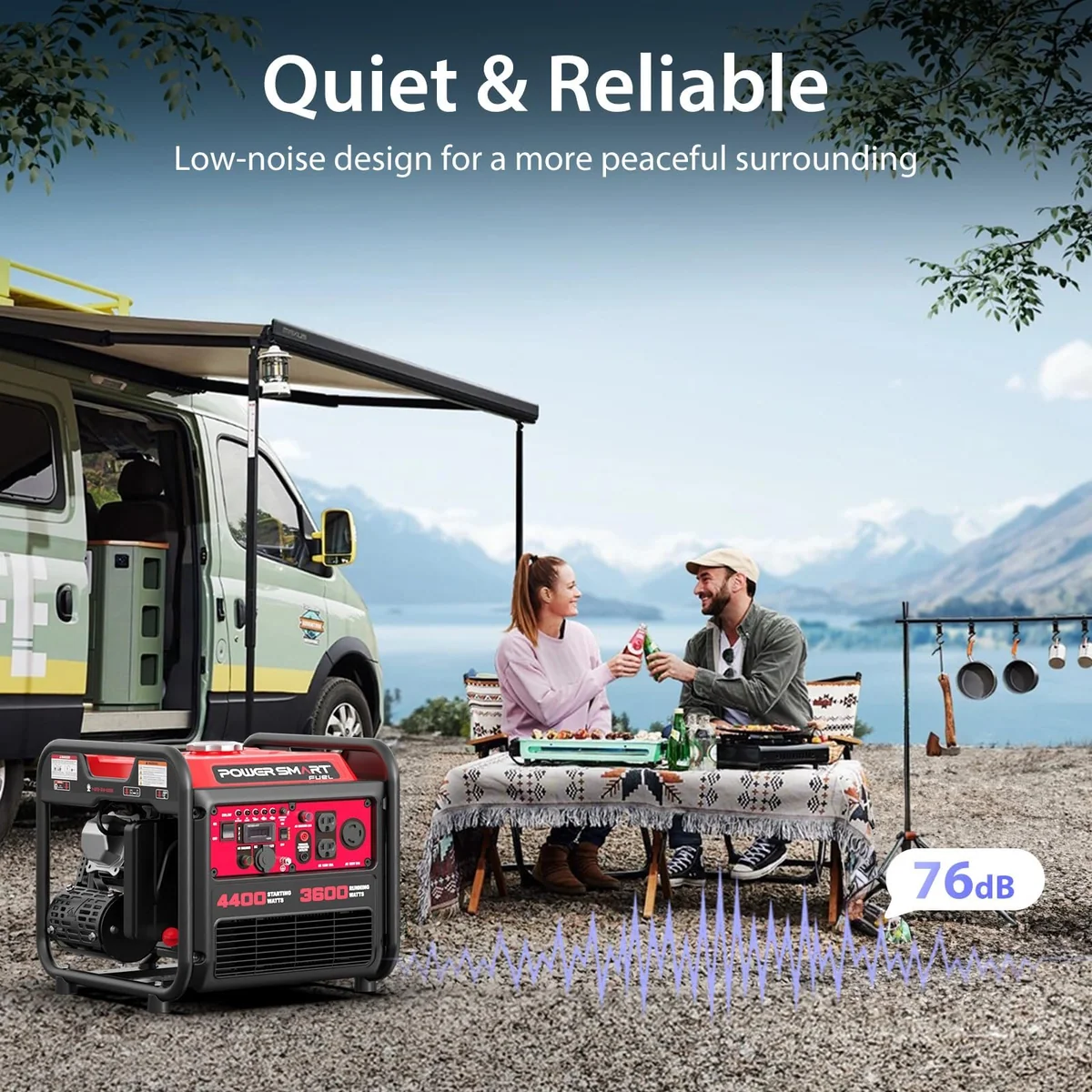
| 76 dB at 23 feet at 25 percent load | Real, and quiet only by open frame standards; see below. |
| 61.29 lb, 19.3 by 16.9 by 16.5 inches | Consistent across every retailer carrying this family, and genuinely a one strong person carry. |
| 223cc four stroke, EPA compliant, CO detection, low oil shutdown, overload protection | Consistent everywhere too, and the CO shutoff is standard on this class now rather than a feature. |
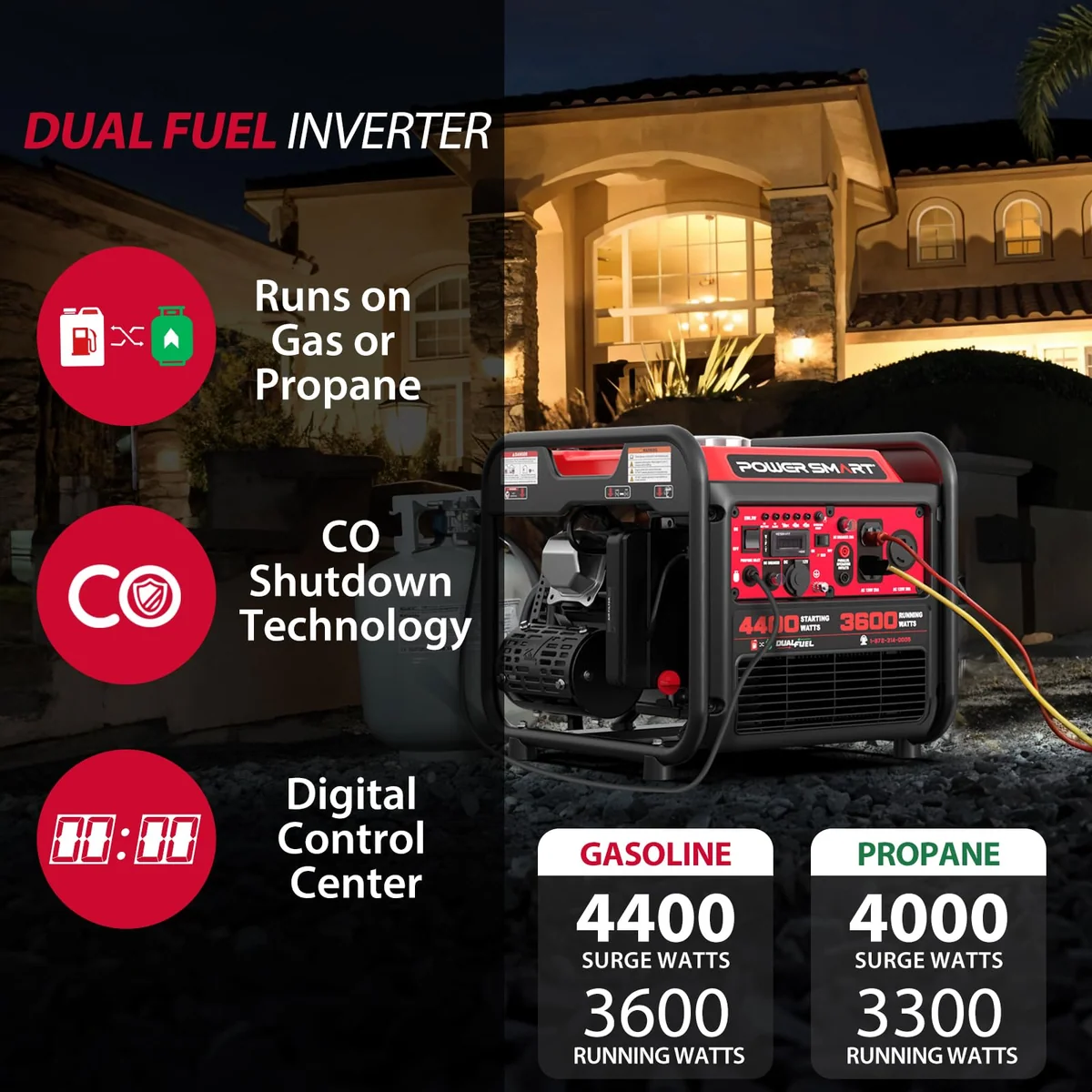
| "Dual Fuel" in the title | Every published number on the page is a gasoline number. |
That last row deserves its own sentence. Dual fuel is the headline, and yet nowhere in the record is there a propane rated wattage, a propane starting wattage, or a runtime figure per twenty pound tank. Propane normally costs you a slice of output against gasoline, and if you are choosing this machine specifically to run it on LPG, as one happy owner does, you are buying an unpublished number. Our explainer on what each fuel costs you in watts and runtime covers the general shape of that trade, but the specific figure for this generator does not exist in anything Specific Load could read.
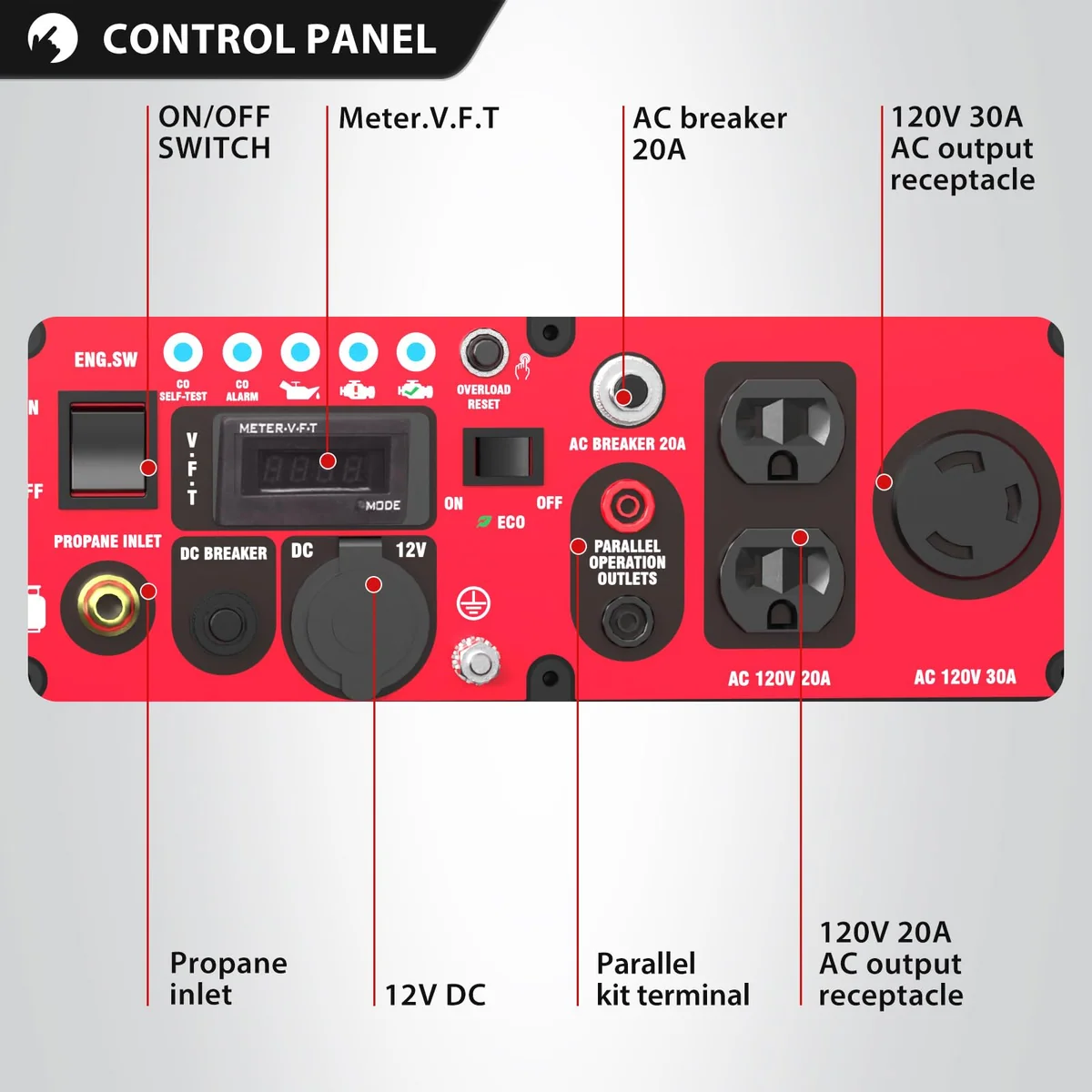
Two other absences matter. The word "inverter" is in the title, but total harmonic distortion is never stated, which is odd, because low THD is the entire reason to want an inverter for laptops and medical gear. And the outlet configuration is not listed either, so nobody should assume 240 volts from this unit. Sibling PowerSmart models advertise things this one does not: dual voltage, parallel capability, sub 3 percent THD. Those are different SKUs and their specifications do not transfer. Neither does the price line advertised elsewhere in the catalogue, which is why what you are actually buying at this tier is worth reading before you commit.
One more identity problem, because it costs people money. The Amazon catalogue calls this HB5040DC; the owner who wrote the one star review names his as MB5040DC and, crucially, calls it an open frame unit, which is how the same generator is sold elsewhere. The Amazon title never uses the words "open frame", and that omission is the single most misleading thing about the listing, because it is the whole story on noise. Separately, "PowerSmart" is also a Briggs & Stratton product line, so searches for PowerSmart 4500 reviews return a different manufacturer's machine entirely. If you want the corporate answer to who is behind the badge, we have written up who makes PowerSmart and Amerisun generators separately.
Finally, if you arrived here from a short video, check what you were actually watching. Nearly all of the social content circulating under this brand is about the PowerSmart 1200W PS50, a two stroke machine that runs on 40 to 1 premix, never gets an oil change and has a single AC outlet. It is a fundamentally different product from the 223cc four stroke reviewed here, and none of its praise or its complaints belong on this page.
Strengths & Limitations
Strengths
- Every owner in the record who mentions starting says it fires on the first pull, on gas or on propane.
- At around 61 pounds it is a genuine one person lift, which is unusual for a 3600 watt rated machine.
- Dual fuel means propane in storage never goes stale, which removes half of the reason cheap generators die in sheds.
- Owners consistently report the eco mode doing real work on fuel consumption.
- CO shutdown, low oil shutdown and overload protection are all on board at a price where they used to be absent.
Limitations
- This is an open frame generator rated by its own listing at 76 dB from 23 feet at its lightest load, so the word "quiet" in the title is graded against contractor generators rather than inverters.
- Two units owned by the same reviewer both burn oil and smoke from the exhaust, which makes it a build characteristic rather than a bad example.
- One owner's recoil rope was already fraying, and there is no electric start to fall back on when it breaks.
- The most detailed report in the record is a unit that sat three weeks, then cut out at thirty seconds with a false overload on both fuels.
- PowerSmart's answer to that owner was to find a repair shop himself, pay the shipping, and hope for reimbursement afterwards.
- The listing publishes no propane wattage, no THD figure and no outlet configuration, and it contradicts itself on runtime within a single screen.
- The product is eight months old with no long term owners and no independent test, so nothing here can tell you what it looks like at 500 hours.
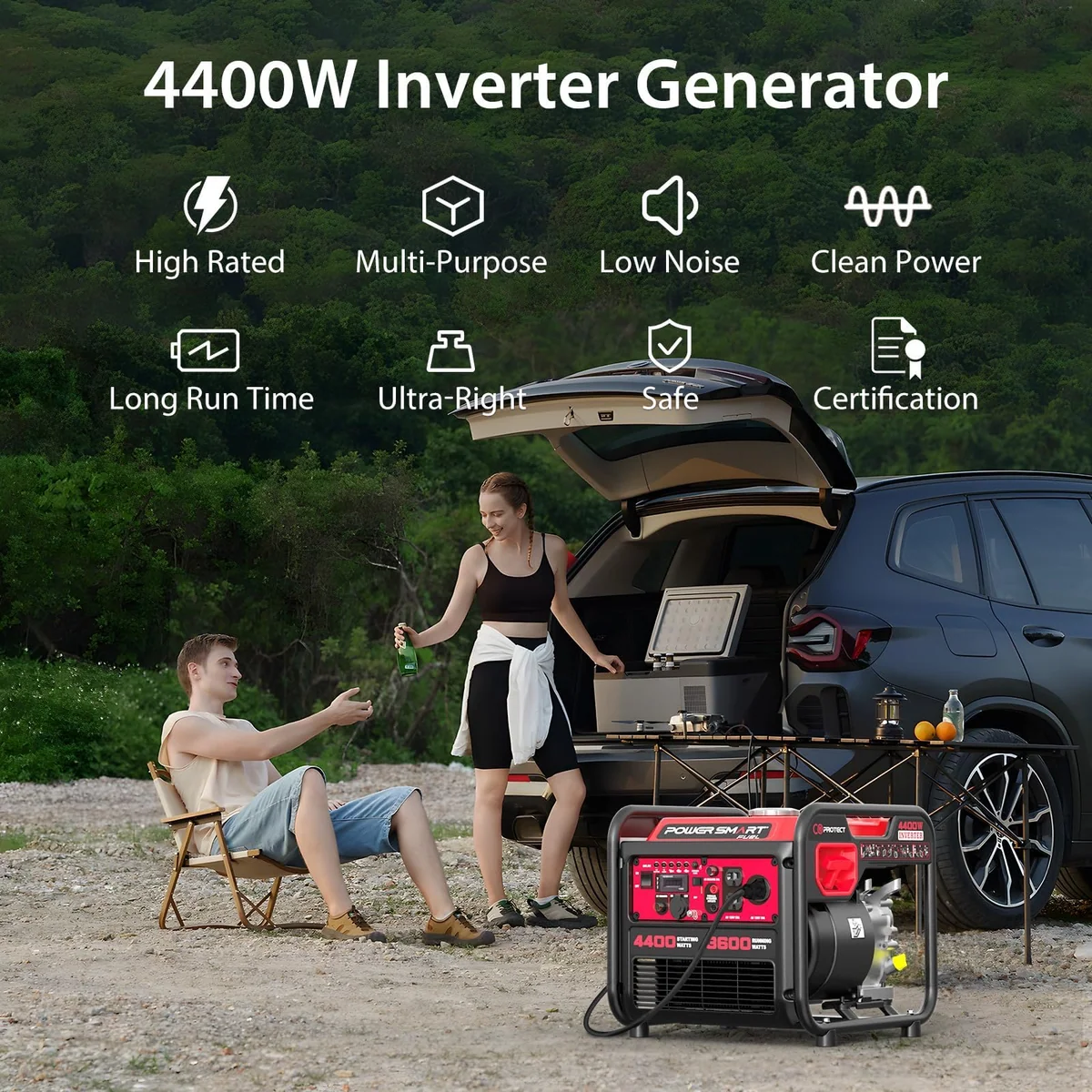
Three thousand six hundred watts, honestly spent
The number that runs your house is 3600, not 4400, and even 3600 is a ceiling rather than a working budget, because motors pull several times their running draw for the half second they spin up. That gap is the single most common way people buy the wrong generator, and it is worth ten minutes with our piece on why the number on the box is not the power you get before you spend anything.
The honest load profile at 3600 rated watts looks like this. A fridge, a chest freezer, a handful of lights, a router, phone charging, fans, and one substantial appliance at a time. One r/Generator owner in this class describes exactly that pattern through a hurricane outage: full size fridge, fans and other items by day, then fridge plus a portable air conditioner overnight, burning very little fuel. That is a realistic picture of what this machine is for.
| Load | Roughly what it draws running | Does 3600 W cope |
|---|---|---|
| Full size fridge | 150 to 250 W | Yes, with a surge on the compressor |
| Chest freezer | 100 to 200 W | Yes, alongside the fridge |
| Gas furnace blower | 600 to 900 W | Usually, and this is the one to test before winter |
| Window air conditioner, 8,000 BTU | 700 to 1,200 W | Yes, one of them |
| RV rooftop air conditioner, 13,500 BTU | 1,300 to 1,800 W | Demonstrated once in this record, on propane |
| Well pump, half horsepower | Around 1,000 W | Yes on its own, not with much else starting |
| Central air conditioning condenser | Thousands, with a brutal start | No |
Those are the typical nameplate ranges you plan against, not measurements Specific Load took from this generator; read the labels on your own appliances, because they vary enormously.
The central air row is not a hedge. When somebody asked r/Generator whether a roughly 5000 watt unit would start a central condenser, the thread was unanimous and did the arithmetic out loud: a 45 amp breaker on the plate implies about 10,000 watts, and 95 locked rotor amps at 240 volts is 22,800 watts of inrush, which even after voltage droop still lands around 11 kW. The top reply was blunt about that little generator being a long way off. A former master electrician in the same thread added that a machine that size might keep such a compressor running but will not start it. A 3600 watt unit is further away still. If air conditioning is why you are here, read what LRA and soft starts actually mean first.
The RV case is different, and it is the one real world load test anywhere in this record. The owner who later had the failure ran his RV air conditioner for about forty five minutes on propane while the unit was healthy. A single rooftop unit is a realistic ask; two of them, or a rooftop plus a microwave, is not. If the RV is the whole reason you are shopping, our picks for travel trailers weigh the 30 amp question properly.
About that word "quiet"
The listing's own figure is 76 dB from 23 feet at 25 percent load. Hold that against the same brand's other machines, which PowerSmart also calls super quiet at 52, 57 and 60 dB, and the marketing word stops meaning anything. Seventy six decibels sits at the loud end of portable generators, and it is measured at the quietest condition the machine has; a quarter load is not what an outage looks like. Louder under load is inference on Specific Load's part rather than a measurement, but it is the direction every generator moves.
Owners still call it quiet, and they are not wrong on their own terms. "Very low levels of noise in comparison to other generators," writes one, and that comparison class is the key: they are standing next to open frame contractor generators, not next to an enclosed inverter. This is quiet for an open frame machine. It is not quiet in the sense that word carries on a camping forum, and if a campground or a neighbour is the constraint, buy from the quiet camping list instead and read what a decibel rating at 23 feet is actually measured at.
The CO sensor is a genuine safety feature and it is not a permit. It shuts the engine down when carbon monoxide accumulates, which is a last line of defence, not a reason to run the thing closer to the house, in a garage, or under an overhang. Where a generator can and cannot live while it runs is the piece to read if you have ever thought about tucking it somewhere out of the rain.
What this money actually buys, and the three ways out of it
Judge this generator as an insurance policy rather than as a tool and it starts making sense. It is one of the cheapest ways to put 3600 watts and dual fuel flexibility in your garage, it weighs little enough to load into a car alone, and every owner who has used it reports it doing the job. Judge it as a machine you will depend on unattended for years and the record does not support that, because the record is eight months long and contains a failure and a support answer that puts the cost of that failure on you.
If the drawbacks above have moved you, there are three honest directions. Spend a little more within the same category and you get electric or remote starting, which removes the recoil rope as a failure point: the LIFAN 4800W and the Oxseryn 5000W both sit a step up, and our dual fuel roundup lines the class up properly. Spend considerably more and you are into whole home territory with something like the GENMAX GM9000iED, which is a different purchase with a different wiring conversation attached. Or spend about the same and go smaller but genuinely quiet, which is what the Aceup Energy 4000W and the rest of the inverter list are for.
The third way out is not a generator at all. A meaningful share of the people reading this are choosing between a cheap gas machine and a battery, and the battery answer is better than it used to be: owners in r/prepping report a large power station carrying a fridge cleanly through a fifteen and a half hour outage, silently, indoors, with no fuel and no exhaust. What it will not do is run indefinitely on refills the way this thing will, and that is the entire trade. Solar versus gas for an outage sets it out, and the power station picks are where to look if silence and indoor use matter more than a multi day outage. If the load in question is a CPAP or an oxygen concentrator, do not buy this generator at all; go to the medical equipment page, where the missing THD figure on this listing becomes the reason.
Eight months of record, and the three things in it that worry me
This product went on sale on 23 December 2025. It has 360 ratings and a 4.2 average, no independent laboratory test that Specific Load could locate, and not one owner anywhere in the record who has had it long enough to say anything about year two. Every durability judgement below is inference from short ownership and from what this class of engine generally does, and it should be read that way.
It smokes a little. The most credible reviewer in the set owns two of these, likes them, and marks them down one star for a single reason: both burn a little oil and smoke a bit from the exhaust. He is charitable about it, expects the rings may seal over time, and reckons you would not see it on the dipstick. He is probably right on all counts, but "both of them" turns this from a lemon into a characteristic of the build. That in turn makes break-in genuinely worth doing properly, and there is a live disagreement among experienced owners about whether synthetic oil belongs in a new engine at all or only after the rings have worn in. Our guide to oil type, quantity and the break-in change nobody mentions takes a side on that.
It wants maintenance sooner than you expect. Walmart reviewers on this family report having to adjust the valves at around fifty hours, which is normal for a cheap overhead valve engine and abnormal for anyone who has only owned a Honda. That report comes from truncated review snippets rather than a page Specific Load read in full, so treat it as a direction rather than a specification. Pair it with the standard advice from owners who have put over a thousand hours on machines in this class: oil every hundred hours, fresh plug each off season, and bin the OEM Torch spark plug before you ever start it.
The pull cord is the weak link. One owner, happy enough to leave five stars, reports the recoil rope already fraying and calls it poor quality. On a generator with no electric start, the rope is a single point of failure between you and power, and it is failing early on at least one unit. If your hands or your shoulder are the reason electric start matters to you, that alone is disqualifying, and the LIFAN 4800W dual fuel with remote start is the nearer neighbour on this site.
The failure, and what happened next
Back to the three week sit and the overload light with nothing plugged in. Worth noting what it is not: it failed on propane as well as on gasoline, so stale fuel and a gummed carburettor do not explain it, which is the usual suspect when a machine dies after sitting. Something in the control or sensing side declared a fault that was not there. Our page on why a generator trips its breaker or shuts down walks the diagnostic ladder, though a unit throwing overload at zero load has skipped most of the rungs.
The harder finding is the support path. When he contacted PowerSmart, he was told to find a repair shop, ship it there at his own cost, and that maybe he would be reimbursed if the fault turned out to be a manufacturing problem. The record shows a two year manufacturer warranty on this listing, and that is what two years is worth in practice on a machine at this price: you locate the servicer, you pay the freight on a 61 pound object, and the reimbursement is retrospective and conditional. On a generator in this bracket, one round of freight is a serious fraction of the purchase. Note also that his first unit arrived damaged in shipping, which says something about the packaging as well as the machine.
The whole episode fits a pattern experienced owners warn about generically. As one put it, if you might go a few weeks between uses, a few weeks easily becomes a few months, and the fix is a quarterly reminder to refresh the fuel and run the thing. That habit would not have prevented this specific fault, but it would have surfaced it in a driveway on a Sunday instead of the night before a trip, and inside the warranty window with time to fight about it. Our page on storing a backup generator so it starts when the power goes out is the routine to adopt on day one.
Frequently Asked Questions
Is it really as quiet as the title says?
It is quiet compared with an open frame contractor generator and loud compared with an enclosed inverter, because its own listing rates it at 76 dB from 23 feet at a quarter load.
Will it run a house during an outage?
It will run the essential circuits of a house, meaning fridge, freezer, lights, electronics and one big appliance at a time, but 3600 rated watts is not a whole house on any honest reading.
Will it start an RV rooftop air conditioner?
One owner in this record ran his RV air conditioner on this generator for about forty five minutes on propane, which makes a single rooftop unit a realistic ask and two of them wishful.
Can it handle central air conditioning?
No, and it is not close, because a central condenser's locked rotor inrush runs into five figures of watts where this machine offers 4400 for a moment.
What oil does it take?
Nothing in the published record for this specific model states a grade or a capacity, so use what the manual in the box specifies rather than a figure borrowed from another PowerSmart product.
Does PowerSmart actually build these engines?
The market's consistent read is that PowerSmart is a badge on imported machines with clone engines rather than an engine manufacturer, and our page on the brand lays out what can and cannot be established about that.
Is this the same PowerSmart that Briggs & Stratton sells?
No, PowerSmart is also a Briggs & Stratton product line name, so reviews you find under that heading belong to a different manufacturer's generator entirely.
How much power do you lose on propane?
Unknown for this model, because every wattage and runtime figure the listing publishes is a gasoline figure despite dual fuel being in the product title.
Is there an electric start version of this unit?
This one is recoil only, and the description walks you through the pull technique, so the rope is your sole route to power.
Sources (3)
- Amazon listings and customer reviews — Powersmart 4400 Dual Fuel
- Owner reports across r/Generator, r/prepping threads
- Owner and reviewer video, 1 channel