The red light on a Guardian is cheap to clear and expensive to ignore
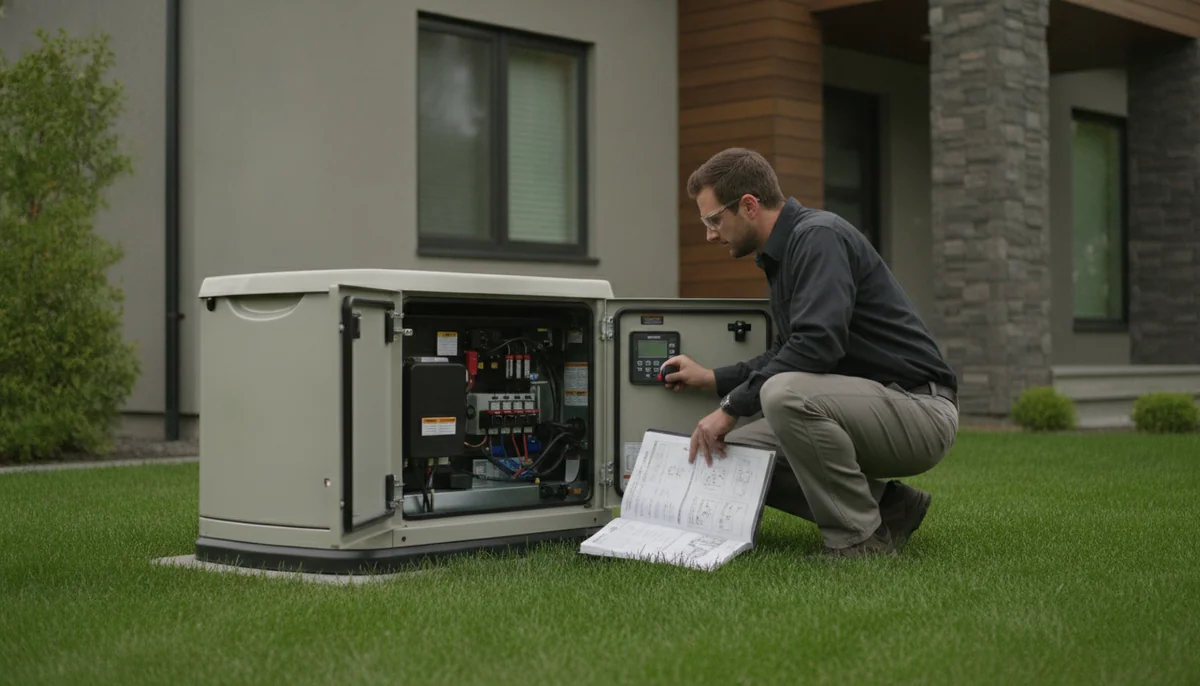
The controller sits under a locked lid on the end of the enclosure and talks to you through three coloured lights and a small display. Green on its own means the machine is in Auto and ready. Green with yellow means it will still start for you, but it wants something. Red means it has shut down or refused to start, and it will sit there doing precisely nothing until a human clears it, which during an outage is the whole difference between a working house and a very expensive lawn ornament.
So do this first, before you read another word. Unlock the lid, write the four-digit number down, press Off, press Enter to clear the fault, then press Auto. If the generator has not picked the house up within about ten seconds, start it manually and return it to Auto once the utility is back. The lid key is not an obstacle either: an electrician who opens these for a living points out that the keys are common across the machines, so a lost one is an errand rather than a service call.
Specific Load takes the do-it-yourself line here for a reason that has nothing to do with confidence in homeowners and everything to do with the state of Generac's service network, which is the weakest component in the whole system and which we come back to at the end. The reset cannot damage the generator. Waiting nine weeks for somebody to come and press the same three buttons can absolutely damage your week.
- Clear it yourself if the machine is otherwise behaving normally, the fault appeared once, and nothing about the unit looks, smells or sounds wrong.
- Clear it yourself if the yellow light is on alongside green, which is a maintenance prompt rather than a shutdown and is answered at the keypad.
- Stop and call if the same code returns within a day or two, because you are now resetting a symptom on a schedule.
- Stop and call if there is a fuel smell, a knock, oil where oil should not be, or acid on the battery tray, none of which a controller reset addresses.
- Stop and call if the unit is new enough to be a warranty claim, since a documented fault history is worth more to you than a cleared display.
One thing the reset explicitly does not do is diagnose. The most useful comment under that electrician's own demonstration is a question from a viewer, asked politely, about what happens when you clear a code without addressing whatever set it. The honest answer is that the generator will try again, fail again, and shut down again, possibly at three in the morning in February. Clearing a fault buys you information about whether it was a one-off. That is all it buys.
Why the number matters more than the light
The four digits are the only diagnostic the machine will give you without a laptop, and they are the first thing any service desk asks for, so writing them down before you touch the keypad is not ceremony. They are also model-specific in ways that make internet code lists dangerous. A 2650 thrown by a 2.4 litre liquid-cooled Generac is a fault on an engine that shares almost nothing with an air-cooled Guardian. Reading a code table written for a different engine family and then buying the part it names is how people spend money on the wrong repair.
For that reason this page does not print an exhaustive code list, because the record behind it does not support one and a half-right list is worse than none. What the record does support is a set of symptom families, each with a first move that is either free or cheap, and each with a fairly reliable answer to the only question that matters on the day: is this me, or is this a technician?
| Symptom | Usual cause | Whose job |
|---|---|---|
| Green and yellow lit together, unit still ready | Scheduled battery or service inspection prompt | Yours, at the keypad |
| Nothing at all when the power fails | Flat or dead starting battery, or the charging circuit that feeds it | Yours to test, possibly yours to fix |
| Cranks strongly, never fires, then a code | Fuel selector position, gas supply or gas pressure | Yours to check, then a gas fitter |
| Cranks slowly, or only in mild weather | Battery condition, or no cold weather kit fitted | Yours |
| Starts, then hunts, surges or trips out on speed | Stepper motor on the fuel valve | A part, and a competent DIYer |
| Runs happily but the house stays dark | Transfer switch, its control circuit or a breaker | An electrician |
| Keeps running after the utility returns | Transfer control fault rather than an engine fault | An electrician |
| Hard to start since the day it was commissioned | Valve lash and plug gap that nobody ever verified | A technician, ideally under warranty |
Suspect the battery first, because it is usually the battery
More dead Guardians in this record trace back to the starting battery than to anything else, and the machine gives you two separate warnings before it becomes a problem. The first is the green and yellow combination, which typically appears somewhere around the three-year mark and means the controller wants the battery inspected: check voltage and electrolyte, wear gloves and eye protection, then answer the service prompt at the keypad to put the light out. The second, if you connected the machine to your wifi, is a push notification, and warning you that the battery is dying is by some distance the most common real work Mobile Link does.
Take the eye protection seriously. An owner of a long-serving Guardian went out to run it manually and heard a bang loud enough that his wife heard it from inside the house, which technicians in the thread identified instantly as a battery cell letting go, along with the advice to neutralise the spilt acid with baking soda before it eats through the sheet metal. The cause named there is the older on-board charger, which had a reputation for cooking batteries, and the same commenter notes that newer variants do not behave that way.
When the battery goes flat repeatedly, the single most repeatable diagnostic in the entire record is not printed anywhere a homeowner will find it: check the T1 fuse inside the transfer switch, which is the circuit that feeds battery charging. A blown T1 gives you a generator that appears perfectly healthy, exercises itself on schedule off residual charge, and then cannot crank when it matters. On current ECM-driven machines there are two charging paths, one built into the controller and fed by that same circuit, and an alternator in the flywheel that charges only while the engine is running. Owners who did not trust the on-board charger simply ran a proper maintainer from utility power instead. If any of this is where your machine has landed, the battery, fuse and cold-kit chain is the longer version.
Two things worth knowing before you start testing. Generac does not include a starting battery with the generator, so if yours is new and does nothing at all, confirm that somebody actually fitted one and that the cold weather kit went on with it in a climate that needs one. And treat the cold rating as optimistic: one owner whose unit is specified to start down to five below zero found it would not turn over until the air had climbed above eight degrees.
It cranks, it will not fire, and now there is a code
An overcrank fault is common enough on these machines to have generated its own repair genre, and the 1502 code is the one most homeowners meet. The word overcrank is describing what the controller did, not what went wrong: it spun the engine for the allotted time, got nothing, and stopped to protect the starter. So the question is always what was missing, and the answer is nearly always fuel, spark or cranking speed.
Start with the fuel selector, because it is a lever and levers get left in the wrong place. A technician tearing down a Guardian that had never started properly found the selector set for natural gas on a house plumbed for propane, a configuration that overfuels and runs the engine hot. The owner had spent more than fifteen hundred dollars chasing the fault before anyone looked at the lever. If the setting is right and the supply is on, the next suspect is pressure rather than presence, and this is where the 24kW machines catch people out. A unit this size at load wants more gas than a standard residential meter will pass. One owner had his utility swap a 250 CFH meter for a 425 CFH one; the same thread carries a warning about newer electronic meters, which ship with a high-flow cutoff that only the utility can reset and can lower at will. A generator shut down by its own gas meter mid-freeze looks exactly like a generator fault from where you are standing. If the fuel question is still open for you, what each supply costs you in watts and runtime covers the trade.
Then the uncomfortable one. A full teardown of a hard-starting air-cooled Guardian found all four valves at essentially zero lash straight from the factory against a spec of two to four thousandths, and the spark plug gapped at forty thousandths against a twenty thousandth spec. Adjusting valves nobody had ever touched took compression from roughly 140 and 160 PSI up to about 200 on both cylinders. That was a smaller and older unit than the 24kW, and Specific Load will not pretend otherwise, but it is the best documented account anywhere of what these engines can arrive with. If your machine has been reluctant since the day it was commissioned rather than reluctant recently, lash and plug gap belong on the list before anything expensive does. The same reasoning applies to any small engine that has never run right, which is why the wider no-start checklist starts with the things nobody checked rather than the things that broke.
Hunting, surging and speed faults are usually a cheap part
An engine that starts, settles, then begins to swing up and down, or that trips out complaining about overspeed or underspeed, is describing a fuel metering problem rather than an engine problem. On a Guardian the component that meters fuel is a stepper motor, and it is a part you can buy and change rather than a diagnosis that ends in a new engine. This matters because surging sounds catastrophic and gets quoted like it is. Before you accept an expensive opinion, establish whether anybody actually tested the stepper. The same symptom under electrical load rather than at idle is a different conversation, and why generators stall or trip when the load arrives separates the two.
The engine is running and the house is still dark
This is the point at which the fault stops being the generator's and starts being the transfer switch's. The 200 amp service-rated switch that ships with this bundle is the boring, durable half of the system: it senses the outage, transfers the house, hands it back when line power returns, and an owner of a smaller Generac switch reports more than a decade of faultless service. Boring and durable is not the same as infallible, and the failure worth knowing is the one where the machine runs but will not transfer, or runs on after the utility has come back. Neither of those is a code you clear. Both are somebody with a meter inside a live enclosure, which is to say an electrician.
Before you get there, rule out the two things that cost nothing. Check the main breaker on the generator itself, and check that whoever installed the switch did not leave something obvious undone: one buyer found his brand-new transfer switch fitted with lug screws of the wrong size and thread, discovered after he had already disconnected his house from the utility, and spent three hours in the dark cannibalising a lug from an old panel. Then run a proper end-to-end test in daylight rather than discovering the answer during a storm; killing the utility feed and watching the whole sequence is the only test that proves anything. If the vocabulary your electrician uses is unfamiliar, the transfer switch and interlock explainer is the translation, and the general case of an engine running with nothing coming out covers portables too.
The prompts that are not faults
Some of what the panel asks for is housekeeping, and answering it promptly is how you avoid meeting the red light at all. Set the exercise schedule to run weekly and leave quiet test mode switched off, so that you hear the machine run and know it can; check the clock and the exercise day yourself after any battery work rather than trusting whatever the controller has in it. Service intervals bring an air filter as well as the battery check. And keep the enclosure clear, because these units breathe through their own bodywork and installers spend real time telling homeowners not to box them in behind fencing or crowd them with landscaping.
Oil deserves its own warning because the book and reality disagree. The manual calls for 1.9 quarts on the 24kW, while owners doing the job land between roughly 1.4 and 1.7 depending on how much they pre-fill the filter, with one reporting an overfull reading at about 1.6 that had to be drained back. Fill short, run it warm, recheck, and work out whether your dipstick reads screwed in or resting. Overfilling an air-cooled twin is a good way to turn a maintenance job into a fault code, and the first service in detail has the rest.
When to stop clearing and start escalating
Here is the part of this page that will not make Generac happy. The dealer network is the least reliable component in the entire product, and the record on it is grim in both directions. A Florida owner of a 48kW machine has had a dead controller since May after a lightning strike: his dealer took three weeks to look at it, six more to quote it, then no-showed twice, while three other dealers sent technicians who confirmed the fault and went away again. The replies blame technician shortages and consolidation rather than the hardware. That is a bigger and different class of unit, so read it as evidence about service and not about this engine.
The other half of the escalation problem is generational, and it changes what a code means. Owners of Guardians installed in 2018 and in late 2024 describe them as bulletproof. Owners of the recent ECM-driven machines tell a very different story: one counted 138 separate calls, texts and emails while getting a catastrophically failed unit replaced with legal help, and had a working generator for five weeks out of six months. Another is watching his dealer and Generac argue over whether a six-month-old engine needs rods or replacement while his house sits without backup. One buyer offered the choice between the older design and the new one on a 24kW deliberately took the older. On the new side, a next-generation 24kW threw fault 2780 from the day it was commissioned, and installers, a general manager and the wider community all converged on firmware rather than wiring.
The practical consequence is this. If your unit is a recent next-generation machine and it is throwing a persistent code, the useful question is not which part to buy but which firmware it is running and whether the fault is a known one, and that question goes to the installer and to Generac rather than to a parts diagram. Document every call and every visit from the first one, because the owners in that thread who got results are the ones who could produce a paper trail.
If you have not bought one of these yet
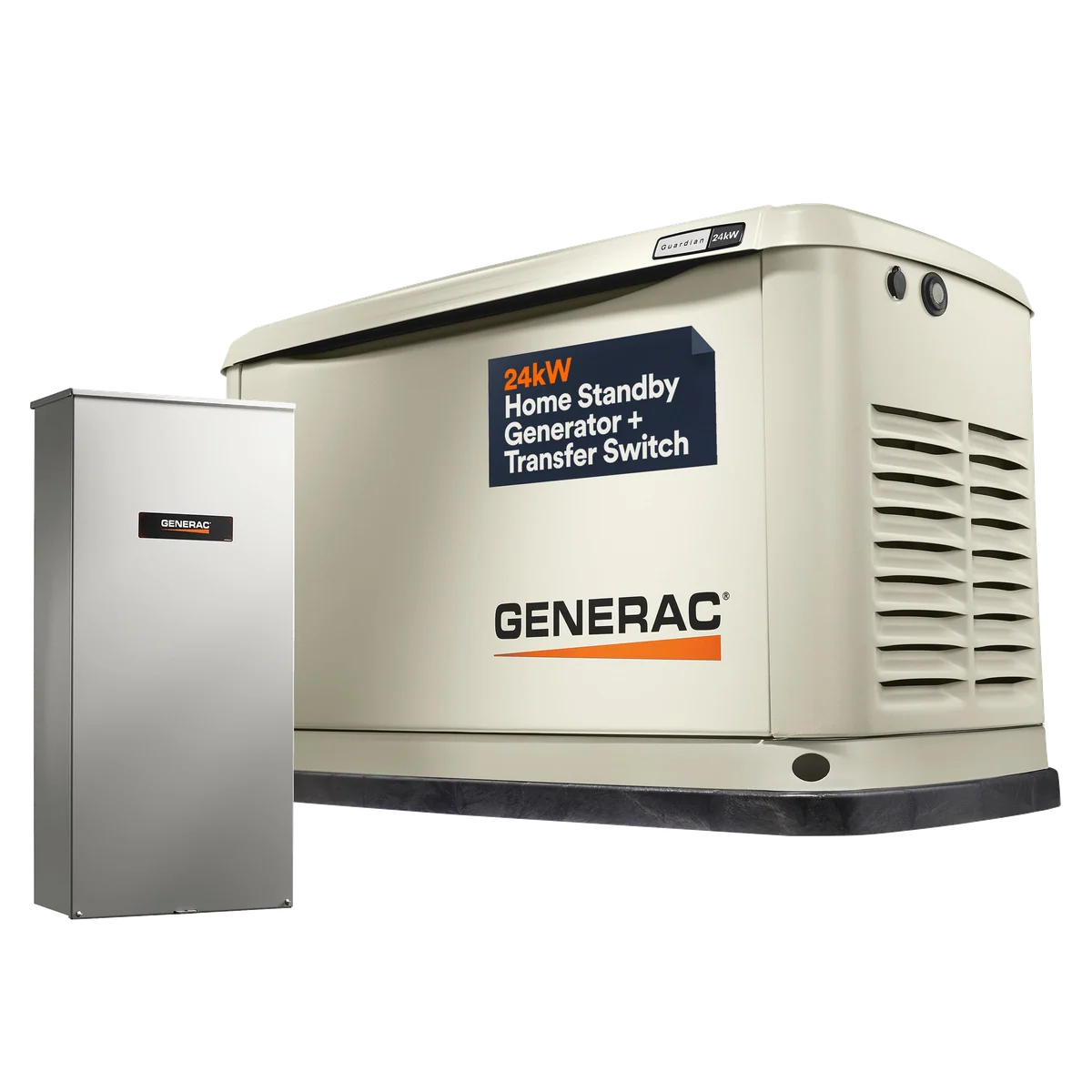
Everything above should tell you what kind of purchase this is. Specific Load's verdict on the 24kW Guardian is that it is a competent whole-house machine wrapped in a delivery, permit and parts process that punishes anyone expecting an appliance, so buy it only if you are effectively project-managing the installation yourself and pocketing the thousands that a turnkey generator outfit would charge to absorb that work for you. The drawbacks are not small and they are not hypothetical: the starting battery is not in the crate, freight damage shows up repeatedly in the retained reviews, the permit clock routinely outlasts the return window, and one buyer discovered a seized engine only after returns had closed. Add a near-certain gas meter upgrade and the open question of which controller generation you will be sent. The full workup, including the pre-installation sequence the listing does not give you, is in our review of the 24kW Guardian, and what one actually costs once every trade has been paid is the number to budget against rather than the sticker.
If that reads as more house than you wanted to remodel, say so now rather than after the pad is poured. What the extra money over a large portable actually buys is the honest comparison, and our full lineup of home backup options puts a permanently installed 24kW next to the tri-fuel and dual-fuel machines that get most houses through most outages without a permit, a pad or a dealer.
One last piece of filing housekeeping, since it is how a fair number of readers arrive here. This generator is listed on Amazon under a category meant for tractor-driven alternators that have no engine of their own, which this very much does. If you came looking for something that mounts to a three-point hitch, the explanation of why those listings are mislabelled is the page you wanted.
Frequently Asked Questions
What is the actual reset sequence?
Note the four-digit code, press Off, press Enter to clear the fault, then press Auto, and give it about ten seconds to pick the house back up.
Do I need a dealer to clear a fault code?
No, the sequence is a homeowner job on every Guardian and the lid keys are common across the machines, though a code that returns immediately is a repair rather than a reset.
Why does the yellow light come on with the green one?
That combination is a maintenance prompt rather than a shutdown, most often a battery inspection, and it clears at the keypad once you have actually done the inspection.
What does an overcrank code such as 1502 mean?
It means the controller spun the engine for its allotted time and gave up without a start, so the real fault is missing fuel, weak cranking or no spark rather than the crank itself.
My next-generation unit has thrown 2780 since it was installed, is that a wiring fault?
The owners, installers and Generac staff in that discussion converged on firmware rather than wiring, so that one goes back to your installer instead of to a parts catalogue.
Why does the battery keep going flat even though nothing looks wrong?
Check the T1 fuse inside the transfer switch, because that is the circuit which feeds battery charging and a blown one leaves a generator that looks healthy right up until it has to crank.
Does it hand the house back to the utility on its own when the power returns?
Yes, the transfer switch senses restored line power and returns the house automatically, after which the engine runs its cooldown and shuts down.
How do I safely stop the generator during an outage?
Press Off at the controller, which stops the engine and prevents it restarting automatically, and remember that the house stays without backup until you put it back to Auto.
Where do I find the correct manual for my unit?
Look it up by the model number on the data plate rather than the marketing name, since this bundle is catalogued as 72101 while the listing bullet calls the machine a 7210.
Sources (3)
- Amazon listings and customer reviews
- Owner reports across r/Generac_Generators, r/Generator threads
- Owner and reviewer video, 17 channels