The safest way to put a generator on your house is also the cheapest, and nobody is advertising it to you
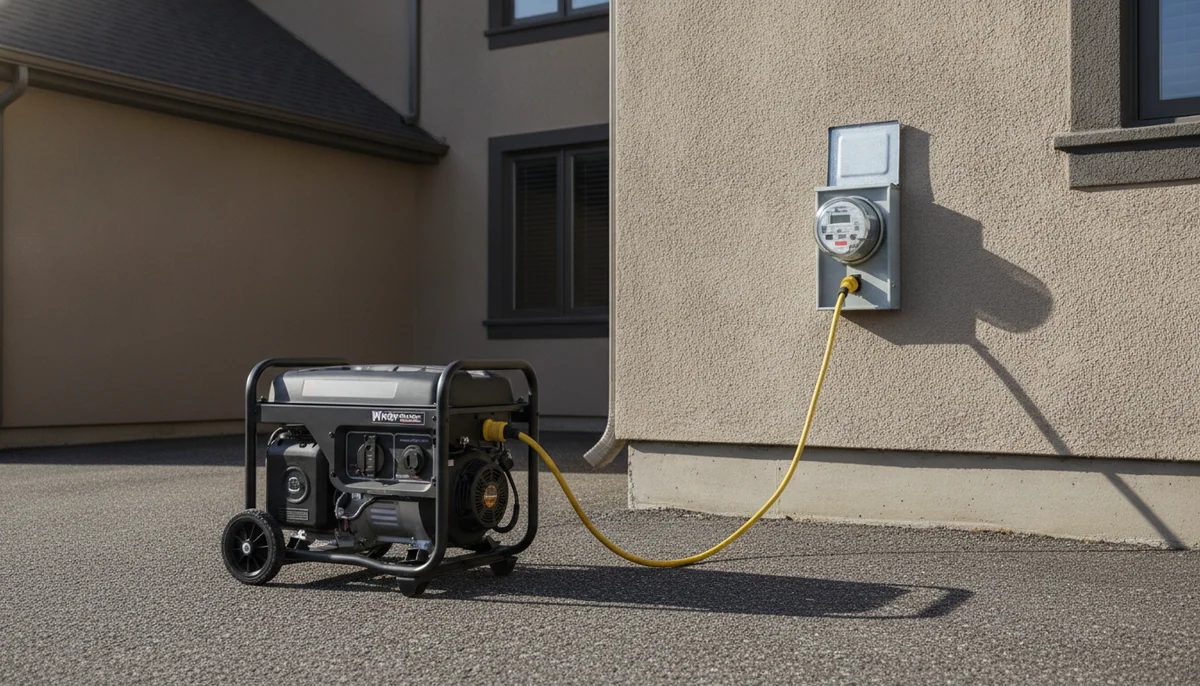
Interlock plus inlet box is right if you own the panel, you are willing to walk over and turn breakers off by hand during an outage, and you want every circuit in the house available to you rather than the six somebody picked in advance.
A manual transfer switch earns its extra cost if your panel is full, obsolete or a brand with no listed kit, if you want the connection idiot-proof for a spouse or a tenant who will be operating it alone, or if you would rather have a labelled box with its own meters than a sliding plate over two breakers.
An automatic transfer switch on a portable is for a very small group: people running natural gas or a large propane supply, who have solved the unattended-start problem, and who understand they are building a slower, cheaper imitation of a home standby unit.
Everything else on this page is the argument for that ordering, and the argument starts with the option that is not on the list. Feeding a house by running a cord with a male plug on both ends from the generator into a dryer or range receptacle is the method that circulates in every comment section, and it is the one worth being genuinely frightened of. Two things happen at once. The pins on the end you are holding are live and exposed, which is a hazard measured in inches. And if the main breaker is closed, your generator pushes power back through the service drop into the pole transformer, which is a step-down transformer being run in reverse, so it steps up. The voltage that leaves your house at 240 arrives on the line at several thousand.
This is not a hypothetical that utilities are relaxed about. A Lansing homeowner's cameras caught a utility contractor switching off the generator that was running her sump pump while she was out, and her basement flooded; the utility's account was that the crew shut it down to keep it from backfeeding during restoration work. Her own reaction is the line to remember: What if it was somebody on a medical device or something like that? They had no idea what was plugged into that.
A lineman answering that story described the other tool crews reach for, which is not touching your generator at all but pulling your meter. Both responses exist because a crew arriving at a dark street has no way to tell a properly interlocked house from a house with a double-ended cord in the dryer outlet. A permitted, inspected connection is the difference between equipment a stranger has to guess about and equipment that is visibly incapable of energising the street.
The three real connections, side by side
Strip the brochures away and the choice is about where the switching happens and who does it.
| Method | What it physically is | What it costs you |
|---|---|---|
| Breaker interlock kit | A listed metal plate on your existing panel that makes it mechanically impossible to close the main breaker and the generator breaker at the same time, fed from an outdoor inlet box. | You manage load by hand: main off, generator breaker on, then switch off the circuits you cannot afford to run before you put load on the machine. |
| Manual transfer switch | A separate box beside the panel with a chosen set of circuits moved into it, each with its own utility or generator selector. | More hardware, more labour, and you live with whichever circuits were wired into it on installation day. |
| Automatic transfer switch | The same idea with a contactor and a controller that senses the outage, signals the generator to start, and transfers on its own. | The most expensive path, and on a portable it only works if the machine can start unattended and has a fuel supply that does not run out at three in the morning. |
| Double-ended cord into a dryer outlet | Not a connection method, a way of energising a de-energised line while somebody is working on it. | Do not. |
The interlock wins on merit, not just on price. It gives you access to every circuit in the panel, including the ones nobody expected to want, and it takes up no wall space. Its one genuine weakness is that it is only as good as the person operating it: the sequence has to be followed, and if that person is going to be somebody who does not want to think about breakers at all, a labelled transfer switch is worth the money purely as an interface.
Whichever you pick, this is permit and inspection work in most jurisdictions, and it is worth hiring carefully rather than cheaply. Electricians pass around photographs of generator installations planned so badly that the professional response is to refuse to touch them, and one of the more useful observations in that discussion is that being an authorised dealer for a big-name brand means very little, since the manufacturers will sign up almost anyone. Ask to see the interlock kit's listing for your specific panel before anybody starts drilling.
The neutral decides whether your install is legal, and no box tells you
Here is the specification that matters most for this job and appears on none of the listings that sell generators as home backup. A portable generator ships with its neutral either bonded to the frame or floating, and which one you need depends entirely on the transfer equipment you just chose. If your transfer equipment does not switch the neutral, and an interlock does not, then the generator's neutral must be floating, because your service panel already carries the one neutral-to-ground bond the system is allowed to have. Put a second bond on the far end of the cord and return current starts flowing on the grounding conductors, which is both a code problem and an excellent way to make ground fault devices behave in ways nobody can explain.
The GENMAX GM9000iED, which is the single most popular machine in Amazon's mislabelled power take off category, ships bonded and its manual gives you nothing on converting it. The most thorough owner in its record had to find the bond himself and left a map for everyone after him: a metal rail behind the electrical panel, lower left corner viewed from the front, near the LPG inlet, and awkward to reach. A member-written how-to on Power Equipment Forum covers the same conversion.
Do not generalise across a model line. Owners asking about a sibling GENMAX have found the manual and the panel text disagreeing between revisions of what is nominally the same product, which means the only answer you can trust is the one you get from the machine in your garage. Put a multimeter between the neutral and the ground pin of a 120V receptacle on the generator and look for continuity: continuity means bonded. Our full write-up on bonded versus floating neutral and how to tell which one you have goes through the test and the exceptions, including the case where a three-pole switch means you want the bonded machine after all.
Size the connection, not the badge on the generator
The inlet and the cord are a ceiling of their own, and people routinely buy a nine kilowatt machine and then wire it to an inlet that cannot pass seven. The arithmetic is unforgiving and worth doing before you order anything.
| Inlet and cord | Amps | Watts | Sensible continuous load |
|---|---|---|---|
| L14-30, the common four-pin 30A | 30 | 7,200 | about 5,760 |
| CS6375 or 14-50, the 50A options | 50 | 12,000 | about 9,600 |
The right-hand column is the conventional guidance to hold continuous draw near 80% of a rating, which exists to keep a machine efficient and alive rather than to be pessimistic.
Now put a real machine against it. The GM9000iED is rated 7,600 running and 9,000 peak, which is 31.7 amps continuous and 37.5 amps momentary at 240 volts, and its owner running it as whole-house backup states the practical version plainly: 32 amps is the ceiling, and the 50 amp outlet exists so a long cord can be run without meaningful voltage drop rather than because the alternator makes fifty amps.
That distinction is the general case, not a quirk of one brand. An owner on a power equipment forum put it better than any spec sheet when he described his generator's 30 amp outlet and matching breaker as really only useful as a switch, because the engine would stall before it ever drove the connector that hard. Receptacles describe what will fit, not what the engine will make. If the number on the carton and the number you can actually draw feel like different currencies, that gap is the entire subject of starting watts versus running watts.
The half-capacity mistake
A 120/240V generator produces two legs. Feed a panel properly through a four-wire inlet and both legs arrive, and your 240V loads work. Feed it through a dogbone adapter off a single 120V receptacle, or wire the inlet carelessly, and everything in the house is trying to come through one leg, so a nine kilowatt generator delivers four and a half. The same discussion contains the reason this bites hardest in August: an air conditioner draws more as the day gets hotter, because the pressure differential across the compressor rises, so the peak load arrives exactly when the margin is thinnest. If the condenser is part of your plan at all, read what an AC compressor actually asks of a generator and budget for a soft start.
Once you are connected and something trips, work the causes in order of how often they are the answer: everything on one leg, then oil level, then a load you forgot was on a circuit you left closed, then the machine genuinely being too small. Why a generator trips, stalls or shuts down under load walks that ladder, and the case where it runs but nothing comes out is a different animal entirely.
One quiet benefit of doing this properly deserves naming. A great many "it keeps tripping" reports are not the generator at all but the extension cord chain feeding it, and the profile is always the same: a new machine, a small load, a trip a few minutes in, and two cords that have been in the shed for fifteen years. An inlet box and a single short generator cord delete that entire category of fault from your life.
ATS-ready is a port, not an installation
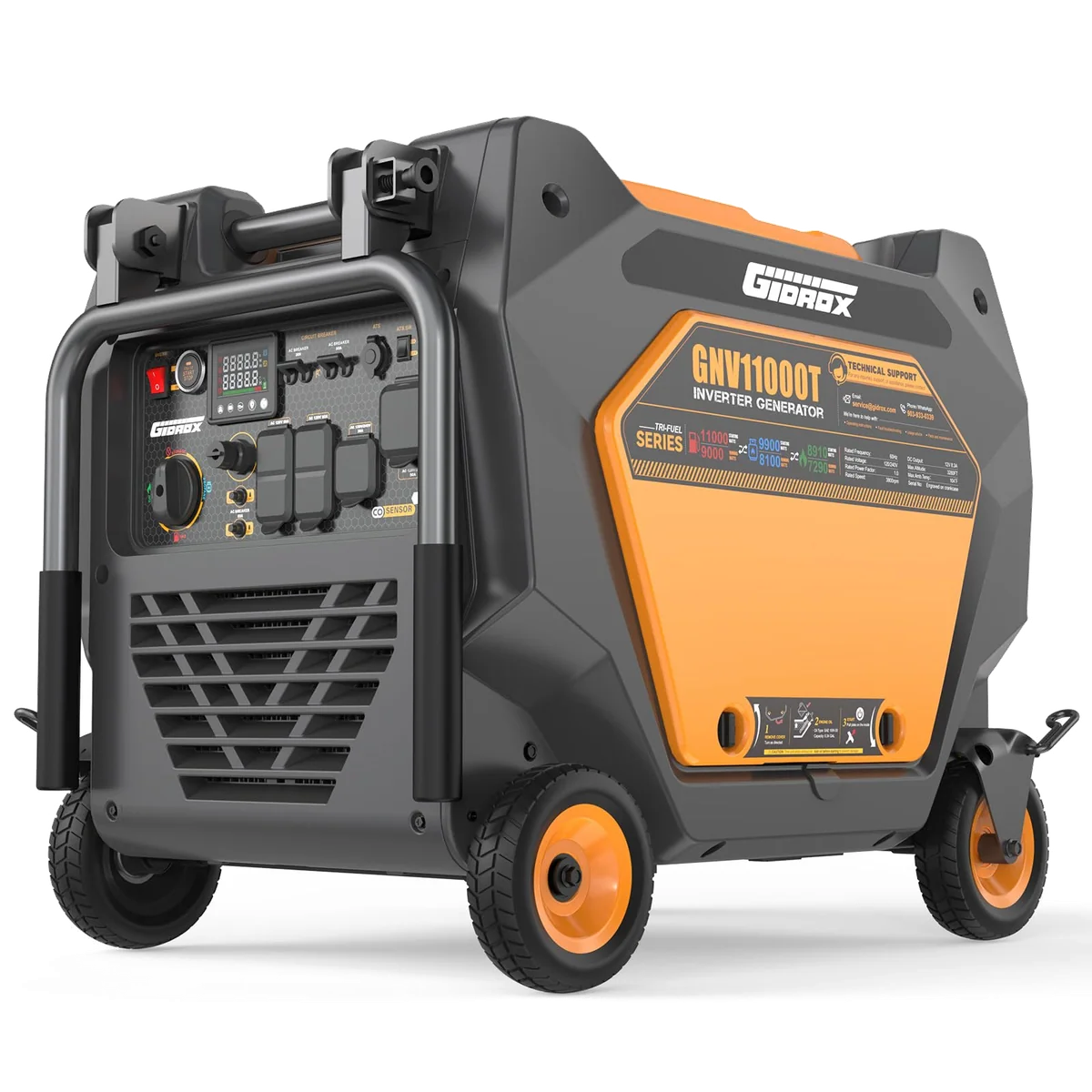
The phrase appears on the Gidrox 11000W tri-fuel listing, which advertises a dedicated port for automatic transfer switch integration and promises that the generator will detect grid failure and restore power on its own. Read the sentence carefully. What ships is the port. No switch is included, no compatible switch is named anywhere in the listing, and the electrician, the permit and the inspection are all still yours to arrange.
There is a further gap between a port and an automatic system, which is starting. A true standby unit exercises itself weekly, carries a maintained battery, and runs on a fuel supply that does not deplete. A portable with a two-wire start terminal has to be fuelled, choked correctly, and left with its master switch on and its battery healthy for however many weeks pass before the outage. Owners working out how to make a GENMAX respond to a two-wire signal are asking each other on a sibling model rather than reading it out of a manual, which tells you how mature this feature is on portables generally.
If genuinely unattended backup is the requirement, price the real thing before you build the imitation: what a 24kW standby actually costs once installed is a more honest comparison than any ATS bullet point, and what the extra money buys lays out the tradeoff. For most households the correct answer is a manual connection they can operate in ninety seconds, because the outage does not care whether you were asleep for the first two minutes of it.
The two machines on this site people are actually wiring in
Both of these sit at the top of a category Amazon calls power take off equipment, which they are not; a PTO generator is a bare alternator on a driveshaft that borrows a tractor's engine, and we have written about why these listings carry that label. Judge them as what they are.
The GENMAX GM9000iED is the one Specific Load would wire to a panel, on the condition that you will actually run it under load every month rather than opening the carton on the night of the storm. Its 50 amp receptacle matches what its alternator can make instead of strangling it, its output is clean and steady under mixed household load, and its most detailed owner did precisely this job, inlet box and interlock, inspected and passed. The drawbacks are real and two of them are about this page: the neutral is bonded with no factory instructions and the bond is buried behind the panel, and the machine's worst owner accounts describe units that failed while stored rather than while working, which is exactly the duty cycle a backup generator is bought for. It is also around 250 pounds, so warranty service is a freight problem before it is a repair problem.
The Gidrox 11000W tri-fuel is the more interesting machine for the household with a natural gas line, because a gas line is the only fuel supply that does not become a logistics problem on day three, and its owners noticed real engineering touches like a carburettor bowl drain. It is also the riskier purchase, and honestly so: its reputation is weeks old, it publishes no natural gas output figure at all despite natural gas being its best argument, and the only owner in the record who reports pushing it says it stops working somewhere between 5,000 and 5,500 watts against a 9,000 watt running claim. If you buy it, load test it to your inlet's ceiling inside the return window. The one owner who has connected it to a house at all was still waiting on his transfer switch when he wrote, which is a fair summary of how much this generator has proved.
If neither of those is the shape of your problem, our home backup picks covers the smaller machines that suit the load most households actually run, and what each fuel costs you in watts and runtime matters more to a multi-day outage than any spec on the panel. Where silence and certainty beat raw watts, a battery sidesteps this entire page, which we weigh in solar generator against gas generator.
The order to do this in
Decide the method first, because it changes the hardware list. Then confirm the neutral on your specific machine with a meter, not a manual. Then size the inlet to the generator rather than to the cheapest kit, and remember that a 30 amp inlet caps a nine kilowatt machine at seven point two. Then site the inlet box for the cord you will actually use, which means thinking about where the generator will stand: well clear of doors, windows, vents and the air conditioner intake, since a CO sensor on the machine shuts it down after carbon monoxide has been detected at the generator and tells you nothing about where the exhaust drifts. Where to put a running generator is the part of this project people plan last and regret first.
Then, and this is the step that gets skipped, rehearse it. Storm outages in the American Midwest this month ran to five days for some households, and day five is not when you want to be learning the breaker sequence by torchlight.
The best line in this entire body of evidence came from somebody answering a homeowner whose inherited generator produced nothing but silence when the storm arrived: You should always test parachutes and generators before you need them. Be happy you are not sky diving.
Run the machine monthly, under real load, through the connection you built, with the main breaker open. Put it in a calendar, keep the fuel system honest with the storage routine that stops a carburettor gumming, and the interlock you paid a few hundred for will outperform an automatic system nobody maintained.
Frequently Asked Questions
Can I just back-feed my house through the dryer outlet if I turn the main breaker off first?
No, because the exposed live pins on the cord are a hazard on their own and the whole arrangement depends on a breaker nobody can verify is open, which is why utility crews treat an uncontrolled generator as something to shut down or meter-pull rather than something to trust.
Is an interlock kit as safe as a transfer switch?
Yes, when it is a kit listed for your specific panel and installed under permit, because it makes closing the main and the generator breaker together mechanically impossible rather than merely inadvisable.
What does an interlock give up compared with a transfer switch?
It gives up automation of load management, since you decide which breakers stay off by hand instead of having the choice made for you at installation.
Do I need a permit and an inspection for this?
In most jurisdictions yes, and the inspection is worth having anyway because it is the cheapest independent check that the neutral, the inlet and the breaker sizing are all correct.
How do I find out whether my generator's neutral is bonded or floating?
Set a multimeter to continuity and test between the neutral and ground pins of a 120V receptacle on the generator, where continuity means bonded and no continuity means floating.
My generator is bonded and my interlock does not switch the neutral, so what now?
The bond has to come off the generator, which on the GM9000iED means reaching a metal rail behind the electrical panel near the LPG inlet, and it is a job worth handing to the same electrician doing the panel work.
Does ATS-ready mean the generator comes with an automatic transfer switch?
No, it means a port on the machine, and the switch, the wiring, the permit and the electrician are all separate purchases that no listing carrying that phrase prices for you.
What size inlet should I install for a 9,000 watt generator?
A 50 amp inlet, because a 30 amp one tops out at 7,200 watts and would waste capacity you paid for.
Why does the generator trip as soon as I connect the house?
Usually because every load has ended up on one of the two 120V legs, or because a circuit you forgot to switch off woke up the moment the panel came alive, well before the machine is genuinely undersized.
Can the utility legally shut off my generator during a restoration?
Crews have done exactly that and have also pulled meters instead, on the reasoning that they cannot tell a safe connection from a backfeed hazard, which is one more argument for a connection that is visibly and permanently incapable of energising the line.
Sources (5)
- Amazon listings and customer reviews
- Owner reports across r/electricians, r/Generator, r/Generac_Generators and 1 more threads
- Owner and reviewer video, 3 channels
- Powerequipmentforum — Article — www.powerequipmentforum.com
- Generatorbible — Article — generatorbible.com