A home standby generator sells you absence, and absence is the one thing a big portable cannot give you
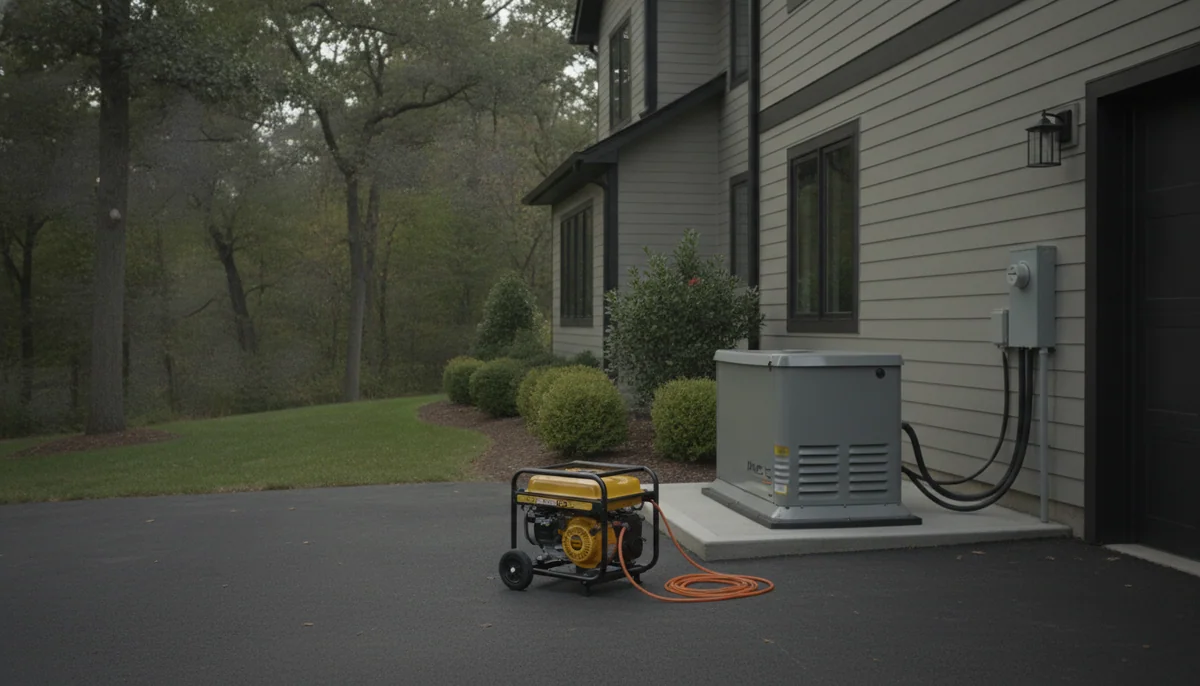
The Guardian's own listing describes the product in one line, and it is worth reading slowly. Connected to your existing propane or natural gas supply, it starts within seconds of sensing power loss, automatically, and runs for as long as necessary until utility power returns. Every clause there is about you not being involved. Not one of them is about electricity, because the electricity is the easy part and the cheap part.
A 9,000W portable makes the same kind of clean 240 volt power, through the same kind of inverter, into the same panel. What it does not do is notice. Somebody has to hear the fridge stop, find a torch, open a fuel valve, press a button, drag a cord, and throw an interlock, in whatever weather caused the outage, at whatever hour it happened. If that somebody is you and you are home and you do not mind, you have just saved an enormous amount of money for about ten minutes of inconvenience per outage. If that somebody is not available, no amount of watts substitutes.
One piece of housekeeping first, because it is how a lot of readers arrive here: Amazon files several of these machines, the Guardian included, under power take off generators, which are tractor-driven alternators with no engine of their own. Every product on this page has its own engine or its own battery, and the explanation of why those listings carry that label is a two-minute read if the category confused you.
- Pay for the standby if your house is all electric, your outages run to days, and you have watched somebody ration appliances by torchlight already.
- Pay for the standby if a sump pump, a well, a freezer full of a season's meat or a medical device has to keep running whether or not anyone is home.
- Pay for the standby if the person who would otherwise be starting the portable cannot safely handle 250 pounds of machine and a jerry can in the dark.
- Take the portable if your outages are hours rather than days, and you are usually home when they happen.
- Take the portable if you rent, expect to move, or want the machine to come with you to the job site, the trailer or the next house.
- Take the portable if what you actually need is a fridge, a furnace fan, the internet and a few lamps, which is what most households discover they need once they add it up.
- Take the portable if your permit office is slow, because the standby's paperwork clock is a real hazard and the next section explains why.
The premium is not a power upgrade, it is a staffing decision
Run the arithmetic in amps and the whole-house rhetoric gets honest fast.
| Machine | Continuous output | Amps at 240V |
|---|---|---|
| Generac Guardian 24kW | 24,000W | 100 |
| Gidrox 11000W tri-fuel, as rated | 9,000W claimed | 37.5 |
| GENMAX GM9000iED | 7,600W | 31.7 |
| EcoFlow Delta Pro 3, battery alone | 4,000W | 16.7 |
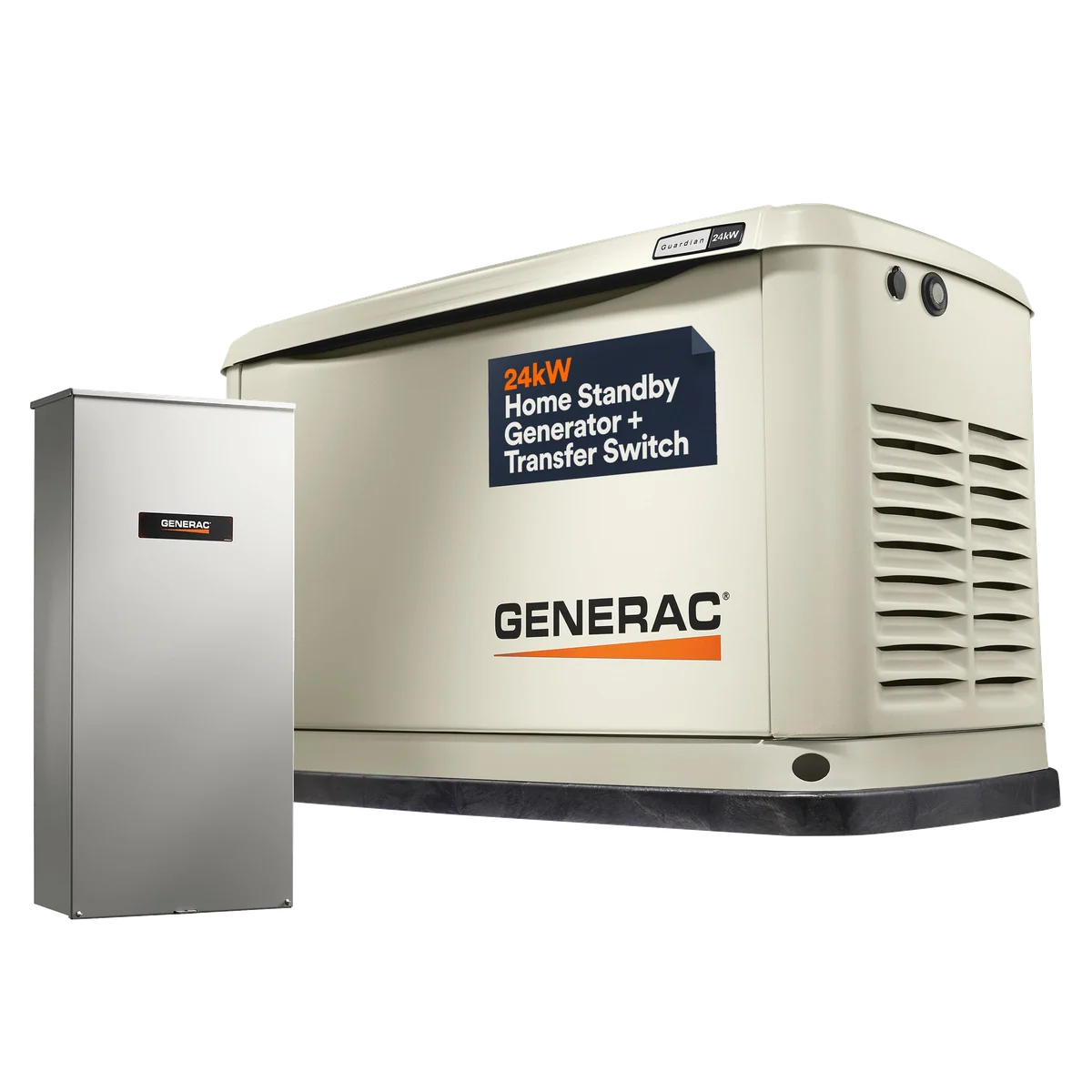
Note what the top row is not. The Guardian ships with a 200 amp service-rated transfer switch, and buyers reasonably read that as two hundred amps of coverage. The switch is rated for your service; the engine makes half of it. A 24kW standby is a hundred amp generator behind a two hundred amp door, and the reason to buy it is still the best argument in the whole record: an owner replacing a fourteen-year-old 17kW unit in an all-electric house said that on the old machine he had to limit which appliances ran at once, and that on the new one there would be no limits. That is the sentence to hold in your head. You are not buying more power, you are buying the end of rationing.
Three times that capacity in a portable is a fantasy, but the gap is narrower than the price gap suggests. The honest question is what you are trying to run, and the one appliance that decides it is the air conditioner. Work it from the data plate rather than the box: locked rotor amps, not rated load amps, is what trips things, and generic arithmetic circulating among generator owners makes the point brutally, with a 95 LRA compressor implying something like eleven kilowatts at the moment of startup once you allow for voltage droop. A soft start changes that number and nothing else does. One GM9000iED owner measured his own condenser going from 94 amps of locked rotor draw to 34, which lands inside the machine's 37.5 amp peak with almost no margin left over. Our fuller treatment of what a compressor asks for at startup and why the number on the box is not the power you get will size this properly for your house.
So a big portable with a soft start fitted covers a three or four ton condenser, a fridge, a furnace, lights and everything with a plug on it. It does not cover a five ton unit, a well pump and an electric range simultaneously. If your list has three of those on it at once, the standby stops being a luxury and becomes the correct tool.
What you are really paying for, line by line
The machine is the smallest part of a standby project and the largest part of a portable one. Everything else on this list is why the totals diverge so hard.
| Line item | Home standby | Big portable |
|---|---|---|
| Transfer arrangement | 200A automatic switch, included in this bundle, wired by an electrician | Inlet box and panel interlock, or a manual switch, still an electrician |
| Permit and inspection | Required, and the timeline is not yours to control | Required for the inlet, a much smaller job |
| Groundwork | A pad, a site clear of the house and clear of landscaping | Somewhere to roll 250 pounds and a cord run |
| Fuel supply | A gas line, and very often a larger meter | Cans, bottles, or a natural gas hose you connect yourself |
| Battery | Not in the crate, and the cold weather kit is extra | Included on electric-start portables |
| The bit nobody warns you about | The utility meter upgrade | Unbonding the neutral before you wire it to a switch |
| Who runs it | Nobody | You, every time |
The gas meter deserves its own paragraph because it is a genuine surprise cost with a genuine failure mode attached. A 24kW air-cooled unit at load wants more gas than a standard residential meter will pass. One owner had his contractor notify the utility, who moved him from a 250 CFH meter to 425 CFH and charged around three hundred dollars; another had the same swap done free after a phone call. The same discussion carries a warning worth more than the fee: newer electronic meters ship with a high-flow cutoff defaulted to 500 CFH that only the utility can reset, and which the utility can lower whenever it likes. A generator shut off by a gas meter during a freeze is not a hypothetical. Ask the question before the pad is poured, and read what the finished job tends to come to before you decide the portable is the expensive option.
On the portable side, the equivalent hidden item is electrical rather than financial. The GM9000iED leaves the factory with its neutral bonded to the frame and no instructions for converting it, and the bond sits on a metal rail behind the electrical panel in a place that takes real determination to reach. That is a job, not a catastrophe, but it is a job that must happen before your generator meets your panel. How to tell which one you have takes ten minutes with a multimeter, and the inlet, interlock and transfer switch comparison is the vocabulary your electrician will use either way.
Runtime is where the argument actually gets decided
Watts are a snapshot. Outages are a duration, and duration is where a fuel line beats a fuel tank without breaking a sweat. Storm outages this month ran to five days for households in northwest Indiana, and five days is precisely the point at which an 8.7 gallon tank and a stack of propane bottles both stop being an inconvenience and start being a logistics problem, while a natural gas line does not notice.
This is the argument for tri-fuel, and it is a better argument than the listings make for themselves. The Gidrox 11000W ships with propane and natural gas hoses in the box, which means the house-supply option is live on day one rather than after a trip to the hardware store. Connect a portable to the gas line and the runtime gap between it and the standby collapses to nothing; what remains is the automation gap, which is the whole point of this page.
There is a second thing a permanent installation buys that almost nobody counts. A homeowner in Lansing lost power, ran a generator to keep her sump pump alive, went out, and came home to a flooded basement after her cameras caught a utility contractor switching the machine off; the utility's explanation was that the crew shut it down to avoid backfeed during restoration work. Her reaction is the useful part: they had no idea what was plugged into it. A cord snaking out of a window is a thing a stranger has to guess about. A properly interlocked, permanently wired installation is visibly not energising the street, and nobody has to guess.
Two machines, two completely different ways of letting you down
The standby mostly fails before anyone switches it on
Read the retained owner reviews on the Guardian listing and the pattern is not mechanical. Three of the eight describe shipping damage, from a bent access panel that nobody would replace to a unit the carrier refused to unload at all. One found the transfer switch fitted with lug screws of the wrong size and thread, in a size he could not match within sixty miles, discovered after he had already disconnected his house from the utility. And the one-star review is the warning that belongs on the front of the box: he waited eight weeks for a permit, and when it finally cleared, the engine would not turn over and appeared seized, by which time the return window had closed.
That is the structural risk of buying a permanently installed appliance from a general retailer. Permits, electricians, gas work and concrete all run on timescales longer than returns do, so the machine can leave the returns period before a single human has tried to start it. Uncrate it and crank it while you can still send it back, whatever your county is doing. The other standing risks are worth knowing rather than fearing: Generac's dealer network draws consistent complaints about response times, with one owner of a big liquid-cooled machine waiting months through no-shows and second opinions, and owner threads show a hard split between older Guardians described as bulletproof and recent ECM-driven units with repeat failures, to the point that one buyer offered the choice on a 24kW deliberately took the older design. Nothing in the record establishes which design a given listing ships, so put that question to the seller rather than to a review page. When something does go wrong, the red light and four-digit fault code walkthrough and the battery, T1 fuse and cold-kit chain will answer most of it before anyone bills you.
The portable mostly fails while it is sitting still
The GM9000iED's ownership record has a shape that ought to change how you buy it. A mobile grooming business putting ten hours a day on one, five days a week, reports nothing at all going wrong. Meanwhile one buyer assembled and started two units in January, was impressed, went back in the spring to exercise them and found one dead at the control panel and the other startable only on the recoil cord; another bought in June, opened the box in February, and got a few minutes of running on both fuels before it quit, which turned out to be a faulty carbon monoxide sensor that the warranty covered. Good duty-cycle record, bad dormancy record, and dormancy is exactly what an emergency generator is bought to do.
That failure mode is not brand-specific, it is the category's signature. A generator sits for months with fuel in it, starts on the first pull because the carburettor bowl filled while it sat, runs for thirty seconds, and dies the moment a house load lands on it. Which is why the detail owners noticed first on the Gidrox is the one that matters most: the designers added tubing to make draining the oil easier and to empty the carburettor bowl before storage. Somebody there has read the complaints. Pair that with the storage routine that keeps a backup machine startable and the fuel valve, hidden battery plug and closed cap vent checklist, and you have removed most of the risk a portable carries. The best line in the whole body of evidence came from someone answering a homeowner whose inherited generator gave nothing but silence when the storm hit: you should always test parachutes and generators before you need them. Put it in a calendar, monthly, under real load, and the standby's automation stops being the only thing standing between you and a dark house.
One caution specific to the Gidrox, and it is the reason Specific Load will not call it this page's default answer despite the tri-fuel case being so strong: its 9,000W running rating is unproven by anyone independent, and the only owner in the record who reports pushing it says it stops working somewhere between 5,000 and 5,500 watts. Another owner says it powers his whole house without issues. Those two accounts cannot be reconciled from the outside, which makes week one an acceptance test rather than a honeymoon.
The third answer, which is quieter than either
There is a version of this decision that does not involve choosing. EcoFlow's Delta Pro 3 bundle pairs a 4,096Wh battery with a 3,200W dual fuel engine, and the engine starts itself when the battery's charge drops below a floor you set, stops at a ceiling you set, holds off if solar is coming in, and is even woken by the battery feeding power backwards into its starter. That is a home standby's automation logic, in two boxes, with no permit and no pad. Bench testing pulled 3,830Wh out of the rated 4,096Wh, which is an unusually honest result in a category where seventy-five to eighty-five percent is normal.
The drawbacks are real and they are geometric. The cable joining the two halves is sixteen feet and cannot be extended, so the running engine has to live sixteen feet from wherever the battery sits, which is nothing like far enough for many garages and driveways. The engine has no choke and its automatic start is unreliable on petrol in freezing weather, which is the weather that causes outages, so this is a propane purchase or it is not worth the premium. And roughly a fifth of the pack never reaches your appliances once the inverter has taken its cut, so plan on about 3.3kWh per charge: one disciplined day of fridge, lights and router, not a house.
Where it wins outright is the first night. A battery is silent, produces no exhaust, needs nobody standing in the rain, and switches over fast enough that the freezer never notices. An engine is the right tool for the third day. That is why people who take outages seriously so often end up owning both, an argument we make properly in solar generator against gas generator, and why usable watt-hours after inverter losses is the number to plan around rather than the one on the case.
Three in the morning, measured properly
Standby buyers are frequently told these machines are quiet, and the claim survives contact with owners in a specific, limited way. One Guardian owner ran his on propane while his wife was in the bedroom on the other side of the wall and she heard nothing, and he volunteered the caveat himself: propane is quieter than natural gas. Against that, a homeowner filming his own Generac carrying the house through an outage drew the flat verdict that the noise on these things is ridiculous, immediately followed by the concession that it beats no power. Both are true. It is quiet for a 24kW engine and it is not quiet for something living outside a bedroom.
The portables play the same game with more precision and no more honesty. The GM9000iED's carton promises as low as 62 dBA, at 25% load, from 23 feet. Every qualifier in that sentence is doing work, and what those ratings are measured at explains why the number in your yard and the number on the box rarely agree. The practical judgement owners converge on is more useful than either figure: you can hold a conversation standing beside it, it is much less intrusive than an idling mower, and it is nothing like a Honda. The point that matters for this comparison is that a machine which starts itself is a machine that can start itself at 3am, whichever kind you buy.
So, which one
If your house is all electric, your outages are measured in days and somebody is going to be away or asleep when the next one starts, buy the standby and buy it as a project rather than an appliance. Our full read on the Guardian 24kW is a qualified yes for exactly that buyer, on the condition that you inspect the pallet, crank the engine inside the return window and get the meter question settled early.
If you are home for most outages and want the cheapest route to a house that keeps working, buy a big portable and spend what you saved on the inlet, the interlock and an electrician who signs the paperwork. The GENMAX GM9000iED is the one with a real owner base behind it, pressure-fed oiling and a 50 amp outlet that matches what the alternator can make, provided you accept the monthly exercise discipline its dormancy record demands. If the natural gas line is genuinely part of your plan and you will load test it in week one, the Gidrox 11000W tri-fuel has the better runtime story and the thinner track record. Both sit alongside the rest of the field in our home backup comparison and the dual and tri-fuel roundup.
And if what you actually want is the automation without the concrete, and you can park a running engine within sixteen feet of where the battery lives, the Delta Pro 3 with its dual fuel smart generator is the one product here that does the standby's job without the permit, at the cost of a loud, cold-shy engine and a leash you cannot lengthen. For a CPAP or an oxygen concentrator, where silence and certainty beat raw watts, the battery is not a compromise at all: it is the right instrument, and our medical equipment picks start there.
The stance has not moved. Most households are buying the standby's convenience, not its capacity, and convenience is the most expensive thing on this page per kilowatt. Be honest about whether you are buying watts or buying absence, and the decision makes itself.
Frequently Asked Questions
Does a standby switch itself off when the power comes back?
Yes, the transfer switch senses the restored utility supply and hands the house back automatically, after which the engine runs a cooldown and stops, which is the half of the automation people forget they are paying for.
Will a 9,000W portable really run a whole house?
It will run a small, disciplined, all-LED house through an inlet and interlock, but its ceiling is roughly 32 amps at 240 volts, so your condenser's data plate rather than the number on the carton decides the answer.
Do I need my gas meter changed for a 24kW unit?
Very probably, since a standard residential meter passing 250 CFH will not feed a 24kW engine at load, and one owner reported paying the utility around three hundred dollars to be moved up to 425 CFH.
Why does a generator trip its breaker or shut down under a load it should handle?
In the field the answer is usually oil level, then stale fuel or a gummed carburettor, then a tired cord or a GFCI, then every load piled onto one 120 volt leg, and only after all of that is it the machine being genuinely undersized, a ladder we walk properly in why a generator trips, stalls or shuts down .
Are either of these the tractor-driven kind of generator?
No, a true power take off unit is a bare alternator spun by a tractor's driveshaft, while everything compared here carries its own engine or its own battery.
What happens if the outage starts while I am away?
The standby starts without you and the portable does not, which is the cleanest line between the two and the reason households with sump pumps, wells and freezers keep concluding the installation is worth it.
Can I install a home standby myself?
Generac's own guidance is that a certified and licensed electrician should do the work, and the route that saves the most money is buying the machine yourself and paying a contractor an install-only price.
Is a battery quiet enough to run through the night?
Yes, a power station makes no exhaust and effectively no noise, which is why the sensible arrangement for most households is a battery for the first night and an engine for the third day.
Sources (4)
- Amazon listings and customer reviews
- Owner reports across r/Generator, r/Generac_Generators, r/HomeMaintenanceAdvice threads
- Owner and reviewer video, 3 channels
- Powerequipmentforum — Article — www.powerequipmentforum.com